Introduction
AI Healthcare Interoperability Mapping (FHIR) Assistants use artificial intelligence (AI), machine learning (ML), natural language processing (NLP), and healthcare data intelligence to simplify the process of connecting, transforming, and standardizing healthcare data across different systems. These platforms help healthcare organizations map clinical data elements, convert healthcare formats, validate FHIR resources, identify integration issues, and improve data exchange between Electronic Health Records (EHR), healthcare applications, laboratories, insurance systems, and digital health platforms.
Healthcare interoperability remains a major challenge because organizations use different data structures, coding systems, terminology standards, and technology platforms. Patient information may exist across multiple systems in different formats, making seamless exchange difficult. Traditional interoperability projects often require significant manual mapping, technical expertise, and long implementation timelines.
AI-powered FHIR mapping assistants help reduce this complexity by automatically analyzing healthcare data models, recommending mappings between systems, identifying missing relationships, generating transformation logic, and assisting developers and healthcare integration teams. These solutions accelerate interoperability projects while improving consistency and reducing manual effort.
Modern AI Healthcare Interoperability Mapping solutions support standards such as HL7 FHIR, HL7 v2, CDA, DICOM, ICD, SNOMED CT, LOINC, and other healthcare terminology frameworks. They integrate with EHR systems, healthcare data platforms, integration engines, cloud healthcare services, and analytics environments.
These tools are designed to assist healthcare architects, integration engineers, developers, and clinical data teams by improving healthcare data exchange while maintaining security, governance, and human validation.
Real-world Use Cases
- FHIR resource mapping
- EHR data integration
- Healthcare data transformation
- Clinical terminology mapping
- HL7 to FHIR migration
- API interoperability development
- Healthcare data normalization
- Patient data exchange
- Clinical analytics enablement
- Digital health integration
Evaluation Criteria for Buyers
When selecting an AI Healthcare Interoperability Mapping Assistant, consider:
- FHIR mapping accuracy
- Healthcare terminology support
- HL7 compatibility
- AI transformation capabilities
- API integration support
- Data validation features
- Developer experience
- Security and compliance
- Scalability
- Governance capabilities
Best For
- Hospitals
- Health systems
- Healthcare software companies
- Health information exchanges
- Digital health platforms
- Healthcare data engineering teams
Not Ideal For
Organizations without healthcare integration requirements or teams expecting AI to replace interoperability architects completely.
Key Trends
- AI-assisted healthcare interoperability
- FHIR-first healthcare ecosystems
- Automated data mapping
- Healthcare API modernization
- Generative AI integration assistants
- Clinical data normalization
- Cloud healthcare platforms
- Real-time health data exchange
- Healthcare data mesh architectures
- Automated terminology management
Methodology
The platforms below were evaluated based on:
- AI interoperability capabilities
- FHIR support
- Healthcare integration maturity
- Data transformation features
- Developer experience
- Scalability
- Enterprise healthcare readiness
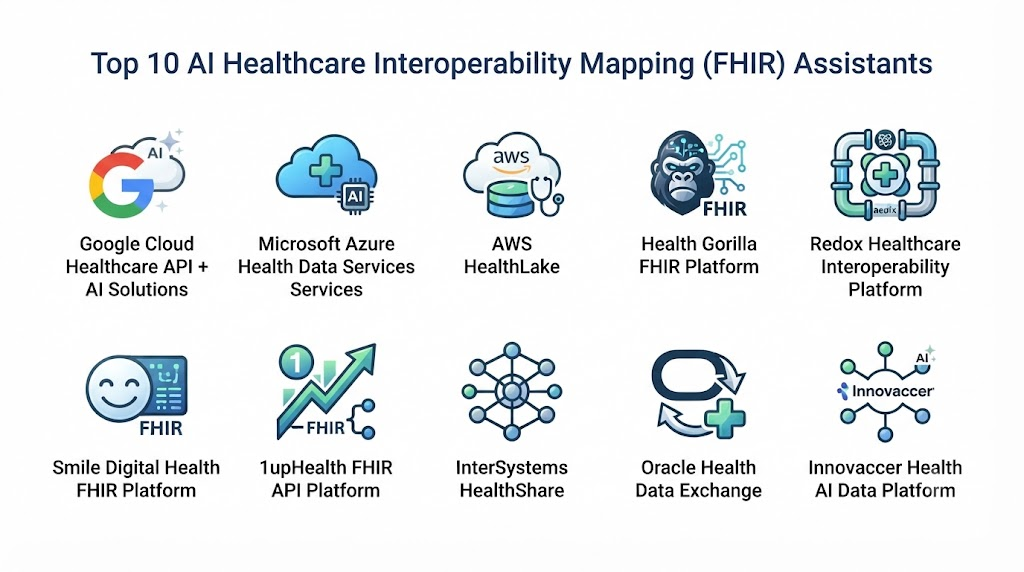
Top 10 AI Healthcare Interoperability Mapping (FHIR) Assistants
1. Google Cloud Healthcare Data Engine
Verdict: Best overall healthcare interoperability platform for FHIR-based data exchange.
Short Description: Google Cloud Healthcare Data Engine helps organizations transform healthcare data into standardized FHIR resources and build interoperable healthcare applications using cloud-based healthcare infrastructure.
Key Features
- FHIR data management
- Healthcare API support
- Data transformation
- Clinical data normalization
- Healthcare analytics integration
- Cloud interoperability
Pros
- Strong FHIR ecosystem
- Enterprise scalability
- Advanced healthcare data capabilities
Cons
- Requires cloud expertise
Deployment: Cloud-based
Security & Compliance: Healthcare data security controls
Integrations & Ecosystem: EHR systems, healthcare APIs, cloud analytics
Support & Community: Enterprise cloud support
Pricing Model: Usage-based and enterprise pricing
Best-Fit Scenarios: Large healthcare data modernization projects
2. Microsoft Azure Health Data Services
Verdict: Enterprise healthcare interoperability platform with FHIR capabilities.
Short Description: Microsoft Azure Health Data Services provides healthcare APIs, FHIR services, and data management capabilities that help organizations securely exchange and analyze healthcare information.
Key Features
- FHIR service
- Healthcare APIs
- Data transformation
- Clinical data exchange
- Healthcare analytics integration
Pros
- Strong cloud healthcare ecosystem
- Developer-friendly tools
Cons
- Requires technical implementation
3. InterSystems IRIS for Health
Verdict: Leading healthcare integration platform supporting complex interoperability workflows.
Short Description: InterSystems IRIS for Health provides healthcare data integration, interoperability, and transformation capabilities supporting HL7, FHIR, and other healthcare standards.
Key Features
- HL7 and FHIR support
- Integration engine
- Data transformation
- Healthcare messaging
- Clinical data exchange
Pros
- Strong healthcare interoperability expertise
- Enterprise adoption
Cons
- Requires specialized knowledge
4. Health Gorilla
Verdict: Healthcare interoperability platform for secure clinical data exchange.
Short Description: Health Gorilla provides healthcare data connectivity and interoperability infrastructure that enables organizations to access, exchange, and normalize healthcare information.
Key Features
- FHIR APIs
- Clinical data exchange
- Healthcare networks
- Data normalization
- API connectivity
Pros
- Strong healthcare data network
- API-focused architecture
Cons
- Depends on connected data sources
5. Redox
Verdict: Healthcare API integration platform simplifying EHR connectivity.
Short Description: Redox helps healthcare applications connect with EHR systems by providing healthcare data exchange infrastructure, APIs, and interoperability workflows.
Key Features
- EHR integration
- Healthcare APIs
- Data transformation
- FHIR support
- Clinical workflows
Pros
- Simplifies healthcare integrations
- Developer-friendly
Cons
- Primarily integration-focused
6. Smile Digital Health
Verdict: FHIR-native healthcare data platform for interoperability solutions.
Short Description: Smile Digital Health provides FHIR infrastructure, healthcare data platforms, and interoperability solutions that help organizations manage standardized clinical data.
Key Features
- FHIR server
- Data transformation
- Clinical data management
- API interoperability
- Healthcare applications
Pros
- Strong FHIR specialization
- Healthcare-focused platform
Cons
- Requires implementation expertise
7. Firely
Verdict: Developer-focused FHIR tooling platform.
Short Description: Firely provides FHIR development tools, SDKs, validation capabilities, and healthcare interoperability solutions for building FHIR-based applications.
Key Features
- FHIR SDKs
- FHIR validation
- Developer tools
- Data modeling
- API development
Pros
- Strong developer ecosystem
- FHIR expertise
Cons
- More technical audience
8. Aidbox
Verdict: Flexible FHIR platform for healthcare application development.
Short Description: Aidbox provides a FHIR-native healthcare platform that helps developers build interoperable healthcare applications and manage clinical data workflows.
Key Features
- FHIR APIs
- Healthcare data models
- Application development
- Data management
- Integration workflows
Pros
- Developer flexibility
- Modern architecture
Cons
- Requires technical expertise
9. Lyniate
Verdict: Healthcare integration platform supporting interoperability modernization.
Short Description: Lyniate provides healthcare integration solutions that support data exchange, interoperability workflows, and healthcare system connectivity.
Key Features
- Healthcare integration
- Data transformation
- HL7 support
- FHIR workflows
- Integration management
Pros
- Strong healthcare connectivity
- Enterprise capabilities
Cons
- Implementation complexity
10. OpenAI-Based Custom FHIR Mapping Assistant
Verdict: Flexible AI assistant for healthcare interoperability mapping workflows.
Short Description: Healthcare organizations can build custom AI FHIR mapping assistants using large language models integrated with healthcare data models, FHIR specifications, terminology services, EHR schemas, and integration platforms. These assistants can recommend mappings, generate transformation logic, explain FHIR resources, and support interoperability teams while requiring technical validation.
Key Features
- AI mapping recommendations
- FHIR resource assistance
- Transformation support
- Terminology analysis
- Integration documentation
Pros
- Highly customizable
- Flexible workflows
- Developer productivity improvement
Cons
- Requires healthcare interoperability expertise
- Validation required
Comparison Table
| Platform | FHIR Support | AI Mapping | Integration Capability | Developer Support | Best Use |
|---|---|---|---|---|---|
| Google Healthcare Data Engine | Excellent | High | Excellent | High | Healthcare Data Platforms |
| Azure Health Data Services | Excellent | High | Excellent | High | Enterprise FHIR |
| InterSystems IRIS for Health | Excellent | High | Excellent | High | Healthcare Integration |
| Health Gorilla | Excellent | Medium | Excellent | High | Clinical Data Exchange |
| Redox | Excellent | Medium | Excellent | Excellent | EHR Connectivity |
| Smile Digital Health | Excellent | High | High | High | FHIR Infrastructure |
| Firely | Excellent | High | Medium | Excellent | FHIR Development |
| Aidbox | Excellent | Medium | High | Excellent | FHIR Applications |
| Lyniate | High | Medium | Excellent | High | Healthcare Integration |
| OpenAI Custom | Custom | Excellent | Custom | High | AI Mapping Assistant |
Evaluation & Scoring Table
| Platform | AI Features 20% | FHIR Capability 20% | Integration 15% | Developer Experience 15% | Security 10% | Ease 10% | Value 10% | Total |
|---|---|---|---|---|---|---|---|---|
| Google Healthcare Data Engine | 19 | 20 | 15 | 14 | 10 | 8 | 8 | 94 |
| Azure Health Data Services | 19 | 20 | 15 | 15 | 10 | 8 | 8 | 95 |
| InterSystems IRIS | 18 | 20 | 15 | 14 | 10 | 8 | 8 | 93 |
| Smile Digital Health | 18 | 20 | 14 | 15 | 10 | 8 | 8 | 93 |
| Redox | 17 | 19 | 15 | 15 | 10 | 9 | 8 | 93 |
| Health Gorilla | 17 | 19 | 15 | 14 | 10 | 8 | 8 | 91 |
| Firely | 18 | 20 | 12 | 15 | 10 | 9 | 8 | 92 |
| Aidbox | 17 | 19 | 13 | 15 | 10 | 8 | 8 | 90 |
| Lyniate | 17 | 18 | 15 | 13 | 10 | 8 | 8 | 89 |
| OpenAI Custom | 20 | 18 | 12 | 15 | 8 | 7 | 9 | 89 |
Which AI Healthcare Interoperability Mapping Assistant Is Right for You?
| If your priority is… | Recommended Platform |
|---|---|
| Enterprise FHIR platform | Azure Health Data Services |
| Healthcare data modernization | Google Healthcare Data Engine |
| Complex healthcare integration | InterSystems IRIS |
| Clinical data exchange | Health Gorilla |
| EHR connectivity | Redox |
| FHIR-native applications | Smile Digital Health |
| FHIR development tools | Firely |
| Flexible FHIR applications | Aidbox |
| Enterprise integration workflows | Lyniate |
| Custom AI mapping assistant | OpenAI-Based FHIR Assistant |
Implementation Playbook
First 30 Days
- Identify interoperability challenges
- Review healthcare data sources
- Define FHIR mapping requirements
- Assess integration architecture
Days 31–60
- Connect healthcare systems
- Configure FHIR resources
- Validate data transformations
- Train integration teams
Days 61–90
- Expand interoperability workflows
- Automate mapping processes
- Monitor data quality
- Improve healthcare data exchange
Common Mistakes
- Poor understanding of healthcare standards
- Ignoring terminology mapping
- Skipping data validation
- Weak governance processes
- Lack of security controls
- Treating AI mappings as final
- Poor EHR integration planning
- Ignoring long-term scalability
Frequently Asked Questions
1. What are AI Healthcare Interoperability Mapping Assistants?
They are AI-powered tools that help healthcare organizations map, transform, and exchange data between different healthcare systems using standards like FHIR.
2. What is FHIR in healthcare?
FHIR is a healthcare data exchange standard designed to improve interoperability between healthcare applications and systems.
3. How does AI help FHIR mapping?
AI can analyze data structures, recommend mappings, identify relationships, and assist developers in creating transformation workflows.
4. Can AI replace healthcare integration engineers?
No. AI assists technical teams but requires expert validation and governance.
5. Which healthcare standards do these tools support?
Many support FHIR, HL7, CDA, DICOM, ICD, SNOMED CT, and LOINC.
6. Who uses AI interoperability assistants?
Healthcare architects, developers, hospitals, health information exchanges, and digital health companies.
7. Do these tools integrate with EHR systems?
Yes. Many platforms connect with major healthcare systems and integration environments.
8. Are AI FHIR mappings always accurate?
Accuracy depends on data quality, healthcare standards, and expert validation.
9. Why is healthcare interoperability difficult?
Healthcare systems often use different data formats, standards, and terminology structures.
10. What should organizations evaluate before adoption?
Consider FHIR support, integration capabilities, AI accuracy, security, scalability, and governance.
Conclusion
AI Healthcare Interoperability Mapping Assistants are helping organizations simplify one of healthcare technology’s biggest challenges: connecting fragmented systems and creating seamless data exchange. By combining artificial intelligence, healthcare standards, and automation, these solutions accelerate FHIR implementation, improve data quality, and support modern digital healthcare ecosystemsHealthcare organizations should choose interoperability solutions based on their integration requirements, FHIR maturity, security needs, developer capabilities, and long-term data strategy. Platforms such as Azure Health Data Services, Google Cloud Healthcare Data Engine, InterSystems IRIS for Health, Redox, and Smile Digital Health demonstrate how AI-assisted interoperability can improve healthcare data exchange and enable more connected healthcare experiences.
