Introduction
AI Single-Cell Analysis Tools use artificial intelligence (AI), machine learning (ML), deep learning, and advanced computational biology techniques to analyze single-cell sequencing and cellular data. These platforms help researchers understand individual cell behaviors, identify cell populations, discover biological patterns, and study complex cellular systems.
Traditional bulk sequencing methods analyze groups of cells together, which can hide important differences between individual cells. Single-cell technologies allow researchers to examine cellular diversity at a much higher resolution, but the resulting datasets are extremely large, complex, and difficult to interpret manually.
AI-powered single-cell analysis platforms help solve these challenges by using machine learning models for cell clustering, cell type identification, gene expression analysis, biomarker discovery, trajectory analysis, and biological interpretation. These tools support researchers in extracting meaningful insights from single-cell RNA sequencing (scRNA-seq), single-cell ATAC sequencing, spatial transcriptomics, and multi-omics datasets.
Modern AI Single-Cell Analysis solutions integrate with sequencing platforms, genomic databases, cloud computing environments, visualization tools, and bioinformatics pipelines. They support pharmaceutical companies, biotechnology organizations, academic institutions, and healthcare researchers in areas such as drug discovery, cancer research, immunology, and precision medicine.
These platforms assist scientists by improving cellular data interpretation while requiring expert biological validation and research review.
Real-world Use Cases
- Single-cell RNA sequencing analysis
- Cell type identification
- Cellular clustering
- Biomarker discovery
- Cancer research
- Immune system analysis
- Drug response analysis
- Spatial biology research
- Disease mechanism discovery
- Multi-omics analysis
Evaluation Criteria for Buyers
When selecting an AI Single-Cell Analysis Tool, consider:
- AI model capabilities
- Single-cell data processing
- Multi-omics support
- Visualization features
- Cell annotation accuracy
- Scalability
- Cloud compatibility
- Bioinformatics workflow integration
- Data security
- Research collaboration features
Best For
- Biotechnology companies
- Pharmaceutical research teams
- Academic laboratories
- Genomics organizations
- Precision medicine researchers
Not Ideal For
Organizations without sequencing data, computational biology expertise, or research workflows requiring single-cell analysis.
Key Trends
- AI-powered cellular analysis
- Single-cell foundation models
- Spatial transcriptomics integration
- Multi-omics analysis
- Automated cell annotation
- AI-driven biomarker discovery
- Cloud-based bioinformatics
- Precision medicine research
- Computational immunology
- Digital biology platforms
Methodology
The platforms below were evaluated based on:
- AI analysis capabilities
- Single-cell workflow support
- Data processing performance
- Research adoption
- Integration capabilities
- Scalability
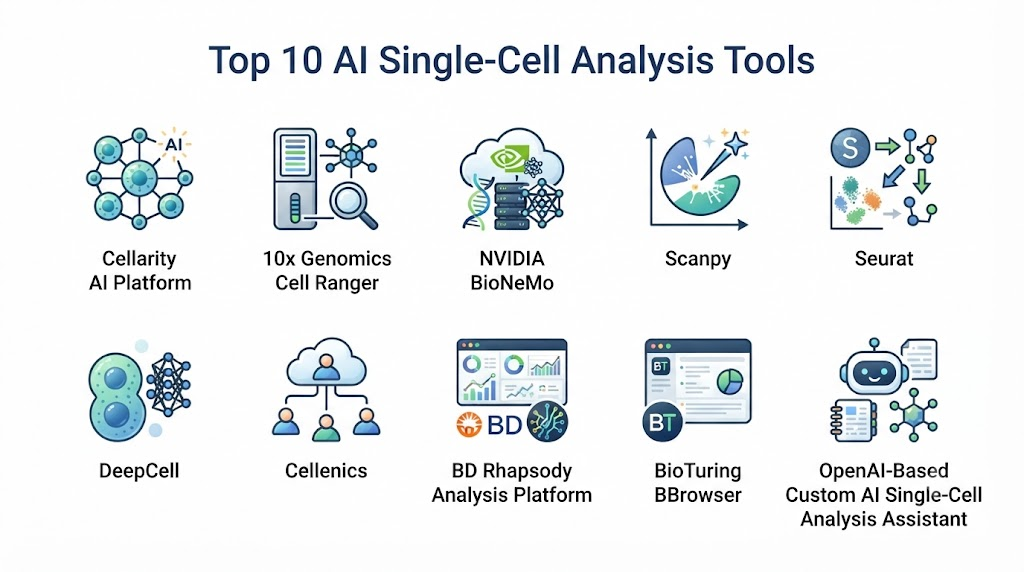
Top 10 AI Single-Cell Analysis Tools
1. Cellarity AI Platform
Verdict: Best overall AI platform for advanced cellular biology analysis.
Short Description: Cellarity uses AI and computational biology approaches to model cellular systems, understand biological interactions, and discover therapeutic opportunities.
Key Features
- AI cellular modeling
- Biological network analysis
- Cell behavior prediction
- Disease mechanism discovery
- Drug discovery support
Pros
- Advanced AI biology approach
- Focused on cellular mechanisms
- Supports therapeutic research
Cons
- Enterprise research focused
Deployment: Research and enterprise environments
Security & Compliance: Enterprise research data controls
Integrations & Ecosystem: Biological datasets, research workflows, computational biology platforms
Support & Community: Enterprise research support
Pricing Model: Custom enterprise pricing
Best-Fit Scenarios: Pharmaceutical and biotechnology research
2. 10x Genomics Cell Ranger
Verdict: Leading single-cell data processing platform.
Short Description: Cell Ranger provides computational pipelines for processing single-cell sequencing data generated from 10x Genomics technologies.
Key Features
- Single-cell RNA analysis
- Gene expression processing
- Cell identification
- Sequencing data processing
- Visualization support
Pros
- Strong ecosystem
- Widely adopted workflow
- Reliable processing pipelines
Cons
- Best suited for compatible sequencing workflows
3. NVIDIA BioNeMo
Verdict: AI infrastructure platform for large-scale biological data analysis.
Short Description: NVIDIA BioNeMo provides AI models and computational resources supporting single-cell analysis, biological modeling, and life science research workflows.
Key Features
- AI biological models
- Generative biology
- Cellular data analysis
- Machine learning workflows
- GPU acceleration
Pros
- Powerful AI infrastructure
- Supports large datasets
Cons
- Requires AI expertise
4. Scanpy
Verdict: Popular open-source framework for single-cell analysis.
Short Description: Scanpy provides Python-based tools for analyzing single-cell gene expression data and performing computational biology workflows.
Key Features
- Cell clustering
- Dimensionality reduction
- Gene expression analysis
- Visualization
- Bioinformatics workflows
Pros
- Open-source flexibility
- Strong research community
Cons
- Requires programming knowledge
5. Seurat
Verdict: Widely used toolkit for single-cell genomics analysis.
Short Description: Seurat provides R-based computational methods for single-cell RNA sequencing analysis, clustering, visualization, and biological interpretation.
Key Features
- Single-cell analysis
- Cell clustering
- Data integration
- Visualization
- Multi-modal analysis
Pros
- Strong scientific adoption
- Extensive documentation
Cons
- Requires computational expertise
6. DeepCell
Verdict: AI-powered cellular imaging analysis platform.
Short Description: DeepCell uses deep learning models to analyze microscopy images, identify cells, and extract biological insights from cellular data.
Key Features
- AI image analysis
- Cell segmentation
- Cell classification
- Microscopy workflows
- Biological insights
Pros
- Strong AI imaging capabilities
- Automated cell analysis
Cons
- Focused on imaging-based workflows
7. Cellenics
Verdict: Cloud-based single-cell data analysis platform.
Short Description: Cellenics provides a user-friendly environment for analyzing single-cell sequencing data without requiring extensive programming expertise.
Key Features
- Single-cell analysis
- Cell annotation
- Data visualization
- Cloud workflows
- Research collaboration
Pros
- Easy-to-use interface
- Accessible for researchers
Cons
- Less customizable than open-source tools
8. BD Rhapsody Analysis Platform
Verdict: Single-cell analysis ecosystem for immune and biological research.
Short Description: BD Rhapsody provides single-cell analysis workflows supporting immune profiling, gene expression studies, and biological research.
Key Features
- Single-cell sequencing analysis
- Immune profiling
- Gene expression analysis
- Data processing
- Research workflows
Pros
- Strong life science ecosystem
- Supports immune research
Cons
- Best suited for specific workflows
9. BioTuring BBrowser
Verdict: Interactive single-cell visualization and analysis platform.
Short Description: BioTuring BBrowser helps researchers explore, visualize, and analyze single-cell datasets through interactive computational tools.
Key Features
- Cell visualization
- Data exploration
- Cell annotation
- Single-cell analysis
- Collaboration tools
Pros
- User-friendly interface
- Supports biological exploration
Cons
- Advanced customization may require expertise
10. OpenAI-Based Custom AI Single-Cell Analysis Assistant
Verdict: Flexible AI assistant for customized cellular data workflows.
Short Description: Research organizations can build custom AI single-cell analysis assistants using large language models integrated with sequencing pipelines, single-cell databases, bioinformatics tools, and visualization platforms. These assistants can summarize datasets, explain cellular patterns, analyze research papers, and support computational workflows while requiring expert validation.
Key Features
- Dataset interpretation
- Research summaries
- Cell analysis assistance
- Literature analysis
- Workflow automation
Pros
- Highly customizable
- Flexible integrations
- Improves researcher productivity
Cons
- Requires computational biology expertise
- Validation required
Comparison Table
| Platform | AI Capability | Single-Cell Analysis | Data Processing | Visualization | Best Use |
|---|---|---|---|---|---|
| Cellarity | Excellent | Excellent | Excellent | High | Cellular Modeling |
| Cell Ranger | High | Excellent | Excellent | High | scRNA-seq Processing |
| NVIDIA BioNeMo | Excellent | High | Excellent | High | AI Biology Research |
| Scanpy | High | Excellent | High | Excellent | Open Research |
| Seurat | High | Excellent | High | Excellent | Single-Cell Genomics |
| DeepCell | Excellent | High | High | High | Cell Imaging |
| Cellenics | High | High | High | Excellent | Easy Analysis |
| BD Rhapsody | High | High | High | High | Immune Research |
| BioTuring BBrowser | High | High | Medium | Excellent | Data Exploration |
| OpenAI Custom | Custom | Custom | Custom | Custom | AI Research Assistant |
Evaluation & Scoring Table
| Platform | AI Features 20% | Analysis Capability 20% | Data Processing 15% | Integration 15% | Security 10% | Ease 10% | Value 10% | Total |
|---|---|---|---|---|---|---|---|---|
| Cellarity | 20 | 20 | 15 | 15 | 10 | 8 | 8 | 96 |
| NVIDIA BioNeMo | 20 | 19 | 15 | 15 | 10 | 8 | 8 | 95 |
| Cell Ranger | 18 | 20 | 15 | 14 | 10 | 8 | 8 | 93 |
| Scanpy | 18 | 19 | 14 | 15 | 10 | 8 | 9 | 93 |
| Seurat | 18 | 19 | 14 | 15 | 10 | 8 | 9 | 93 |
| DeepCell | 19 | 18 | 14 | 14 | 10 | 8 | 8 | 91 |
| Cellenics | 17 | 17 | 14 | 14 | 10 | 9 | 8 | 89 |
| BD Rhapsody | 17 | 18 | 13 | 14 | 10 | 8 | 8 | 88 |
| BioTuring BBrowser | 17 | 17 | 13 | 13 | 10 | 9 | 8 | 87 |
| OpenAI Custom | 20 | 16 | 12 | 15 | 8 | 7 | 9 | 87 |
Which AI Single-Cell Analysis Tool Is Right for You?
| If your priority is… | Recommended Platform |
|---|---|
| Cellular modeling with AI | Cellarity |
| 10x Genomics workflows | Cell Ranger |
| AI biology infrastructure | NVIDIA BioNeMo |
| Open-source analysis | Scanpy |
| Research-standard workflows | Seurat |
| Cell imaging analysis | DeepCell |
| Easy cloud analysis | Cellenics |
| Immune profiling | BD Rhapsody |
| Interactive visualization | BioTuring BBrowser |
| Custom AI analysis assistant | OpenAI-Based AI Assistant |
Implementation Playbook
First 30 Days
- Define single-cell analysis goals
- Identify sequencing datasets
- Select analysis workflows
- Review computational requirements
Days 31–60
- Process single-cell datasets
- Configure analysis pipelines
- Train research teams
- Validate biological findings
Days 61–90
- Integrate multi-omics workflows
- Automate analysis processes
- Improve biological interpretation
- Expand research applications
Common Mistakes
- Poor-quality sequencing data
- Incorrect cell annotation
- Ignoring biological validation
- Lack of computational expertise
- Poor workflow design
- Ignoring data security
- Overinterpreting AI results
- Weak integration with research systems
Frequently Asked Questions
1. What are AI Single-Cell Analysis Tools?
They are AI-powered platforms that analyze individual cell-level biological data to discover cellular patterns and biological insights.
2. Why is single-cell analysis important?
It helps researchers understand differences between individual cells that are hidden in traditional bulk analysis.
3. How does AI improve single-cell analysis?
AI helps identify cell types, detect patterns, analyze large datasets, and improve biological interpretation.
4. Who uses single-cell analysis platforms?
Researchers, biotechnology companies, pharmaceutical organizations, and academic laboratories.
5. What data do these tools analyze?
They analyze single-cell RNA sequencing, spatial data, imaging data, and multi-omics datasets.
6. Can AI replace biological researchers?
No. AI supports researchers but requires expert interpretation.
7. Are single-cell AI predictions reliable?
Reliability depends on data quality, model performance, and biological validation.
8. Can these tools support drug discovery?
Yes. They help identify biomarkers, disease mechanisms, and therapeutic targets.
9. What security concerns exist?
Organizations should protect genomic data, research information, and sensitive biological datasets.
10. What should organizations evaluate before adoption?
Consider AI capabilities, workflow support, scalability, integrations, security, and research requirements.
Conclusion
AI Single-Cell Analysis Tools are transforming modern biology by enabling researchers to understand cellular complexity at unprecedented resolution. By combining artificial intelligence, computational biology, and advanced sequencing analysis, these platforms help uncover disease mechanisms, discover biomarkers, and accelerate precision medicine research.Organizations adopting AI single-cell solutions should focus on analytical accuracy, workflow integration, computational scalability, and biological validation. Platforms such as Cellarity, 10x Genomics Cell Ranger, NVIDIA BioNeMo, Scanpy, and Seurat demonstrate how artificial intelligence is advancing cellular research and creating new opportunities in biotechnology, healthcare, and drug discovery.
