Introduction
AI Biomarker Discovery Platforms use artificial intelligence (AI), machine learning (ML), deep learning, and advanced biological data analytics to identify, validate, and prioritize biomarkers associated with diseases, treatment response, and biological processes. These platforms analyze complex datasets including genomics, proteomics, imaging data, clinical records, molecular data, and multi-omics information to discover meaningful biological indicators.
Biomarkers play an important role in modern healthcare by helping researchers understand disease mechanisms, diagnose conditions earlier, predict treatment outcomes, and develop personalized therapies. However, identifying reliable biomarkers from large biological datasets is challenging due to complex biological interactions and massive amounts of research data.
AI-powered biomarker discovery platforms help researchers uncover hidden patterns, analyze relationships between biological signals, identify potential disease indicators, and accelerate precision medicine research. These solutions combine machine learning algorithms, knowledge graphs, natural language processing, and multi-omics analytics to support pharmaceutical companies, biotechnology organizations, and research institutions.
Modern AI biomarker discovery tools integrate with genomic databases, proteomics platforms, clinical research systems, electronic health records, imaging systems, and drug discovery workflows. They assist scientists by improving biomarker identification while requiring laboratory validation, clinical evaluation, and expert review.
Real-world Use Cases
- Disease biomarker identification
- Cancer biomarker discovery
- Drug response prediction
- Precision medicine research
- Clinical trial optimization
- Patient stratification
- Diagnostic development
- Therapeutic target discovery
- Multi-omics analysis
- Companion diagnostics research
Evaluation Criteria for Buyers
When selecting an AI Biomarker Discovery Platform, consider:
- AI modeling capabilities
- Multi-omics support
- Clinical data integration
- Biomarker validation workflows
- Machine learning explainability
- Research database connectivity
- Scalability
- Data security
- Collaboration features
- Regulatory readiness
Best For
- Pharmaceutical companies
- Biotechnology organizations
- Clinical research organizations
- Academic institutions
- Precision medicine teams
Not Ideal For
Organizations expecting AI predictions to replace clinical validation, laboratory testing, or regulatory approval processes.
Key Trends
- AI-powered precision medicine
- Multi-omics biomarker discovery
- Foundation models for biology
- Explainable AI in healthcare
- Digital biomarkers
- Clinical data intelligence
- AI-driven drug development
- Personalized therapeutics
- Automated literature mining
- Real-world evidence analytics
Methodology
The platforms below were evaluated based on:
- AI biomarker discovery capabilities
- Biological data integration
- Research workflow support
- Clinical application readiness
- Scalability
- Industry adoption
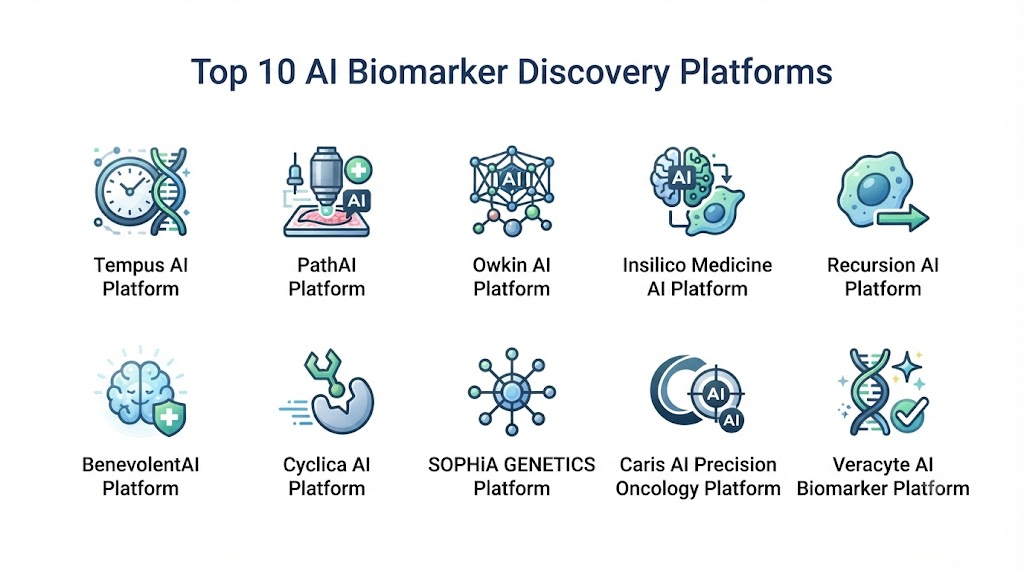
Top 10 AI Biomarker Discovery Platforms
1. Tempus AI Platform
Verdict: Best overall AI platform for clinical and molecular biomarker discovery.
Short Description: Tempus uses artificial intelligence, genomic data, and clinical information to identify molecular patterns, support precision medicine, and discover biomarkers for disease research.
Key Features
- AI clinical data analysis
- Genomic biomarker discovery
- Molecular profiling
- Patient stratification
- Precision medicine workflows
Pros
- Combines clinical and molecular data
- Strong healthcare AI capabilities
- Supports oncology research
Cons
- Primarily enterprise healthcare focused
Deployment: Healthcare and research environments
Security & Compliance: Healthcare data protection controls
Integrations & Ecosystem: Genomic systems, clinical workflows, research platforms
Support & Community: Enterprise healthcare support
Pricing Model: Custom enterprise pricing
Best-Fit Scenarios: Precision medicine and clinical research
2. IBM Watson Health AI Analytics
Verdict: AI analytics platform supporting healthcare research and biomarker insights.
Short Description: IBM healthcare AI solutions use machine learning and data analytics to analyze clinical information and support biomedical research workflows.
Key Features
- Clinical data analytics
- AI pattern recognition
- Research insights
- Healthcare data integration
- Predictive modeling
Pros
- Strong enterprise AI capabilities
- Healthcare analytics experience
Cons
- Requires integration expertise
3. NVIDIA BioNeMo
Verdict: AI foundation platform for biological data analysis and biomarker research.
Short Description: NVIDIA BioNeMo provides AI models and computational infrastructure for analyzing biological data, proteins, molecules, and complex biomedical relationships.
Key Features
- Biological AI models
- Protein and molecular analysis
- Machine learning workflows
- Generative biology support
- Large-scale data processing
Pros
- Powerful AI infrastructure
- Supports advanced biological research
Cons
- Requires computational expertise
4. BenevolentAI Platform
Verdict: AI-powered biomedical discovery platform using knowledge graphs.
Short Description: BenevolentAI combines machine learning, knowledge graphs, and biomedical datasets to discover disease mechanisms, biomarkers, and therapeutic opportunities.
Key Features
- Biomedical knowledge graphs
- Literature intelligence
- Disease pathway analysis
- Biomarker discovery
- Drug discovery support
Pros
- Strong biological intelligence
- Advanced data integration
Cons
- Enterprise research focus
5. Insilico Medicine AI Platform
Verdict: AI drug discovery platform supporting biomarker and therapeutic research.
Short Description: Insilico Medicine uses AI models to analyze biological data, identify disease mechanisms, discover targets, and support biomarker research.
Key Features
- AI biology models
- Target discovery
- Biomarker analysis
- Drug discovery workflows
- Multi-omics research
Pros
- End-to-end AI discovery capabilities
- Strong pharmaceutical focus
Cons
- Designed mainly for research organizations
6. Owkin AI Platform
Verdict: AI biotechnology platform for clinical and molecular biomarker discovery.
Short Description: Owkin uses machine learning and healthcare data to discover biomarkers, improve patient stratification, and support precision medicine research.
Key Features
- Clinical AI models
- Biomarker discovery
- Patient segmentation
- Medical research analytics
- Privacy-focused AI approaches
Pros
- Strong healthcare AI focus
- Combines clinical and biological data
Cons
- Requires healthcare data partnerships
7. Cellarity AI Platform
Verdict: AI platform focused on cellular biology and disease mechanism discovery.
Short Description: Cellarity applies AI models to understand cellular behavior and identify biological patterns that can support biomarker and therapeutic research.
Key Features
- Cellular modeling
- Biological pattern discovery
- Disease mechanism analysis
- AI-driven research
- Therapeutic insights
Pros
- Advanced cellular AI approach
- Supports complex biology research
Cons
- Specialized research use cases
8. Seven Bridges Genomics
Verdict: Cloud-based bioinformatics platform supporting genomic biomarker research.
Short Description: Seven Bridges provides genomic analysis infrastructure for researchers working with sequencing data, clinical studies, and biomarker discovery workflows.
Key Features
- Genomic analysis
- Workflow management
- Data integration
- Research pipelines
- Cloud bioinformatics
Pros
- Strong genomics capabilities
- Scalable workflows
Cons
- Requires bioinformatics knowledge
9. Veracyte AI Diagnostics Platform
Verdict: AI-supported diagnostic biomarker platform.
Short Description: Veracyte uses genomic information and computational analysis to develop diagnostic tests and biomarker-based healthcare solutions.
Key Features
- Molecular diagnostics
- Biomarker analysis
- Genomic testing
- Disease classification
- Clinical research support
Pros
- Strong diagnostic focus
- Clinical application experience
Cons
- Focused on specific diagnostic areas
10. OpenAI-Based Custom AI Biomarker Discovery Assistant
Verdict: Flexible AI assistant for customized biomarker research workflows.
Short Description: Research organizations can build custom AI biomarker discovery assistants using large language models integrated with genomic datasets, proteomics platforms, clinical databases, scientific literature, and bioinformatics pipelines. These assistants can analyze research papers, summarize datasets, identify biological patterns, and support biomarker research while requiring expert validation.
Key Features
- Literature analysis
- Biomarker research assistance
- Multi-omics data interpretation
- Scientific reporting
- Knowledge discovery
Pros
- Highly customizable
- Flexible research integrations
- Improves scientist productivity
Cons
- Requires biomedical expertise
- Validation required
Comparison Table
| Platform | AI Capability | Biomarker Discovery | Data Integration | Research Workflow | Best Use |
|---|---|---|---|---|---|
| Tempus AI | Excellent | Excellent | Excellent | Excellent | Precision Medicine |
| IBM Watson Health AI | High | High | Excellent | High | Healthcare Analytics |
| NVIDIA BioNeMo | Excellent | Excellent | Excellent | High | AI Biology Research |
| BenevolentAI | Excellent | Excellent | Excellent | Excellent | Biomedical Discovery |
| Insilico Medicine | Excellent | Excellent | High | Excellent | Drug Discovery |
| Owkin | High | Excellent | High | High | Clinical Biomarkers |
| Cellarity | Excellent | High | High | High | Cellular Research |
| Seven Bridges | High | High | Excellent | High | Genomic Biomarkers |
| Veracyte | High | Excellent | High | High | Diagnostics |
| OpenAI Custom | Custom | Custom | Custom | Custom | AI Research Assistant |
Evaluation & Scoring Table
| Platform | AI Features 20% | Biomarker Accuracy 20% | Biological Data 15% | Integration 15% | Security 10% | Ease 10% | Value 10% | Total |
|---|---|---|---|---|---|---|---|---|
| Tempus AI | 20 | 20 | 15 | 15 | 10 | 8 | 8 | 96 |
| NVIDIA BioNeMo | 20 | 19 | 15 | 15 | 10 | 8 | 8 | 95 |
| BenevolentAI | 20 | 19 | 15 | 15 | 10 | 8 | 8 | 95 |
| Insilico Medicine | 20 | 19 | 14 | 15 | 10 | 8 | 8 | 94 |
| Owkin | 18 | 19 | 14 | 14 | 10 | 8 | 8 | 91 |
| IBM Watson Health AI | 18 | 18 | 15 | 14 | 10 | 8 | 8 | 91 |
| Cellarity | 19 | 18 | 14 | 14 | 10 | 8 | 8 | 91 |
| Seven Bridges | 17 | 18 | 14 | 14 | 10 | 8 | 8 | 89 |
| Veracyte | 17 | 18 | 13 | 14 | 10 | 9 | 8 | 89 |
| OpenAI Custom | 20 | 16 | 12 | 15 | 8 | 7 | 9 | 87 |
Which AI Biomarker Discovery Platform Is Right for You?
| If your priority is… | Recommended Platform |
|---|---|
| Clinical biomarker discovery | Tempus AI |
| Biomedical knowledge discovery | BenevolentAI |
| AI biology research | NVIDIA BioNeMo |
| Drug discovery biomarkers | Insilico Medicine |
| Clinical AI research | Owkin |
| Cellular biomarker analysis | Cellarity |
| Genomic biomarker workflows | Seven Bridges |
| Diagnostic biomarkers | Veracyte |
| Healthcare analytics | IBM Watson Health AI |
| Custom AI biomarker assistant | OpenAI-Based AI Assistant |
Implementation Playbook
First 30 Days
- Define biomarker discovery goals
- Identify biological datasets
- Review research workflows
- Select AI analysis requirements
Days 31–60
- Integrate genomic and clinical data
- Configure AI models
- Validate biomarker candidates
- Train research teams
Days 61–90
- Connect multi-omics workflows
- Automate discovery processes
- Improve biomarker prioritization
- Establish validation pipelines
Common Mistakes
- Treating AI biomarkers as clinically approved
- Ignoring laboratory validation
- Using incomplete datasets
- Lack of biological expertise
- Poor data governance
- Ignoring bias in datasets
- Weak clinical validation
- Poor workflow integration
Frequently Asked Questions
1. What are AI Biomarker Discovery Platforms?
They are AI-powered systems that analyze biological and clinical data to identify potential disease or treatment-related biomarkers.
2. How does AI help biomarker discovery?
AI identifies hidden patterns across genomic, proteomic, clinical, and molecular datasets.
3. Can AI biomarkers be used directly in healthcare?
No. Biomarkers require laboratory testing, clinical validation, and regulatory review.
4. Who uses AI biomarker platforms?
Pharmaceutical companies, biotechnology organizations, researchers, and clinical institutions.
5. What data sources are used?
Genomics, proteomics, imaging, clinical records, and scientific literature.
6. Can AI discover cancer biomarkers?
Yes. AI helps analyze tumor biology and identify potential cancer-related biomarkers.
7. Does AI replace biomedical researchers?
No. AI supports scientists by improving analysis and discovery workflows.
8. Are AI biomarker predictions reliable?
Reliability depends on data quality, model performance, and validation processes.
9. What security concerns exist?
Organizations must protect genomic data, clinical information, and research intellectual property.
10. What should organizations evaluate before adoption?
Consider AI capabilities, data integration, validation workflows, security, scalability, and research objectives.
Conclusion
AI Biomarker Discovery Platforms are transforming biomedical research by helping scientists identify meaningful biological signals hidden within complex datasets. By combining artificial intelligence, multi-omics analysis, clinical information, and computational biology, these platforms accelerate precision medicine, drug discovery, and diagnostic innovation.Organizations adopting AI biomarker solutions should focus on scientific validation, data quality, workflow integration, and responsible AI practices. Platforms such as Tempus AI, NVIDIA BioNeMo, BenevolentAI, Insilico Medicine, and Owkin demonstrate how artificial intelligence is enabling faster biomarker discovery and advancing the future of personalized healthcare.
