Introduction
AI Biomedical Literature Mining Tools use artificial intelligence (AI), natural language processing (NLP), machine learning (ML), and knowledge extraction technologies to analyze large volumes of biomedical research publications. These platforms help researchers discover scientific insights, identify relationships between genes, proteins, diseases, drugs, and biological pathways, and accelerate evidence-based research.
The growth of biomedical literature has created significant challenges for researchers. Millions of scientific papers, clinical studies, patents, and medical documents are published across different sources, making manual review extremely time-consuming. AI-powered literature mining solutions help researchers automatically search, summarize, classify, and extract meaningful information from complex scientific content.
Modern AI biomedical literature mining platforms use transformer-based language models, semantic search, knowledge graphs, entity recognition, and automated summarization to support drug discovery, clinical research, genomics, proteomics, and biotechnology innovation.
These tools integrate with scientific databases, research workflows, knowledge management systems, and bioinformatics platforms. They assist scientists, pharmaceutical researchers, clinicians, and academic institutions in finding relevant information faster while requiring expert validation and scientific interpretation.
Real-world Use Cases
- Biomedical research discovery
- Drug target identification
- Literature review automation
- Clinical evidence analysis
- Gene-disease relationship discovery
- Drug interaction research
- Biomarker research
- Scientific knowledge extraction
- Patent intelligence
- Research collaboration
Evaluation Criteria for Buyers
When selecting an AI Biomedical Literature Mining Tool, consider:
- AI search capabilities
- Scientific document coverage
- NLP accuracy
- Knowledge extraction features
- Citation analysis
- Research database integration
- Summarization capabilities
- Collaboration features
- Data security
- Scalability
Best For
- Pharmaceutical companies
- Biotechnology organizations
- Academic researchers
- Clinical research teams
- Healthcare organizations
Not Ideal For
Organizations expecting AI-generated research summaries to replace expert scientific review.
Key Trends
- AI scientific assistants
- Biomedical knowledge graphs
- Semantic literature search
- Automated systematic reviews
- Large language models for research
- AI drug discovery support
- Evidence intelligence platforms
- Automated citation analysis
- Multi-omics literature integration
- Research workflow automation
Methodology
The platforms below were evaluated based on:
- AI literature analysis capabilities
- Biomedical knowledge extraction
- Research workflow support
- Search intelligence
- Scientific adoption
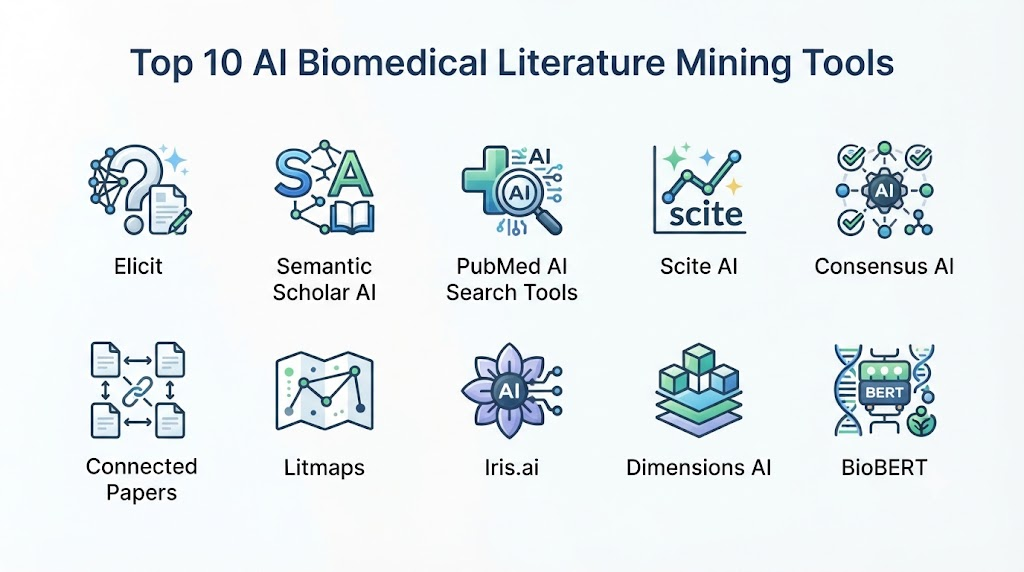
Top 10 AI Biomedical Literature Mining Tools
1. Elicit
Verdict: Best overall AI research assistant for biomedical literature discovery.
Short Description: Elicit uses AI to search, summarize, and analyze scientific papers, helping researchers find evidence and extract insights from academic literature.
Key Features
- AI literature search
- Research paper summarization
- Evidence extraction
- Question-based discovery
- Scientific analysis support
Pros
- Simplifies literature review
- Saves researcher time
- Easy-to-use interface
Cons
- Requires expert validation of findings
Deployment: Cloud-based research environment
Security & Compliance: Depends on usage environment
Integrations & Ecosystem: Research databases and academic workflows
Support & Community: Research user community
Pricing Model: Subscription and research access options
Best-Fit Scenarios: Literature reviews and scientific discovery
2. PubTator
Verdict: Biomedical text mining platform for scientific information extraction.
Short Description: PubTator uses natural language processing to identify biomedical concepts such as genes, diseases, chemicals, and mutations from research publications.
Key Features
- Biomedical entity recognition
- Literature annotation
- Gene and disease extraction
- Scientific text mining
- Database integration
Pros
- Strong biomedical focus
- Supports large-scale literature analysis
Cons
- Requires technical expertise
3. Semantic Scholar
Verdict: AI-powered academic search platform.
Short Description: Semantic Scholar uses AI techniques to improve scientific literature discovery, paper recommendations, and research analysis.
Key Features
- AI-powered search
- Paper recommendations
- Citation analysis
- Research discovery
- Scientific indexing
Pros
- Broad research coverage
- Intelligent recommendations
Cons
- Not limited to biomedical research
4. IBM Watson Discovery
Verdict: Enterprise AI search and knowledge extraction platform.
Short Description: IBM Watson Discovery uses AI and NLP technologies to analyze large document collections and extract meaningful information.
Key Features
- Natural language processing
- Document analysis
- Knowledge extraction
- Enterprise search
- Data intelligence
Pros
- Enterprise scalability
- Strong AI capabilities
Cons
- Requires implementation expertise
5. Elsevier AI Solutions
Verdict: AI-powered scientific intelligence platform.
Short Description: Elsevier provides research intelligence solutions using scientific databases, analytics, and AI capabilities to help researchers discover biomedical information.
Key Features
- Scientific search
- Research analytics
- Evidence discovery
- Citation intelligence
- Literature analysis
Pros
- Large scientific database ecosystem
- Trusted research content
Cons
- Enterprise-focused access
6. CAS SciFinder Discovery Platform
Verdict: Scientific information discovery platform for chemistry and life sciences.
Short Description: CAS SciFinder provides AI-supported scientific search and discovery capabilities for researchers working with chemical, biological, and pharmaceutical information.
Key Features
- Scientific literature search
- Chemical information
- Biological relationships
- Research discovery
- Compound intelligence
Pros
- Strong chemistry and life science coverage
- High-quality scientific data
Cons
- Specialized research platform
7. BenevolentAI Knowledge Platform
Verdict: AI biomedical knowledge discovery platform.
Short Description: BenevolentAI combines machine learning, knowledge graphs, and biomedical literature analysis to identify relationships between diseases, targets, and therapies.
Key Features
- Biomedical knowledge graphs
- Literature intelligence
- Disease pathway analysis
- Drug discovery insights
- AI reasoning
Pros
- Strong biomedical intelligence
- Supports therapeutic research
Cons
- Enterprise research focus
8. Google Scholar + AI Research Assistants
Verdict: Flexible AI-supported academic discovery approach.
Short Description: Google Scholar combined with AI research assistants helps researchers discover scientific publications, analyze papers, and organize biomedical evidence.
Key Features
- Academic search
- Citation discovery
- Research organization
- Literature analysis
- Knowledge extraction
Pros
- Broad research coverage
- Easy accessibility
Cons
- Requires workflow customization
9. Lens.org
Verdict: Research and patent intelligence platform.
Short Description: Lens.org combines scientific publications, patents, and analytics tools to help researchers discover innovation trends and biomedical research connections.
Key Features
- Literature search
- Patent analysis
- Citation networks
- Research intelligence
- Knowledge discovery
Pros
- Combines patents and research
- Useful for innovation analysis
Cons
- Requires interpretation skills
10. OpenAI-Based Custom AI Biomedical Literature Assistant
Verdict: Flexible AI assistant for customized biomedical research workflows.
Short Description: Research organizations can build custom AI biomedical literature assistants using large language models integrated with scientific databases, publication repositories, clinical research systems, and knowledge graphs. These assistants can summarize papers, compare studies, extract findings, and support research workflows while requiring expert review.
Key Features
- Research paper summarization
- Evidence extraction
- Scientific question answering
- Literature comparison
- Knowledge organization
Pros
- Highly customizable
- Flexible integrations
- Improves researcher productivity
Cons
- Requires scientific expertise
- Validation required
Comparison Table
| Platform | AI Literature Mining | Biomedical Coverage | NLP Capability | Research Integration | Best Use |
|---|---|---|---|---|---|
| Elicit | Excellent | High | Excellent | High | Literature Review |
| PubTator | Excellent | Excellent | Excellent | High | Biomedical Text Mining |
| Semantic Scholar | High | Medium | High | High | Research Discovery |
| IBM Watson Discovery | Excellent | High | Excellent | Excellent | Enterprise Search |
| Elsevier AI Solutions | High | Excellent | High | Excellent | Scientific Intelligence |
| CAS SciFinder | High | Excellent | High | High | Chemical Research |
| BenevolentAI | Excellent | Excellent | Excellent | Excellent | Drug Discovery |
| Google Scholar AI Assistants | High | High | Medium | Medium | Academic Search |
| Lens.org | High | High | High | High | Patent Research |
| OpenAI Custom | Custom | Custom | Custom | Custom | AI Research Assistant |
Evaluation & Scoring Table
| Platform | AI Capability 20% | Literature Analysis 20% | Biomedical Data 15% | Integration 15% | Security 10% | Ease 10% | Value 10% | Total |
|---|---|---|---|---|---|---|---|---|
| BenevolentAI | 20 | 20 | 15 | 15 | 10 | 8 | 8 | 96 |
| Elicit | 20 | 19 | 14 | 14 | 10 | 9 | 9 | 95 |
| PubTator | 19 | 19 | 15 | 14 | 10 | 8 | 8 | 93 |
| Elsevier AI Solutions | 18 | 19 | 15 | 15 | 10 | 8 | 8 | 93 |
| IBM Watson Discovery | 19 | 18 | 14 | 15 | 10 | 8 | 8 | 92 |
| CAS SciFinder | 18 | 18 | 15 | 14 | 10 | 8 | 8 | 91 |
| Semantic Scholar | 17 | 17 | 13 | 14 | 10 | 9 | 9 | 89 |
| Lens.org | 17 | 17 | 13 | 13 | 10 | 9 | 8 | 87 |
| Google Scholar AI Assistants | 17 | 16 | 13 | 12 | 10 | 9 | 9 | 86 |
| OpenAI Custom | 20 | 16 | 12 | 15 | 8 | 7 | 9 | 87 |
Which AI Biomedical Literature Mining Tool Is Right for You?
| If your priority is… | Recommended Platform |
|---|---|
| AI literature reviews | Elicit |
| Biomedical text extraction | PubTator |
| Academic research discovery | Semantic Scholar |
| Enterprise document intelligence | IBM Watson Discovery |
| Scientific database intelligence | Elsevier AI Solutions |
| Chemistry and biology research | CAS SciFinder |
| Drug discovery intelligence | BenevolentAI |
| Patent and innovation analysis | Lens.org |
| General academic search | Google Scholar AI Assistants |
| Custom research assistant | OpenAI-Based AI Assistant |
Implementation Playbook
First 30 Days
- Define literature mining goals
- Identify research sources
- Select AI search workflows
- Establish knowledge management requirements
Days 31–60
- Connect scientific databases
- Configure AI analysis workflows
- Train researchers
- Validate extracted information
Days 61–90
- Automate literature monitoring
- Improve research discovery
- Build knowledge repositories
- Optimize scientific workflows
Common Mistakes
- Trusting AI summaries without verification
- Ignoring scientific context
- Using incomplete literature sources
- Poor citation management
- Lack of researcher review
- Ignoring data licensing
- Weak knowledge organization
- Overlooking research bias
Frequently Asked Questions
1. What are AI Biomedical Literature Mining Tools?
They are AI-powered platforms that analyze scientific publications and extract useful biomedical insights.
2. How does AI help literature mining?
AI helps researchers search, summarize, classify, and identify relationships across scientific documents.
3. Can AI replace scientific researchers?
No. AI supports research workflows but requires expert interpretation.
4. Who uses biomedical literature mining platforms?
Pharmaceutical companies, researchers, clinicians, universities, and biotechnology organizations.
5. What information can AI extract?
AI can identify genes, diseases, drugs, pathways, relationships, and research findings.
6. Can AI help drug discovery?
Yes. AI literature mining helps identify targets, mechanisms, and scientific evidence.
7. Are AI-generated summaries reliable?
They require expert review and verification against original publications.
8. What databases do these tools use?
Many integrate with scientific publications, biomedical databases, patents, and research repositories.
9. How is research data protected?
Organizations should evaluate security controls, access management, and data policies.
10. What should buyers evaluate before adoption?
Consider AI accuracy, database coverage, integrations, scalability, security, and research workflows.
Conclusion
AI Biomedical Literature Mining Tools are transforming scientific research by enabling faster discovery, automated evidence analysis, and improved knowledge management. By combining artificial intelligence, natural language processing, and biomedical databases, these platforms help researchers uncover valuable insights from massive volumes of scientific information.Organizations adopting AI literature mining solutions should focus on data quality, scientific validation, workflow integration, and responsible AI usage. Platforms such as Elicit, PubTator, BenevolentAI, Elsevier AI Solutions, and IBM Watson Discovery demonstrate how artificial intelligence is accelerating biomedical research and supporting innovation across healthcare and life sciences.
