Introduction
AI Defect Detection for Production Lines uses artificial intelligence (AI), machine learning (ML), computer vision, deep learning, and automated inspection technologies to identify product defects during manufacturing processes.
Production environments require fast, accurate, and consistent quality inspection to maintain product standards and reduce waste. Traditional manual inspection methods can be slow, subjective, and difficult to scale for high-speed manufacturing operations. AI-powered defect detection systems analyze images, videos, sensor data, and production information in real time to identify defects and quality issues automatically.
These platforms use deep learning models, image recognition, anomaly detection, object detection, and automated visual inspection workflows to detect problems such as surface damage, missing components, incorrect assembly, dimensional errors, packaging issues, and manufacturing abnormalities.
Modern AI defect detection solutions integrate with industrial cameras, robotics systems, Manufacturing Execution Systems (MES), Industrial IoT platforms, and quality management systems. They are widely used in automotive, electronics, semiconductor, pharmaceutical, food manufacturing, and industrial production environments.
AI defect detection systems help quality teams improve inspection accuracy, reduce production errors, and increase manufacturing efficiency while requiring proper model training, validation, and operational monitoring.
Real-world Use Cases
- Surface defect detection
- Assembly error detection
- Product inspection automation
- Packaging quality checks
- Semiconductor defect analysis
- Automotive component inspection
- Pharmaceutical manufacturing inspection
- Food quality monitoring
- Electronics inspection
- Production line monitoring
Evaluation Criteria for Buyers
When selecting an AI Defect Detection Platform, consider:
- AI detection accuracy
- Real-time inspection capability
- Camera compatibility
- Edge processing support
- Defect classification features
- Manufacturing system integration
- Model training flexibility
- Scalability
- Reporting capabilities
- Security controls
Best For
- Manufacturing companies
- Quality assurance teams
- Industrial automation organizations
- Automotive manufacturers
- Electronics producers
Not Ideal For
Organizations without production image data, inspection workflows, or suitable camera infrastructure.
Key Trends
- AI-powered visual inspection
- Automated quality control
- Edge AI manufacturing
- Smart factory transformation
- Deep learning defect detection
- Zero-defect manufacturing
- Industrial robotics integration
- Real-time production analytics
- Automated quality assurance
- Digital manufacturing intelligence
Methodology
The platforms below were evaluated based on:
- AI defect detection capabilities
- Inspection accuracy
- Production line integration
- Automation features
- Scalability
- Industrial adoption
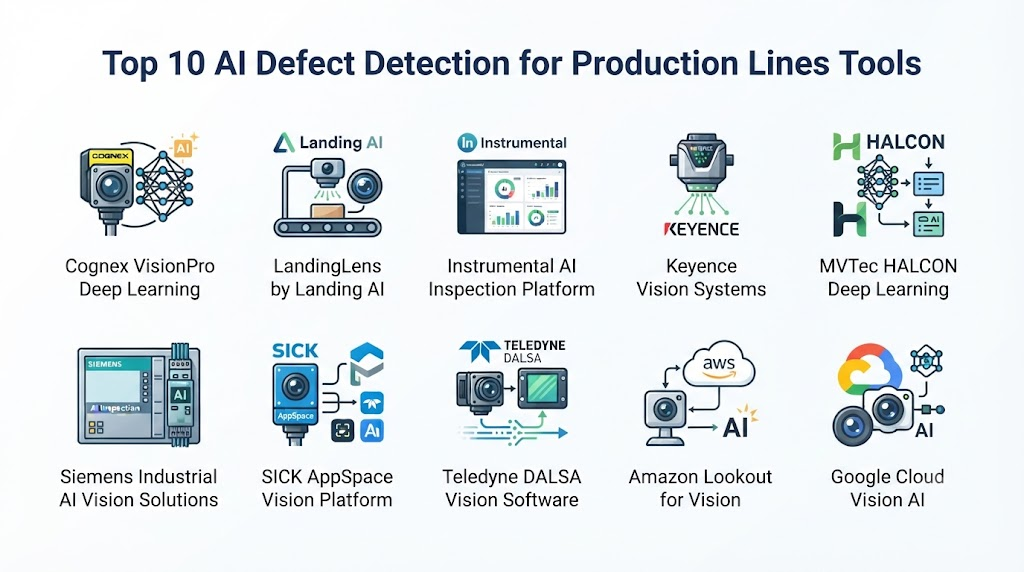
Top 10 AI Defect Detection for Production Lines Tools
1. Cognex In-Sight Vision AI
Verdict: Best overall AI defect detection solution for production lines.
Short Description: Cognex In-Sight Vision AI combines computer vision, deep learning, and industrial inspection capabilities to detect defects and automate quality checks.
Key Features
- AI-based defect detection
- Image classification
- Object recognition
- Industrial camera integration
- Real-time inspection
Pros
- Strong manufacturing adoption
- High inspection accuracy
- Supports complex defects
Cons
- Requires industrial vision expertise
Deployment: Factory production environments
Security & Compliance: Industrial security controls
Integrations & Ecosystem: Cameras, robots, MES, automation systems
Support & Community: Enterprise industrial support
Pricing Model: Custom enterprise pricing
Best-Fit Scenarios: Automated production inspection
2. Keyence Vision Systems
Verdict: Advanced AI vision solution for automated factory inspection.
Short Description: Keyence provides AI-powered vision systems designed for high-speed defect detection, measurement, and quality verification.
Key Features
- AI inspection algorithms
- Defect classification
- Measurement automation
- High-speed imaging
- Production integration
Pros
- Easy factory deployment
- Strong hardware ecosystem
Cons
- Best suited for Keyence hardware environments
3. Landing AI Industrial Inspection
Verdict: AI-first platform for scalable manufacturing inspection.
Short Description: Landing AI helps manufacturers build computer vision models to detect defects using deep learning and simplified model training workflows.
Key Features
- AI defect detection
- Data labeling
- Model training
- Visual inspection
- Production analytics
Pros
- Flexible AI development
- Reduces programming requirements
Cons
- Requires quality image datasets
4. Siemens Industrial Edge Vision
Verdict: Industrial AI inspection platform integrated with automation systems.
Short Description: Siemens provides edge-based AI vision solutions for automated inspection, production monitoring, and manufacturing quality improvement.
Key Features
- Edge AI processing
- Industrial vision
- Automation integration
- Production monitoring
- Quality analytics
Pros
- Strong industrial ecosystem
- Supports large manufacturing environments
Cons
- Requires automation expertise
5. Amazon Lookout for Vision
Verdict: Cloud AI service for industrial defect detection.
Short Description: Amazon Lookout for Vision uses machine learning models to identify defects and anomalies in manufactured products.
Key Features
- Image-based defect detection
- Machine learning models
- Cloud deployment
- Anomaly detection
- Industrial analytics
Pros
- Scalable cloud platform
- Flexible AI workflows
Cons
- Requires cloud integration skills
6. Google Vertex AI Vision
Verdict: AI vision development platform for customized inspection systems.
Short Description: Google Vertex AI Vision provides machine learning tools for building custom computer vision applications for industrial inspection.
Key Features
- AI vision models
- Image analytics
- Custom model development
- Cloud AI infrastructure
- Data processing
Pros
- Highly flexible
- Strong AI capabilities
Cons
- Requires AI expertise
7. MVTec HALCON
Verdict: Professional machine vision software for industrial inspection.
Short Description: MVTec HALCON provides advanced machine vision tools for image processing, inspection, and automation applications.
Key Features
- Image processing
- Object detection
- Pattern recognition
- Industrial inspection
- Vision development tools
Pros
- Powerful vision capabilities
- Supports complex applications
Cons
- Requires technical expertise
8. Zebra Aurora Vision
Verdict: Machine vision platform for automated quality inspection.
Short Description: Zebra Aurora Vision provides software tools for developing industrial vision applications including defect detection and production inspection.
Key Features
- Machine vision development
- Image analysis
- Defect detection
- Pattern recognition
- Industrial integration
Pros
- Flexible development environment
- Supports multiple industries
Cons
- Requires technical knowledge
9. Basler AI Vision Solutions
Verdict: Industrial imaging ecosystem with AI inspection support.
Short Description: Basler combines industrial cameras, image processing technologies, and AI capabilities for automated production inspection.
Key Features
- Industrial cameras
- AI image analysis
- Inspection workflows
- Image processing
- Automation support
Pros
- Strong imaging hardware
- Reliable industrial performance
Cons
- Hardware-focused solution
10. OpenAI-Based Custom AI Defect Detection Assistant
Verdict: Flexible AI assistant for customized production quality workflows.
Short Description: Organizations can build custom AI defect detection assistants using computer vision models integrated with industrial cameras, MES platforms, quality databases, and manufacturing systems. These assistants can analyze inspection results, summarize defects, identify quality trends, and support production decisions while requiring validation.
Key Features
- Defect analysis
- Quality report generation
- Production insights
- Inspection summaries
- Workflow assistance
Pros
- Highly customizable
- Flexible integrations
- Improves quality operations
Cons
- Requires manufacturing expertise
- Validation required
Comparison Table
| Platform | AI Detection | Real-Time Inspection | Production Integration | Automation | Best Use |
|---|---|---|---|---|---|
| Cognex In-Sight Vision AI | Excellent | Excellent | Excellent | Excellent | Factory Inspection |
| Keyence Vision Systems | Excellent | Excellent | Excellent | Excellent | High-Speed Quality Control |
| Landing AI | Excellent | High | High | High | AI Inspection Development |
| Siemens Industrial Edge Vision | Excellent | Excellent | Excellent | Excellent | Smart Manufacturing |
| Amazon Lookout for Vision | High | High | Medium | High | Cloud Defect Detection |
| Google Vertex AI Vision | Excellent | High | High | High | Custom AI Inspection |
| MVTec HALCON | High | Excellent | High | High | Machine Vision |
| Zebra Aurora Vision | High | High | High | High | Industrial Vision |
| Basler AI Vision | High | High | Excellent | High | Camera-Based Inspection |
| OpenAI Custom | Custom | Custom | Custom | Custom | AI Quality Assistant |
Evaluation & Scoring Table
| Platform | AI Capability 20% | Detection Accuracy 20% | Automation 15% | Integration 15% | Security 10% | Ease 10% | Value 10% | Total |
|---|---|---|---|---|---|---|---|---|
| Cognex In-Sight Vision AI | 20 | 20 | 15 | 15 | 10 | 8 | 8 | 96 |
| Keyence Vision Systems | 20 | 20 | 15 | 15 | 10 | 8 | 8 | 96 |
| Siemens Industrial Edge Vision | 19 | 19 | 15 | 15 | 10 | 8 | 8 | 94 |
| Landing AI | 19 | 18 | 14 | 14 | 10 | 9 | 8 | 92 |
| MVTec HALCON | 18 | 19 | 14 | 14 | 10 | 8 | 8 | 91 |
| Google Vertex AI Vision | 20 | 17 | 14 | 14 | 10 | 8 | 8 | 91 |
| Zebra Aurora Vision | 17 | 18 | 13 | 14 | 10 | 8 | 8 | 88 |
| Basler AI Vision | 17 | 18 | 13 | 14 | 10 | 9 | 8 | 89 |
| Amazon Lookout for Vision | 18 | 17 | 14 | 13 | 10 | 9 | 8 | 89 |
| OpenAI Custom | 20 | 16 | 12 | 15 | 8 | 7 | 9 | 87 |
Which AI Defect Detection Platform Is Right for You?
| If your priority is… | Recommended Platform |
|---|---|
| Production line defect detection | Cognex In-Sight Vision AI |
| High-speed factory inspection | Keyence Vision Systems |
| AI model flexibility | Landing AI |
| Industrial automation integration | Siemens Industrial Edge Vision |
| Cloud-based defect detection | Amazon Lookout for Vision |
| Custom AI vision development | Google Vertex AI Vision |
| Advanced machine vision | MVTec HALCON |
| Industrial vision applications | Zebra Aurora Vision |
| Camera-based inspection | Basler AI Vision |
| Custom AI quality assistant | OpenAI-Based AI Assistant |
Implementation Playbook
First 30 Days
- Define defect categories
- Collect production images
- Review camera systems
- Identify inspection requirements
Days 31–60
- Train AI inspection models
- Connect production systems
- Validate detection accuracy
- Train quality teams
Days 61–90
- Deploy automated inspection
- Monitor defect patterns
- Improve production quality
- Expand AI workflows
Common Mistakes
- Poor image quality
- Insufficient defect examples
- Incorrect camera setup
- Overestimating AI accuracy
- Weak production integration
- Lack of validation
- Ignoring manufacturing variations
- Poor maintenance of AI models
Frequently Asked Questions
1. What are AI Defect Detection Tools?
They are AI-powered systems that automatically identify defects and quality issues during production.
2. How does AI detect manufacturing defects?
AI analyzes images and production data using computer vision models to identify abnormal patterns.
3. Can AI replace quality inspectors?
No. AI assists inspectors by automating repetitive inspection tasks.
4. Which industries use AI defect detection?
Automotive, electronics, pharmaceuticals, food manufacturing, and industrial production industries.
5. What defects can AI detect?
AI can detect surface damage, missing parts, assembly issues, packaging errors, and product variations.
6. Can AI inspection work in real time?
Yes. Many systems inspect products directly on production lines.
7. Are AI defect detection results accurate?
Accuracy depends on image quality, training data, and production conditions.
8. Can these systems integrate with robots?
Yes. Many integrate with robotics and industrial automation systems.
9. How is inspection data protected?
Organizations should use secure industrial networks and access controls.
10. What should companies evaluate before adoption?
Consider AI accuracy, camera compatibility, integration, scalability, security, and operational requirements.
Conclusion
AI Defect Detection for Production Lines is transforming manufacturing quality control by enabling faster, more accurate, and automated inspection processes. By combining artificial intelligence, computer vision, industrial cameras, and real-time analytics, these platforms help manufacturers reduce defects, improve efficiency, and achieve consistent product quality.Organizations adopting AI defect detection solutions should focus on image quality, model validation, production integration, and operational scalability. Platforms such as Cognex In-Sight Vision AI, Keyence Vision Systems, Siemens Industrial Edge Vision, Landing AI, and MVTec HALCON demonstrate how artificial intelligence is improving production quality and supporting smarter manufacturing environments.
