Introduction
AI Supply Forecasting for Materials Tools use artificial intelligence (AI), machine learning (ML), predictive analytics, and supply chain intelligence technologies to forecast material requirements, optimize inventory levels, and improve procurement planning.
Manufacturing organizations depend on accurate material forecasting to ensure production continuity, reduce inventory costs, avoid shortages, and improve supplier coordination. Traditional forecasting methods often rely on historical averages, manual planning, and fixed assumptions, which may struggle with changing demand, supply disruptions, and complex production environments.
AI-powered material supply forecasting platforms analyze historical consumption data, production schedules, market conditions, supplier performance, demand patterns, inventory levels, and external factors to generate more accurate forecasts.
These solutions use machine learning models, demand sensing, predictive analytics, scenario planning, and automated recommendations to help organizations determine what materials are needed, when they are required, and how much inventory should be maintained.
Modern AI supply forecasting platforms integrate with Enterprise Resource Planning (ERP), Supply Chain Management (SCM), Manufacturing Execution Systems (MES), Warehouse Management Systems (WMS), procurement platforms, and supplier networks.
They support industries such as manufacturing, automotive, electronics, pharmaceuticals, aerospace, retail, and industrial production by improving material availability and supply chain resilience.
Real-world Use Cases
- Raw material demand forecasting
- Inventory optimization
- Procurement planning
- Supplier demand prediction
- Production material planning
- Shortage risk detection
- Safety stock optimization
- Supply disruption analysis
- Warehouse inventory planning
- Multi-location supply forecasting
Evaluation Criteria for Buyers
When selecting an AI Supply Forecasting Platform, consider:
- Forecasting accuracy
- Machine learning capabilities
- Demand sensing features
- ERP integration
- Inventory optimization
- Scenario planning
- Supplier collaboration
- Scalability
- Reporting capabilities
- Data security
Best For
- Manufacturing companies
- Supply chain teams
- Procurement departments
- Inventory managers
- Enterprise operations
Not Ideal For
Organizations without reliable supply chain data, inventory visibility, or digital planning systems.
Key Trends
- AI-driven demand forecasting
- Predictive supply chain planning
- Autonomous inventory optimization
- Real-time demand sensing
- Supplier risk intelligence
- Digital supply chain twins
- Automated procurement recommendations
- Supply chain resilience analytics
- Machine learning forecasting
- Connected planning ecosystems
Methodology
The platforms below were evaluated based on:
- AI forecasting capabilities
- Material planning features
- Supply chain integration
- Analytics maturity
- Scalability
- Enterprise adoption
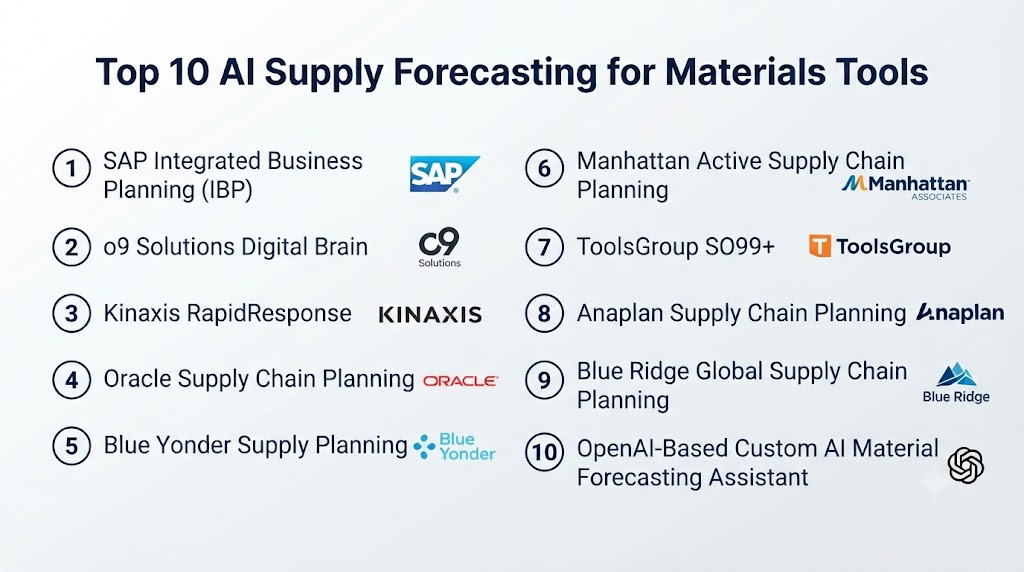
Top 10 AI Supply Forecasting for Materials Tools
1. SAP Integrated Business Planning (IBP)
Verdict: Best overall AI-powered supply forecasting platform.
Short Description: SAP IBP combines demand forecasting, supply planning, inventory optimization, and analytics to help organizations improve material planning decisions.
Key Features
- Demand forecasting
- Supply planning
- Inventory optimization
- Scenario simulation
- Enterprise analytics
Pros
- Strong ERP integration
- Enterprise scalability
- Advanced planning capabilities
Cons
- Requires SAP expertise
Deployment: Enterprise cloud environments
Security & Compliance: Enterprise data security controls
Integrations & Ecosystem: ERP, SCM, procurement, manufacturing systems
Support & Community: Enterprise support
Pricing Model: Custom enterprise pricing
Best-Fit Scenarios: Large supply chain operations
2. o9 Solutions Digital Brain
Verdict: AI-driven supply chain planning platform.
Short Description: o9 Solutions uses artificial intelligence, analytics, and digital planning technologies to optimize supply forecasting and material decisions.
Key Features
- AI forecasting
- Demand sensing
- Supply planning
- Scenario modeling
- Decision intelligence
Pros
- Strong AI capabilities
- Supports complex supply chains
Cons
- Requires data integration
3. Kinaxis RapidResponse
Verdict: Real-time supply chain planning platform.
Short Description: Kinaxis RapidResponse provides AI-assisted supply chain planning, forecasting, and response management capabilities.
Key Features
- Demand planning
- Supply forecasting
- Scenario analysis
- Inventory optimization
- Real-time collaboration
Pros
- Strong supply chain visibility
- Fast scenario planning
Cons
- Requires implementation planning
4. Oracle Supply Chain Planning
Verdict: Enterprise supply planning solution.
Short Description: Oracle Supply Chain Planning helps organizations optimize demand, inventory, production, and material requirements using advanced analytics.
Key Features
- Material forecasting
- Demand planning
- Supply optimization
- Inventory management
- Analytics
Pros
- Strong enterprise ecosystem
- Broad supply chain features
Cons
- Complex deployment
5. Blue Yonder Supply Planning
Verdict: AI-powered supply chain optimization platform.
Short Description: Blue Yonder provides intelligent planning solutions for demand forecasting, inventory optimization, and supply chain decision-making.
Key Features
- Demand forecasting
- Inventory optimization
- Supply planning
- AI recommendations
- Scenario analysis
Pros
- Strong retail and manufacturing adoption
- Advanced planning capabilities
Cons
- Requires configuration expertise
6. Manhattan Active Supply Chain Planning
Verdict: Modern supply chain planning platform.
Short Description: Manhattan Active helps organizations optimize supply planning, inventory decisions, and operational workflows using advanced analytics.
Key Features
- Supply forecasting
- Inventory planning
- Demand analytics
- Collaboration tools
- Optimization models
Pros
- Strong supply chain capabilities
- Cloud-based platform
Cons
- Enterprise-focused solution
7. ToolsGroup SO99+
Verdict: AI-powered inventory and supply optimization platform.
Short Description: ToolsGroup uses AI forecasting and inventory optimization technologies to improve material availability and reduce excess stock.
Key Features
- Demand forecasting
- Inventory optimization
- Supply planning
- Automated recommendations
- Service-level optimization
Pros
- Strong forecasting capabilities
- Inventory-focused approach
Cons
- Requires quality supply data
8. Anaplan Supply Chain Planning
Verdict: Connected planning platform for supply forecasting.
Short Description: Anaplan enables organizations to connect supply chain planning processes, forecast demand, and optimize resources.
Key Features
- Connected planning
- Forecasting
- Scenario modeling
- Collaboration
- Supply visibility
Pros
- Flexible planning workflows
- User-friendly interface
Cons
- Requires customization
9. Blue Ridge Global Supply Chain Planning
Verdict: AI-supported inventory and supply planning platform.
Short Description: Blue Ridge provides supply chain optimization solutions focused on forecasting, inventory planning, and replenishment decisions.
Key Features
- Inventory forecasting
- Replenishment planning
- Demand analytics
- Supply optimization
- AI recommendations
Pros
- Strong inventory optimization
- Practical planning workflows
Cons
- Industry-focused capabilities vary
10. OpenAI-Based Custom AI Material Forecasting Assistant
Verdict: Flexible AI assistant for customized supply forecasting workflows.
Short Description: Organizations can build custom AI material forecasting assistants using large language models integrated with ERP systems, inventory databases, supplier information, production schedules, and analytics platforms. These assistants can analyze material requirements, summarize supply risks, identify shortages, and support procurement decisions while requiring expert validation.
Key Features
- Material demand analysis
- Supply risk summaries
- Forecast explanations
- Procurement insights
- Planning assistance
Pros
- Highly customizable
- Flexible integrations
- Improves planning productivity
Cons
- Requires supply chain expertise
- Validation required
Comparison Table
| Platform | AI Forecasting | Material Planning | ERP Integration | Supply Optimization | Best Use |
|---|---|---|---|---|---|
| SAP IBP | Excellent | Excellent | Excellent | Excellent | Enterprise Supply Planning |
| o9 Solutions | Excellent | Excellent | High | Excellent | AI Supply Intelligence |
| Kinaxis RapidResponse | High | Excellent | High | Excellent | Real-Time Planning |
| Oracle Supply Chain Planning | High | Excellent | Excellent | High | Enterprise Operations |
| Blue Yonder | Excellent | High | High | Excellent | Inventory Optimization |
| Manhattan Active SCP | High | High | High | High | Supply Chain Planning |
| ToolsGroup SO99+ | Excellent | Excellent | High | Excellent | Inventory Forecasting |
| Anaplan | High | High | High | Medium | Connected Planning |
| Blue Ridge Global | High | High | Medium | High | Inventory Planning |
| OpenAI Custom | Custom | Custom | Custom | Custom | AI Forecasting Assistant |
Evaluation & Scoring Table
| Platform | AI Capability 20% | Forecast Accuracy 20% | Planning 15% | Integration 15% | Security 10% | Ease 10% | Value 10% | Total |
|---|---|---|---|---|---|---|---|---|
| SAP IBP | 20 | 20 | 15 | 15 | 10 | 8 | 8 | 96 |
| o9 Solutions | 20 | 20 | 15 | 14 | 10 | 8 | 8 | 95 |
| Kinaxis RapidResponse | 19 | 19 | 15 | 14 | 10 | 8 | 8 | 93 |
| Blue Yonder | 19 | 19 | 14 | 14 | 10 | 8 | 8 | 92 |
| ToolsGroup SO99+ | 19 | 19 | 15 | 13 | 10 | 8 | 8 | 92 |
| Oracle SCP | 18 | 18 | 15 | 15 | 10 | 8 | 8 | 92 |
| Manhattan Active SCP | 18 | 18 | 14 | 14 | 10 | 9 | 8 | 91 |
| Anaplan | 17 | 17 | 14 | 14 | 10 | 9 | 8 | 89 |
| Blue Ridge Global | 17 | 17 | 13 | 13 | 10 | 9 | 8 | 87 |
| OpenAI Custom | 20 | 16 | 12 | 15 | 8 | 7 | 9 | 87 |
Which AI Supply Forecasting Tool Is Right for You?
| If your priority is… | Recommended Platform |
|---|---|
| Enterprise material planning | SAP IBP |
| AI supply chain intelligence | o9 Solutions |
| Real-time supply planning | Kinaxis RapidResponse |
| Enterprise supply optimization | Oracle Supply Chain Planning |
| Inventory forecasting | Blue Yonder |
| Supply chain collaboration | Manhattan Active SCP |
| Inventory optimization | ToolsGroup SO99+ |
| Connected planning | Anaplan |
| Replenishment planning | Blue Ridge Global |
| Custom AI forecasting assistant | OpenAI-Based AI Assistant |
Implementation Playbook
First 30 Days
- Define forecasting objectives
- Review material consumption history
- Identify critical suppliers
- Collect inventory data
Days 31–60
- Integrate ERP and supply systems
- Configure AI forecasting models
- Validate demand predictions
- Train planning teams
Days 61–90
- Automate material forecasting
- Optimize inventory levels
- Improve procurement planning
- Monitor forecast accuracy
Common Mistakes
- Poor-quality historical data
- Ignoring supplier variability
- Overlooking production changes
- Weak ERP integration
- Lack of planner involvement
- Overreliance on AI forecasts
- Poor inventory visibility
- Not validating recommendations
Frequently Asked Questions
1. What are AI Supply Forecasting Tools for Materials?
They are AI-powered platforms that predict material requirements and optimize supply planning.
2. How does AI improve material forecasting?
AI analyzes historical demand, production schedules, inventory levels, and supply conditions to generate better forecasts.
3. Can AI predict material shortages?
Yes. AI can identify potential shortages by analyzing supply and demand patterns.
4. Who uses AI material forecasting platforms?
Manufacturers, supply chain teams, procurement departments, and operations organizations.
5. What data do these tools analyze?
They analyze inventory data, production plans, supplier information, demand patterns, and historical usage.
6. Can AI reduce inventory costs?
Yes. Better forecasts help optimize stock levels and reduce excess inventory.
7. Are AI forecasts always accurate?
Accuracy depends on data quality, market conditions, and model performance.
8. Do these tools integrate with ERP systems?
Many integrate with ERP, SCM, MES, and procurement platforms.
9. How is supply chain data protected?
Organizations should use secure platforms, access controls, and data governance practices.
10. What should companies evaluate before adoption?
Consider forecasting accuracy, integrations, scalability, security, and business requirements.
Conclusion
AI Supply Forecasting for Materials Tools are transforming supply chain planning by enabling more accurate demand prediction, smarter inventory management, and improved procurement decisions. By combining artificial intelligence, predictive analytics, and connected supply chain data, these platforms help organizations reduce shortages, control costs, and improve operational resilienceOrganizations adopting AI material forecasting solutions should focus on data quality, ERP integration, supplier visibility, and planner collaboration. Platforms such as SAP IBP, o9 Solutions, Kinaxis RapidResponse, Oracle Supply Chain Planning, and Blue Yonder demonstrate how artificial intelligence is improving supply chain intelligence and enabling more efficient manufacturing operations.
