Introduction
AI Robotics Cell Programming Assistants use artificial intelligence (AI), machine learning (ML), simulation, robotics software, and automation technologies to simplify robot programming, optimize industrial robot cells, and improve manufacturing automation.
Programming industrial robots traditionally requires specialized robotics knowledge, manual teaching processes, complex code development, and significant engineering time. As manufacturing environments become more flexible and demand frequent production changes, companies need faster ways to configure, program, and optimize robotic workcells.
AI-powered robotics programming assistants help engineers generate robot programs, optimize motion paths, simulate robot behavior, identify collision risks, and improve automation workflows. These solutions combine AI models, simulation environments, digital twins, computer vision, and robotic programming frameworks to reduce programming effort and accelerate deployment.
Modern AI robotics cell programming platforms support applications such as welding, assembly, material handling, painting, inspection, packaging, and collaborative robotics. They integrate with robot controllers, CAD systems, simulation platforms, Manufacturing Execution Systems (MES), and industrial automation environments.
These tools help robotics engineers and manufacturers increase flexibility, reduce deployment time, and improve robot utilization while requiring proper validation, safety testing, and engineering oversight.
Real-world Use Cases
- Industrial robot programming
- Robotic welding automation
- Assembly cell configuration
- Robot motion optimization
- Pick-and-place programming
- Robotic inspection workflows
- Collision detection
- Simulation-based programming
- Digital twin robotics
- Collaborative robot deployment
Evaluation Criteria for Buyers
When selecting an AI Robotics Cell Programming Assistant, consider:
- AI programming capabilities
- Robot compatibility
- Simulation support
- Motion optimization
- CAD integration
- Digital twin capabilities
- Offline programming support
- Safety validation
- Scalability
- Ease of deployment
Best For
- Manufacturing companies
- Robotics engineering teams
- Industrial automation providers
- Smart factories
- System integrators
Not Ideal For
Organizations without robotics infrastructure, automation workflows, or engineering expertise.
Key Trends
- AI-assisted robot programming
- Natural language robot commands
- Simulation-driven robotics
- Digital twin automation
- Autonomous robot optimization
- No-code robotics programming
- Industrial robotics intelligence
- Collaborative robot adoption
- AI-powered motion planning
- Smart factory automation
Methodology
The platforms below were evaluated based on:
- AI robotics programming capabilities
- Simulation features
- Industrial compatibility
- Automation maturity
- Scalability
- Enterprise adoption
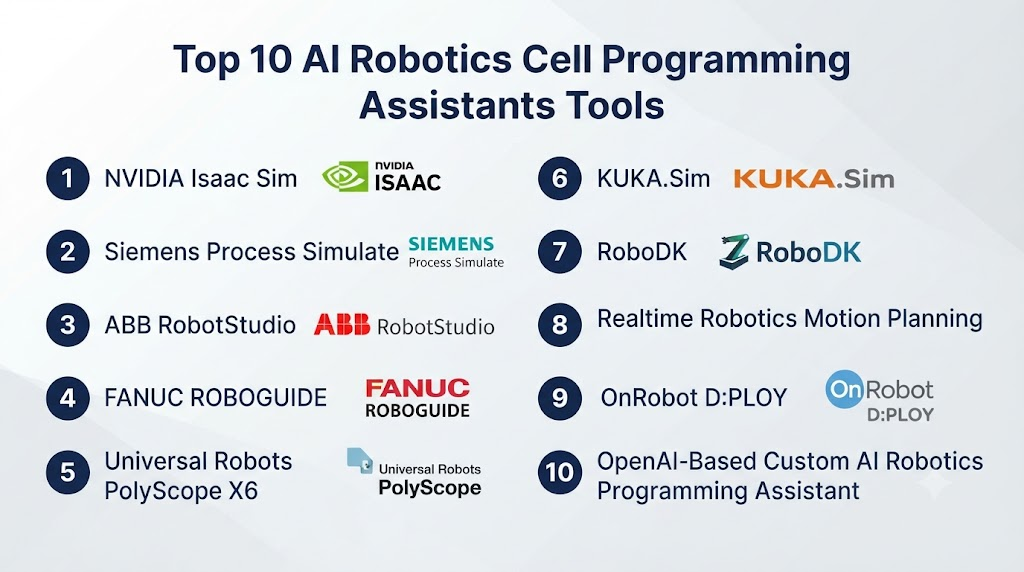
Top 10 AI Robotics Cell Programming Assistants Tools
1. NVIDIA Isaac Sim
Verdict: Best overall AI robotics simulation and programming assistant platform.
Short Description: NVIDIA Isaac Sim provides AI-powered robotics simulation, digital twin capabilities, and development workflows for designing and optimizing robotic cells.
Key Features
- Robot simulation
- AI-based robotics development
- Digital twins
- Motion planning
- Synthetic data generation
Pros
- Advanced AI simulation capabilities
- Supports complex robotics workflows
- Strong ecosystem
Cons
- Requires GPU and technical expertise
Deployment: Robotics development and industrial simulation environments
Security & Compliance: Enterprise software security controls
Integrations & Ecosystem: Robot platforms, simulation tools, AI frameworks
Support & Community: Developer and enterprise support
Pricing Model: Custom enterprise pricing
Best-Fit Scenarios: Advanced robotics development
2. Siemens Process Simulate
Verdict: Industrial robotics simulation and offline programming solution.
Short Description: Siemens Process Simulate enables manufacturers to design, validate, and optimize robotic manufacturing cells before physical deployment.
Key Features
- Robot simulation
- Offline programming
- Collision analysis
- Manufacturing validation
- Digital manufacturing
Pros
- Strong manufacturing integration
- Supports complex robot cells
Cons
- Requires engineering expertise
3. ABB RobotStudio
Verdict: Robotics programming and simulation platform.
Short Description: ABB RobotStudio helps engineers program, simulate, and optimize ABB robotic cells using virtual environments.
Key Features
- Offline robot programming
- Robot simulation
- Motion optimization
- Cell design
- Virtual commissioning
Pros
- Strong industrial robotics capabilities
- Reduces deployment time
Cons
- Best suited for ABB robots
4. FANUC ROBOGUIDE
Verdict: Robot simulation and programming platform.
Short Description: FANUC ROBOGUIDE provides simulation tools for designing, testing, and optimizing FANUC robotic applications.
Key Features
- Robot simulation
- Offline programming
- Cycle time analysis
- Cell layout design
- Robot optimization
Pros
- Strong FANUC ecosystem
- Manufacturing-focused
Cons
- Primarily focused on FANUC systems
5. Universal Robots PolyScope X
Verdict: AI-assisted collaborative robot programming environment.
Short Description: Universal Robots provides intuitive robot programming tools designed to simplify collaborative robot deployment and automation workflows.
Key Features
- Simplified programming
- Robot configuration
- Automation workflows
- Motion control
- Collaborative robotics support
Pros
- Easy for operators
- Fast deployment
Cons
- Focused mainly on collaborative robots
6. KUKA.Sim
Verdict: Robotics simulation platform for industrial automation.
Short Description: KUKA.Sim enables engineers to simulate robotic applications, optimize processes, and validate robot cell designs.
Key Features
- Robot simulation
- Cell planning
- Offline programming
- Motion analysis
- Virtual commissioning
Pros
- Strong industrial robotics support
- Accurate simulation
Cons
- Requires robotics expertise
7. RoboDK
Verdict: Flexible robot programming and simulation platform.
Short Description: RoboDK provides offline programming and simulation capabilities for multiple industrial robot brands.
Key Features
- Multi-brand robot support
- Offline programming
- Simulation
- Path optimization
- Robot calibration
Pros
- Supports many robot brands
- Flexible deployment
Cons
- Advanced features require expertise
8. Realtime Robotics Motion Planning
Verdict: AI-powered robot motion planning solution.
Short Description: Realtime Robotics provides automated motion planning technologies that help optimize robot paths and reduce programming complexity.
Key Features
- Automated motion planning
- Collision avoidance
- Multi-robot coordination
- Path optimization
- Real-time planning
Pros
- Improves robot efficiency
- Supports complex cells
Cons
- Requires integration with robotics systems
9. OnRobot D:PLOY
Verdict: No-code robotics deployment platform.
Short Description: OnRobot D:PLOY simplifies robot deployment by enabling faster programming and configuration of collaborative robot applications.
Key Features
- Automated robot setup
- No-code workflows
- Robot application templates
- Deployment assistance
- Collaborative robot support
Pros
- Reduces programming effort
- Easy deployment
Cons
- Best suited for collaborative applications
10. OpenAI-Based Custom AI Robotics Programming Assistant
Verdict: Flexible AI assistant for customized robotics programming workflows.
Short Description: Organizations can build custom AI robotics assistants using large language models integrated with robot controllers, simulation environments, CAD systems, automation platforms, and engineering databases. These assistants can generate programming guidance, explain robot errors, optimize workflows, and support robotics engineers while requiring safety validation.
Key Features
- Robot programming assistance
- Code explanation
- Workflow optimization
- Troubleshooting support
- Engineering documentation
Pros
- Highly customizable
- Flexible integrations
- Improves engineering productivity
Cons
- Requires robotics expertise
- Safety validation required
Comparison Table
| Platform | AI Capability | Robot Programming | Simulation | Industrial Integration | Best Use |
|---|---|---|---|---|---|
| NVIDIA Isaac Sim | Excellent | High | Excellent | High | AI Robotics Development |
| Siemens Process Simulate | High | Excellent | Excellent | Excellent | Manufacturing Cells |
| ABB RobotStudio | High | Excellent | Excellent | High | ABB Robotics |
| FANUC ROBOGUIDE | Medium | Excellent | Excellent | High | FANUC Automation |
| Universal Robots PolyScope X | High | Excellent | Medium | High | Collaborative Robots |
| KUKA.Sim | High | Excellent | Excellent | High | Industrial Robotics |
| RoboDK | High | Excellent | High | High | Multi-brand Robotics |
| Realtime Robotics | Excellent | High | High | High | Motion Planning |
| OnRobot D:PLOY | High | High | Medium | High | No-Code Robotics |
| OpenAI Custom | Custom | Custom | Custom | Custom | AI Robotics Assistant |
Evaluation & Scoring Table
| Platform | AI Capability 20% | Programming 20% | Simulation 15% | Integration 15% | Security 10% | Ease 10% | Value 10% | Total |
|---|---|---|---|---|---|---|---|---|
| NVIDIA Isaac Sim | 20 | 18 | 15 | 14 | 10 | 8 | 8 | 93 |
| Siemens Process Simulate | 18 | 20 | 15 | 15 | 10 | 8 | 8 | 94 |
| ABB RobotStudio | 17 | 20 | 15 | 14 | 10 | 8 | 8 | 92 |
| FANUC ROBOGUIDE | 16 | 20 | 15 | 14 | 10 | 8 | 8 | 91 |
| KUKA.Sim | 17 | 19 | 15 | 14 | 10 | 8 | 8 | 91 |
| RoboDK | 17 | 18 | 14 | 14 | 10 | 9 | 8 | 90 |
| Realtime Robotics | 20 | 17 | 14 | 14 | 10 | 8 | 8 | 91 |
| Universal Robots PolyScope X | 16 | 18 | 12 | 14 | 10 | 10 | 8 | 88 |
| OnRobot D:PLOY | 16 | 17 | 12 | 14 | 10 | 10 | 8 | 87 |
| OpenAI Custom | 20 | 16 | 12 | 15 | 8 | 7 | 9 | 87 |
Which AI Robotics Cell Programming Assistant Is Right for You?
| If your priority is… | Recommended Platform |
|---|---|
| AI robotics simulation | NVIDIA Isaac Sim |
| Manufacturing robot cells | Siemens Process Simulate |
| ABB robot programming | ABB RobotStudio |
| FANUC automation | FANUC ROBOGUIDE |
| Collaborative robots | Universal Robots PolyScope X |
| KUKA automation | KUKA.Sim |
| Multi-brand robots | RoboDK |
| Advanced motion planning | Realtime Robotics |
| No-code robot deployment | OnRobot D:PLOY |
| Custom AI robotics assistant | OpenAI-Based AI Assistant |
Implementation Playbook
First 30 Days
- Define robotics automation goals
- Identify robot applications
- Review existing cell designs
- Collect programming requirements
Days 31–60
- Build simulation models
- Test robot workflows
- Optimize motion paths
- Validate safety requirements
Days 61–90
- Deploy robot programming workflows
- Improve cycle times
- Automate repetitive tasks
- Expand robotics capabilities
Common Mistakes
- Ignoring safety validation
- Poor simulation accuracy
- Lack of robot compatibility checks
- Overcomplicating automation
- Weak engineering collaboration
- Poor cell design planning
- Ignoring maintenance requirements
- Not validating robot programs
Frequently Asked Questions
1. What are AI Robotics Cell Programming Assistants?
They are AI-powered tools that help engineers design, program, simulate, and optimize industrial robot cells.
2. How does AI improve robot programming?
AI helps generate programming guidance, optimize movements, and identify potential issues.
3. Can AI replace robotics engineers?
No. AI assists engineers by reducing programming effort and improving productivity.
4. What industries use robotics programming assistants?
Automotive, electronics, manufacturing, aerospace, logistics, and industrial automation industries.
5. Can AI optimize robot movements?
Yes. AI and optimization algorithms can improve paths, cycle times, and efficiency.
6. Do these tools support multiple robot brands?
Some platforms support multiple brands, while others focus on specific robot manufacturers.
7. Are AI-generated robot programs safe?
Programs require testing, simulation, and safety validation before deployment.
8. Can these tools work with digital twins?
Many integrate with simulation and digital twin environments.
9. What data is needed for AI robotics assistants?
Robot models, CAD data, process requirements, programming information, and operational data.
10. What should companies evaluate before adoption?
Consider AI capability, robot compatibility, simulation support, safety, scalability, and integration needs.
Conclusion
AI Robotics Cell Programming Assistants are transforming industrial automation by making robot programming faster, smarter, and more accessible. By combining artificial intelligence, simulation, digital twins, and robotics engineering workflows, these platforms help manufacturers reduce deployment time and improve automation efficiency.Organizations adopting AI robotics programming solutions should focus on safety validation, robot compatibility, simulation accuracy, and engineering collaboration. Platforms such as Siemens Process Simulate, NVIDIA Isaac Sim, ABB RobotStudio, FANUC ROBOGUIDE, and KUKA.Sim demonstrate how artificial intelligence is advancing robotics programming and enabling smarter manufacturing environments.
