Introduction
AI ETA (Estimated Time of Arrival) Prediction APIs use artificial intelligence (AI), machine learning (ML), predictive analytics, geospatial intelligence, and real-time traffic analysis to accurately estimate arrival times for deliveries, shipments, field service teams, public transportation, and fleet operations.
Accurate ETA predictions are essential for logistics providers, e-commerce companies, manufacturers, mobility platforms, and field service organizations. Customers increasingly expect real-time delivery updates, while businesses rely on ETA predictions to improve scheduling, resource allocation, customer communication, and operational efficiency.
Traditional ETA calculations often use static routing algorithms or historical averages, making them less effective when traffic congestion, weather conditions, road closures, vehicle performance, customs delays, or operational disruptions occur.
AI-powered ETA prediction APIs continuously analyze GPS data, live traffic, road conditions, weather, driver behavior, historical trip patterns, shipment milestones, and transportation constraints to generate highly accurate arrival predictions.
These APIs combine machine learning, predictive traffic modeling, geospatial analytics, route optimization, and continuous recalculation to improve delivery reliability, reduce delays, enhance customer satisfaction, and optimize logistics planning.
Modern AI ETA APIs integrate with Transportation Management Systems (TMS), Enterprise Resource Planning (ERP), Warehouse Management Systems (WMS), Fleet Management Systems, GPS devices, telematics platforms, mobile applications, logistics software, and customer service platforms.
They support industries including logistics, manufacturing, retail, e-commerce, food delivery, healthcare, utilities, transportation, ride-hailing, and field services.
Real-world Use Cases
- Delivery ETA prediction
- Shipment tracking
- Fleet arrival estimation
- Field service scheduling
- Customer delivery notifications
- Dynamic route planning
- Logistics planning
- Public transportation tracking
- Ride-hailing applications
- Supply chain visibility
Evaluation Criteria for Buyers
When selecting an AI ETA Prediction API, consider:
- ETA prediction accuracy
- Real-time traffic intelligence
- Global map coverage
- API performance
- GPS integration
- Scalability
- Developer tools
- Security controls
- Documentation quality
- Pricing flexibility
Best For
- Logistics providers
- E-commerce companies
- Fleet operators
- Mobility platforms
- Software developers
Not Ideal For
Organizations without transportation operations, GPS-enabled assets, or location-based services.
Key Trends
- AI-powered ETA prediction
- Predictive traffic intelligence
- Dynamic route recalculation
- Real-time fleet visibility
- Geospatial AI
- Connected transportation platforms
- Smart logistics APIs
- Intelligent customer notifications
- Autonomous fleet optimization
- Cloud-native mapping services
Methodology
The platforms below were evaluated based on:
- AI prediction capabilities
- API reliability
- Developer experience
- Enterprise integration
- Scalability
- Industry adoption
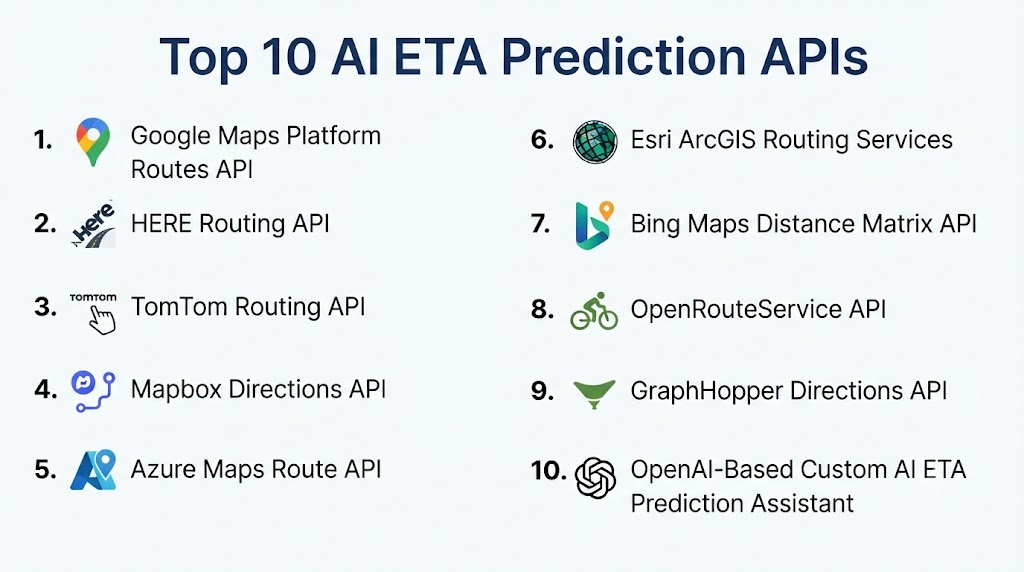
Top 10 AI ETA Prediction APIs
1. Google Maps Platform Routes API
Verdict: Best overall AI-powered ETA prediction API.
Short Description: Google Maps Platform provides AI-driven ETA prediction, real-time traffic intelligence, route optimization, and global mapping services for enterprise applications.
Key Features
- AI ETA prediction
- Real-time traffic
- Dynamic routing
- Geospatial intelligence
- Global mapping
Pros
- Excellent prediction accuracy
- Worldwide coverage
- Comprehensive developer ecosystem
Cons
- Usage-based pricing
Deployment: Cloud API
Security & Compliance: Enterprise-grade security controls
Integrations & Ecosystem: TMS, ERP, mobile apps, logistics platforms, GPS systems
Support & Community: Extensive developer support
Pricing Model: Usage-based and enterprise pricing
Best-Fit Scenarios: Global logistics and mobility applications
2. HERE Routing API
Verdict: Enterprise-grade routing and ETA platform.
Short Description: HERE Routing API provides AI-powered ETA prediction, route optimization, and geospatial intelligence for transportation applications.
Key Features
- ETA prediction
- Traffic intelligence
- Route optimization
- Fleet routing
- Geospatial analytics
Pros
- Excellent enterprise mapping
- Strong logistics support
Cons
- Advanced enterprise features require configuration
3. TomTom Routing API
Verdict: Intelligent traffic and ETA prediction platform.
Short Description: TomTom combines AI traffic analytics, routing intelligence, and predictive ETA calculations for logistics and mobility applications.
Key Features
- Live traffic
- ETA prediction
- Route optimization
- Traffic analytics
- Fleet routing
Pros
- Accurate traffic intelligence
- Strong navigation ecosystem
Cons
- Premium capabilities require higher-tier plans
4. Mapbox Directions API
Verdict: Flexible mapping and routing platform.
Short Description: Mapbox provides AI-assisted routing, ETA prediction, traffic-aware navigation, and customizable mapping APIs.
Key Features
- Route optimization
- ETA prediction
- Traffic routing
- Mapping services
- Developer APIs
Pros
- Highly customizable
- Excellent developer experience
Cons
- Advanced routing requires configuration
5. Azure Maps Route API
Verdict: Cloud-native enterprise routing platform.
Short Description: Azure Maps provides enterprise routing, predictive ETA calculations, traffic analysis, and geospatial services integrated with Microsoft Azure.
Key Features
- Route planning
- ETA prediction
- Traffic intelligence
- Fleet routing
- Azure integration
Pros
- Strong Microsoft ecosystem
- Enterprise scalability
Cons
- Best suited for Azure customers
6. Esri ArcGIS Routing Services
Verdict: GIS-focused routing and logistics platform.
Short Description: Esri combines geographic information systems, route optimization, and AI-assisted ETA prediction for enterprise logistics.
Key Features
- Route analysis
- ETA prediction
- GIS intelligence
- Logistics planning
- Spatial analytics
Pros
- Excellent GIS capabilities
- Strong enterprise mapping
Cons
- Geared toward GIS-centric organizations
7. Bing Maps Distance Matrix API
Verdict: Enterprise routing and travel time estimation API.
Short Description: Bing Maps provides travel time calculations, ETA prediction, routing services, and location intelligence for enterprise applications.
Key Features
- Travel time estimation
- Route optimization
- Traffic analysis
- Location services
- Fleet support
Pros
- Good enterprise integration
- Familiar developer tools
Cons
- Smaller ecosystem than leading mapping platforms
8. OpenRouteService API
Verdict: Flexible routing API based on open geographic data.
Short Description: OpenRouteService provides routing, travel time estimation, optimization, and geospatial APIs for logistics and mobility applications.
Key Features
- Route planning
- ETA estimation
- Optimization
- Geospatial APIs
- Multi-modal routing
Pros
- Flexible integration
- Open mapping ecosystem
Cons
- Enterprise support options are more limited
9. GraphHopper Directions API
Verdict: Route optimization and fleet planning API.
Short Description: GraphHopper provides AI-assisted routing, vehicle optimization, ETA prediction, and fleet management APIs.
Key Features
- Route optimization
- Fleet routing
- ETA prediction
- Vehicle optimization
- Logistics APIs
Pros
- Strong optimization engine
- Good fleet planning support
Cons
- Requires implementation expertise
10. OpenAI-Based Custom AI ETA Prediction Assistant
Verdict: Flexible AI assistant for customized ETA intelligence.
Short Description: Organizations can build custom AI ETA prediction assistants using large language models integrated with mapping APIs, GPS platforms, telematics systems, TMS platforms, ERP systems, fleet databases, and logistics applications. These assistants can explain ETA changes, summarize transportation performance, recommend routing adjustments, identify delay risks, and support dispatch teams while requiring operational validation.
Key Features
- ETA summaries
- Delay explanations
- Routing insights
- Fleet reporting
- Logistics recommendations
Pros
- Highly customizable
- Flexible integrations
- Improves operational decision-making
Cons
- Requires logistics expertise
- Validation required
Comparison Table
| Platform | AI ETA Prediction | Traffic Intelligence | API Integration | Global Coverage | Best Use |
|---|---|---|---|---|---|
| Google Maps Routes API | Excellent | Excellent | Excellent | Excellent | Enterprise Logistics |
| HERE Routing API | Excellent | Excellent | High | Excellent | Fleet Routing |
| TomTom Routing API | Excellent | Excellent | High | Excellent | Navigation & Logistics |
| Mapbox Directions API | High | High | Excellent | High | Custom Applications |
| Azure Maps Route API | High | High | Excellent | High | Microsoft Ecosystem |
| Esri ArcGIS Routing | High | High | High | High | GIS & Logistics |
| Bing Maps Distance Matrix API | High | High | High | High | Enterprise Applications |
| OpenRouteService API | High | Medium | High | High | Flexible Routing |
| GraphHopper Directions API | High | High | High | High | Fleet Optimization |
| OpenAI Custom | Custom | Custom | Custom | Custom | AI ETA Assistant |
Evaluation & Scoring Table
| Platform | AI Capability 20% | ETA Accuracy 20% | Analytics 15% | Integration 15% | Security 10% | Ease 10% | Value 10% | Total |
|---|---|---|---|---|---|---|---|---|
| Google Maps Routes API | 20 | 20 | 15 | 15 | 10 | 8 | 8 | 96 |
| HERE Routing API | 19 | 19 | 15 | 14 | 10 | 8 | 8 | 93 |
| TomTom Routing API | 19 | 19 | 15 | 14 | 10 | 8 | 8 | 93 |
| Mapbox Directions API | 18 | 18 | 14 | 15 | 10 | 9 | 8 | 92 |
| Azure Maps Route API | 18 | 18 | 14 | 15 | 10 | 8 | 8 | 91 |
| Esri ArcGIS Routing | 18 | 18 | 15 | 14 | 10 | 8 | 8 | 91 |
| GraphHopper Directions API | 17 | 18 | 14 | 14 | 10 | 8 | 8 | 89 |
| Bing Maps Distance Matrix API | 17 | 17 | 14 | 14 | 10 | 9 | 8 | 89 |
| OpenRouteService API | 17 | 17 | 13 | 14 | 10 | 9 | 9 | 89 |
| OpenAI Custom | 20 | 16 | 12 | 15 | 8 | 7 | 9 | 87 |
Which AI ETA Prediction API Is Right for You?
| If your priority is… | Recommended Platform |
|---|---|
| Global ETA prediction | Google Maps Platform Routes API |
| Enterprise fleet routing | HERE Routing API |
| Traffic-aware navigation | TomTom Routing API |
| Custom mapping applications | Mapbox Directions API |
| Microsoft cloud integration | Azure Maps Route API |
| GIS-based logistics | Esri ArcGIS Routing Services |
| Enterprise travel-time calculations | Bing Maps Distance Matrix API |
| Open mapping ecosystem | OpenRouteService API |
| Fleet optimization | GraphHopper Directions API |
| Custom AI ETA assistant | OpenAI-Based AI Assistant |
Implementation Playbook
First 30 Days
- Define ETA prediction objectives
- Connect GPS and fleet data
- Review routing workflows
- Identify key logistics KPIs
Days 31–60
- Integrate ETA APIs with TMS and ERP systems
- Configure routing parameters
- Validate ETA accuracy
- Train operations teams
Days 61–90
- Automate ETA notifications
- Improve dispatch planning
- Optimize delivery schedules
- Expand predictive transportation capabilities
Common Mistakes
- Poor GPS data quality
- Ignoring live traffic updates
- Weak API integration
- Overreliance on ETA predictions without operational review
- Missing vehicle-specific routing constraints
- Limited historical data usage
- Poor exception handling
- Failure to monitor prediction accuracy
Frequently Asked Questions
1. What are AI ETA Prediction APIs?
They are AI-powered APIs that calculate estimated arrival times using live traffic, GPS data, historical travel patterns, and predictive analytics.
2. How does AI improve ETA accuracy?
AI continuously evaluates traffic conditions, weather, routing changes, driver behavior, and historical trip data to improve prediction accuracy.
3. Can AI reduce delivery delays?
AI cannot eliminate delays but helps identify likely delays early so organizations can reroute vehicles, adjust schedules, and communicate with customers.
4. Which industries use AI ETA APIs?
Logistics, retail, manufacturing, e-commerce, healthcare, transportation, field services, ride-hailing, and food delivery.
5. What data is required?
GPS locations, vehicle information, traffic conditions, routing data, delivery schedules, historical trips, and mapping services.
6. Can ETA predictions update in real time?
Yes. Most platforms continuously recalculate ETAs as traffic, weather, routing, or operational conditions change.
7. Do these APIs integrate with TMS and fleet management systems?
Many integrate with TMS, ERP, WMS, GPS devices, telematics platforms, mobile applications, and logistics management systems.
8. Are AI-generated ETAs always accurate?
Accuracy depends on GPS quality, traffic information, external conditions, routing algorithms, and continuous model improvements.
9. How is transportation data protected?
Organizations should implement encryption, role-based access controls, cybersecurity measures, and enterprise data governance.
10. What should companies evaluate before adoption?
Consider ETA accuracy, API performance, global coverage, traffic intelligence, scalability, integrations, documentation quality, security, and pricing.
Conclusion
AI ETA Prediction APIs are transforming transportation and logistics by providing accurate arrival predictions, intelligent route analysis, proactive delay detection, and improved customer communication. By combining artificial intelligence, machine learning, predictive analytics, and geospatial intelligence, these APIs help organizations improve delivery reliability, optimize fleet operations, and enhance customer satisfaction.Organizations implementing AI ETA prediction solutions should prioritize accurate GPS and telematics data, seamless integration with transportation systems, continuous validation of ETA calculations, and close collaboration between logistics planners, dispatchers, developers, and customer service teams. Platforms such as Google Maps Platform Routes API, HERE Routing API, TomTom Routing API, Mapbox Directions API, and Azure Maps Route API demonstrate how artificial intelligence is enabling smarter transportation planning and more predictable logistics operations.
