Introduction
AI Checkout Automation Systems use artificial intelligence (AI), computer vision, machine learning (ML), sensor fusion, deep learning, RFID, and edge computing to automate the retail checkout process. These systems enable customers to purchase products with minimal or no manual scanning by automatically identifying selected items, calculating totals, processing payments, and generating digital receipts.
Retailers continue to face challenges such as long checkout queues, labor shortages, scanning errors, self-checkout fraud, and rising customer expectations for faster shopping experiences. Traditional checkout methods often increase operational costs while reducing customer satisfaction during peak shopping hours.
AI-powered checkout automation platforms continuously analyze camera feeds, shelf sensors, RFID data, barcode information, weight sensors, and customer movements to accurately recognize products, monitor shopping behavior, and complete purchases with minimal human intervention.
These solutions combine computer vision, object recognition, shopper tracking, payment automation, inventory synchronization, fraud detection, and predictive analytics to improve operational efficiency, reduce checkout times, minimize shrinkage, and enhance customer experiences.
Modern AI checkout automation platforms integrate with Enterprise Resource Planning (ERP), Point of Sale (POS) systems, payment gateways, inventory management systems, Customer Relationship Management (CRM), loyalty platforms, Warehouse Management Systems (WMS), and business intelligence tools.
They support industries including grocery, supermarkets, convenience stores, retail chains, fashion, pharmacies, airports, stadiums, cafeterias, hospitality, and unattended retail environments.
Real-world Use Cases
- Frictionless checkout
- Cashierless stores
- Self-checkout automation
- Smart shopping carts
- Automated payment processing
- Inventory synchronization
- Retail fraud prevention
- Queue reduction
- Digital receipt generation
- Store operations optimization
Evaluation Criteria for Buyers
When selecting an AI Checkout Automation Platform, consider:
- Product recognition accuracy
- Checkout speed
- Computer vision capabilities
- POS integration
- Payment system compatibility
- Fraud detection
- Scalability
- Security controls
- Analytics dashboards
- Ease of deployment
Best For
- Grocery retailers
- Supermarkets
- Convenience stores
- Retail chains
- Smart retail environments
Not Ideal For
Businesses without physical retail stores or those requiring only traditional cashier-operated checkout systems.
Key Trends
- Cashierless retail
- Computer vision checkout
- Smart shopping carts
- AI-powered payment automation
- Autonomous retail stores
- Sensor fusion technologies
- Edge AI retail computing
- Contactless shopping
- Intelligent fraud prevention
- Omnichannel retail automation
Methodology
The platforms below were evaluated based on:
- AI checkout capabilities
- Computer vision accuracy
- Enterprise integration
- Analytics maturity
- Scalability
- Industry adoption
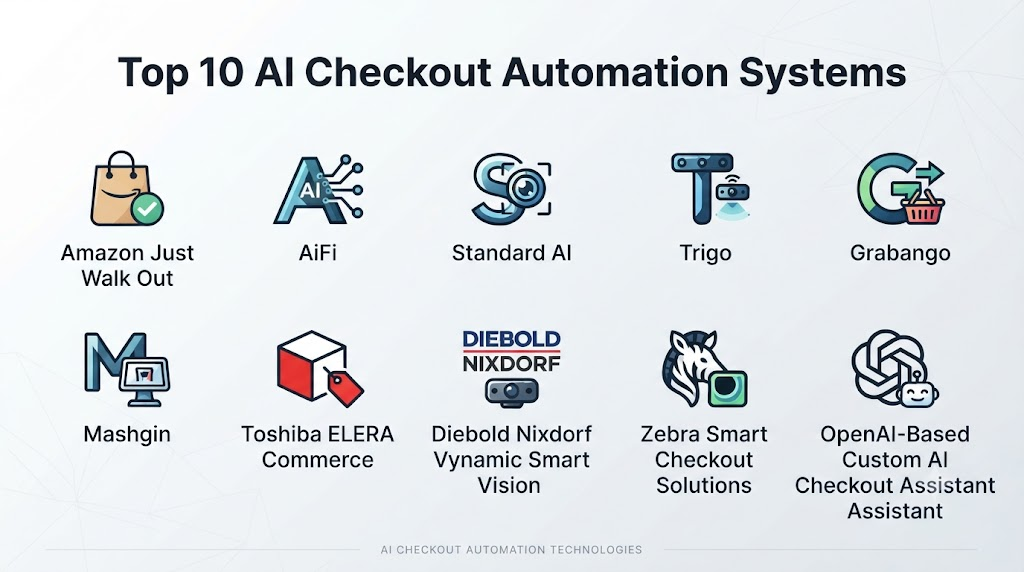
Top 10 AI Checkout Automation Systems
1. Amazon Just Walk Out
Verdict: Best overall AI-powered checkout automation platform.
Short Description: Amazon Just Walk Out enables customers to enter a store, pick up products, and leave without traditional checkout by using computer vision, sensors, and AI to automatically identify purchases.
Key Features
- Cashierless checkout
- Computer vision
- Sensor fusion
- Automatic payment
- Inventory synchronization
Pros
- Excellent checkout experience
- High automation level
- Enterprise scalability
Cons
- Significant infrastructure investment required
Deployment: Cloud and edge deployment
Security & Compliance: Enterprise-grade security controls
Integrations & Ecosystem: POS, ERP, payment gateways, inventory systems, loyalty platforms
Support & Community: Enterprise support
Pricing Model: Enterprise deployment pricing
Best-Fit Scenarios: Cashierless retail stores
2. AiFi
Verdict: AI-powered autonomous retail platform.
Short Description: AiFi provides computer vision-based autonomous shopping experiences for convenience stores, supermarkets, and retail environments.
Key Features
- Autonomous checkout
- Computer vision
- Product recognition
- Store analytics
- Inventory synchronization
Pros
- Flexible store deployment
- Strong AI capabilities
Cons
- Infrastructure implementation required
3. Standard AI
Verdict: Computer vision retail automation platform.
Short Description: Standard AI enables frictionless checkout using existing camera infrastructure combined with AI-powered shopper tracking and product recognition.
Key Features
- Computer vision
- Shopper tracking
- Product recognition
- Automated checkout
- Retail analytics
Pros
- Uses existing cameras
- Reduced hardware requirements
Cons
- Best suited for larger retail environments
4. Trigo
Verdict: AI-powered grocery automation platform.
Short Description: Trigo combines computer vision, shelf monitoring, and AI-powered checkout automation for supermarkets and grocery stores.
Key Features
- Checkout automation
- Shelf monitoring
- Product recognition
- Inventory tracking
- Shopper analytics
Pros
- Excellent grocery specialization
- Strong inventory synchronization
Cons
- Grocery-focused implementation
5. Grabango
Verdict: Enterprise cashierless checkout platform.
Short Description: Grabango enables existing retail stores to implement checkout-free shopping using AI, computer vision, and automated payment systems.
Key Features
- Checkout-free shopping
- AI vision
- Payment automation
- Inventory updates
- Customer analytics
Pros
- Retrofits existing stores
- Strong automation capabilities
Cons
- Enterprise deployment required
6. Mashgin
Verdict: AI-powered self-checkout system.
Short Description: Mashgin uses computer vision to instantly recognize products placed on a checkout counter without requiring barcode scanning.
Key Features
- AI product recognition
- Touchless checkout
- Fast transactions
- Self-service
- POS integration
Pros
- Very fast checkout
- Easy deployment
Cons
- Primarily designed for assisted self-checkout rather than fully cashierless stores
7. Toshiba ELERA Commerce
Verdict: Intelligent retail commerce platform.
Short Description: Toshiba ELERA combines AI checkout, retail operations, inventory intelligence, and omnichannel commerce capabilities.
Key Features
- Self-checkout
- Retail analytics
- Inventory integration
- Customer insights
- AI recommendations
Pros
- Strong retail ecosystem
- Enterprise integration
Cons
- Best suited for enterprise retailers
8. Diebold Nixdorf Vynamic Smart Vision
Verdict: AI-powered retail vision platform.
Short Description: Diebold Nixdorf provides computer vision, self-checkout monitoring, fraud detection, and operational analytics for retailers.
Key Features
- Computer vision
- Checkout monitoring
- Fraud detection
- Retail analytics
- POS integration
Pros
- Strong retail automation
- Excellent operational visibility
Cons
- Requires compatible retail infrastructure
9. Zebra Smart Checkout Solutions
Verdict: Intelligent retail checkout platform.
Short Description: Zebra combines AI-powered checkout, mobile POS, inventory intelligence, and workforce optimization.
Key Features
- Smart checkout
- Mobile POS
- Inventory intelligence
- AI analytics
- Workforce integration
Pros
- Strong retail operations support
- Flexible deployment
Cons
- Best suited for Zebra ecosystem users
10. OpenAI-Based Custom AI Checkout Assistant
Verdict: Flexible AI assistant for intelligent checkout operations.
Short Description: Organizations can build custom AI checkout assistants using large language models integrated with POS systems, payment gateways, computer vision platforms, ERP software, inventory systems, loyalty programs, and analytics tools. These assistants can explain transaction issues, summarize checkout performance, support customer service teams, identify operational bottlenecks, generate reports, and assist store managers while requiring operational validation.
Key Features
- Checkout summaries
- Operational insights
- Customer assistance
- Fraud reporting
- Executive dashboards
Pros
- Highly customizable
- Flexible integrations
- Improves operational efficiency
Cons
- Requires existing checkout infrastructure
- Human review recommended for payment exceptions
Comparison Table
| Platform | AI Checkout | Computer Vision | Payment Automation | Enterprise Integration | Best Use |
|---|---|---|---|---|---|
| Amazon Just Walk Out | Excellent | Excellent | Excellent | Excellent | Cashierless Stores |
| AiFi | Excellent | Excellent | Excellent | High | Autonomous Retail |
| Standard AI | Excellent | Excellent | High | High | Existing Retail Stores |
| Trigo | Excellent | Excellent | High | High | Grocery Stores |
| Grabango | Excellent | Excellent | Excellent | High | Retail Chains |
| Mashgin | High | Excellent | High | High | Self-Checkout |
| Toshiba ELERA Commerce | High | High | High | Excellent | Enterprise Retail |
| Diebold Nixdorf Vynamic Smart Vision | High | High | High | High | Retail Checkout Monitoring |
| Zebra Smart Checkout Solutions | High | High | High | High | Smart Retail |
| OpenAI Custom | Custom | Custom | Custom | Custom | AI Checkout Assistant |
Evaluation & Scoring Table
| Platform | AI Capability 20% | Checkout Accuracy 20% | Analytics 15% | Integration 15% | Security 10% | Ease 10% | Value 10% | Total |
|---|---|---|---|---|---|---|---|---|
| Amazon Just Walk Out | 20 | 20 | 15 | 15 | 10 | 8 | 8 | 96 |
| AiFi | 19 | 20 | 15 | 14 | 10 | 8 | 8 | 94 |
| Standard AI | 19 | 19 | 15 | 14 | 10 | 8 | 8 | 93 |
| Trigo | 19 | 19 | 15 | 14 | 10 | 8 | 8 | 93 |
| Grabango | 18 | 19 | 15 | 14 | 10 | 8 | 8 | 92 |
| Mashgin | 18 | 18 | 14 | 14 | 10 | 9 | 9 | 92 |
| Toshiba ELERA Commerce | 18 | 18 | 15 | 15 | 10 | 8 | 8 | 92 |
| Diebold Nixdorf Vynamic Smart Vision | 17 | 18 | 14 | 14 | 10 | 8 | 8 | 89 |
| Zebra Smart Checkout Solutions | 17 | 17 | 14 | 14 | 10 | 9 | 8 | 89 |
| OpenAI Custom | 20 | 16 | 12 | 15 | 8 | 7 | 9 | 87 |
Which AI Checkout Automation Platform Is Right for You?
| If your priority is… | Recommended Platform |
|---|---|
| Fully cashierless retail | Amazon Just Walk Out |
| Autonomous store deployment | AiFi |
| Existing camera infrastructure | Standard AI |
| Grocery automation | Trigo |
| Retrofitting existing stores | Grabango |
| Fast AI self-checkout | Mashgin |
| Enterprise retail commerce | Toshiba ELERA Commerce |
| Checkout monitoring and fraud detection | Diebold Nixdorf Vynamic Smart Vision |
| Smart retail operations | Zebra Smart Checkout Solutions |
| Custom AI checkout assistant | OpenAI-Based AI Assistant |
Implementation Playbook
First 30 Days
- Review checkout workflows
- Audit POS and payment infrastructure
- Define checkout performance KPIs
- Assess camera and sensor coverage
Days 31–60
- Integrate POS, ERP, payment gateways, and inventory systems
- Configure AI recognition models
- Validate product identification accuracy
- Train store operations teams
Days 61–90
- Launch automated checkout
- Optimize customer flows
- Reduce checkout times
- Expand AI-driven retail automation
Common Mistakes
- Poor camera positioning
- Incomplete product catalog data
- Weak POS integration
- Ignoring payment exception handling
- Overreliance on AI without operational oversight
- Limited staff training
- Infrequent AI model updates
- Failure to monitor checkout accuracy
Frequently Asked Questions
1. What are AI Checkout Automation Systems?
They are AI-powered retail platforms that automate checkout by identifying purchased products, calculating totals, processing payments, and generating receipts with minimal manual intervention.
2. How does AI automate checkout?
AI combines computer vision, sensors, product recognition, and payment integration to identify selected items and complete purchases automatically.
3. Can AI reduce checkout queues?
Yes. Automated checkout significantly reduces waiting times, improves customer throughput, and enhances the overall shopping experience.
4. Which industries use AI checkout automation?
Grocery, supermarkets, convenience stores, fashion, pharmacies, airports, stadiums, hospitality, cafeterias, and retail chains.
5. What data is required?
Product catalogs, POS transactions, inventory records, payment information, camera feeds, sensor data, pricing information, and loyalty program data.
6. Can AI prevent checkout fraud?
Many platforms include fraud detection capabilities that identify unusual shopping behavior, scanning errors, and transaction anomalies to support loss prevention efforts.
7. Do these platforms integrate with ERP and POS systems?
Many integrate with ERP platforms, POS systems, payment gateways, inventory software, CRM platforms, loyalty programs, and business intelligence tools.
8. Are AI-generated product identifications always accurate?
Performance depends on camera quality, product catalog completeness, environmental conditions, AI model quality, and continuous validation.
9. How is customer and payment data protected?
Organizations should implement encryption, role-based access controls, cybersecurity measures, payment security standards, enterprise data governance, and comply with applicable privacy regulations.
10. What should companies evaluate before adoption?
Consider product recognition accuracy, checkout speed, payment integration, scalability, analytics, security, fraud detection, ease of deployment, and operational compatibility.
Conclusion
AI Checkout Automation Systems are transforming physical retail by enabling frictionless shopping, intelligent product recognition, automated payments, and faster customer experiences. By combining artificial intelligence, computer vision, machine learning, and payment automation, these platforms help retailers reduce checkout times, improve operational efficiency, minimize shrinkage, and enhance customer satisfaction.Organizations implementing AI checkout automation solutions should prioritize high-quality product data, seamless integration with POS, ERP, payment gateways, inventory systems, and loyalty platforms, continuous validation of AI-generated product recognition, and close collaboration between store operations, IT teams, security, finance, and executive leadership. Platforms such as Amazon Just Walk Out, AiFi, Standard AI, Trigo, and Grabango demonstrate how artificial intelligence is enabling smarter, faster, and more automated retail checkout experiences.
