Introduction
AI Image Generation Platforms use artificial intelligence (AI), generative AI, diffusion models, large language models (LLMs), computer vision, and deep learning to create high-quality images from text prompts, sketches, reference images, or existing visual assets. These platforms enable organizations to accelerate creative workflows, produce marketing visuals, generate product imagery, create concept art, and automate content production while reducing design time and costs.
The demand for visual content continues to grow across marketing, advertising, e-commerce, media, gaming, education, architecture, healthcare, and entertainment. Traditional design workflows often require significant time, creative resources, and specialized expertise. AI-powered image generation platforms allow users to rapidly create professional-quality visuals using natural language prompts and intelligent editing tools.
Modern AI image generation platforms can generate photorealistic images, illustrations, logos, product mockups, marketing creatives, concept art, architectural visualizations, game assets, storyboards, and social media graphics. Many platforms also support image editing, inpainting, outpainting, style transfer, background replacement, image expansion, and brand-consistent content creation.
These solutions combine generative AI, prompt engineering, multimodal AI, image editing, visual reasoning, workflow automation, and API integrations to improve creative productivity, accelerate content production, and enable scalable visual asset generation.
Modern AI image generation platforms integrate with Digital Asset Management (DAM), Content Management Systems (CMS), Customer Relationship Management (CRM), Product Information Management (PIM), design software, marketing automation platforms, collaboration tools, cloud storage, and business intelligence solutions.
They support industries including marketing, advertising, e-commerce, retail, media, publishing, gaming, architecture, manufacturing, education, healthcare, fashion, and software development.
Real-world Use Cases
- Marketing campaign visuals
- Social media graphics
- Product image generation
- Advertising creatives
- Concept art
- Brand asset creation
- Storyboarding
- Architectural visualization
- Game asset generation
- Creative content production
Evaluation Criteria for Buyers
When selecting an AI Image Generation Platform, consider:
- Image quality
- Prompt understanding
- Image editing capabilities
- API availability
- Workflow automation
- Commercial licensing
- Scalability
- Security controls
- Collaboration features
- Ease of use
Best For
- Marketing teams
- Creative agencies
- Designers
- E-commerce businesses
- Enterprise content teams
Not Ideal For
Organizations requiring only basic image editing without AI-generated content.
Key Trends
- Diffusion-based image generation
- Multimodal AI
- AI-assisted design workflows
- Brand-consistent content generation
- Image editing with AI
- AI product photography
- Creative workflow automation
- Enterprise generative AI
- Real-time visual generation
- AI-assisted digital asset creation
Methodology
The platforms below were evaluated based on:
- AI image quality
- Prompt accuracy
- Editing capabilities
- Enterprise integrations
- Scalability
- Industry adoption
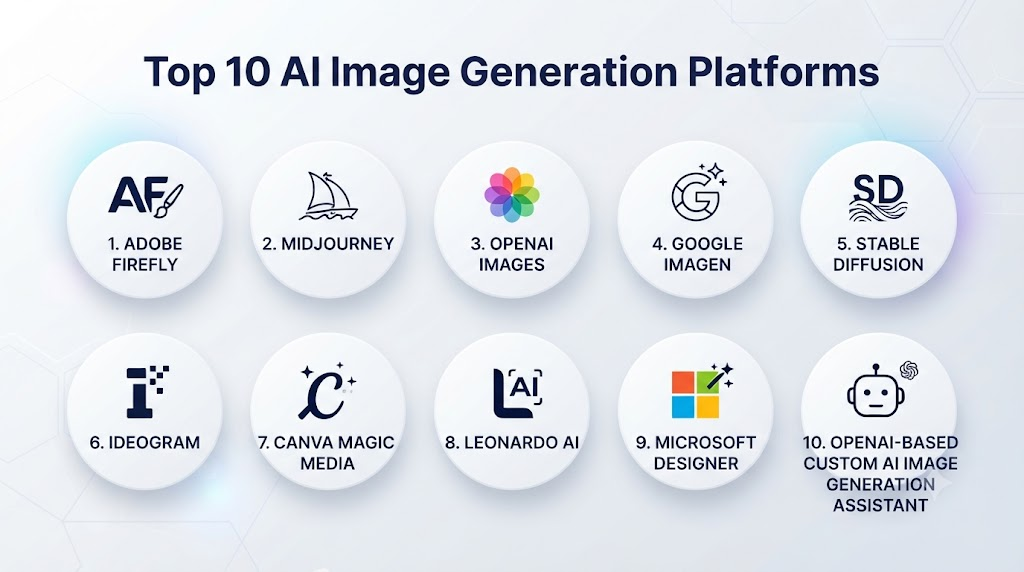
Top 10 AI Image Generation Platforms
1. Adobe Firefly
Verdict: Best overall enterprise AI image generation platform.
Short Description: Adobe Firefly combines high-quality AI image generation, generative fill, commercial-safe content creation, and deep Creative Cloud integration for professional creative teams.
Key Features
- Text-to-image generation
- Generative Fill
- Generative Expand
- Style customization
- Commercial content generation
Pros
- Excellent image quality
- Strong Creative Cloud integration
- Enterprise-ready governance
Cons
- Best experience within Adobe ecosystem
Deployment: Cloud-based platform
Security & Compliance: Enterprise-grade security controls
Integrations & Ecosystem: Adobe Creative Cloud, DAM, CMS, marketing platforms
Support & Community: Enterprise and community support
Pricing Model: Subscription-based
Best-Fit Scenarios: Enterprise creative teams
2. Midjourney
Verdict: Best for artistic and high-quality creative visuals.
Short Description: Midjourney specializes in creating visually rich artwork, concept art, illustrations, branding assets, and photorealistic imagery using advanced generative AI.
Key Features
- Text-to-image
- Artistic rendering
- Style variation
- Upscaling
- Image remixing
Pros
- Outstanding artistic quality
- Strong creative community
Cons
- Limited enterprise workflow integrations
3. OpenAI Images
Verdict: Best for conversational image generation and editing.
Short Description: OpenAI Images provides high-quality image generation, editing, inpainting, and visual creation through natural language prompts.
Key Features
- Text-to-image
- Image editing
- Inpainting
- Style control
- Prompt refinement
Pros
- Excellent prompt understanding
- Strong editing capabilities
Cons
- Enterprise customization may require API implementation
4. Google Imagen
Verdict: Enterprise-grade image generation platform.
Short Description: Google Imagen delivers photorealistic image generation, enterprise AI capabilities, and cloud-based scalability.
Key Features
- Photorealistic generation
- Prompt understanding
- Image editing
- Cloud APIs
- Enterprise deployment
Pros
- High-quality image output
- Strong Google Cloud ecosystem
Cons
- Best suited for Google Cloud users
5. Stable Diffusion
Verdict: Best open-source image generation platform.
Short Description: Stable Diffusion provides flexible image generation, model customization, local deployment, and extensive community support.
Key Features
- Open-source models
- Local deployment
- Model fine-tuning
- Image editing
- API support
Pros
- Highly customizable
- Strong open-source ecosystem
Cons
- Requires technical expertise
6. Ideogram
Verdict: Best for AI-generated graphics with high-quality text rendering.
Short Description: Ideogram specializes in creating marketing graphics, posters, logos, and images with accurate embedded text.
Key Features
- Text-to-image
- Text rendering
- Poster creation
- Graphic design
- Brand visuals
Pros
- Excellent typography generation
- Easy to use
Cons
- Fewer enterprise workflow features
7. Canva Magic Media
Verdict: Best for business users and marketing teams.
Short Description: Canva Magic Media combines AI image generation with templates, collaborative design tools, and marketing workflows.
Key Features
- AI image generation
- Marketing templates
- Social media graphics
- Collaboration
- Brand kits
Pros
- User-friendly interface
- Strong collaboration features
Cons
- Less customization than specialist AI platforms
8. Leonardo AI
Verdict: Best for game development and creative production.
Short Description: Leonardo AI offers AI-powered asset generation, concept art, game assets, and production-ready creative workflows.
Key Features
- Asset generation
- Concept art
- Model training
- Image editing
- Creative workflows
Pros
- Excellent gaming workflows
- Strong creative flexibility
Cons
- Advanced features require learning
9. Microsoft Designer
Verdict: AI-powered business design platform.
Short Description: Microsoft Designer combines AI-generated visuals, marketing content creation, presentation graphics, and productivity integrations.
Key Features
- AI image generation
- Marketing graphics
- Social content
- Design assistance
- Productivity integration
Pros
- Strong Microsoft ecosystem
- Easy business adoption
Cons
- More marketing-focused than professional illustration
10. OpenAI-Based Custom AI Image Generation Assistant
Verdict: Flexible AI assistant for enterprise visual content creation.
Short Description: Organizations can build custom AI image generation assistants using large language models integrated with DAM systems, CMS platforms, marketing automation software, design tools, product databases, brand guidelines, and creative workflows. These assistants can generate visual concepts, marketing assets, product imagery, social media graphics, creative briefs, and design variations while supporting human review for brand consistency and approval.
Key Features
- Prompt generation
- Brand-aware image creation
- Marketing assets
- Workflow automation
- Creative assistance
Pros
- Highly customizable
- Flexible integrations
- Accelerates creative production
Cons
- Human review recommended for published assets
- Brand guidelines must be carefully configured
Comparison Table
| Platform | Image Quality | Image Editing | Enterprise Integration | Best Use |
|---|---|---|---|---|
| Adobe Firefly | Excellent | Excellent | Excellent | Enterprise Creative |
| Midjourney | Excellent | High | Medium | Creative Artwork |
| OpenAI Images | Excellent | Excellent | High | Conversational Image Generation |
| Google Imagen | Excellent | High | Excellent | Enterprise AI |
| Stable Diffusion | High | Excellent | High | Open-Source AI |
| Ideogram | High | Medium | Medium | Marketing Graphics |
| Canva Magic Media | High | High | High | Business Design |
| Leonardo AI | High | High | High | Game & Creative Assets |
| Microsoft Designer | High | High | High | Business Marketing |
| OpenAI Custom | Custom | Custom | Custom | Enterprise AI Assistant |
Evaluation & Scoring Table
| Platform | AI Capability 20% | Image Quality 20% | Editing 15% | Integration 15% | Security 10% | Ease 10% | Value 10% | Total |
|---|---|---|---|---|---|---|---|---|
| Adobe Firefly | 20 | 20 | 15 | 15 | 10 | 9 | 8 | 97 |
| Midjourney | 20 | 20 | 13 | 12 | 9 | 8 | 9 | 91 |
| OpenAI Images | 20 | 19 | 15 | 14 | 10 | 9 | 8 | 95 |
| Google Imagen | 19 | 19 | 14 | 15 | 10 | 8 | 8 | 93 |
| Stable Diffusion | 19 | 18 | 15 | 13 | 9 | 7 | 10 | 91 |
| Ideogram | 18 | 18 | 13 | 12 | 9 | 9 | 9 | 88 |
| Canva Magic Media | 18 | 17 | 14 | 14 | 10 | 10 | 9 | 92 |
| Leonardo AI | 19 | 18 | 14 | 13 | 9 | 8 | 9 | 90 |
| Microsoft Designer | 18 | 17 | 14 | 14 | 10 | 10 | 9 | 92 |
| OpenAI Custom | 20 | 18 | 13 | 15 | 8 | 8 | 9 | 91 |
Which AI Image Generation Platform Is Right for You?
| If your priority is… | Recommended Platform |
|---|---|
| Enterprise creative workflows | Adobe Firefly |
| High-end artistic images | Midjourney |
| Conversational image generation | OpenAI Images |
| Enterprise cloud deployment | Google Imagen |
| Open-source flexibility | Stable Diffusion |
| Marketing graphics with text | Ideogram |
| Business design workflows | Canva Magic Media |
| Game and creative assets | Leonardo AI |
| Productivity-focused design | Microsoft Designer |
| Custom enterprise AI image assistant | OpenAI-Based AI Assistant |
Implementation Playbook
First 30 Days
- Define image generation objectives
- Establish brand guidelines
- Identify priority creative workflows
- Select pilot teams
Days 31–60
- Integrate DAM, CMS, and design platforms
- Configure AI image generation workflows
- Validate output quality
- Train creative and marketing teams
Days 61–90
- Scale AI-assisted creative production
- Standardize approval workflows
- Measure productivity improvements
- Expand enterprise AI adoption
Common Mistakes
- Using vague prompts
- Ignoring brand consistency
- Publishing AI-generated images without review
- Weak copyright and licensing governance
- Poor integration with creative workflows
- Infrequent prompt optimization
- Lack of quality assurance
- Failure to measure creative performance
Frequently Asked Questions
1. What are AI Image Generation Platforms?
They are AI-powered platforms that generate images, illustrations, artwork, and marketing visuals from text prompts or existing visual inputs.
2. How does AI create images?
AI uses diffusion models, deep learning, computer vision, and large language models to interpret prompts and generate new visual content.
3. Can AI generate commercial marketing assets?
Yes. Many platforms support commercial content creation, although organizations should review licensing terms and internal approval policies before publication.
4. Which industries use AI image generation platforms?
Marketing, advertising, retail, media, gaming, architecture, education, healthcare, manufacturing, fashion, and e-commerce.
5. What data is required?
Text prompts, brand guidelines, reference images, product catalogs, design assets, and creative requirements.
6. Can AI edit existing images?
Yes. Many platforms support inpainting, outpainting, background replacement, image expansion, style transfer, and object editing.
7. Do these platforms integrate with enterprise software?
Many integrate with DAM platforms, CMS systems, marketing automation tools, cloud storage, design applications, and business intelligence solutions.
8. Are AI-generated images always accurate?
Image quality depends on prompt quality, model capabilities, reference material, and iterative refinement. Human review is recommended for customer-facing content.
9. How are creative assets protected?
Organizations should implement access controls, asset governance, audit logging, secure storage, and comply with applicable intellectual property and privacy requirements.
10. What should companies evaluate before adoption?
Consider image quality, editing features, commercial licensing, integrations, scalability, governance, security, workflow automation, reporting, and operational compatibility.
Conclusion
AI Image Generation Platforms are transforming creative production by enabling rapid visual content creation, intelligent image editing, automated asset generation, and scalable design workflows. By combining artificial intelligence, diffusion models, computer vision, and generative AI, these platforms help organizations accelerate content creation, improve creative productivity, reduce production costs, and deliver engaging visual experiencesOrganizations implementing AI image generation solutions should prioritize strong brand governance, high-quality prompts, seamless integration with DAM, CMS, marketing automation, and creative tools, continuous review of AI-generated assets, and close collaboration between designers, marketers, product managers, legal teams, and executive leadership. Platforms such as Adobe Firefly, Midjourney, OpenAI Images, Google Imagen, and Stable Diffusion demonstrate how artificial intelligence is enabling faster, smarter, and more scalable visual content creation.
