Introduction
AI Color Grading Assistants use artificial intelligence (AI), computer vision, machine learning (ML), deep learning, generative AI, and image analysis to automate and enhance color correction, cinematic color grading, scene matching, exposure balancing, skin tone correction, look creation, and visual consistency across video productions. These platforms help filmmakers, broadcasters, content creators, advertising agencies, and post-production studios accelerate color grading workflows while maintaining professional-quality visual aesthetics.
Color grading plays a critical role in filmmaking, television, advertising, streaming media, documentaries, social media, and corporate video production. Traditional color grading often requires experienced colorists who manually adjust exposure, contrast, white balance, color balance, saturation, highlights, shadows, and scene consistency. AI-powered color grading assistants automate many of these repetitive tasks, allowing creative professionals to focus on artistic direction rather than manual adjustments.
Modern AI color grading platforms support automatic color correction, cinematic look generation, shot matching, HDR optimization, skin tone enhancement, LUT generation, scene analysis, RAW image processing, video enhancement, and collaborative review workflows.
These solutions combine computer vision, AI-powered image analysis, neural color matching, workflow automation, GPU acceleration, and API integrations to improve production efficiency and deliver consistent visual quality.
Modern AI color grading platforms integrate with Digital Asset Management (DAM), Content Management Systems (CMS), video editing software, Digital Intermediate (DI) pipelines, rendering systems, cloud storage, production management platforms, and collaboration tools.
They support industries including film, television, streaming media, advertising, animation, gaming, education, corporate communications, social media, marketing, and digital content production.
Real-world Use Cases
- Automatic color correction
- Cinematic color grading
- Shot matching
- HDR optimization
- Skin tone enhancement
- Commercial video production
- Documentary finishing
- Social media video editing
- Corporate video production
- Broadcast post-production
Evaluation Criteria for Buyers
When selecting an AI Color Grading Assistant, consider:
- Color accuracy
- Cinematic quality
- Shot matching capabilities
- HDR support
- Workflow automation
- Integration with editing software
- GPU performance
- Scalability
- Security controls
- Ease of deployment
Best For
- Film studios
- Television production
- Advertising agencies
- Content creators
- Professional post-production teams
Not Ideal For
Organizations with minimal video editing or post-production requirements.
Key Trends
- AI cinematic grading
- Automatic shot matching
- Neural color correction
- AI-powered LUT generation
- HDR color optimization
- AI-assisted finishing
- Cloud-based post-production
- Intelligent scene analysis
- AI video enhancement
- Automated production workflows
Methodology
The platforms below were evaluated based on:
- Color grading quality
- AI automation
- Enterprise integration
- Workflow efficiency
- Scalability
- Industry adoption
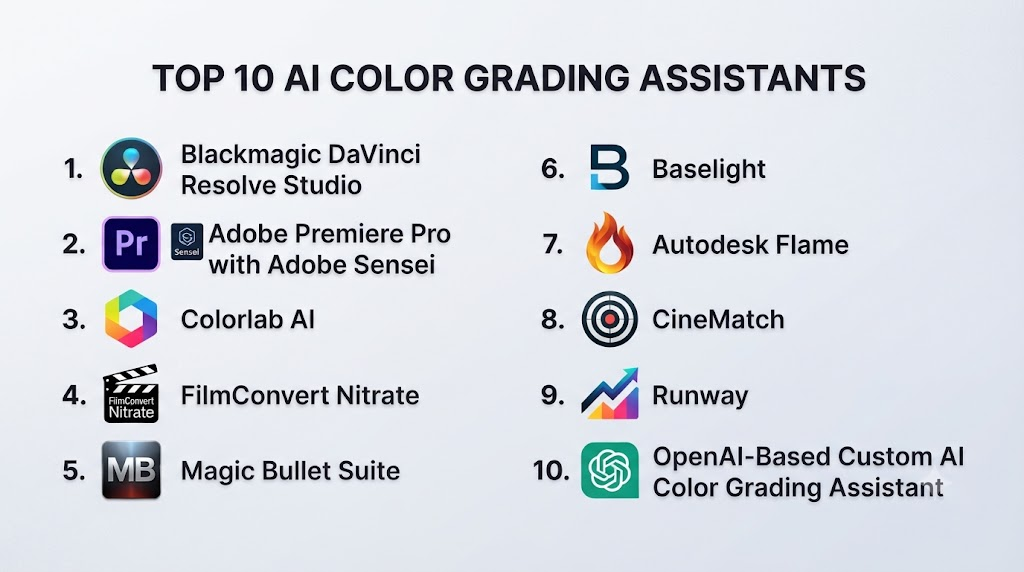
Top 10 AI Color Grading Assistants
1. Blackmagic DaVinci Resolve Studio
Verdict: Best overall AI color grading assistant.
Short Description: DaVinci Resolve Studio combines AI-powered color correction, Magic Mask, shot matching, HDR grading, facial recognition, and professional finishing workflows for film and television production.
Key Features
- AI color correction
- Automatic shot matching
- Magic Mask
- HDR grading
- Scene analysis
Pros
- Industry-leading color grading
- Excellent AI-assisted workflows
- Complete post-production suite
Cons
- Advanced capabilities require the Studio edition
Deployment: Desktop and cloud collaboration
Security & Compliance: Enterprise-grade security controls
Integrations & Ecosystem: Editing, audio, VFX, cloud collaboration, DAM platforms
Support & Community: Enterprise and professional community support
Pricing Model: Perpetual license
Best-Fit Scenarios: Professional film and broadcast color grading
2. Adobe Premiere Pro with Adobe Sensei
Verdict: Best for AI-assisted video editing and color workflows.
Short Description: Adobe Premiere Pro uses Adobe Sensei AI to automate color correction, scene detection, color matching, and video enhancement while integrating with Creative Cloud.
Key Features
- Auto color correction
- Scene detection
- Color matching
- AI editing
- Creative Cloud integration
Pros
- Excellent editing integration
- Easy-to-use AI tools
Cons
- Advanced grading often requires additional Adobe tools
3. Colorlab AI
Verdict: AI-powered professional color grading platform.
Short Description: Colorlab AI automates cinematic color grading, shot matching, look creation, and collaborative finishing for professional productions.
Key Features
- Shot matching
- AI color grading
- Look generation
- Scene analysis
- Workflow automation
Pros
- Excellent grading automation
- Professional cinematic results
Cons
- Primarily designed for professional colorists
4. FilmConvert Nitrate
Verdict: Best for cinematic film emulation.
Short Description: FilmConvert Nitrate combines AI-assisted color grading with realistic film stock emulation and camera profile matching.
Key Features
- Film emulation
- Camera matching
- Grain simulation
- Color correction
- Creative looks
Pros
- Excellent cinematic aesthetics
- Broad camera support
Cons
- Focused on film-style grading
5. Magic Bullet Suite
Verdict: Professional color grading and finishing toolkit.
Short Description: Magic Bullet Suite provides AI-assisted color correction, cinematic looks, skin tone optimization, and finishing effects for editors and filmmakers.
Key Features
- Color correction
- Skin tone adjustment
- Cinematic presets
- Look creation
- Finishing effects
Pros
- User-friendly workflow
- Excellent preset library
Cons
- Plugin-based workflow
6. Baselight
Verdict: Enterprise digital intermediate grading platform.
Short Description: Baselight provides advanced AI-assisted grading, HDR finishing, scene management, and high-end post-production workflows for feature films and television.
Key Features
- HDR grading
- Scene management
- Advanced color tools
- AI-assisted workflows
- Digital intermediate support
Pros
- Enterprise-grade grading
- Excellent HDR support
Cons
- Premium enterprise pricing
7. Autodesk Flame
Verdict: High-end finishing and color platform.
Short Description: Autodesk Flame combines AI-assisted color grading, compositing, finishing, and post-production workflows in a unified environment.
Key Features
- AI color grading
- Finishing
- Compositing
- HDR workflows
- Timeline editing
Pros
- Integrated finishing platform
- Enterprise production workflows
Cons
- Steeper learning curve
8. CineMatch
Verdict: Camera color matching specialist.
Short Description: CineMatch automatically matches footage captured from different cameras, improving grading consistency and reducing manual adjustments.
Key Features
- Camera matching
- Color normalization
- LUT support
- Workflow optimization
- Scene consistency
Pros
- Excellent multi-camera support
- Simplifies color matching
Cons
- Focused on camera matching rather than full grading
9. Runway
Verdict: AI-powered creative video enhancement platform.
Short Description: Runway provides AI-assisted color enhancement, scene editing, visual effects, and creative post-production automation.
Key Features
- AI enhancement
- Scene editing
- Visual effects
- Color improvement
- Video automation
Pros
- Fast creative workflows
- Easy AI automation
Cons
- Less specialized than dedicated grading systems
10. OpenAI-Based Custom AI Color Grading Assistant
Verdict: Flexible AI assistant for enterprise color grading workflows.
Short Description: Organizations can build custom AI color grading assistants using large language models integrated with Digital Asset Management (DAM), editing software, Digital Intermediate (DI) pipelines, rendering systems, production tracking platforms, cloud collaboration tools, and creative workflows. These assistants can analyze footage, recommend grading strategies, generate LUT suggestions, identify scene inconsistencies, create production notes, and assist colorists while supporting human creative review before final delivery.
Key Features
- Scene analysis
- Color grading recommendations
- LUT guidance
- Production documentation
- Workflow automation
Pros
- Highly customizable
- Flexible enterprise integrations
- Accelerates grading preparation
Cons
- Human colorists remain essential for creative decisions
- Final grading quality depends on connected color grading software
Comparison Table
| Platform | Color Quality | AI Automation | Shot Matching | Enterprise Integration | Best Use |
|---|---|---|---|---|---|
| DaVinci Resolve Studio | Excellent | Excellent | Excellent | Excellent | Professional Color Grading |
| Adobe Premiere Pro | High | High | High | Excellent | Video Editing |
| Colorlab AI | Excellent | Excellent | Excellent | High | Cinematic Grading |
| FilmConvert Nitrate | Excellent | Medium | High | High | Film Emulation |
| Magic Bullet Suite | High | High | Medium | High | Creative Color Correction |
| Baselight | Excellent | High | Excellent | Excellent | Enterprise DI |
| Autodesk Flame | Excellent | High | High | Excellent | Post-Production |
| CineMatch | High | Medium | Excellent | High | Multi-Camera Matching |
| Runway | High | High | Medium | High | AI Video Enhancement |
| OpenAI Custom | Custom | Custom | Custom | Custom | AI Grading Assistant |
Evaluation & Scoring Table
| Platform | AI Capability 20% | Color Quality 20% | Automation 15% | Integration 15% | Security 10% | Ease 10% | Value 10% | Total |
|---|---|---|---|---|---|---|---|---|
| DaVinci Resolve Studio | 20 | 20 | 15 | 15 | 10 | 9 | 9 | 98 |
| Adobe Premiere Pro | 19 | 18 | 14 | 15 | 10 | 9 | 9 | 94 |
| Colorlab AI | 20 | 20 | 15 | 14 | 10 | 8 | 8 | 95 |
| FilmConvert Nitrate | 18 | 19 | 12 | 13 | 10 | 9 | 9 | 90 |
| Magic Bullet Suite | 18 | 18 | 13 | 13 | 10 | 9 | 9 | 90 |
| Baselight | 19 | 20 | 15 | 15 | 10 | 7 | 7 | 93 |
| Autodesk Flame | 19 | 19 | 14 | 15 | 10 | 7 | 7 | 91 |
| CineMatch | 17 | 18 | 12 | 13 | 10 | 9 | 9 | 88 |
| Runway | 18 | 17 | 13 | 13 | 9 | 10 | 9 | 89 |
| OpenAI Custom | 20 | 18 | 13 | 15 | 8 | 8 | 9 | 91 |
Which AI Color Grading Assistant Is Right for You?
| If your priority is… | Recommended Platform |
|---|---|
| Professional film color grading | DaVinci Resolve Studio |
| AI-assisted video editing | Adobe Premiere Pro |
| Automated cinematic grading | Colorlab AI |
| Film stock emulation | FilmConvert Nitrate |
| Creative color correction | Magic Bullet Suite |
| Enterprise finishing | Baselight |
| Broadcast post-production | Autodesk Flame |
| Multi-camera color matching | CineMatch |
| AI video enhancement | Runway |
| Custom enterprise grading assistant | OpenAI-Based AI Assistant |
Implementation Playbook
First 30 Days
- Define color grading standards
- Audit current post-production workflows
- Select pilot projects
- Establish visual style guidelines
Days 31–60
- Integrate editing and color grading platforms
- Configure AI grading workflows
- Validate color consistency
- Train editors and colorists
Days 61–90
- Scale AI-assisted grading
- Standardize review processes
- Optimize rendering workflows
- Measure production efficiency
Common Mistakes
- Relying entirely on automated grading
- Ignoring artistic direction
- Inconsistent camera calibration
- Poor monitor calibration
- Weak color management
- Skipping HDR validation
- Limited quality assurance
- Failure to review AI-generated grading
Frequently Asked Questions
1. What are AI Color Grading Assistants?
They are AI-powered platforms that automate and assist with color correction, shot matching, cinematic grading, HDR optimization, and visual consistency in video production.
2. How does AI perform color grading?
AI analyzes exposure, white balance, contrast, saturation, scene composition, and color relationships to recommend or automatically apply grading adjustments.
3. Can AI replace professional colorists?
AI significantly accelerates repetitive grading tasks, but experienced colorists remain essential for creative decisions, visual storytelling, and final artistic refinement.
4. Which industries use AI color grading platforms?
Film, television, advertising, streaming media, gaming, education, marketing, corporate communications, and digital content production.
5. What data is required?
RAW or edited footage, camera metadata, color profiles, creative references, LUTs, production requirements, and visual style guidelines.
6. Can AI match footage from different cameras?
Yes. Many platforms automatically normalize color, exposure, and white balance across multiple camera systems to improve visual consistency.
7. Do these platforms integrate with professional editing software?
Many integrate with video editing applications, Digital Asset Management systems, Digital Intermediate pipelines, rendering software, cloud collaboration tools, and production workflows.
8. Is AI-generated color grading production-ready?
AI provides an excellent starting point, but professional review is recommended to ensure creative intent, color consistency, and delivery quality.
9. How are production assets protected?
Organizations should implement encryption, secure storage, access controls, version management, audit logging, governance policies, and comply with applicable intellectual property requirements.
10. What should companies evaluate before adoption?
Consider grading quality, AI automation, shot matching, HDR support, integrations, scalability, governance, security, workflow automation, and operational compatibility.
Conclusion
AI Color Grading Assistants are transforming post-production by enabling intelligent color correction, automated shot matching, cinematic look creation, and scalable finishing workflows. By combining artificial intelligence, computer vision, deep learning, and image analysis, these platforms help production teams accelerate grading, improve visual consistency, reduce manual effort, and deliver high-quality cinematic results.Organizations implementing AI color grading solutions should prioritize calibrated production workflows, seamless integration with editing, rendering, and Digital Asset Management platforms, continuous human review of AI-generated grading decisions, and close collaboration between colorists, editors, cinematographers, VFX teams, and production leadership. Platforms such as DaVinci Resolve Studio, Colorlab AI, Adobe Premiere Pro, Baselight, and FilmConvert Nitrate demonstrate how artificial intelligence is enabling faster, smarter, and more scalable color grading workflows.
