Introduction
AI Copyright & Similarity Detection tools help organizations identify copied content, potential copyright risks, duplicated information, and similarities between original and AI-generated materials. These platforms analyze different types of digital content, including written documents, research papers, software code, images, and other creative assets, helping teams understand content originality and ownership risks.
The growth of generative AI has changed how businesses, creators, developers, educators, and researchers produce content. AI assistants can now generate articles, marketing materials, software code, product descriptions, reports, and creative assets at a large scale. While this improves productivity, it also creates new challenges around originality, intellectual property protection, attribution, and responsible AI usage.
AI Copyright & Similarity Detection platforms help organizations create safer AI workflows by identifying possible duplication, improving content review processes, and supporting transparency. These tools are becoming important parts of AI governance strategies where businesses need better control over AI-assisted creation.
Common real-world use cases include:
- Checking AI-generated articles, blogs, and marketing content for originality.
- Protecting company documents, research materials, and intellectual property.
- Detecting duplicated academic or professional content.
- Reviewing software code for similarity and unauthorized reuse.
- Supporting publishers, educators, and content teams with verification workflows.
- Improving trust in AI-assisted business processes.
When evaluating an AI Copyright & Similarity Detection platform, organizations should consider:
- Accuracy of similarity detection.
- Ability to identify AI-generated content.
- Support for multiple content formats.
- Quality of detection reports and explanations.
- Privacy and data protection controls.
- Integration options with existing platforms.
- API availability and automation capabilities.
- Enterprise administration features.
- Scalability for large content volumes.
- Human review and approval workflows.
- Security controls.
- Total cost of ownership.
Best for: Content teams, enterprises, educational institutions, publishers, software companies, legal teams, research organizations, and businesses using generative AI workflows.
Not ideal for: Individuals or small teams with limited content needs who only require basic plagiarism checking. Organizations without significant AI adoption may find advanced copyright detection platforms unnecessary.
What’s Changed in AI Copyright & Similarity Detection
AI Copyright & Similarity Detection is moving beyond traditional plagiarism checking. Modern platforms are adapting to a world where content can be created through human effort, AI assistance, automation tools, and autonomous AI systems.
Important category changes include:
- AI-generated content analysis: Detection systems are focusing on identifying machine-generated writing patterns rather than only matching copied phrases.
- Multimodal content checking: Platforms are expanding from text-only analysis toward images, code, documents, and mixed media content.
- AI governance integration: Organizations are connecting similarity detection with broader AI risk management and responsible AI practices.
- Human-in-the-loop review: Businesses are combining automated detection with expert approval instead of relying only on automated decisions.
- Enterprise privacy requirements: Companies increasingly require stronger controls around document storage, processing, and data handling.
- Copyright risk evaluation: Modern tools aim to provide risk insights instead of only showing similarity percentages.
- AI agent workflow monitoring: Organizations are beginning to review content created by AI agents that research, summarize, and generate materials automatically.
- Code similarity detection growth: Software teams are adopting similarity analysis to review AI-assisted programming output.
- Better reporting and explanations: Users expect clear reasons behind flagged content and actionable recommendations.
- API-based automation: Businesses are embedding copyright detection into publishing systems, development workflows, and internal applications.
- Security-focused AI adoption: Companies are looking for tools that support safer AI usage without exposing confidential information.
- Responsible AI practices: Copyright detection is becoming part of enterprise AI governance frameworks.
Quick Buyer Checklist
Before selecting an AI Copyright & Similarity Detection platform, review these important points:
Detection Capability
- Does the tool detect AI-generated content?
- Can it identify copied or highly similar material?
- Does it support different content formats?
- Can it handle large-scale analysis?
AI Workflow Compatibility
- Does it work with modern generative AI workflows?
- Can it integrate with content creation pipelines?
- Does it provide detailed explanations?
- Does it support human review processes?
Privacy and Data Protection
- How does the platform handle uploaded content?
- Are retention controls available?
- Can organizations control data processing?
- Are enterprise privacy options available?
Model Flexibility
- Does it use proprietary detection models?
- Does it support private deployment options?
- Can it integrate through APIs?
- Does it create dependency on a single vendor?
Evaluation and Accuracy
- Are detection results explainable?
- Can teams review flagged content?
- Does it reduce false positives?
- Are analysis reports available?
Security and Administration
- Are user permissions available?
- Are audit features supported?
- Can administrators manage access?
- Are enterprise controls available?
Cost and Scalability
- Is pricing based on usage, subscription, or enterprise licensing?
- Can the platform support increasing workloads?
- Are API costs predictable?
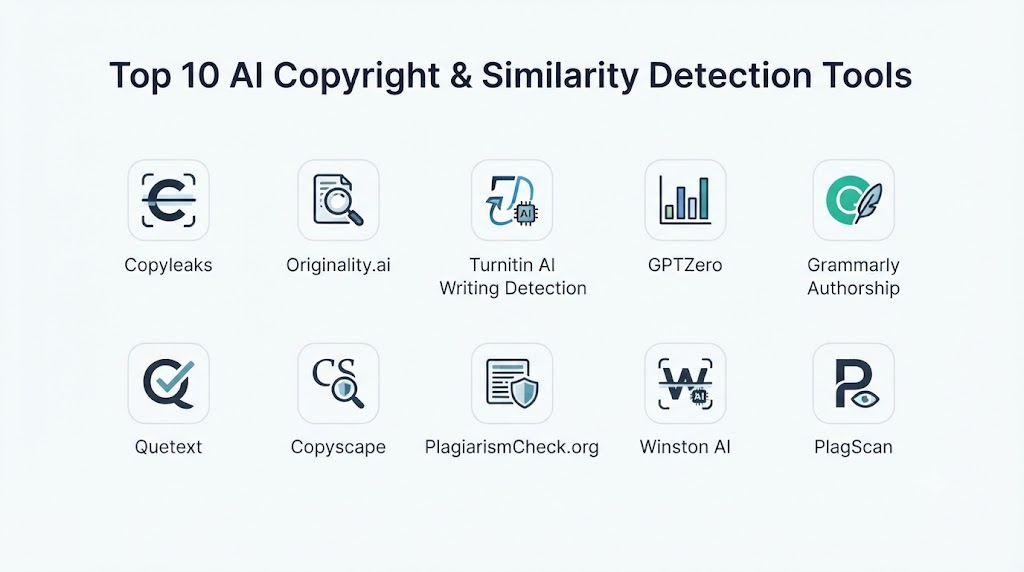
Top 10 AI Copyright & Similarity Detection Tools
1 — Copyleaks
One-line verdict: Best for organizations needing AI content detection and large-scale originality verification workflows.
Short description:
Copyleaks is an AI-powered content analysis platform focused on plagiarism detection, AI-generated content identification, and similarity checking. It is used by educational institutions, enterprises, publishers, and organizations that need content verification capabilities.
The platform helps teams review digital content, identify potential duplication, and maintain trust in AI-assisted creation workflows.
Standout Capabilities
- AI-generated content detection.
- Similarity analysis across content sources.
- Plagiarism detection workflows.
- Code similarity checking capabilities.
- Enterprise content verification.
- Automated reporting.
- API-based integration options.
- Large-scale content scanning.
AI-Specific Depth
- Model support: Proprietary detection technology; specific model details are Not publicly stated.
- RAG / knowledge integration: N/A.
- Evaluation: Provides content analysis reports and detection results; detailed evaluation methods are Not publicly stated.
- Guardrails: Focuses on content detection rather than AI safety guardrails.
- Observability: Reporting capabilities available; advanced AI tracing and token monitoring are Not publicly stated.
Pros
- Strong focus on AI content detection and similarity analysis.
- Suitable for organizations handling large content volumes.
- Supports multiple professional use cases.
Cons
- Detection accuracy may vary depending on content type and AI generation methods.
- Does not replace legal copyright review processes.
- Advanced enterprise features may vary by plan.
Security & Compliance
- Enterprise security capabilities vary depending on deployment.
- Specific certifications are Not publicly stated.
- Data retention and residency controls vary.
Deployment & Platforms
- Web-based platform.
- Cloud deployment.
- API access available.
- Self-hosted availability is Not publicly stated.
Integrations & Ecosystem
Copyleaks supports integration into content workflows, education systems, and enterprise applications.
Common ecosystem capabilities include:
- API integrations.
- Learning management system connections.
- Content management workflows.
- Enterprise applications.
- Developer integrations.
Pricing Model
Pricing generally follows subscription or usage-based models.
Exact pricing details are Not publicly stated.
Best-Fit Scenarios
- Educational organizations checking academic integrity.
- Enterprises reviewing AI-generated content.
- Publishers verifying originality before release.
2 — Originality.ai
One-line verdict: Best for publishers and content teams requiring AI detection and originality monitoring.
Short description:
Originality.ai is a content verification platform designed for publishers, marketing teams, agencies, and organizations that need to evaluate content originality.
It combines AI content detection and similarity checking features to help teams maintain content quality and authenticity.
Standout Capabilities
- AI writing detection.
- Content originality analysis.
- Plagiarism checking.
- Team collaboration features.
- Website content scanning.
- Document analysis.
- Content quality review workflows.
- Reporting capabilities.
AI-Specific Depth
- Model support: Proprietary detection technology; specific model information is Not publicly stated.
- RAG / knowledge integration: N/A.
- Evaluation: Provides detection scores and analysis reports.
- Guardrails: Detection-focused; AI safety guardrails are N/A.
- Observability: Content reports available; advanced AI monitoring features are Not publicly stated.
Pros
- Designed specifically for content professionals.
- Combines AI detection with originality checking.
- Useful for editorial workflows.
Cons
- More focused on content teams than broad enterprise governance.
- Results may require human interpretation.
- Advanced security information is Not publicly stated.
Security & Compliance
- Security features vary by plan.
- Certifications are Not publicly stated.
- Data handling policies vary.
Deployment & Platforms
- Web-based application.
- Cloud deployment.
- Browser-based access.
- Integration options vary.
Integrations & Ecosystem
Originality.ai supports content review environments and professional publishing workflows.
Common integrations include:
- API access.
- Team workflows.
- Website analysis.
- Content management processes.
- Publishing operations.
Pricing Model
Pricing generally follows subscription or usage-based models.
Exact pricing is Not publicly stated.
Best-Fit Scenarios
- Digital publishers.
- Marketing agencies.
- Businesses managing AI-assisted content production.
3 — Turnitin AI Writing Detection
One-line verdict: Best for educational institutions managing academic integrity and AI-assisted writing review.
Short description:
Turnitin AI Writing Detection supports educational organizations by helping educators review written submissions and identify potential AI-generated content patterns.
The platform is widely associated with academic integrity workflows and similarity checking environments.
Standout Capabilities
- Academic similarity analysis.
- AI writing detection.
- Submission review workflows.
- Educator reporting tools.
- Institutional content management.
- Similarity comparison.
- Academic integrity support.
- Large-scale education deployment.
AI-Specific Depth
- Model support: Proprietary detection systems; specific model details are Not publicly stated.
- RAG / knowledge integration: N/A.
- Evaluation: Provides similarity and AI writing indicators.
- Guardrails: Focuses on academic review rather than AI security controls.
- Observability: Reporting features available; advanced AI observability is Not publicly stated.
Pros
- Strong fit for educational environments.
- Supports structured review workflows.
- Designed for institutional usage.
Cons
- Primarily focused on education use cases.
- Less suitable for general enterprise copyright management.
- Automated results require human judgment.
Security & Compliance
- Institutional security controls vary.
- Compliance details are Not publicly stated.
- Access management depends on deployment agreements.
Deployment & Platforms
- Cloud-based platform.
- Web access.
- Education system integrations.
- Deployment options vary.
Integrations & Ecosystem
Turnitin connects with educational technology environments.
Common integrations include:
- Learning management systems.
- Academic submission platforms.
- Institutional workflows.
- Education technology ecosystems.
Pricing Model
Institutional subscription model.
Exact pricing is Not publicly stated.
Best-Fit Scenarios
- Universities and colleges.
- Schools reviewing AI-assisted assignments.
- Educational organizations managing academic integrity.
4 — GPTZero
One-line verdict: Best for educators and organizations looking for AI-generated text analysis and writing transparency.
Short description:
GPTZero is an AI content detection platform focused on identifying whether text may have been generated using artificial intelligence systems. It is commonly used by educators, writers, publishers, and organizations that want additional visibility into AI-assisted content creation.
The platform provides analysis reports designed to help users review content originality and make informed decisions rather than relying only on automated detection.
Standout Capabilities
- AI-generated text detection.
- Document scanning and analysis.
- Writing pattern evaluation.
- Content originality review.
- Educator-focused workflows.
- Batch content checking.
- Reporting and analysis features.
- Integration options for professional workflows.
AI-Specific Depth
- Model support: Proprietary detection technology; specific model architecture is Not publicly stated.
- RAG / knowledge integration: N/A.
- Evaluation: Provides AI detection indicators and analysis reports.
- Guardrails: Focuses on detection; AI safety guardrails are N/A.
- Observability: Content analysis reporting available; advanced AI workflow monitoring is Not publicly stated.
Pros
- Easy-to-use interface for content analysis.
- Useful for educational and professional review workflows.
- Helps organizations understand AI involvement in writing.
Cons
- AI detection accuracy can vary depending on writing style and model output.
- Detection results should be reviewed by humans.
- Enterprise governance capabilities are limited compared with broader AI management platforms.
Security & Compliance
- Security features vary depending on account type.
- Compliance certifications are Not publicly stated.
- Data handling and retention options vary.
Deployment & Platforms
- Web-based platform.
- Cloud deployment.
- Browser-based access.
- API availability varies.
Integrations & Ecosystem
GPTZero focuses primarily on content analysis workflows.
Common ecosystem capabilities include:
- Document analysis.
- Education workflow support.
- API access options.
- Content review processes.
- Enterprise integrations.
Pricing Model
Pricing generally follows subscription-based or usage-based models.
Exact pricing details are Not publicly stated.
Best-Fit Scenarios
- Schools and universities reviewing AI-assisted writing.
- Content teams checking originality.
- Organizations creating AI usage policies.
5 — Grammarly Authorship
One-line verdict: Best for organizations tracking writing origins and improving transparency in AI-assisted communication.
Short description:
Grammarly Authorship is designed to help users understand how content was created by analyzing writing sources and AI assistance patterns. It focuses on transparency around human-written and AI-assisted communication.
The solution fits organizations already using writing productivity workflows that want better visibility into content creation methods.
Standout Capabilities
- Writing origin analysis.
- AI-assisted content transparency.
- Enterprise communication support.
- Writing workflow integration.
- Productivity-focused content review.
- User-friendly reporting.
- Integration with writing environments.
- Content quality improvement support.
AI-Specific Depth
- Model support: Proprietary AI systems; specific model details are Not publicly stated.
- RAG / knowledge integration: N/A.
- Evaluation: Provides authorship insights; detailed evaluation methodology is Not publicly stated.
- Guardrails: Focuses on responsible writing transparency rather than AI security controls.
- Observability: Writing analysis features available; advanced AI tracing is Not publicly stated.
Pros
- Supports responsible AI usage in business communication.
- Fits existing writing workflows.
- Helps organizations create transparency around AI assistance.
Cons
- Not designed as a complete copyright investigation platform.
- Limited focus on external similarity databases.
- Enterprise capabilities vary.
Security & Compliance
- Enterprise security options vary.
- Specific certifications are Not publicly stated.
- Data controls depend on organizational settings.
Deployment & Platforms
- Web-based access.
- Browser integrations.
- Desktop writing environments.
- Cloud-based deployment.
Integrations & Ecosystem
Grammarly Authorship fits into broader writing productivity ecosystems.
Common integrations include:
- Browser-based writing tools.
- Business communication workflows.
- Document creation environments.
- Productivity platforms.
- Enterprise writing systems.
Pricing Model
Pricing follows subscription and enterprise licensing models.
Exact pricing is Not publicly stated.
Best-Fit Scenarios
- Companies managing AI-assisted workplace communication.
- Teams requiring writing transparency.
- Organizations using digital writing workflows.
6 — Quetext
One-line verdict: Best for individuals and organizations needing straightforward plagiarism and similarity checking.
Short description:
Quetext is a plagiarism detection and similarity analysis platform designed to help users identify copied or matching content. It is used by students, educators, writers, and professionals who need content verification.
The platform focuses on finding similarities between submitted text and existing content sources.
Standout Capabilities
- Plagiarism detection.
- Similarity checking.
- Citation assistance features.
- Content scanning.
- Similarity reporting.
- User-friendly analysis workflow.
- Document review support.
- Writing verification tools.
AI-Specific Depth
- Model support: Detection technology details are Not publicly stated.
- RAG / knowledge integration: N/A.
- Evaluation: Similarity reports available; detailed AI evaluation methods are Not publicly stated.
- Guardrails: N/A.
- Observability: Reporting available; advanced AI monitoring features are Not publicly stated.
Pros
- Simple workflow for plagiarism checking.
- Suitable for smaller teams and individual users.
- Easy content verification process.
Cons
- Limited enterprise AI governance features.
- Less focused on AI-generated content compared with specialized platforms.
- Advanced integrations may be limited.
Security & Compliance
- Security details are Not publicly stated.
- Compliance certifications are Not publicly stated.
- Data retention policies vary.
Deployment & Platforms
- Web-based application.
- Cloud deployment.
- Browser access.
- Additional deployment options are Not publicly stated.
Integrations & Ecosystem
Quetext primarily supports plagiarism checking workflows.
Common capabilities include:
- Document uploads.
- Similarity reports.
- Writing review processes.
- Educational workflows.
- Content verification tasks.
Pricing Model
Subscription-based pricing model.
Exact pricing is Not publicly stated.
Best-Fit Scenarios
- Freelancers checking content originality.
- Students and educators.
- Small businesses reviewing written materials.
7 — Copyscape
One-line verdict: Best for website owners and publishers protecting online content from duplication.
Short description:
Copyscape is a content similarity detection platform focused on identifying duplicate online content. It has traditionally been used by website owners, publishers, and digital marketing teams to monitor content originality.
The platform helps businesses identify copied web content and maintain content uniqueness.
Standout Capabilities
- Website content comparison.
- Duplicate content detection.
- Online plagiarism checking.
- Content monitoring workflows.
- Search-based similarity analysis.
- Publisher-focused tools.
- Content protection support.
- Professional verification features.
AI-Specific Depth
- Model support: Traditional similarity detection approach; AI model details are Not publicly stated.
- RAG / knowledge integration: N/A.
- Evaluation: Similarity comparison available.
- Guardrails: N/A.
- Observability: Reporting features available; AI workflow monitoring is Not publicly stated.
Pros
- Established reputation in online content checking.
- Useful for website owners.
- Simple duplicate content detection workflow.
Cons
- Less focused on modern AI-generated content detection.
- Limited enterprise AI governance capabilities.
- Primarily designed for web content.
Security & Compliance
- Security details are Not publicly stated.
- Compliance certifications are Not publicly stated.
- Enterprise controls vary.
Deployment & Platforms
- Web-based platform.
- Cloud service.
- Browser access.
- Additional deployment options are Not publicly stated.
Integrations & Ecosystem
Copyscape integrates mainly with digital publishing and website workflows.
Common capabilities include:
- Website content checking.
- Content monitoring.
- Publisher workflows.
- Writing verification processes.
Pricing Model
Usage-based and subscription models may apply.
Exact pricing is Not publicly stated.
Best-Fit Scenarios
- Website publishers.
- SEO teams.
- Businesses protecting online content.
8 — PlagiarismCheck.org
One-line verdict: Best for educational organizations needing similarity checking and academic content verification.
Short description:
PlagiarismCheck.org is a similarity detection platform designed for educational institutions, teachers, and organizations that need content originality verification.
The platform focuses on identifying matching content and supporting academic review processes.
Standout Capabilities
- Similarity detection.
- Academic content checking.
- Document analysis.
- Educator workflows.
- Reporting features.
- Learning platform compatibility.
- Content review support.
- Institutional usage support.
AI-Specific Depth
- Model support: Detection technology details are Not publicly stated.
- RAG / knowledge integration: N/A.
- Evaluation: Similarity reports available.
- Guardrails: N/A.
- Observability: Reporting available; advanced AI observability is Not publicly stated.
Pros
- Designed for educational workflows.
- Supports content review processes.
- Simple similarity analysis.
Cons
- Limited enterprise AI governance capabilities.
- AI copyright analysis features may vary.
- Security details are limited.
Security & Compliance
- Security information is Not publicly stated.
- Certifications are Not publicly stated.
- Data handling options vary.
Deployment & Platforms
- Cloud-based platform.
- Web access.
- Educational integrations.
- Deployment options vary.
Integrations & Ecosystem
The platform supports academic environments.
Common integrations include:
- Learning management systems.
- Education workflows.
- Document submission systems.
- Institutional platforms.
Pricing Model
Subscription-based model.
Exact pricing is Not publicly stated.
Best-Fit Scenarios
- Educational institutions.
- Online learning providers.
- Academic content reviewers.
9 — Winston AI
One-line verdict: Best for organizations needing AI-generated content detection across education, publishing, and business workflows.
Short description:
Winston AI is an AI content detection platform designed to help users identify whether written content may have been generated by artificial intelligence systems. It supports content verification workflows for educators, publishers, businesses, and professional users.
The platform focuses on analyzing writing patterns and providing detection insights that help teams review AI-assisted content responsibly.
Standout Capabilities
- AI-generated content detection.
- Document analysis.
- Content originality review.
- Text scanning workflows.
- Detection reports.
- Professional content verification.
- Educational review support.
- Enterprise content monitoring.
AI-Specific Depth
- Model support: Proprietary detection technology; specific model details are Not publicly stated.
- RAG / knowledge integration: N/A.
- Evaluation: Provides AI detection scores and analysis reports.
- Guardrails: Detection-focused; AI security guardrails are N/A.
- Observability: Reporting features available; advanced AI tracing and cost monitoring are Not publicly stated.
Pros
- Focused specifically on AI-generated content identification.
- Suitable for content review workflows.
- Easy-to-understand detection reports.
Cons
- Detection accuracy can vary depending on AI models and writing styles.
- Not a complete enterprise AI governance platform.
- Advanced integrations may vary.
Security & Compliance
- Security capabilities vary by plan.
- Certifications are Not publicly stated.
- Data retention and privacy controls vary.
Deployment & Platforms
- Web-based application.
- Cloud deployment.
- Browser access.
- Additional deployment options are Not publicly stated.
Integrations & Ecosystem
Winston AI supports content verification workflows for professional and educational users.
Common ecosystem capabilities include:
- Document scanning.
- Content review workflows.
- API availability varies.
- Educational use cases.
- Publishing workflows.
Pricing Model
Pricing generally follows subscription-based models.
Exact pricing details are Not publicly stated.
Best-Fit Scenarios
- Educational organizations reviewing AI-assisted assignments.
- Publishers checking content authenticity.
- Businesses managing AI-generated documents.
10 — PlagScan
One-line verdict: Best for organizations requiring structured plagiarism checking and document similarity analysis.
Short description:
PlagScan is a document similarity detection platform focused on identifying matching content across submitted documents and available sources. It is commonly associated with educational and professional environments where content originality verification is required.
The platform helps organizations review documents, maintain integrity standards, and identify possible duplication.
Standout Capabilities
- Document similarity analysis.
- Plagiarism detection.
- Academic content verification.
- Report generation.
- Document comparison.
- Institutional workflows.
- Content review processes.
- Similarity reporting.
AI-Specific Depth
- Model support: Detection technology details are Not publicly stated.
- RAG / knowledge integration: N/A.
- Evaluation: Similarity analysis and reporting available.
- Guardrails: N/A.
- Observability: Reporting available; advanced AI monitoring features are Not publicly stated.
Pros
- Useful for document-based similarity checking.
- Supports structured review workflows.
- Suitable for educational and professional environments.
Cons
- Limited AI-specific governance features.
- Less focused on modern generative AI detection.
- Enterprise AI workflow capabilities are Not publicly stated.
Security & Compliance
- Security information is Not publicly stated.
- Compliance certifications are Not publicly stated.
- Data controls vary.
Deployment & Platforms
- Web-based platform.
- Cloud deployment.
- Browser access.
- Additional deployment options vary.
Integrations & Ecosystem
PlagScan supports document review environments.
Common capabilities include:
- Document management workflows.
- Academic systems.
- Institutional review processes.
- Content verification environments.
Pricing Model
Subscription and enterprise pricing models may apply.
Exact pricing is Not publicly stated.
Best-Fit Scenarios
- Educational institutions.
- Research organizations.
- Businesses reviewing professional documents.
Comparison Table (Top 10)
| Tool Name | Best For | Deployment (Cloud/Self-hosted/Hybrid) | Model Flexibility | Strength | Watch-Out | Public Rating |
|---|---|---|---|---|---|---|
| Copyleaks | Enterprise content verification | Cloud | Hosted detection technology | AI detection and similarity analysis | Accuracy varies by content type | N/A |
| Originality.ai | Publishers and content teams | Cloud | Hosted | AI content detection workflow | Limited governance features | N/A |
| Turnitin AI Writing Detection | Education institutions | Cloud | Hosted | Academic integrity workflows | Education-focused | N/A |
| GPTZero | AI writing analysis | Cloud | Hosted | Simple AI detection | Requires human review | N/A |
| Grammarly Authorship | Writing transparency | Cloud | Hosted | AI-assisted writing visibility | Not a complete copyright platform | N/A |
| Quetext | Plagiarism checking | Cloud | Hosted | Easy similarity checking | Limited enterprise features | N/A |
| Copyscape | Website content protection | Cloud | Hosted | Duplicate web content detection | Less AI-focused | N/A |
| PlagiarismCheck.org | Academic verification | Cloud | Hosted | Education workflows | Limited AI governance | N/A |
| Winston AI | AI content detection | Cloud | Hosted | AI-generated content analysis | Detection limitations | N/A |
| PlagScan | Document similarity checking | Cloud | Hosted | Document comparison | Limited AI features | N/A |
Scoring & Evaluation (Transparent Rubric)
The following scoring compares tools based on common buyer requirements. Scores are comparative indicators, not absolute rankings. Different organizations may prioritize accuracy, security, integrations, cost, or workflow compatibility differently.
Evaluation criteria:
- Core features – 20%
- AI reliability & evaluation – 15%
- Guardrails & safety – 10%
- Integrations & ecosystem – 15%
- Ease of use – 10%
- Performance & cost controls – 15%
- Security & admin – 10%
- Support & community – 5%
| Tool | Core | Reliability/Eval | Guardrails | Integrations | Ease | Perf/Cost | Security/Admin | Support | Weighted Total |
|---|---|---|---|---|---|---|---|---|---|
| Copyleaks | 9 | 8 | 7 | 8 | 8 | 8 | 7 | 8 | 8.0 |
| Originality.ai | 8 | 8 | 6 | 7 | 9 | 8 | 7 | 7 | 7.6 |
| Turnitin AI Writing Detection | 9 | 8 | 7 | 8 | 8 | 7 | 8 | 9 | 8.0 |
| GPTZero | 8 | 7 | 6 | 6 | 9 | 8 | 6 | 7 | 7.2 |
| Grammarly Authorship | 7 | 7 | 6 | 9 | 10 | 8 | 7 | 8 | 7.8 |
| Quetext | 7 | 7 | 5 | 6 | 9 | 8 | 6 | 7 | 6.9 |
| Copyscape | 7 | 6 | 5 | 6 | 9 | 8 | 6 | 7 | 6.7 |
| PlagiarismCheck.org | 7 | 7 | 5 | 7 | 8 | 7 | 6 | 7 | 6.8 |
| Winston AI | 8 | 7 | 6 | 6 | 8 | 7 | 6 | 7 | 7.0 |
| PlagScan | 7 | 6 | 5 | 7 | 8 | 7 | 6 | 7 | 6.7 |
Top 3 for Enterprise
1. Copyleaks
Strong choice for organizations requiring scalable content verification, AI detection, and integration options.
2. Turnitin AI Writing Detection
Suitable for educational enterprises requiring structured review workflows.
3. Originality.ai
Useful for publishing and content-heavy organizations.
Top 3 for SMB
1. Originality.ai
Good fit for agencies, publishers, and marketing teams.
2. GPTZero
Suitable for teams needing simple AI content analysis.
3. Quetext
Useful for smaller teams needing straightforward similarity checking.
Top 3 for Developers
1. Copyleaks
Suitable for API-driven content verification workflows.
2. Grammarly Authorship
Useful for writing-focused productivity environments.
3. Winston AI
Useful for integrating AI detection into content review processes.
Part 3 Complete
Covered:
- Tools 9–10
- Top 10 Comparison Table
- Scoring & Evaluation
- Enterprise, SMB, Developer Recommendations
Which AI Copyright & Similarity Detection Tool Is Right for You?
Choosing the right AI Copyright & Similarity Detection platform depends on your organization size, workflow complexity, content volume, security requirements, and AI adoption level. There is no single solution that works perfectly for every use case. The right choice depends on whether you need academic integrity protection, publishing verification, enterprise governance, developer integration, or simple content checking.
Solo / Freelancer
Individual creators, writers, consultants, and freelancers usually need simple tools that help verify content originality without complex administration.
Recommended approach:
- Choose easy-to-use platforms with fast content scanning.
- Focus on AI detection, plagiarism checking, and simple reporting.
- Avoid enterprise platforms with unnecessary administration features.
- Consider workflow speed and affordability.
Good options:
- GPTZero for AI writing analysis.
- Quetext for simple similarity checking.
- Originality.ai for content professionals.
Solo users should focus on:
- Accuracy of reports.
- Ease of uploading content.
- Clear explanations of detected similarities.
- Data privacy before submitting confidential work.
SMB
Small and medium businesses often use AI for marketing, documentation, customer communication, and content creation. They need reliable verification without complex enterprise infrastructure.
Recommended approach:
- Select tools that support team workflows.
- Look for collaboration features.
- Consider API availability if content volume increases.
- Establish internal AI usage guidelines.
Good options:
- Originality.ai for publishing and marketing teams.
- Copyleaks for broader content verification.
- Grammarly Authorship for workplace communication transparency.
SMBs should evaluate:
- Number of users supported.
- Content volume limits.
- Reporting quality.
- Integration options.
- Future scalability.
Mid-Market
Mid-market organizations usually require stronger controls because multiple teams create and share AI-assisted content.
Recommended approach:
- Prioritize centralized management.
- Look for workflow integration.
- Create review processes for AI-generated materials.
- Combine automated detection with human approval.
Good options:
- Copyleaks for enterprise-style content analysis.
- Turnitin AI Writing Detection for education-focused organizations.
- Originality.ai for content-heavy companies.
Mid-market teams should consider:
- Role-based access.
- Audit visibility.
- API capabilities.
- Data protection requirements.
- Integration with existing systems.
Enterprise
Large organizations need AI Copyright & Similarity Detection as part of broader AI governance strategies.
Enterprise buyers should focus on:
- Scalable processing.
- Security controls.
- Workflow automation.
- Integration with existing enterprise platforms.
- Detailed reporting.
- Governance processes.
Recommended options:
- Copyleaks for scalable content verification.
- Turnitin AI Writing Detection for large educational environments.
- Originality.ai for publishing organizations.
Enterprise teams should also consider:
- Internal AI policies.
- Content approval workflows.
- Data retention rules.
- Compliance requirements.
- Incident management procedures.
Regulated Industries (Finance, Healthcare, Public Sector)
Organizations in regulated environments require stronger controls around sensitive information and intellectual property.
Important requirements:
- Secure handling of confidential documents.
- Clear data processing policies.
- Strong access management.
- Audit capabilities.
- Human review workflows.
Recommended approach:
- Avoid uploading sensitive information without reviewing privacy controls.
- Prefer platforms with enterprise administration features.
- Establish internal approval processes before using AI detection systems.
Additional considerations:
- Verify vendor security documentation.
- Review retention settings.
- Understand how uploaded content is processed.
Budget vs Premium
Budget-focused organizations should prioritize:
- Core detection accuracy.
- Simple reporting.
- Easy deployment.
- Low operational complexity.
Premium platforms may provide:
- Larger-scale scanning.
- Enterprise administration.
- Better integrations.
- Advanced reporting.
- Team collaboration features.
A higher price does not automatically mean better results. Organizations should match platform capabilities with actual requirements.
Build vs Buy (When to DIY)
Building an internal similarity detection system may make sense for organizations with:
- Large engineering teams.
- Unique content verification requirements.
- Existing AI infrastructure.
- Strict data control needs.
A custom solution may include:
- Internal document indexing.
- Similarity search systems.
- Private AI models.
- Custom evaluation pipelines.
- Organization-specific policies.
However, buying a commercial platform is usually better when organizations need:
- Faster deployment.
- Mature detection workflows.
- Maintenance handled by vendors.
- Ready-made reporting features.
Implementation Playbook (30 / 60 / 90 Days)
A successful AI Copyright & Similarity Detection implementation requires more than selecting a tool. Organizations need policies, testing processes, security reviews, and continuous improvement.
First 30 Days: Pilot and Define Success Metrics
Focus on understanding requirements and testing real workflows.
Key activities:
- Identify important content workflows.
- Select pilot teams.
- Define success criteria.
- Test different content types.
- Review detection accuracy.
- Establish human review processes.
AI-specific tasks:
- Create evaluation datasets.
- Test AI-generated and human-created content.
- Measure false positives.
- Document acceptable AI usage policies.
- Identify sensitive content categories.
Success metrics:
- Detection usefulness.
- Review time reduction.
- User acceptance.
- Workflow compatibility.
First 60 Days: Security Hardening and Rollout
After successful testing, organizations should prepare for wider adoption.
Key activities:
- Configure user access.
- Review privacy settings.
- Create governance guidelines.
- Connect integrations.
- Train users.
AI-specific tasks:
- Build evaluation workflows.
- Create review checklists.
- Establish content approval processes.
- Test edge cases.
- Review AI-generated content policies.
Security activities:
- Review data retention settings.
- Configure administrative controls.
- Define access permissions.
- Document incident response procedures.
First 90 Days: Optimization and Governance
The final stage focuses on improving efficiency and long-term management.
Key activities:
- Monitor platform performance.
- Optimize workflows.
- Expand adoption.
- Review costs.
- Improve governance processes.
AI-specific tasks:
- Maintain evaluation datasets.
- Perform periodic testing.
- Review detection effectiveness.
- Monitor changing AI risks.
- Update internal AI policies.
Long-term improvements:
- Better automation.
- Faster content review.
- Improved security controls.
- Reduced operational costs.
Common Mistakes & How to Avoid Them
1. Treating AI Detection Results as Perfect Decisions
Detection systems can make mistakes. Organizations should always include human review for important decisions.
2. Ignoring False Positives
Content may be incorrectly flagged. Teams should understand detection limitations before taking action.
3. Uploading Sensitive Information Without Reviewing Privacy Policies
Confidential documents should only be analyzed after understanding data handling practices.
4. Using Detection Without Clear AI Policies
Organizations should define acceptable AI usage rules before deploying detection tools.
5. Not Testing Different Content Types
AI-generated articles, code, research documents, and marketing materials may behave differently.
6. Lack of Human Review
Automated detection should support decision-making, not replace expert judgment.
7. Ignoring Integration Requirements
A standalone tool may not work efficiently without connecting to existing workflows.
8. Choosing Only Based on Price
Low-cost tools may lack important features needed for business requirements.
9. Not Evaluating Security Features
Organizations should review access controls, retention settings, and administrative options.
10. Forgetting Future AI Changes
AI systems evolve quickly. Tools should support changing content workflows.
11. No Measurement Framework
Organizations should define success metrics before deployment.
12. Creating Vendor Dependency Without Planning
Businesses should consider portability and future migration needs.
FAQs
What is AI Copyright & Similarity Detection?
AI Copyright & Similarity Detection tools analyze digital content to identify possible duplication, copied material, and AI-generated patterns. They help organizations improve content authenticity and reduce intellectual property risks.
Can AI Copyright Detection tools identify all copied content?
No. Detection accuracy depends on available data sources, content type, and analysis methods. Organizations should combine automated tools with human review.
Do these tools detect AI-generated content?
Many platforms provide AI-generated content detection features, but accuracy can vary depending on the AI system used and how the content was modified.
Are AI detection tools suitable for businesses?
Yes. Businesses use them for content verification, publishing workflows, marketing review, software code analysis, and AI governance processes.
Can organizations use these tools with confidential documents?
Organizations should review privacy policies and data handling practices before uploading sensitive information. Enterprise controls may vary by platform.
Do these platforms support APIs?
Some platforms provide API capabilities, while others focus mainly on web-based workflows. Availability depends on the specific tool.
Can these tools replace copyright experts?
No. They provide analysis and insights but do not replace legal review or professional copyright evaluation.
Are open-source AI copyright detection tools available?
Some organizations build internal solutions using similarity search and AI evaluation systems, but complete open-source alternatives vary.
Do AI detection tools work for software code?
Some platforms support code similarity analysis, but capabilities differ significantly between tools.
How expensive are AI Copyright & Similarity Detection platforms?
Pricing varies depending on usage volume, features, users, and enterprise requirements. Exact pricing is Not publicly stated for many platforms.
Should small businesses invest in these tools?
Businesses creating regular AI-assisted content may benefit from these tools. Small teams with limited needs may prefer simpler solutions.
How should companies evaluate these platforms?
Companies should test real workflows, review privacy controls, compare accuracy, evaluate integrations, and measure operational benefits before choosing a solution.
Conclusion
AI Copyright & Similarity Detection tools are becoming important for organizations that want to use artificial intelligence responsibly while protecting originality, intellectual property, and contentThe best platform depends on your specific needs. Educational institutions may prioritize academic integrity workflows, publishers may focus on originality verification, enterprises may require governance and integration capabilities, and developers may need automation through APIs.
