Introduction
AI Student Success Prediction Tools use artificial intelligence, machine learning, predictive analytics, and educational data mining to identify student performance patterns, forecast academic outcomes, and help educators provide timely support.
Educational institutions collect large amounts of learner data, including grades, attendance, assignment completion, learning activity, engagement patterns, assessment results, and course interactions. AI-powered prediction systems analyze this information to identify students who may need additional academic support, personalized interventions, or improved learning strategies.
Unlike traditional reporting systems that only show past performance, AI prediction platforms aim to provide forward-looking insights. They help institutions answer important questions:
- Which students may be at risk academically?
- Who may require additional support?
- What learning resources should be recommended?
- Which interventions can improve student outcomes?
- How can institutions improve retention and graduation rates?
AI student success prediction is increasingly used by:
- Universities
- Schools
- Online learning platforms
- Training organizations
- Professional education providers
- Student support departments
Modern solutions combine predictive modeling, learning analytics, early-warning systems, recommendation engines, and dashboards to support evidence-based educational decisions.
AI predictions should support educators rather than replace human judgment. Factors such as personal circumstances, motivation, learning environment, and accessibility needs require human understanding.
How AI Student Success Prediction Works
Data Collection
AI systems collect academic and engagement information such as:
- Grades
- Attendance
- Assignment submissions
- Assessment results
- Learning activity
- Course participation
- Interaction patterns
Pattern Analysis
Machine learning models identify relationships between student behaviors and academic outcomes.
Risk Prediction
The system estimates potential risks such as:
- Course failure
- Low engagement
- Dropout probability
- Skill gaps
- Need for intervention
Recommended Actions
Platforms may suggest:
- Additional resources
- Tutoring support
- Personalized learning activities
- Instructor outreach
- Academic advising
Common Use Cases
- Early warning systems
- Student retention programs
- Academic advising
- Personalized learning support
- Course improvement analysis
- Learning engagement monitoring
- Intervention planning
- Online education analytics
- Institutional planning
- Student support services
Why AI Student Success Prediction Matters
Early Intervention
Institutions can identify challenges before students experience serious academic difficulties.
Personalized Support
Educators can provide targeted assistance based on individual learner needs.
Improved Retention
Predictive insights can help institutions develop strategies to improve student persistence.
Better Resource Allocation
Schools and universities can prioritize support services where they are most needed.
Data-Driven Decisions
Educational leaders can use analytics to improve programs, teaching methods, and student services.
Evaluation Criteria for Buyers
Prediction Accuracy
Organizations should evaluate how effectively models identify meaningful patterns and avoid incorrect predictions.
Data Integration
The platform should connect with LMS systems, student information systems, assessment platforms, and academic databases.
Explainability
Educators need understandable reasons behind predictions rather than only risk scores.
Intervention Support
Strong platforms help institutions take action after identifying student needs.
Privacy and Security
Student data requires strong governance, access controls, encryption, and responsible AI practices.
Scalability
Solutions should support different institution sizes, programs, departments, and learner populations.
Bias Management
Organizations should evaluate fairness, transparency, and responsible use of predictive models.
Key Trends
AI Early Warning Systems
Institutions are moving from reactive student support toward proactive intervention.
Learning Analytics Integration
Predictive systems increasingly combine academic, behavioral, and engagement data.
Personalized Student Journeys
AI recommendations are helping create customized learning experiences.
Explainable AI in Education
Educational institutions are focusing more on transparent predictions that educators can understand.
Student Wellbeing Analytics
Some systems are expanding beyond academics to identify engagement challenges and support needs.
Responsible AI Governance
Schools are creating policies around privacy, fairness, transparency, and ethical student data usage.
Methodology
The following platforms were evaluated using:
- Prediction and analytics capabilities
- Ease of use
- Integrations and ecosystem
- Security and privacy capabilities
- Performance and reliability
- Support and community
- Price and value
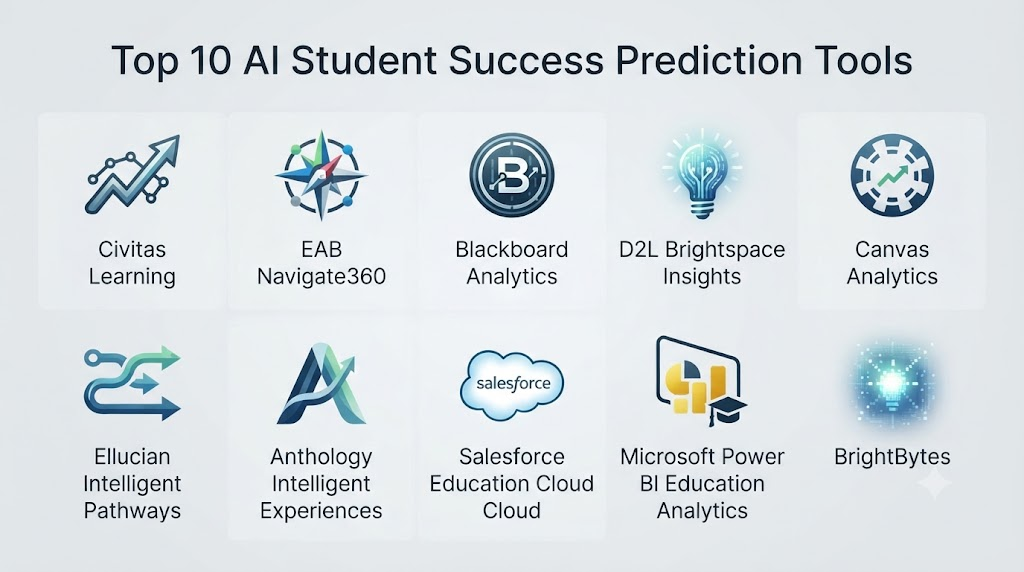
Top 10 AI Student Success Prediction Tools
1. Civitas Learning
Civitas Learning provides predictive analytics and student success solutions designed to help institutions understand learner progress, identify risks, and improve student outcomes.
Key Features
- Student success prediction
- Early alert systems
- Predictive analytics
- Student engagement analysis
- Retention insights
- Intervention tracking
- Institutional dashboards
- Learner profiles
- Academic analytics
- Decision support
Pros
- Strong focus on student success
- Designed for higher education
- Supports proactive interventions
- Provides institutional insights
- Helps improve retention strategies
Cons
- Primarily focused on institutions
- Requires quality student data
- Implementation may require planning
Platforms
Web-based analytics platform.
Deployment or Support
Cloud-based education analytics solution.
Security & Compliance
Education data security requirements vary by deployment.
Integrations & Ecosystem
Student information systems, LMS platforms, academic workflows, and institutional databases.
Support & Community
Institutional support, documentation, and implementation assistance.
2. EAB Navigate360
EAB Navigate360 supports student advising, engagement, retention, and success initiatives through analytics, communication tools, and predictive insights.
Key Features
- Student risk identification
- Academic advising
- Student communication
- Success planning
- Case management
- Engagement tracking
- Analytics dashboards
- Intervention workflows
- Advising support
- Student journey management
Pros
- Strong advising ecosystem
- Supports student services teams
- Combines analytics with action workflows
- Useful for retention programs
- Institution-focused
Cons
- Requires institutional adoption
- Complex implementation
- Pricing is not publicly stated
Platforms
Web and institutional applications.
Deployment or Support
Cloud-based education platform.
Security & Compliance
Institutional privacy and security controls.
Integrations & Ecosystem
Universities, student information systems, LMS platforms, advising systems.
Support & Community
Professional services, training, and institutional support.
3. Blackboard Analytics
Blackboard Analytics provides educational institutions with reporting and analytics capabilities to understand learner performance, engagement, and academic trends.
Key Features
- Student analytics
- Academic reporting
- Performance insights
- Learning engagement analysis
- Dashboards
- Institutional reporting
- Course analytics
- Data visualization
- Trend analysis
- Decision support
Pros
- Strong education analytics background
- Useful institutional reporting
- Supports large educational environments
- Connects with learning ecosystems
- Helps administrators make informed decisions
Cons
- Analytics capabilities depend on deployment
- Requires institutional data integration
- Advanced prediction may require additional solutions
Platforms
Web-based education analytics.
Deployment or Support
Cloud-based education platform.
Security & Compliance
Education security controls vary by institution.
Integrations & Ecosystem
Learning platforms, student systems, and academic databases.
Support & Community
Educational technology support and documentation.
4. D2L Brightspace Insights
D2L Brightspace Insights provides learning analytics and reporting features that help educators understand learner progress and engagement.
Key Features
- Learning analytics
- Student progress tracking
- Engagement insights
- Course performance analysis
- Reporting dashboards
- Learner activity monitoring
- Instructor insights
- Assessment analytics
- Data visualization
- Academic reporting
Pros
- Integrated with learning management workflows
- Useful educator insights
- Strong LMS ecosystem
- Supports personalized teaching
- Good reporting capabilities
Cons
- Best suited for Brightspace users
- Predictive capabilities depend on configuration
- Requires institutional deployment
Platforms
Web and LMS environments.
Deployment or Support
Cloud-based LMS analytics.
Security & Compliance
Education security practices vary by deployment.
Integrations & Ecosystem
LMS platforms, education systems, assessment tools, and institutional workflows.
Support & Community
Documentation, training, and customer support.
5. Canvas Analytics
Canvas Analytics provides educational insights through the Canvas learning platform, helping instructors understand student activity, engagement, and performance.
Key Features
- Student activity analytics
- Course insights
- Engagement tracking
- Assignment analytics
- Learning progress reports
- Instructor dashboards
- Performance monitoring
- Data visualization
- Academic insights
- LMS integration
Pros
- Works within Canvas ecosystem
- Easy access for instructors
- Useful engagement insights
- Supports teaching decisions
- Widely used LMS environment
Cons
- Mainly focused on Canvas users
- Advanced predictions require additional tools
- Analytics depend on available data
Platforms
Web and Canvas LMS.
Deployment or Support
Cloud-based LMS environment.
Security & Compliance
Institutional controls vary.
Integrations & Ecosystem
Canvas LMS, education platforms, student systems, and analytics tools.
Support & Community
Documentation, educator community, and support resources.
6. Ellucian Intelligent Pathways
Ellucian provides higher education technology solutions that use analytics and intelligent recommendations to support student pathways and academic success.
Key Features
- Student journey analysis
- Academic planning
- Success recommendations
- Degree pathway support
- Student analytics
- Institutional insights
- Advising support
- Enrollment analytics
- Data management
- Workflow automation
Pros
- Strong higher education focus
- Supports student pathways
- Useful institutional insights
- Integrates with academic systems
- Supports advising teams
Cons
- Designed mainly for institutions
- Requires implementation effort
- Enterprise pricing varies
Platforms
Web-based institutional systems.
Deployment or Support
Cloud and enterprise deployment options.
Security & Compliance
Higher education security practices vary.
Integrations & Ecosystem
Student information systems, academic platforms, advising tools, and institutional databases.
Support & Community
Enterprise support and professional services.
7. Anthology Intelligent Experiences
Anthology provides education technology solutions that combine analytics, engagement tools, and student success capabilities for institutions.
Key Features
- Student analytics
- Engagement insights
- Retention support
- Academic workflows
- Learner communication
- Reporting
- Institutional dashboards
- Student services support
- Data analysis
- Success management
Pros
- Broad education technology ecosystem
- Supports student services
- Enterprise-ready
- Strong institutional focus
- Multiple education workflows
Cons
- Requires institutional deployment
- Product capabilities vary by solution
- Complex ecosystem
Platforms
Web and enterprise education systems.
Deployment or Support
Cloud and enterprise solutions.
Security & Compliance
Education security controls vary.
Integrations & Ecosystem
LMS, student systems, academic platforms, and institutional applications.
Support & Community
Enterprise support and training.
8. Salesforce Education Cloud
Salesforce Education Cloud provides institutions with data management, student engagement, communication, and analytics capabilities.
Key Features
- Student relationship management
- Engagement tracking
- Data analytics
- Communication workflows
- Student profiles
- Case management
- Automation
- Reporting dashboards
- Workflow management
- Integration capabilities
Pros
- Strong CRM capabilities
- Flexible customization
- Enterprise ecosystem
- Supports communication workflows
- Powerful automation
Cons
- Requires configuration
- Not a dedicated academic prediction engine
- Implementation can be complex
Platforms
Cloud CRM platform.
Deployment or Support
Cloud-based enterprise platform.
Security & Compliance
Enterprise security capabilities vary by configuration.
Integrations & Ecosystem
Education systems, CRM tools, analytics platforms, and enterprise applications.
Support & Community
Large partner ecosystem and documentation.
9. Microsoft Power BI Education Analytics
Microsoft Power BI helps educational institutions create dashboards and predictive analytics workflows by connecting academic data sources and analyzing student performance trends.
Key Features
- Data visualization
- Student dashboards
- Academic reporting
- Predictive analytics workflows
- Data integration
- Custom reports
- Performance analysis
- Trend identification
- Institutional analytics
- Business intelligence tools
Pros
- Flexible analytics platform
- Strong visualization capabilities
- Broad data connectivity
- Enterprise ecosystem
- Customizable dashboards
Cons
- Requires data modeling expertise
- Prediction requires additional AI models
- Not education-specific by default
Platforms
Web, desktop, and cloud environments.
Deployment or Support
Cloud-based analytics platform.
Security & Compliance
Enterprise security depends on configuration.
Integrations & Ecosystem
Education databases, Microsoft ecosystem, LMS systems, and data platforms.
Support & Community
Large documentation and professional community.
10. BrightBytes
BrightBytes provides educational analytics solutions that help institutions analyze student data, identify challenges, and support improvement strategies.
Key Features
- Student analytics
- Data insights
- Risk analysis
- Educational reporting
- School improvement analytics
- Data visualization
- Student support insights
- Institutional dashboards
- Research-based analytics
- Decision support
Pros
- Education-focused analytics
- Useful school insights
- Supports data-driven decisions
- Helps identify improvement areas
- Designed for educators
Cons
- Analytics depth depends on available data
- Requires institutional usage
- Specific AI capabilities vary
Platforms
Web-based analytics platform.
Deployment or Support
Cloud-based education analytics.
Security & Compliance
Education privacy controls vary.
Integrations & Ecosystem
Schools, education systems, and institutional data sources.
Support & Community
Educational resources and customer support.
Comparison Table
| Tool Name | Best For | Platform(s) Supported | Deployment | Standout Feature | Public Rating |
|---|---|---|---|---|---|
| Civitas Learning | Higher education success prediction | Web | Cloud | Student risk analytics | N/A |
| EAB Navigate360 | Advising and retention | Web | Cloud | Student intervention workflows | N/A |
| Blackboard Analytics | Institutional reporting | Web | Cloud | Education analytics | N/A |
| D2L Brightspace Insights | LMS analytics | Web | Cloud | Learning engagement insights | N/A |
| Canvas Analytics | LMS-based insights | Web | Cloud | Course activity analytics | N/A |
| Ellucian Intelligent Pathways | Academic planning | Web | Cloud/Enterprise | Student pathway support | N/A |
| Anthology Intelligent Experiences | Student services | Web | Cloud | Education ecosystem | N/A |
| Salesforce Education Cloud | Student engagement | Cloud CRM | Cloud | Education CRM analytics | N/A |
| Microsoft Power BI | Custom analytics | Web/Desktop | Cloud | Flexible dashboards | N/A |
| BrightBytes | School analytics | Web | Cloud | Education insights | N/A |
Weighted Evaluation
| Tool Name | Core Features 25% | Ease of Use 15% | Integrations & Ecosystem 15% | Security & Compliance 10% | Performance & Reliability 10% | Support & Community 10% | Price/Value 15% | Total |
|---|---|---|---|---|---|---|---|---|
| Civitas Learning | 24 | 12 | 14 | 9 | 10 | 10 | 11 | 90 |
| EAB Navigate360 | 23 | 12 | 15 | 9 | 10 | 10 | 11 | 90 |
| Blackboard Analytics | 22 | 13 | 14 | 9 | 10 | 10 | 11 | 89 |
| D2L Brightspace Insights | 22 | 14 | 15 | 9 | 10 | 10 | 12 | 92 |
| Canvas Analytics | 21 | 15 | 15 | 9 | 10 | 10 | 12 | 92 |
| Ellucian Intelligent Pathways | 22 | 12 | 14 | 9 | 10 | 9 | 11 | 87 |
| Anthology Intelligent Experiences | 22 | 12 | 14 | 9 | 10 | 10 | 11 | 88 |
| Salesforce Education Cloud | 21 | 11 | 15 | 10 | 10 | 10 | 11 | 88 |
| Microsoft Power BI | 23 | 11 | 15 | 10 | 10 | 10 | 12 | 91 |
| BrightBytes | 21 | 13 | 12 | 9 | 9 | 9 | 11 | 84 |
Which AI Student Success Prediction Tool Is Right for You?
Choose Civitas Learning when higher education institutions need dedicated student success prediction and intervention support.
Choose EAB Navigate360 when academic advising and student engagement workflows are priorities.
Choose Blackboard Analytics when institutions require education reporting and analytics.
Choose D2L Brightspace Insights when learning analytics within an LMS environment is important.
Choose Canvas Analytics when institutions already use Canvas and need learner engagement insights.
Choose Ellucian Intelligent Pathways when academic planning and student journeys are priorities.
Choose Anthology Intelligent Experiences when institutions need broader education technology workflows.
Choose Salesforce Education Cloud when student relationship management and engagement automation matter.
Choose Microsoft Power BI when organizations need flexible analytics dashboards and custom prediction models.
Choose BrightBytes when schools need education-focused analytics and improvement insights.
Implementation Playbook
Phase 1: Define Success Goals
- Identify student success metrics
- Define intervention objectives
- Determine risk indicators
- Establish ethical guidelines
- Identify stakeholders
Phase 2: Prepare Data
- Connect academic systems
- Clean student records
- Validate data quality
- Establish privacy controls
- Define access permissions
Phase 3: Build Prediction Models
- Select relevant indicators
- Train analytical models
- Validate predictions
- Review fairness
- Configure alerts
Phase 4: Create Intervention Workflows
- Assign advisors
- Define support actions
- Track outcomes
- Measure effectiveness
- Improve recommendations
Phase 5: Continuous Improvement
- Monitor model accuracy
- Review bias
- Update data sources
- Improve interventions
- Maintain transparency
Common Mistakes
- Using predictions without human review
- Ignoring privacy requirements
- Treating risk scores as final decisions
- Using incomplete data
- Failing to address model bias
- Not connecting predictions with interventions
- Ignoring student communication
- Focusing only on academic data
FAQs
1. What are AI Student Success Prediction Tools?
AI Student Success Prediction Tools use artificial intelligence and analytics to forecast academic outcomes, identify risks, and support timely student interventions.
2. How do AI systems predict student success?
They analyze academic performance, engagement patterns, attendance, learning activity, and other educational data to identify trends.
3. Can AI predict whether a student will drop out?
Some systems estimate risk indicators related to disengagement or academic challenges, but predictions should support human-led support decisions.
4. Can AI replace academic advisors?
No. AI provides insights, while advisors offer personal guidance, emotional support, and contextual understanding.
5. What data do these systems use?
Data may include grades, attendance, assignments, learning activity, assessments, and engagement information.
6. Are AI predictions always accurate?
No. Accuracy depends on data quality, model design, student population, and implementation practices.
7. How can institutions protect student privacy?
Institutions should use security controls, access restrictions, transparency policies, and responsible AI governance.
8. Can schools use AI success prediction tools?
Yes. Schools, universities, and online learning organizations use analytics to improve student support.
9. How do educators use prediction results?
Educators use insights to provide tutoring, advising, additional resources, and personalized interventions.
10. What should institutions evaluate before adoption?
They should consider prediction accuracy, explainability, integrations, privacy, fairness, scalability, cost, and intervention capabilities.
Conclusion
AI Student Success Prediction Tools are helping educational institutions move from reactive support toward proactive student assistance. By analyzing learning data and identifying potential challenges early, these systems help educators provide more targeted support and improve learning outcomes.Civitas Learning and EAB Navigate360 focus strongly on student success and retention, while LMS analytics solutions such as D2L Brightspace Insights and Canvas Analytics provide valuable learning engagement data. Platforms such as Microsoft Power BI and Salesforce Education Cloud provide flexible analytics capabilities for institutions building customized solutions.
