Introduction
AI Insider Trading Risk Detection Tools use artificial intelligence, machine learning, natural language processing, behavioral analytics, and market intelligence technologies to help organizations identify potential insider trading risks, monitor employee activities, and strengthen financial compliance programs.
Insider trading remains a major concern for financial institutions, investment firms, publicly listed companies, and regulatory organizations. Detecting suspicious trading behavior requires analyzing large volumes of information, including trading activity, employee relationships, communication patterns, market events, and access to confidential information.
Traditional insider trading monitoring often depends on manual reviews, predefined rules, and compliance investigations. These approaches can struggle with complex trading patterns, large datasets, and evolving market behaviors.
AI-powered insider trading risk detection platforms analyze trading behaviors, communication signals, and contextual information to identify unusual activity, assign risk scores, and help compliance teams investigate potential issues.
These tools help organizations:
- Detect suspicious trading patterns
- Monitor employee trading activity
- Identify conflicts of interest
- Analyze communication risks
- Prioritize compliance investigations
- Improve regulatory reporting
- Reduce manual monitoring efforts
AI insider trading detection solutions are used by:
- Investment banks
- Asset management firms
- Broker-dealers
- Hedge funds
- Public companies
- Compliance departments
- Regulatory organizations
Modern AI compliance platforms combine machine learning models, surveillance analytics, communication monitoring, market data analysis, entity relationships, and workflow automation.
The goal of these solutions is to help organizations proactively identify insider trading risks while supporting transparent and compliant financial operations.
How AI Insider Trading Risk Detection Works
Data Collection
AI systems analyze:
- Trading activity
- Employee information
- Market data
- Communication records
- Corporate events
- Access permissions
Behavioral Analysis
Machine learning identifies:
- Unusual trading patterns
- Abnormal timing
- Suspicious relationships
- Behavioral changes
Risk Scoring
AI evaluates:
- Trading behavior
- Market conditions
- Insider access
- Historical patterns
Communication Analysis
Natural language processing reviews:
- Messages
- Emails
- Internal communications
- Relevant discussions
Investigation Support
Compliance teams receive:
- Alerts
- Risk scores
- Investigation summaries
- Supporting evidence
Common Use Cases
- Employee trading surveillance
- Market abuse monitoring
- Insider risk management
- Compliance investigations
- Regulatory reporting
- Trade surveillance
- Conflict-of-interest monitoring
- Broker-dealer supervision
- Financial crime prevention
- Corporate governance
Why AI Insider Trading Risk Detection Tools Matter
Faster Risk Identification
AI can analyze large volumes of trading data quickly.
Improved Detection Accuracy
Machine learning helps identify complex behavioral patterns.
Reduced Compliance Workload
Automation allows compliance teams to focus on high-risk cases.
Better Regulatory Readiness
Organizations can maintain stronger surveillance processes.
Proactive Risk Management
AI helps identify potential risks before they become larger issues.
Evaluation Criteria for Buyers
Detection Accuracy
The platform should identify meaningful insider trading risks while reducing unnecessary alerts.
AI and Analytics Capability
Strong solutions should support behavioral analysis and anomaly detection.
Data Integration
Platforms should connect with trading systems, market data, communication tools, and compliance platforms.
Explainability
Compliance teams should understand why alerts are generated.
Workflow Management
Solutions should support investigations, documentation, and escalation.
Security and Privacy
Financial and employee data require strong protection.
Regulatory Support
Platforms should support applicable market surveillance requirements.
Key Trends
AI-Based Market Surveillance
Financial organizations are increasingly adopting AI to monitor trading activities.
Behavioral Risk Analytics
Machine learning is improving detection of unusual trading behaviors.
Communication Intelligence
NLP is helping identify potential risks in business communications.
Real-Time Trade Monitoring
Organizations are moving toward faster risk identification.
Explainable AI for Compliance
Financial institutions are focusing on transparent AI decision-making.
Integrated Compliance Platforms
Trade surveillance is becoming connected with broader risk and compliance systems.
Methodology
The following platforms were evaluated using:
- Insider trading surveillance capabilities
- AI analytics features
- Market monitoring capabilities
- Ease of use
- Integrations and ecosystem
- Security and privacy
- Performance and reliability
- Support and community
- Price and value
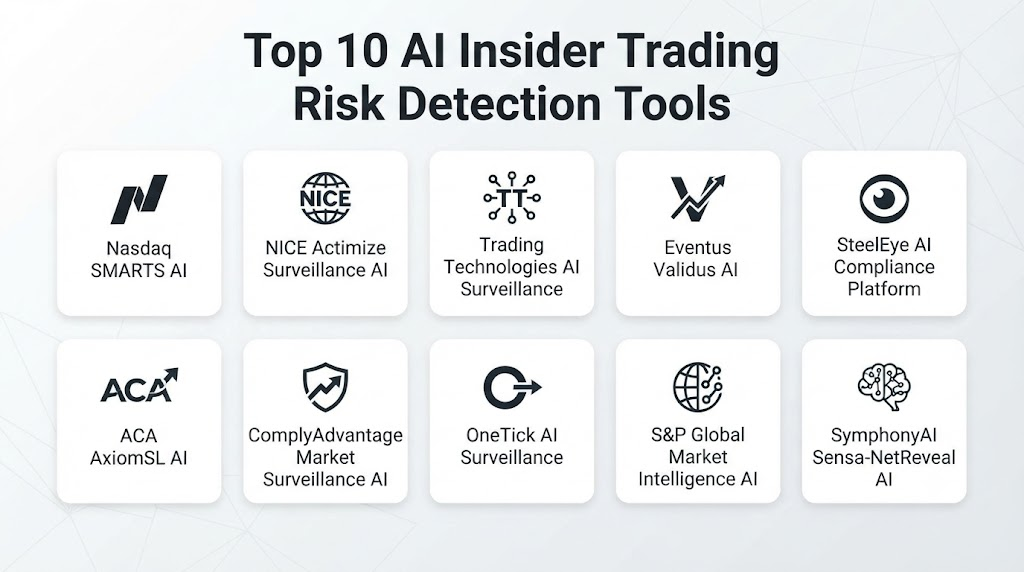
Top 10 AI Insider Trading Risk Detection Tools
1. NICE Actimize Surveillance
NICE Actimize provides AI-powered compliance surveillance solutions for detecting market abuse, insider trading risks, and financial crime activities.
Key Features
- Insider trading surveillance
- Market abuse detection
- AI risk analytics
- Trade monitoring
- Communication analysis
- Alert management
- Investigation workflows
- Risk scoring
- Compliance reporting
- Regulatory support
Pros
- Strong financial crime capabilities
- Enterprise-scale platform
- Advanced analytics
- Supports complex compliance programs
- Broad financial industry adoption
Cons
- Complex implementation
- Enterprise-focused
- Requires configuration
Platforms
Web-based platform.
Deployment or Support
Cloud and enterprise deployment options.
Security & Compliance
Enterprise security controls vary.
Integrations & Ecosystem
Trading systems, compliance platforms, market data systems, and enterprise applications.
Support & Community
Enterprise support.
2. Nasdaq Market Surveillance
Nasdaq provides market surveillance technology to detect suspicious trading activities and market abuse risks.
Key Features
- Market monitoring
- Trade surveillance
- Insider trading detection
- Pattern analysis
- Alert generation
- Market data analytics
- Investigation support
- Compliance reporting
- Risk monitoring
- Regulatory workflows
Pros
- Strong market surveillance expertise
- Extensive market data capabilities
- Trusted financial infrastructure
- Advanced analytics
- Supports regulators and exchanges
Cons
- Enterprise-focused
- Complex requirements
- Pricing varies
Platforms
Web-based platform.
Deployment or Support
Enterprise market surveillance platform.
Security & Compliance
Enterprise controls.
Integrations & Ecosystem
Trading platforms, exchanges, compliance systems, and market data sources.
Support & Community
Professional support.
3. Trading Technologies Surveillance
Trading Technologies provides trading infrastructure and surveillance capabilities for financial markets.
Key Features
- Trade monitoring
- Market surveillance
- Compliance analytics
- Trading activity analysis
- Risk monitoring
- Alert workflows
- Reporting
- Market data integration
- Trading controls
- Investigation support
Pros
- Strong trading ecosystem
- Supports professional markets
- Integrated trading workflows
- Useful monitoring tools
- Enterprise reliability
Cons
- Market-focused solution
- Requires specialized knowledge
- Enterprise deployment
Platforms
Web-based platform.
Deployment or Support
Cloud and enterprise options.
Security & Compliance
Enterprise security controls.
Integrations & Ecosystem
Trading systems, exchanges, and financial platforms.
Support & Community
Professional support.
4. Aquis Market Surveillance
Aquis provides AI-supported market surveillance solutions for detecting trading irregularities.
Key Features
- Market abuse monitoring
- Trading analysis
- Alert generation
- Pattern recognition
- Risk detection
- Compliance workflows
- Market data analysis
- Investigation support
- Reporting
- Surveillance automation
Pros
- Strong market monitoring
- Automated detection
- Useful analytics
- Supports regulated markets
- Compliance-focused
Cons
- Specialized platform
- Market coverage varies
- Enterprise implementation
Platforms
Web-based platform.
Deployment or Support
Cloud-based surveillance platform.
Security & Compliance
Security controls vary.
Integrations & Ecosystem
Market data systems, trading platforms, and compliance tools.
Support & Community
Professional support.
5. Eventus Validus
Eventus Validus provides trade surveillance and risk analytics solutions for financial organizations.
Key Features
- Trade surveillance
- Market abuse detection
- Insider trading monitoring
- Risk analytics
- Alert management
- Compliance workflows
- Data analysis
- Reporting
- Investigation support
- Custom surveillance rules
Pros
- Flexible surveillance capabilities
- Strong financial market focus
- Good analytics
- Supports multiple asset classes
- Customizable workflows
Cons
- Requires configuration
- Enterprise-focused
- Specialized implementation
Platforms
Web-based platform.
Deployment or Support
Cloud-based surveillance platform.
Security & Compliance
Security practices vary.
Integrations & Ecosystem
Trading systems, market data providers, and compliance platforms.
Support & Community
Customer support.
6. S&P Global Market Intelligence
S&P Global Market Intelligence provides financial data, analytics, and risk intelligence capabilities.
Key Features
- Market intelligence
- Risk analytics
- Entity information
- Financial data analysis
- Compliance insights
- Research tools
- Data monitoring
- Reporting
- Market analysis
- Risk assessment
Pros
- Strong financial data resources
- Broad market intelligence
- Enterprise adoption
- Useful analytics
- Global coverage
Cons
- Not exclusively insider trading focused
- Requires integration
- Enterprise pricing
Platforms
Web-based platform.
Deployment or Support
Cloud-based financial intelligence platform.
Security & Compliance
Enterprise controls vary.
Integrations & Ecosystem
Financial systems, research platforms, and compliance tools.
Support & Community
Professional support.
7. Bloomberg Regulatory Intelligence
Bloomberg Regulatory Intelligence provides regulatory monitoring and compliance intelligence for financial organizations.
Key Features
- Regulatory monitoring
- Market intelligence
- Compliance insights
- Risk analysis
- Research tools
- Regulatory updates
- Market information
- Reporting
- Data analysis
- Compliance support
Pros
- Strong regulatory intelligence
- Financial industry expertise
- Extensive information resources
- Professional adoption
- Global coverage
Cons
- Subscription-based
- Requires expertise
- Enterprise-oriented
Platforms
Web-based platform.
Deployment or Support
Cloud-based intelligence platform.
Security & Compliance
Enterprise security controls.
Integrations & Ecosystem
Financial systems, compliance platforms, and research workflows.
Support & Community
Professional support.
8. SteelEye
SteelEye provides financial data analytics and surveillance solutions for compliance teams.
Key Features
- Trade surveillance
- Market abuse detection
- Data analytics
- Risk monitoring
- Compliance workflows
- Communication surveillance
- Reporting
- Data management
- Investigation tools
- Regulatory support
Pros
- Strong data analytics
- Modern compliance platform
- Supports multiple surveillance needs
- Good data management
- Flexible workflows
Cons
- Requires data integration
- Enterprise-focused
- Implementation effort
Platforms
Web-based platform.
Deployment or Support
Cloud-based compliance platform.
Security & Compliance
Enterprise controls vary.
Integrations & Ecosystem
Trading systems, market data platforms, and compliance tools.
Support & Community
Customer support.
9. ACA ComplianceAlpha
ACA ComplianceAlpha provides compliance management and surveillance technology for investment firms.
Key Features
- Employee trading monitoring
- Compliance workflows
- Risk assessment
- Regulatory tracking
- Trade surveillance
- Compliance reporting
- Policy management
- Case management
- Analytics
- Governance tools
Pros
- Strong investment compliance focus
- Supports employee monitoring
- Good compliance workflows
- Useful reporting
- Industry expertise
Cons
- Investment-focused
- Requires configuration
- Enterprise deployment
Platforms
Web-based platform.
Deployment or Support
Cloud-based compliance platform.
Security & Compliance
Security controls vary.
Integrations & Ecosystem
Investment systems, compliance tools, and enterprise applications.
Support & Community
Professional support.
10. Smarsh
Smarsh provides communication surveillance and compliance archiving solutions.
Key Features
- Communication monitoring
- AI analytics
- Message surveillance
- Compliance review
- Risk detection
- Data archiving
- Investigation support
- Reporting
- Policy monitoring
- Workflow management
Pros
- Strong communication monitoring
- Supports compliance teams
- Good data capture
- Useful analytics
- Enterprise adoption
Cons
- Communication-focused
- Requires integration
- Surveillance scope varies
Platforms
Web-based platform.
Deployment or Support
Cloud-based compliance platform.
Security & Compliance
Enterprise controls vary.
Integrations & Ecosystem
Communication systems, compliance platforms, and enterprise applications.
Support & Community
Customer support.
Comparison Table
| Tool Name | Best For | Platform(s) Supported | Deployment | Standout Feature | Public Rating |
|---|---|---|---|---|---|
| NICE Actimize Surveillance | Enterprise surveillance | Web | Cloud/Enterprise | AI risk analytics | N/A |
| Nasdaq Market Surveillance | Market monitoring | Web | Enterprise | Exchange-grade surveillance | N/A |
| Trading Technologies Surveillance | Trading compliance | Web | Cloud | Trading integration | N/A |
| Aquis Market Surveillance | Market abuse detection | Web | Cloud | Pattern recognition | N/A |
| Eventus Validus | Trade surveillance | Web | Cloud | Flexible analytics | N/A |
| S&P Global Market Intelligence | Financial intelligence | Web | Cloud | Market data insights | N/A |
| Bloomberg Regulatory Intelligence | Regulatory monitoring | Web | Cloud | Compliance intelligence | N/A |
| SteelEye | Data-driven surveillance | Web | Cloud | Data analytics | N/A |
| ACA ComplianceAlpha | Investment compliance | Web | Cloud | Employee monitoring | N/A |
| Smarsh | Communication surveillance | Web | Cloud | Message monitoring | N/A |
Weighted Evaluation
| Tool Name | Core Features 25% | Ease of Use 15% | Integrations & Ecosystem 15% | Security & Compliance 10% | Performance & Reliability 10% | Support & Community 10% | Price/Value 15% | Total |
|---|---|---|---|---|---|---|---|---|
| NICE Actimize | 25 | 11 | 15 | 10 | 10 | 10 | 10 | 91 |
| Nasdaq Market Surveillance | 25 | 12 | 15 | 10 | 10 | 10 | 10 | 92 |
| Trading Technologies | 23 | 13 | 14 | 10 | 10 | 10 | 11 | 91 |
| Aquis Market Surveillance | 23 | 13 | 13 | 9 | 10 | 10 | 11 | 89 |
| Eventus Validus | 24 | 13 | 14 | 10 | 10 | 10 | 11 | 92 |
| S&P Global Market Intelligence | 23 | 12 | 15 | 10 | 10 | 10 | 10 | 90 |
| Bloomberg Regulatory Intelligence | 23 | 12 | 15 | 10 | 10 | 10 | 10 | 90 |
| SteelEye | 23 | 14 | 14 | 9 | 10 | 10 | 11 | 91 |
| ACA ComplianceAlpha | 23 | 13 | 13 | 10 | 10 | 10 | 11 | 90 |
| Smarsh | 22 | 14 | 13 | 9 | 10 | 10 | 12 | 90 |
Which AI Insider Trading Risk Detection Tool Is Right for You?
Choose NICE Actimize Surveillance when organizations need enterprise-level compliance surveillance.
Choose Nasdaq Market Surveillance when market monitoring capabilities are the priority.
Choose Trading Technologies Surveillance when integrated trading workflows matter.
Choose Aquis Market Surveillance when market abuse detection is required.
Choose Eventus Validus when flexible trade surveillance is important.
Choose S&P Global Market Intelligence when financial data intelligence is needed.
Choose Bloomberg Regulatory Intelligence when regulatory insights are priorities.
Choose SteelEye when data analytics and surveillance integration matter.
Choose ACA ComplianceAlpha when investment compliance monitoring is required.
Choose Smarsh when communication surveillance supports insider risk detection.
Implementation Playbook
Phase 1: Define Surveillance Requirements
- Identify insider risk scenarios
- Define monitoring objectives
- Select data sources
- Establish investigation workflows
- Determine compliance requirements
Phase 2: Prepare Data Integration
- Connect trading systems
- Integrate communication sources
- Configure employee information
- Review privacy requirements
- Validate data quality
Phase 3: Deploy AI Detection
- Configure risk models
- Monitor trading activity
- Generate alerts
- Review suspicious patterns
- Train compliance teams
Phase 4: Measure Performance
- Track alert quality
- Reduce unnecessary reviews
- Evaluate detection accuracy
- Improve workflows
- Monitor compliance outcomes
Phase 5: Maintain Surveillance Programs
- Update detection rules
- Review market changes
- Improve AI models
- Maintain audit records
- Ensure regulatory alignment
Common Mistakes
- Treating AI alerts as proof of misconduct
- Ignoring human compliance review
- Using incomplete trading data
- Failing to monitor model accuracy
- Ignoring employee privacy requirements
- Poor integration planning
- Not updating surveillance rules
- Overlooking regulatory expectations
FAQs
1. What are AI Insider Trading Risk Detection Tools?
AI Insider Trading Risk Detection Tools use artificial intelligence to analyze trading behavior, communications, and market data to identify potential insider trading risks.
2. How does AI detect insider trading risks?
AI analyzes unusual trading patterns, relationships, timing, and other risk indicators.
3. Can AI prove insider trading violations?
No. AI identifies potential risks, while compliance teams and regulators conduct investigations.
4. What data do insider trading detection systems analyze?
They may analyze trades, employee information, communications, market events, and access to sensitive information.
5. How does machine learning improve surveillance?
Machine learning identifies complex patterns that traditional rules may miss.
6. Are these tools used by financial institutions?
Yes. Banks, investment firms, broker-dealers, and asset managers commonly use surveillance technology.
7. Can AI monitor employee trading activity?
Yes. Many platforms support employee trade monitoring and compliance checks.
8. How important is explainability in AI surveillance?
Explainability helps compliance teams understand alerts and support regulatory reviews.
9. Are AI surveillance tools secure?
Organizations should evaluate security controls, privacy practices, and data protection measures.
10. What should companies consider before choosing an AI insider trading detection tool?
Companies should evaluate detection accuracy, analytics capabilities, integrations, security, scalability, and compliance requirements.
Conclusion
AI Insider Trading Risk Detection Tools are helping financial organizations strengthen market surveillance by combining machine learning, behavioral analytics, and compliance automation. These platforms help identify unusual trading patterns, prioritize investigations, and improve regulatory readiness.Nasdaq Market Surveillance, NICE Actimize, and Eventus Validus provide advanced surveillance capabilities, while SteelEye, ACA ComplianceAlpha, and Smarsh support broader compliance monitoring needs.
