Introduction
AI Data Retention Classification Tools use artificial intelligence, machine learning, natural language processing, and automated data governance capabilities to help organizations classify information, manage retention policies, and control the lifecycle of business data.
Organizations generate massive volumes of structured and unstructured data across cloud platforms, databases, collaboration systems, applications, email systems, and file repositories. Managing how long data should be stored, archived, or deleted has become increasingly complex.
Traditional data retention processes often rely on manual classification, predefined rules, and spreadsheet-based tracking. These approaches can lead to unnecessary data storage, compliance risks, increased operational costs, and difficulty responding to regulatory requirements.
AI-powered data retention classification platforms automatically analyze data content, context, sensitivity, and usage patterns to classify information and recommend appropriate retention actions. Machine learning models help identify sensitive information, apply retention categories, and support automated data lifecycle management.
These tools help organizations:
- Automatically classify data
- Identify sensitive information
- Apply retention policies
- Reduce unnecessary data storage
- Support privacy regulations
- Improve data governance
- Automate information lifecycle management
AI data retention classification solutions are used by:
- Enterprise IT teams
- Data governance teams
- Compliance departments
- Security organizations
- Legal departments
- Financial institutions
- Healthcare organizations
- Government agencies
Modern platforms combine AI classification, content analysis, metadata intelligence, policy automation, data discovery, records management, and compliance workflows.
The goal of these solutions is to help organizations manage data responsibly while maintaining compliance, security, and operational efficiency.
How AI Data Retention Classification Works
Data Discovery
AI systems identify:
- Files
- Documents
- Emails
- Databases
- Cloud storage content
- Collaboration data
Content Classification
Machine learning analyzes:
- Document content
- Metadata
- User behavior
- Data sensitivity
- Business context
Retention Policy Mapping
AI connects data with:
- Retention schedules
- Compliance requirements
- Business rules
- Legal obligations
Lifecycle Management
Platforms automate:
- Archiving
- Data preservation
- Deletion workflows
- Review processes
Continuous Monitoring
AI tracks:
- Data changes
- Classification updates
- Policy compliance
- Retention status
Common Use Cases
- Data lifecycle management
- Records management
- Privacy compliance
- Legal discovery preparation
- Information governance
- Data classification
- Cloud data management
- Regulatory compliance
- Data minimization programs
- Enterprise content management
Why AI Data Retention Classification Tools Matter
Better Data Governance
AI helps organizations understand what information they store.
Reduced Compliance Risk
Automated retention policies help prevent improper data handling.
Lower Storage Costs
Organizations can identify unnecessary data for deletion or archiving.
Faster Data Discovery
AI makes finding relevant information easier.
Improved Privacy Management
Retention automation supports responsible personal data management.
Evaluation Criteria for Buyers
Classification Accuracy
Platforms should correctly identify data categories and sensitivity levels.
AI Capability
Solutions should analyze content, context, and metadata effectively.
Retention Automation
Tools should automate policy application and lifecycle actions.
Integration Support
Important integrations include cloud storage, databases, collaboration tools, and enterprise applications.
Compliance Support
Platforms should support privacy and regulatory requirements.
Security and Privacy
Data classification systems require strong protection.
Scalability
Solutions should handle large enterprise data environments.
Key Trends
AI-Based Data Classification
Organizations are using machine learning to automatically categorize information.
Automated Data Lifecycle Management
Businesses are moving toward intelligent retention and deletion workflows.
Privacy-Driven Data Minimization
Organizations are reducing unnecessary data storage.
Cloud Data Governance
AI tools are helping manage information across cloud environments.
Intelligent Records Management
AI is improving enterprise records classification.
Responsible AI Data Governance
Organizations are focusing on controlling AI-related data usage.
Methodology
The following platforms were evaluated using:
- AI data classification capabilities
- Retention management features
- Data governance functionality
- Ease of use
- Integrations and ecosystem
- Security and privacy
- Performance and reliability
- Support and community
- Price and value
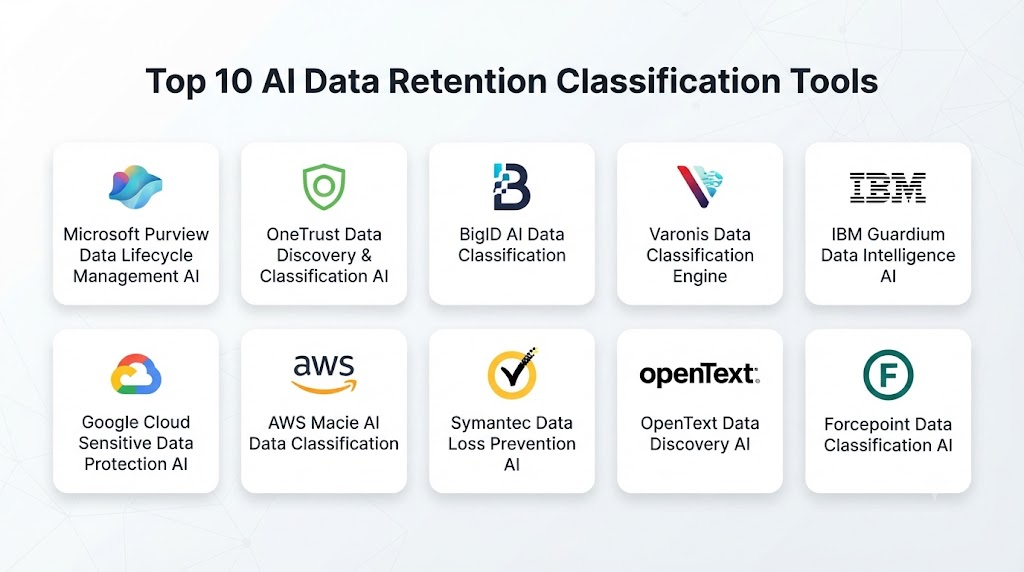
Top 10 AI Data Retention Classification Tools
1. Microsoft Purview Data Lifecycle Management
Microsoft Purview provides data governance, classification, retention, and lifecycle management capabilities.
Key Features
- Data classification
- Retention labels
- Information governance
- Data discovery
- Compliance policies
- Records management
- Sensitivity labeling
- Data lifecycle automation
- Reporting dashboards
- Risk management
Pros
- Strong enterprise integration
- Broad Microsoft ecosystem support
- Powerful classification capabilities
- Good compliance features
- Scalable for large organizations
Cons
- Best suited for Microsoft environments
- Configuration complexity
- Requires governance planning
Platforms
Cloud-based platform.
Deployment or Support
Enterprise cloud deployment.
Security & Compliance
Enterprise security controls.
Integrations & Ecosystem
Microsoft 365, cloud services, security platforms, and enterprise applications.
Support & Community
Enterprise support.
2. IBM Watson Discovery
IBM Watson Discovery provides AI-powered content analysis and document intelligence capabilities.
Key Features
- AI content analysis
- Document classification
- Natural language processing
- Data extraction
- Search capabilities
- Content insights
- Document understanding
- Analytics
- Knowledge discovery
- Workflow support
Pros
- Strong AI text analysis
- Good document intelligence
- Supports complex information environments
- Enterprise capabilities
- Advanced search
Cons
- Requires technical expertise
- Implementation effort
- Enterprise-focused
Platforms
Cloud-based platform.
Deployment or Support
Cloud and enterprise deployment options.
Security & Compliance
Security controls vary.
Integrations & Ecosystem
Enterprise applications, content repositories, and data platforms.
Support & Community
Enterprise support.
3. Google Cloud Sensitive Data Protection
Google Cloud Sensitive Data Protection provides data discovery, classification, and sensitive information management capabilities.
Key Features
- Data discovery
- Sensitive data detection
- Data classification
- Privacy protection
- Risk analysis
- Data inspection
- Cloud data governance
- Reporting
- Automation
- Security controls
Pros
- Strong cloud data discovery
- Advanced classification
- Scalable infrastructure
- Good automation
- Cloud-native capabilities
Cons
- Best suited for Google Cloud environments
- Requires technical expertise
- Configuration required
Platforms
Cloud platform.
Deployment or Support
Cloud-based deployment.
Security & Compliance
Enterprise security controls.
Integrations & Ecosystem
Cloud storage, databases, analytics platforms, and security systems.
Support & Community
Enterprise support.
4. AWS Amazon Macie
Amazon Macie provides machine learning-based data discovery and sensitive data classification.
Key Features
- Sensitive data discovery
- Machine learning classification
- Data security analysis
- Privacy monitoring
- Risk identification
- Data inventory
- Alerts
- Reporting
- Cloud data protection
- Security insights
Pros
- Strong AWS integration
- Automated sensitive data discovery
- Cloud-native architecture
- Useful security insights
- Scalable platform
Cons
- AWS-focused
- Requires cloud expertise
- Limited outside AWS environments
Platforms
Cloud platform.
Deployment or Support
AWS cloud service.
Security & Compliance
AWS security controls.
Integrations & Ecosystem
AWS services, security tools, and cloud applications.
Support & Community
AWS support ecosystem.
5. BigID Data Intelligence Platform
BigID provides AI-powered data discovery, classification, and governance capabilities.
Key Features
- Data discovery
- Data classification
- Sensitive data detection
- Data mapping
- Privacy management
- Retention analysis
- Data governance
- Risk assessment
- Analytics
- Automation
Pros
- Strong AI classification
- Broad data discovery
- Supports complex environments
- Good governance capabilities
- Enterprise scalability
Cons
- Requires implementation
- Complex environments need expertise
- Enterprise-focused
Platforms
Cloud-based platform.
Deployment or Support
Cloud and enterprise deployment.
Security & Compliance
Enterprise security controls.
Integrations & Ecosystem
Cloud platforms, databases, applications, and governance systems.
Support & Community
Enterprise support.
6. Collibra Data Intelligence Cloud
Collibra provides data governance and intelligence capabilities.
Key Features
- Data catalog
- Data classification
- Data governance
- Data lineage
- Policy management
- Compliance support
- Metadata management
- Data workflows
- Collaboration
- Reporting
Pros
- Strong governance platform
- Enterprise adoption
- Good data visibility
- Supports complex organizations
- Comprehensive metadata management
Cons
- Requires implementation
- Enterprise-focused
- Configuration complexity
Platforms
Cloud-based platform.
Deployment or Support
Cloud deployment.
Security & Compliance
Enterprise security controls.
Integrations & Ecosystem
Data platforms, analytics tools, enterprise systems, and GRC solutions.
Support & Community
Enterprise support.
7. OpenText Information Governance
OpenText provides enterprise information governance and records management solutions.
Key Features
- Records management
- Data classification
- Retention policies
- Information lifecycle management
- Content governance
- Compliance workflows
- Document management
- Archiving
- Reporting
- Policy enforcement
Pros
- Strong enterprise content management
- Good records management
- Compliance-focused
- Supports large organizations
- Mature platform
Cons
- Complex deployment
- Requires expertise
- Enterprise-focused
Platforms
Web-based enterprise platform.
Deployment or Support
Cloud and enterprise deployment.
Security & Compliance
Enterprise security controls.
Integrations & Ecosystem
Content systems, enterprise applications, and governance platforms.
Support & Community
Enterprise support.
8. Veritas Enterprise Vault
Veritas Enterprise Vault provides information archiving and retention management capabilities.
Key Features
- Data archiving
- Retention management
- Records classification
- Email archiving
- Information governance
- Search capabilities
- Compliance support
- Data lifecycle management
- Policy automation
- Reporting
Pros
- Strong archiving capabilities
- Enterprise adoption
- Good retention controls
- Compliance support
- Mature technology
Cons
- More focused on archiving
- Requires administration
- Enterprise deployment
Platforms
Enterprise software platform.
Deployment or Support
Cloud and enterprise options.
Security & Compliance
Enterprise security controls.
Integrations & Ecosystem
Email systems, content platforms, and enterprise applications.
Support & Community
Professional support.
9. Informatica Intelligent Data Management Cloud
Informatica provides AI-powered data management and governance capabilities.
Key Features
- Data discovery
- Data classification
- Data governance
- Metadata management
- Data quality
- Data lineage
- Policy management
- Automation
- Analytics
- Compliance support
Pros
- Strong data management capabilities
- AI-powered governance
- Enterprise scalability
- Good integration options
- Comprehensive platform
Cons
- Requires expertise
- Complex implementation
- Enterprise-focused
Platforms
Cloud-based platform.
Deployment or Support
Cloud deployment.
Security & Compliance
Enterprise security controls.
Integrations & Ecosystem
Data platforms, databases, cloud systems, and enterprise applications.
Support & Community
Enterprise support.
10. OneTrust Data Discovery
OneTrust provides privacy, data discovery, and governance capabilities.
Key Features
- Data discovery
- Data classification
- Privacy management
- Data mapping
- Retention policies
- Risk assessment
- Compliance workflows
- Reporting
- Automation
- Governance tools
Pros
- Strong privacy capabilities
- Good data discovery
- Compliance-focused
- Enterprise adoption
- Broad ecosystem
Cons
- Platform complexity
- Requires configuration
- Enterprise-oriented
Platforms
Cloud-based platform.
Deployment or Support
Cloud deployment.
Security & Compliance
Enterprise security controls.
Integrations & Ecosystem
Privacy platforms, GRC systems, data tools, and enterprise applications.
Support & Community
Enterprise support.
Comparison Table
| Tool Name | Best For | Platform(s) Supported | Deployment | Standout Feature | Public Rating |
|---|---|---|---|---|---|
| Microsoft Purview | Enterprise retention management | Cloud | Cloud | Retention automation | N/A |
| IBM Watson Discovery | AI content analysis | Cloud | Cloud | NLP classification | N/A |
| Google Sensitive Data Protection | Cloud data discovery | Cloud | Cloud | Sensitive data detection | N/A |
| Amazon Macie | AWS data classification | Cloud | AWS Cloud | ML data discovery | N/A |
| BigID | Data intelligence | Cloud | Cloud | AI classification | N/A |
| Collibra | Data governance | Cloud | Cloud | Data intelligence | N/A |
| OpenText Information Governance | Records management | Web | Enterprise | Information lifecycle | N/A |
| Veritas Enterprise Vault | Archiving | Enterprise | Cloud/Enterprise | Retention controls | N/A |
| Informatica IDMC | Data management | Cloud | Cloud | Data governance | N/A |
| OneTrust Data Discovery | Privacy governance | Cloud | Cloud | Privacy data mapping | N/A |
Weighted Evaluation
| Tool Name | Core Features 25% | Ease of Use 15% | Integrations & Ecosystem 15% | Security & Compliance 10% | Performance & Reliability 10% | Support & Community 10% | Price/Value 15% | Total |
|---|---|---|---|---|---|---|---|---|
| Microsoft Purview | 25 | 13 | 15 | 10 | 10 | 10 | 11 | 94 |
| IBM Watson Discovery | 23 | 12 | 14 | 10 | 10 | 10 | 11 | 90 |
| Google Sensitive Data Protection | 24 | 13 | 15 | 10 | 10 | 10 | 11 | 93 |
| Amazon Macie | 23 | 14 | 15 | 10 | 10 | 10 | 12 | 94 |
| BigID | 25 | 12 | 14 | 10 | 10 | 10 | 11 | 92 |
| Collibra | 24 | 12 | 15 | 10 | 10 | 10 | 10 | 91 |
| OpenText Information Governance | 23 | 11 | 14 | 10 | 10 | 10 | 10 | 88 |
| Veritas Enterprise Vault | 22 | 12 | 14 | 10 | 10 | 10 | 11 | 89 |
| Informatica IDMC | 24 | 11 | 15 | 10 | 10 | 10 | 10 | 90 |
| OneTrust Data Discovery | 24 | 12 | 14 | 10 | 10 | 10 | 11 | 91 |
Which AI Data Retention Classification Tool Is Right for You?
Choose Microsoft Purview when organizations need enterprise retention and governance within Microsoft environments.
Choose IBM Watson Discovery when AI-powered document analysis is important.
Choose Google Sensitive Data Protection when cloud data classification is required.
Choose Amazon Macie when AWS-based sensitive data discovery is the priority.
Choose BigID when advanced data intelligence and classification are needed.
Choose Collibra when enterprise data governance is the main requirement.
Choose OpenText Information Governance when records management is important.
Choose Veritas Enterprise Vault when archiving and retention control are priorities.
Choose Informatica Intelligent Data Management Cloud when enterprise data governance is required.
Choose OneTrust Data Discovery when privacy-focused retention management is needed.
Implementation Playbook
Phase 1: Define Data Retention Goals
- Identify data categories
- Define retention requirements
- Review regulations
- Establish ownership
- Create governance policies
Phase 2: Discover Data Sources
- Connect storage systems
- Scan repositories
- Identify sensitive information
- Classify data types
- Validate results
Phase 3: Deploy AI Classification
- Apply classification models
- Map retention policies
- Automate lifecycle actions
- Review AI recommendations
- Configure workflows
Phase 4: Monitor Data Lifecycle
- Track retention status
- Review policy compliance
- Identify outdated data
- Improve classification accuracy
- Generate reports
Phase 5: Maintain Governance
- Update retention rules
- Review regulatory changes
- Improve AI models
- Monitor data growth
- Maintain documentation
Common Mistakes
- Keeping data longer than necessary
- Applying incorrect retention policies
- Ignoring unstructured data
- Failing to validate AI classifications
- Poor data discovery practices
- Not integrating systems
- Ignoring privacy requirements
- Treating AI classification as fully automatic
FAQs
1. What are AI Data Retention Classification Tools?
AI Data Retention Classification Tools use artificial intelligence to classify data and help organizations manage retention and lifecycle policies.
2. How does AI improve data retention management?
AI analyzes content, context, and metadata to automatically classify information and recommend retention actions.
3. Can AI identify sensitive data?
Many platforms can detect sensitive information such as personal, financial, or confidential data.
4. Why is data retention important?
Proper retention management helps organizations reduce risk, control storage costs, and support compliance requirements.
5. Can AI automatically delete data?
Some platforms support automated lifecycle actions, but organizations typically configure approval and governance processes.
6. What types of data can these tools classify?
They can classify documents, emails, databases, cloud files, and other enterprise information.
7. Are AI data retention tools useful for privacy compliance?
Yes. They help organizations manage data minimization and retention requirements.
8. Can these tools work with cloud platforms?
Many solutions integrate with cloud storage, databases, and enterprise applications.
9. How accurate is AI data classification?
Accuracy depends on data quality, configuration, models, and human review processes.
10. What should organizations consider before choosing an AI data retention classification tool?
Organizations should evaluate classification accuracy, integrations, compliance support, security, scalability, and cost.
Conclusion
AI Data Retention Classification Tools are helping organizations manage growing volumes of information by combining artificial intelligence, data governance, and automated lifecycle management.Microsoft Purview, Amazon Macie, Google Sensitive Data Protection, and BigID provide strong classification capabilities, while Collibra, OneTrust, and Informatica support broader data governance programs.The most effective data retention strategy combines AI automation with clear policies, human oversight, and continuous governance. AI should help organizations store the right data for the right period while improving compliance, security, and operational efficiency.
