Introduction
AI GRC Evidence Collection Tools use artificial intelligence, machine learning, automation, and intelligent document processing to help organizations collect, organize, validate, and manage compliance evidence for governance, risk, and compliance (GRC) programs.
Modern organizations must demonstrate compliance with various security frameworks, industry regulations, and internal controls. Compliance teams often spend significant time collecting screenshots, documents, system reports, access records, audit logs, and other evidence required for audits.
Traditional evidence collection processes are often manual, repetitive, and difficult to maintain. Teams may rely on spreadsheets, emails, shared folders, and disconnected systems, creating challenges such as missing documentation, delayed audits, and inconsistent evidence management.
AI-powered GRC evidence collection platforms automate evidence gathering by connecting with business systems, security tools, cloud platforms, and enterprise applications. Machine learning helps classify evidence, identify gaps, map controls, and improve audit readiness.
These tools help organizations:
- Automate compliance evidence collection
- Reduce manual audit preparation work
- Maintain organized evidence repositories
- Map evidence to compliance controls
- Improve audit readiness
- Identify missing documentation
- Support continuous compliance monitoring
AI GRC evidence collection solutions are used by:
- Security teams
- Compliance departments
- Risk management teams
- IT organizations
- SaaS companies
- Financial institutions
- Healthcare organizations
- Enterprise businesses
Modern platforms combine AI document analysis, automated integrations, control mapping, workflow automation, compliance dashboards, and audit management capabilities.
The goal of these solutions is to help organizations maintain continuous compliance visibility and simplify audit processes.
How AI GRC Evidence Collection Tools Work
Evidence Discovery
AI systems collect evidence from:
- Cloud platforms
- Security tools
- Identity systems
- HR applications
- Business software
- Documentation repositories
Automated Collection
Platforms automatically gather:
- Security configurations
- Access records
- Policies
- Logs
- Reports
- Compliance documents
Evidence Classification
AI identifies:
- Evidence type
- Related control
- Compliance requirement
- Review status
Control Mapping
AI connects evidence with:
- Security frameworks
- Internal controls
- Audit requirements
Continuous Monitoring
Platforms track:
- Evidence changes
- Control status
- Compliance gaps
- Audit readiness
Common Use Cases
- SOC compliance preparation
- ISO compliance management
- Security audits
- Internal control testing
- Risk assessments
- Regulatory compliance
- Vendor audits
- Continuous compliance monitoring
- Policy management
- Audit evidence management
Why AI GRC Evidence Collection Tools Matter
Faster Audit Preparation
Automation reduces the time required to collect compliance evidence.
Improved Accuracy
AI helps organize and classify evidence consistently.
Continuous Compliance
Organizations can monitor controls continuously instead of preparing only before audits.
Reduced Manual Work
Compliance teams spend less time gathering documentation.
Better Audit Visibility
Dashboards provide clearer understanding of compliance status.
Evaluation Criteria for Buyers
Automation Capability
Platforms should collect evidence automatically from connected systems.
Framework Support
Solutions should support common compliance frameworks.
AI Intelligence
Strong tools should classify evidence and identify compliance gaps.
Integration Capability
Important integrations include cloud platforms, security tools, HR systems, and GRC applications.
Reporting and Analytics
Organizations need clear compliance dashboards.
Security and Privacy
Compliance evidence requires strong data protection.
Ease of Use
The platform should be accessible for security and compliance teams.
Key Trends
Continuous Compliance Monitoring
Organizations are moving from periodic audits toward continuous evidence collection.
AI-Based Evidence Classification
Machine learning is helping categorize and map compliance evidence automatically.
Automated Audit Readiness
AI platforms are reducing preparation time for security certifications.
Cloud-Native Compliance
Organizations are integrating cloud infrastructure directly with compliance workflows.
Generative AI Compliance Assistance
AI assistants are helping summarize evidence and prepare audit documentation.
Integrated GRC Operations
Evidence collection is becoming connected with broader risk and governance processes.
Methodology
The following platforms were evaluated using:
- Evidence collection automation
- AI capabilities
- Compliance framework support
- Ease of use
- Integrations and ecosystem
- Security and privacy
- Performance and reliability
- Support and community
- Price and value
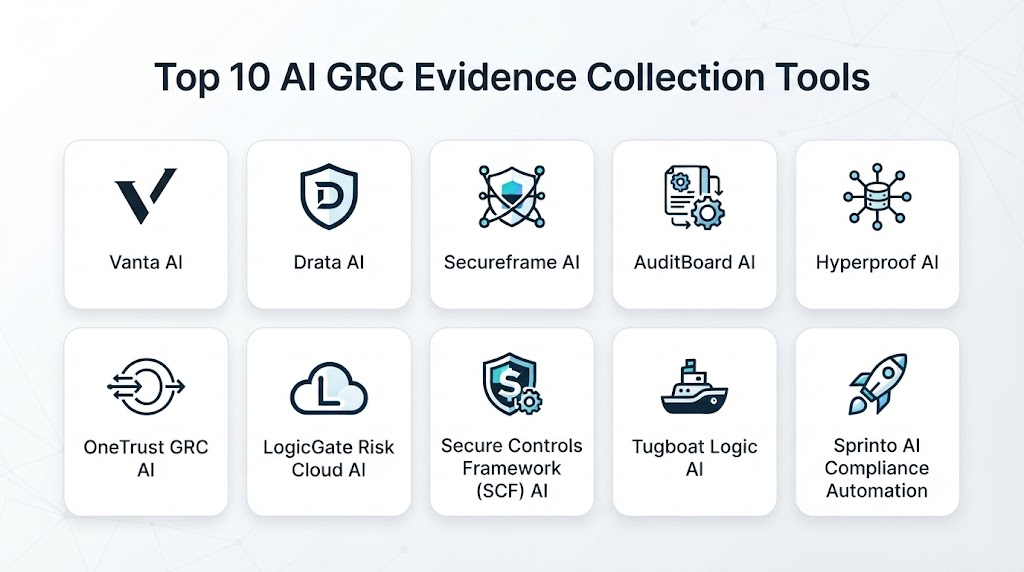
Top 10 AI GRC Evidence Collection Tools
1. Drata
Drata provides automated compliance management and evidence collection capabilities for organizations preparing for security and compliance audits.
Key Features
- Automated evidence collection
- Compliance monitoring
- Control tracking
- Audit preparation
- Policy management
- Security integrations
- Compliance dashboards
- Risk management
- Framework mapping
- Reporting
Pros
- Strong automation capabilities
- Simplifies audit preparation
- Good integrations
- Continuous monitoring support
- User-friendly interface
Cons
- Framework-focused approach
- Requires system integrations
- Enterprise needs may require customization
Platforms
Web-based platform.
Deployment or Support
Cloud-based compliance platform.
Security & Compliance
Security controls vary.
Integrations & Ecosystem
Cloud platforms, security tools, identity systems, and business applications.
Support & Community
Customer support.
2. Vanta
Vanta provides automated compliance monitoring and evidence collection for security frameworks.
Key Features
- Automated evidence collection
- Control monitoring
- Compliance automation
- Audit readiness
- Security integrations
- Risk tracking
- Policy management
- Compliance reporting
- Framework support
- Continuous monitoring
Pros
- Easy implementation
- Strong automation
- Good user experience
- Helpful compliance workflows
- Supports growing companies
Cons
- Focused compliance scope
- Advanced enterprise needs vary
- Requires connected systems
Platforms
Web-based platform.
Deployment or Support
Cloud-based compliance platform.
Security & Compliance
Security controls vary.
Integrations & Ecosystem
Security tools, cloud platforms, identity providers, and business systems.
Support & Community
Customer support.
3. Secureframe
Secureframe provides automated compliance and security audit preparation capabilities.
Key Features
- Evidence collection
- Compliance automation
- Control monitoring
- Audit preparation
- Policy management
- Security integrations
- Risk assessments
- Reporting
- Framework management
- Compliance workflows
Pros
- Strong automation focus
- Simplifies certification preparation
- Good security integrations
- Easy compliance tracking
- Suitable for startups and enterprises
Cons
- Requires integration setup
- Compliance coverage varies
- Advanced workflows may need configuration
Platforms
Web-based platform.
Deployment or Support
Cloud-based compliance platform.
Security & Compliance
Security controls vary.
Integrations & Ecosystem
Cloud providers, security tools, and enterprise applications.
Support & Community
Customer support.
4. Hyperproof
Hyperproof provides compliance operations automation and evidence management capabilities.
Key Features
- Evidence management
- Control tracking
- Compliance workflows
- Audit preparation
- Risk management
- Evidence requests
- Reporting dashboards
- Policy management
- Collaboration tools
- Framework mapping
Pros
- Strong compliance operations
- Good workflow management
- Useful dashboards
- Supports multiple frameworks
- Collaboration features
Cons
- Requires configuration
- Integration planning needed
- Enterprise features vary
Platforms
Web-based platform.
Deployment or Support
Cloud-based GRC platform.
Security & Compliance
Security controls vary.
Integrations & Ecosystem
Security systems, business applications, and compliance platforms.
Support & Community
Customer support.
5. AuditBoard
AuditBoard provides audit, risk, and compliance management capabilities.
Key Features
- Audit evidence management
- Risk assessments
- Control testing
- Compliance workflows
- Documentation management
- Reporting
- Collaboration
- Audit planning
- Issue tracking
- Analytics
Pros
- Strong audit workflows
- Good collaboration features
- Useful reporting
- Enterprise adoption
- Compliance-focused
Cons
- More audit-focused
- Requires implementation
- Advanced automation varies
Platforms
Web-based platform.
Deployment or Support
Cloud-based audit platform.
Security & Compliance
Security controls vary.
Integrations & Ecosystem
Business systems, GRC tools, and enterprise applications.
Support & Community
Customer support.
6. LogicGate Risk Cloud
LogicGate provides customizable GRC workflows for managing evidence, risks, and compliance processes.
Key Features
- Evidence workflows
- Risk assessments
- Compliance management
- Control tracking
- Workflow automation
- Reporting
- Collaboration
- Custom applications
- Task management
- Governance support
Pros
- Flexible workflows
- Customizable platform
- Good automation
- Supports multiple risk programs
- User-friendly design
Cons
- Requires configuration
- Customization needs expertise
- Enterprise deployment considerations
Platforms
Web-based platform.
Deployment or Support
Cloud-based GRC platform.
Security & Compliance
Security controls vary.
Integrations & Ecosystem
Enterprise systems, security platforms, and business applications.
Support & Community
Customer support.
7. OneTrust GRC
OneTrust provides governance, risk, privacy, and compliance management solutions.
Key Features
- Evidence management
- Risk assessments
- Compliance workflows
- Privacy management
- Control monitoring
- Reporting
- Policy management
- Vendor risk management
- Automation
- Governance tools
Pros
- Broad GRC capabilities
- Strong privacy features
- Enterprise adoption
- Large ecosystem
- Comprehensive workflows
Cons
- Complex platform
- Requires configuration
- Enterprise-focused
Platforms
Web-based platform.
Deployment or Support
Cloud-based enterprise platform.
Security & Compliance
Enterprise security controls.
Integrations & Ecosystem
GRC systems, security tools, privacy platforms, and enterprise applications.
Support & Community
Enterprise support.
8. ServiceNow Integrated Risk Management
ServiceNow IRM provides enterprise governance, risk, and compliance workflow automation.
Key Features
- Compliance workflows
- Evidence management
- Risk management
- Control monitoring
- Audit support
- Reporting dashboards
- Workflow automation
- Policy management
- Enterprise integrations
- Governance capabilities
Pros
- Strong enterprise workflows
- Broad ecosystem
- Scalable platform
- Powerful automation
- Integration capabilities
Cons
- Complex implementation
- Requires expertise
- Enterprise pricing
Platforms
Web-based platform.
Deployment or Support
Cloud-based enterprise platform.
Security & Compliance
Enterprise security controls.
Integrations & Ecosystem
Enterprise systems, security platforms, and business applications.
Support & Community
Enterprise support.
9. Sprinto
Sprinto provides automated compliance and security readiness solutions.
Key Features
- Automated evidence collection
- Compliance monitoring
- Security checks
- Audit preparation
- Policy management
- Risk tracking
- Framework support
- Reporting
- Workflow automation
- Integrations
Pros
- Easy compliance automation
- Good for SaaS companies
- Fast setup
- Helpful workflows
- User-friendly
Cons
- Scope depends on framework
- Enterprise requirements vary
- Integration required
Platforms
Web-based platform.
Deployment or Support
Cloud-based compliance platform.
Security & Compliance
Security controls vary.
Integrations & Ecosystem
Cloud platforms, security systems, and business applications.
Support & Community
Customer support.
10. Tugboat Logic
Tugboat Logic provides compliance automation and security program management capabilities.
Key Features
- Evidence management
- Compliance automation
- Security policies
- Risk assessments
- Framework mapping
- Audit preparation
- Documentation
- Control management
- Reporting
- Security program guidance
Pros
- Simplifies compliance programs
- Good documentation support
- Helpful for growing organizations
- Easy workflows
- Security-focused
Cons
- Less suited for complex enterprises
- Requires configuration
- Advanced analytics vary
Platforms
Web-based platform.
Deployment or Support
Cloud-based compliance platform.
Security & Compliance
Security controls vary.
Integrations & Ecosystem
Security tools, cloud platforms, and business applications.
Support & Community
Customer support.
Comparison Table
| Tool Name | Best For | Platform(s) Supported | Deployment | Standout Feature | Public Rating |
|---|---|---|---|---|---|
| Drata | Automated compliance evidence | Web | Cloud | Evidence automation | N/A |
| Vanta | Continuous compliance | Web | Cloud | Monitoring workflows | N/A |
| Secureframe | Security compliance automation | Web | Cloud | Audit readiness | N/A |
| Hyperproof | Compliance operations | Web | Cloud | Evidence management | N/A |
| AuditBoard | Audit management | Web | Cloud | Audit workflows | N/A |
| LogicGate Risk Cloud | Custom GRC workflows | Web | Cloud | Workflow flexibility | N/A |
| OneTrust GRC | Enterprise GRC | Web | Cloud | Governance ecosystem | N/A |
| ServiceNow IRM | Enterprise compliance | Web | Cloud | Workflow automation | N/A |
| Sprinto | SaaS compliance | Web | Cloud | Compliance automation | N/A |
| Tugboat Logic | Security programs | Web | Cloud | Compliance guidance | N/A |
Weighted Evaluation
| Tool Name | Core Features 25% | Ease of Use 15% | Integrations & Ecosystem 15% | Security & Compliance 10% | Performance & Reliability 10% | Support & Community 10% | Price/Value 15% | Total |
|---|---|---|---|---|---|---|---|---|
| Drata | 24 | 15 | 13 | 9 | 10 | 10 | 13 | 94 |
| Vanta | 24 | 15 | 13 | 9 | 10 | 10 | 13 | 94 |
| Secureframe | 23 | 15 | 13 | 9 | 10 | 10 | 13 | 93 |
| Hyperproof | 24 | 13 | 13 | 10 | 10 | 10 | 11 | 91 |
| AuditBoard | 23 | 14 | 13 | 10 | 10 | 10 | 11 | 91 |
| LogicGate Risk Cloud | 23 | 14 | 13 | 9 | 10 | 10 | 12 | 91 |
| OneTrust GRC | 25 | 12 | 15 | 10 | 10 | 10 | 10 | 92 |
| ServiceNow IRM | 25 | 11 | 15 | 10 | 10 | 10 | 10 | 91 |
| Sprinto | 22 | 15 | 12 | 9 | 10 | 10 | 13 | 91 |
| Tugboat Logic | 21 | 14 | 12 | 9 | 10 | 10 | 12 | 88 |
Which AI GRC Evidence Collection Tool Is Right for You?
Choose Drata when organizations need automated compliance evidence collection and audit readiness.
Choose Vanta when continuous compliance monitoring is important.
Choose Secureframe when security certification preparation is the priority.
Choose Hyperproof when compliance operations and evidence management matter.
Choose AuditBoard when audit workflows are the primary requirement.
Choose LogicGate Risk Cloud when customizable GRC workflows are needed.
Choose OneTrust GRC when broad governance and compliance management are required.
Choose ServiceNow IRM when enterprise workflow automation is needed.
Choose Sprinto when SaaS compliance automation is important.
Choose Tugboat Logic when organizations need guided security compliance management.
Implementation Playbook
Phase 1: Define Compliance Requirements
- Identify frameworks
- Define evidence requirements
- Map controls
- Assign responsibilities
- Establish audit goals
Phase 2: Connect Data Sources
- Integrate security tools
- Connect cloud systems
- Import documentation
- Configure permissions
- Validate evidence sources
Phase 3: Deploy AI Evidence Collection
- Automate evidence gathering
- Map evidence to controls
- Review AI classifications
- Track compliance status
- Manage audit workflows
Phase 4: Measure Improvement
- Reduce audit preparation time
- Monitor evidence quality
- Review compliance gaps
- Improve workflows
- Collect team feedback
Phase 5: Maintain Continuous Compliance
- Update controls
- Review evidence regularly
- Monitor system changes
- Improve automation
- Maintain audit readiness
Common Mistakes
- Collecting evidence only before audits
- Ignoring evidence quality
- Poor system integration
- Not mapping evidence to controls
- Failing to review AI classifications
- Ignoring security requirements
- Not maintaining documentation
- Treating automation as a complete compliance solution
FAQs
1. What are AI GRC Evidence Collection Tools?
AI GRC Evidence Collection Tools use artificial intelligence to automatically collect, organize, and manage compliance evidence for audits and governance programs.
2. How does AI improve evidence collection?
AI automates data gathering, classifies evidence, maps controls, and identifies missing documentation.
3. Can AI replace compliance teams?
No. AI supports compliance professionals by reducing manual work and improving efficiency.
4. What type of evidence can these tools collect?
They can collect security configurations, documents, reports, access records, policies, and audit-related information.
5. Which compliance frameworks do these tools support?
Many platforms support frameworks such as SOC, ISO, privacy standards, and security compliance requirements.
6. Are AI evidence collection tools useful for audits?
Yes. They help organizations maintain organized evidence and improve audit preparation.
7. Can these platforms integrate with cloud systems?
Many solutions connect with cloud providers, security tools, identity systems, and business applications.
8. How secure is compliance evidence stored in these platforms?
Organizations should evaluate encryption, access controls, and security practices before adoption.
9. Do AI tools provide continuous compliance monitoring?
Many platforms provide ongoing monitoring and automated evidence updates.
10. What should organizations consider before selecting an AI GRC evidence collection tool?
Organizations should evaluate automation features, framework support, integrations, security, scalability, and cost.
Conclusion
AI GRC Evidence Collection Tools are helping organizations modernize compliance operations by automating evidence gathering, improving audit readiness, and providing continuous visibility into control performance.Drata, Vanta, and Secureframe provide strong automated compliance capabilities, while Hyperproof, AuditBoard, OneTrust, and ServiceNow support broader enterprise governance needs.The most effective compliance strategy combines AI-powered automation with strong governance, human review, and continuous improvement. AI should help organizations reduce manual compliance effort while improving accuracy, transparency, and audit confidence.
