Introduction
AI Third-Party Risk Analytics Tools use artificial intelligence, machine learning, natural language processing, and risk intelligence technologies to help organizations identify, assess, monitor, and manage risks associated with vendors, suppliers, partners, and external service providers.
Modern businesses increasingly depend on third-party organizations for cloud services, software platforms, logistics, financial services, infrastructure, and operational support. While these relationships create business advantages, they also introduce risks related to cybersecurity, compliance, operational resilience, privacy, financial stability, and regulatory requirements.
Traditional third-party risk management processes often rely on questionnaires, spreadsheets, manual reviews, and periodic assessments. These methods can be slow, difficult to scale, and unable to provide continuous visibility into changing vendor risks.
AI-powered third-party risk analytics platforms automate vendor assessments by analyzing security data, compliance information, financial signals, threat intelligence, regulatory requirements, and business relationships. Machine learning models help identify risk patterns, prioritize vendors, and provide actionable insights.
These tools help organizations:
- Assess vendor risk automatically
- Monitor third-party security posture
- Identify high-risk suppliers
- Improve due diligence processes
- Automate risk scoring
- Support compliance requirements
- Enable continuous monitoring
AI third-party risk solutions are used by:
- Enterprise organizations
- Financial institutions
- Healthcare companies
- Technology companies
- Procurement teams
- Security departments
- Compliance teams
Modern AI third-party risk platforms combine risk intelligence, machine learning, security ratings, vendor monitoring, workflow automation, analytics dashboards, and governance capabilities.
The goal of these solutions is to help organizations maintain stronger visibility and control over third-party risks.
How AI Third-Party Risk Analytics Works
Vendor Data Collection
AI systems collect information from:
- Vendor questionnaires
- Security assessments
- Public records
- Compliance documents
- Threat intelligence sources
- Business databases
Risk Analysis
Machine learning analyzes:
- Security vulnerabilities
- Compliance gaps
- Financial risks
- Operational concerns
- Business dependencies
Risk Scoring
AI assigns risk levels based on:
- Vendor profile
- Security posture
- Industry requirements
- Historical information
- External signals
Continuous Monitoring
Platforms track:
- Security changes
- Compliance updates
- Threat indicators
- Vendor incidents
Reporting and Workflow
Organizations receive:
- Risk dashboards
- Vendor rankings
- Assessment reports
- Remediation tasks
Common Use Cases
- Vendor risk management
- Supplier security assessment
- Third-party cybersecurity monitoring
- Procurement risk evaluation
- Compliance assessments
- Supply chain risk management
- Cloud vendor analysis
- Regulatory compliance
- Partner risk monitoring
- Business continuity planning
Why AI Third-Party Risk Analytics Tools Matter
Continuous Risk Visibility
AI helps organizations monitor vendor risks beyond periodic assessments.
Faster Vendor Assessment
Automation reduces the time required for vendor reviews.
Improved Risk Prioritization
Organizations can focus resources on higher-risk third parties.
Better Compliance Management
AI supports regulatory and governance requirements.
Scalable Vendor Management
Organizations can manage large supplier ecosystems efficiently.
Evaluation Criteria for Buyers
Risk Intelligence Quality
Platforms should provide accurate and useful vendor risk information.
AI Analytics Capability
Strong solutions should identify patterns and predict potential risks.
Continuous Monitoring
Tools should detect changes in vendor risk profiles.
Workflow Automation
Solutions should support assessments, approvals, and remediation tracking.
Integration Capability
Important integrations include GRC platforms, security tools, procurement systems, and enterprise applications.
Security and Privacy
Vendor risk data requires strong protection.
Reporting and Analytics
Organizations need clear dashboards and actionable insights.
Key Trends
AI-Based Vendor Risk Scoring
Organizations are using AI to automatically evaluate third-party risks.
Continuous Third-Party Monitoring
Risk management is moving from periodic reviews toward ongoing monitoring.
Cybersecurity Risk Intelligence
AI is helping organizations identify vendor security weaknesses.
Automated Due Diligence
Machine learning is reducing manual vendor assessment activities.
Supply Chain Risk Analytics
Organizations are applying AI to understand complex supplier relationships.
Integrated Risk Management
Third-party risk tools are becoming connected with broader GRC platforms.
Methodology
The following platforms were evaluated using:
- Third-party risk analytics capabilities
- AI features
- Vendor monitoring functionality
- Ease of use
- Integrations and ecosystem
- Security and privacy
- Performance and reliability
- Support and community
- Price and value
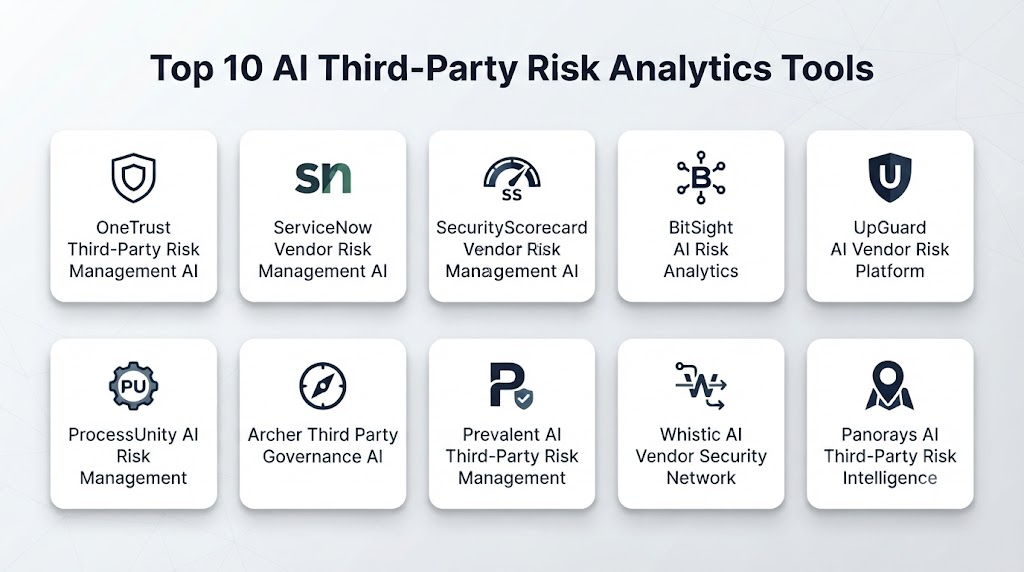
Top 10 AI Third-Party Risk Analytics Tools
1. SecurityScorecard
SecurityScorecard provides AI-supported cybersecurity ratings and third-party risk monitoring capabilities.
Key Features
- Vendor security ratings
- Cyber risk scoring
- Continuous monitoring
- Vulnerability analysis
- Threat intelligence
- Risk dashboards
- Vendor comparison
- Security assessments
- Reporting
- Risk alerts
Pros
- Strong cybersecurity visibility
- Continuous monitoring
- Easy vendor comparison
- Useful risk scoring
- Broad enterprise adoption
Cons
- Focused heavily on cybersecurity risk
- Requires interpretation
- Pricing varies
Platforms
Web-based platform.
Deployment or Support
Cloud-based risk intelligence platform.
Security & Compliance
Security controls vary.
Integrations & Ecosystem
GRC platforms, security tools, procurement workflows, and enterprise systems.
Support & Community
Customer support.
2. BitSight
BitSight provides security ratings and third-party cyber risk analytics.
Key Features
- Cybersecurity ratings
- Vendor monitoring
- Risk assessment
- Security analytics
- Benchmarking
- Risk reporting
- Portfolio monitoring
- Threat intelligence
- Compliance support
- Analytics dashboards
Pros
- Strong security rating capabilities
- Continuous monitoring
- Industry recognition
- Useful benchmarking
- Enterprise scalability
Cons
- Cybersecurity focused
- Requires security expertise
- Pricing varies
Platforms
Web-based platform.
Deployment or Support
Cloud-based security ratings platform.
Security & Compliance
Security practices vary.
Integrations & Ecosystem
Security platforms, GRC tools, and enterprise workflows.
Support & Community
Customer support.
3. OneTrust Third-Party Risk Management
OneTrust provides third-party risk management solutions covering privacy, compliance, security, and vendor governance.
Key Features
- Vendor risk assessments
- Privacy risk management
- Compliance workflows
- Security assessments
- Risk scoring
- Vendor monitoring
- Reporting
- Workflow automation
- Documentation management
- Governance tools
Pros
- Broad risk management capabilities
- Strong privacy features
- Enterprise adoption
- Comprehensive workflows
- Large ecosystem
Cons
- Platform complexity
- Requires configuration
- Enterprise-focused
Platforms
Web-based platform.
Deployment or Support
Cloud-based enterprise platform.
Security & Compliance
Enterprise security controls.
Integrations & Ecosystem
GRC platforms, security tools, privacy systems, and business applications.
Support & Community
Enterprise support.
4. ServiceNow Vendor Risk Management
ServiceNow Vendor Risk Management provides automated workflows for managing third-party risks.
Key Features
- Vendor assessments
- Risk workflows
- Compliance tracking
- Risk scoring
- Issue management
- Reporting dashboards
- Vendor lifecycle management
- Workflow automation
- Governance support
- Enterprise integrations
Pros
- Strong workflow automation
- Enterprise ecosystem
- Good integration capabilities
- Scalable platform
- Supports complex organizations
Cons
- Requires implementation
- Configuration complexity
- Enterprise pricing
Platforms
Web-based platform.
Deployment or Support
Cloud-based enterprise platform.
Security & Compliance
Enterprise security controls.
Integrations & Ecosystem
Enterprise systems, GRC platforms, IT workflows, and security tools.
Support & Community
Enterprise support.
5. RSA Archer Third Party Governance
RSA Archer provides governance, risk, and compliance capabilities for third-party risk management.
Key Features
- Vendor risk assessments
- Risk workflows
- Compliance tracking
- Third-party governance
- Reporting
- Risk dashboards
- Policy management
- Issue tracking
- Assessment automation
- Analytics
Pros
- Established GRC platform
- Flexible workflows
- Strong risk management
- Enterprise adoption
- Customizable processes
Cons
- Complex setup
- Requires expertise
- Enterprise-focused
Platforms
Web-based platform.
Deployment or Support
Cloud and enterprise deployment options.
Security & Compliance
Enterprise controls vary.
Integrations & Ecosystem
GRC systems, security tools, and enterprise applications.
Support & Community
Professional support.
6. Prevalent
Prevalent provides third-party risk management and vendor assessment automation solutions.
Key Features
- Vendor assessments
- Risk monitoring
- Questionnaire automation
- Compliance tracking
- Risk scoring
- Vendor intelligence
- Reporting
- Workflow automation
- Remediation tracking
- Third-party management
Pros
- Strong vendor risk focus
- Good assessment automation
- Useful reporting
- Supports compliance teams
- User-friendly workflows
Cons
- Requires configuration
- Advanced analytics vary
- Integration planning needed
Platforms
Web-based platform.
Deployment or Support
Cloud-based vendor risk platform.
Security & Compliance
Security controls vary.
Integrations & Ecosystem
GRC platforms, security tools, and procurement systems.
Support & Community
Customer support.
7. UpGuard
UpGuard provides cybersecurity risk ratings and third-party risk monitoring.
Key Features
- Vendor risk scoring
- Security ratings
- Continuous monitoring
- Data leak detection
- Cybersecurity assessments
- Risk alerts
- Vendor insights
- Reporting
- Security questionnaires
- Compliance support
Pros
- Easy vendor monitoring
- Strong cybersecurity visibility
- Useful risk scoring
- Good user experience
- Fast assessments
Cons
- Cybersecurity-focused
- Limited broader operational risk features
- Requires interpretation
Platforms
Web-based platform.
Deployment or Support
Cloud-based cybersecurity platform.
Security & Compliance
Security controls vary.
Integrations & Ecosystem
Security platforms and risk workflows.
Support & Community
Customer support.
8. ProcessUnity
ProcessUnity provides cloud-based third-party risk management and GRC solutions.
Key Features
- Vendor risk management
- Assessments
- Risk scoring
- Workflow automation
- Compliance tracking
- Reporting
- Vendor lifecycle management
- Risk dashboards
- Policy management
- Collaboration
Pros
- Strong vendor risk workflows
- Flexible configuration
- Good reporting
- Supports compliance programs
- Cloud-based platform
Cons
- Requires setup
- Enterprise features vary
- Configuration effort needed
Platforms
Web-based platform.
Deployment or Support
Cloud-based GRC platform.
Security & Compliance
Security controls vary.
Integrations & Ecosystem
GRC systems, security platforms, and business applications.
Support & Community
Customer support.
9. CyberGRX
CyberGRX provides third-party cyber risk management solutions using threat intelligence and risk analytics.
Key Features
- Third-party risk intelligence
- Vendor assessments
- Cyber risk scoring
- Threat analysis
- Risk exchange platform
- Security questionnaires
- Analytics
- Reporting
- Vendor insights
- Risk monitoring
Pros
- Strong cyber risk intelligence
- Useful vendor insights
- Supports large ecosystems
- Good assessment capabilities
- Risk-focused platform
Cons
- Cybersecurity focused
- Requires integration
- Enterprise-oriented
Platforms
Web-based platform.
Deployment or Support
Cloud-based cyber risk platform.
Security & Compliance
Security controls vary.
Integrations & Ecosystem
Security systems, GRC platforms, and vendor management workflows.
Support & Community
Customer support.
10. Whistic
Whistic provides vendor security and trust management capabilities.
Key Features
- Vendor security profiles
- Risk assessments
- Trust documentation
- Security questionnaires
- Vendor monitoring
- Compliance information
- Collaboration tools
- Risk insights
- Reporting
- Vendor management
Pros
- Simplifies vendor assessments
- Good collaboration
- User-friendly interface
- Faster security reviews
- Useful documentation management
Cons
- More security-focused
- Advanced analytics vary
- Enterprise needs may require additional tools
Platforms
Web-based platform.
Deployment or Support
Cloud-based vendor risk platform.
Security & Compliance
Security controls vary.
Integrations & Ecosystem
Security workflows, procurement systems, and business applications.
Support & Community
Customer support.
Comparison Table
| Tool Name | Best For | Platform(s) Supported | Deployment | Standout Feature | Public Rating |
|---|---|---|---|---|---|
| SecurityScorecard | Cyber risk ratings | Web | Cloud | Security scoring | N/A |
| BitSight | Vendor security monitoring | Web | Cloud | Cyber ratings | N/A |
| OneTrust TPRM | Enterprise third-party risk | Web | Cloud | Privacy and compliance | N/A |
| ServiceNow VRM | Workflow automation | Web | Cloud | Enterprise workflows | N/A |
| RSA Archer TPG | GRC-based risk management | Web | Cloud/Enterprise | Risk governance | N/A |
| Prevalent | Vendor assessments | Web | Cloud | Assessment automation | N/A |
| UpGuard | Cyber vendor monitoring | Web | Cloud | Risk visibility | N/A |
| ProcessUnity | Vendor risk programs | Web | Cloud | Flexible workflows | N/A |
| CyberGRX | Cyber risk intelligence | Web | Cloud | Risk exchange | N/A |
| Whistic | Vendor trust management | Web | Cloud | Security collaboration | N/A |
Weighted Evaluation
| Tool Name | Core Features 25% | Ease of Use 15% | Integrations & Ecosystem 15% | Security & Compliance 10% | Performance & Reliability 10% | Support & Community 10% | Price/Value 15% | Total |
|---|---|---|---|---|---|---|---|---|
| SecurityScorecard | 24 | 14 | 14 | 10 | 10 | 10 | 11 | 93 |
| BitSight | 24 | 13 | 14 | 10 | 10 | 10 | 11 | 92 |
| OneTrust TPRM | 25 | 12 | 15 | 10 | 10 | 10 | 10 | 92 |
| ServiceNow VRM | 25 | 11 | 15 | 10 | 10 | 10 | 10 | 91 |
| RSA Archer TPG | 24 | 11 | 15 | 10 | 10 | 10 | 10 | 90 |
| Prevalent | 23 | 14 | 13 | 9 | 10 | 10 | 12 | 91 |
| UpGuard | 22 | 15 | 13 | 9 | 10 | 10 | 12 | 91 |
| ProcessUnity | 23 | 13 | 13 | 9 | 10 | 10 | 11 | 89 |
| CyberGRX | 23 | 13 | 13 | 10 | 10 | 10 | 11 | 90 |
| Whistic | 22 | 15 | 12 | 9 | 10 | 10 | 12 | 90 |
Which AI Third-Party Risk Analytics Tool Is Right for You?
Choose SecurityScorecard when cybersecurity risk ratings and continuous monitoring are priorities.
Choose BitSight when vendor security benchmarking is important.
Choose OneTrust Third-Party Risk Management when organizations need broad privacy, compliance, and vendor risk management.
Choose ServiceNow Vendor Risk Management when enterprise workflow automation is required.
Choose RSA Archer Third Party Governance when integrated GRC capabilities are needed.
Choose Prevalent when vendor assessments and risk workflows are priorities.
Choose UpGuard when cybersecurity visibility is the main requirement.
Choose ProcessUnity when flexible vendor risk workflows are needed.
Choose CyberGRX when cyber risk intelligence is important.
Choose Whistic when vendor security collaboration is the priority.
Implementation Playbook
Phase 1: Define Third-Party Risk Goals
- Identify vendor categories
- Define risk criteria
- Establish assessment processes
- Select stakeholders
- Determine reporting requirements
Phase 2: Prepare Vendor Data
- Collect vendor information
- Connect security sources
- Configure risk models
- Define access permissions
- Review compliance needs
Phase 3: Deploy AI Risk Analytics
- Assess vendors
- Generate risk scores
- Monitor changes
- Assign remediation tasks
- Review insights
Phase 4: Measure Performance
- Track assessment speed
- Review risk accuracy
- Monitor vendor changes
- Improve workflows
- Collect feedback
Phase 5: Maintain Continuous Monitoring
- Update risk models
- Review vendor posture
- Monitor threats
- Improve automation
- Maintain governance records
Common Mistakes
- Reviewing vendors only once a year
- Ignoring cybersecurity changes
- Using incomplete vendor information
- Failing to prioritize high-risk suppliers
- Poor workflow integration
- Ignoring compliance requirements
- Treating AI scores as final decisions
- Not involving business stakeholders
FAQs
1. What are AI Third-Party Risk Analytics Tools?
AI Third-Party Risk Analytics Tools use artificial intelligence to assess, monitor, and manage risks associated with vendors and external partners.
2. How does AI improve third-party risk management?
AI helps analyze vendor data, identify risks, automate assessments, and provide continuous monitoring.
3. What risks can these platforms detect?
They can help identify cybersecurity, compliance, operational, and vendor-related risks.
4. Can AI replace vendor risk analysts?
No. AI supports analysts by improving efficiency and providing risk insights.
5. How does AI score vendor risk?
AI evaluates security information, compliance data, business factors, and external risk signals.
6. Are these tools useful for large supplier networks?
Yes. They help organizations manage large numbers of vendors efficiently.
7. Do AI third-party risk tools monitor vendors continuously?
Many platforms provide continuous monitoring capabilities.
8. Can these platforms integrate with GRC systems?
Many solutions integrate with GRC, security, procurement, and enterprise systems.
9. How secure is vendor risk data?
Organizations should evaluate platform security, access controls, and data protection practices.
10. What should companies consider before choosing an AI third-party risk platform?
Companies should evaluate risk accuracy, monitoring capabilities, integrations, security, scalability, and cost.
Conclusion
AI Third-Party Risk Analytics Tools are helping organizations move from periodic vendor reviews toward continuous, data-driven risk management. These platforms combine artificial intelligence, security intelligence, workflow automation, and analytics to provide better visibility into supplier and partner risks.SecurityScorecard, BitSight, OneTrust, and ServiceNow provide strong enterprise third-party risk capabilities, while Prevalent, UpGuard, ProcessUnity, and Whistic support specialized vendor risk workflows.
