Introduction
AI Legal Billing Anomaly Detection Tools use artificial intelligence, machine learning, natural language processing, and advanced analytics to help law firms, corporate legal departments, and organizations identify unusual billing patterns, invoice errors, and potential compliance issues.
Legal billing involves complex information such as time entries, matter codes, billing guidelines, expense records, attorney rates, and invoice details. Reviewing large volumes of legal invoices manually can be time-consuming and may result in missed inconsistencies, overbilling risks, or billing guideline violations.
Traditional legal invoice review processes often depend on manual audits, spreadsheets, and rule-based checks. These approaches may struggle to detect subtle patterns such as unusual time entries, duplicate charges, incorrect matter allocations, or deviations from expected billing behavior.
AI-powered legal billing analytics platforms analyze invoices, historical billing data, law firm performance patterns, and client guidelines to identify anomalies and provide actionable insights.
These tools help organizations:
- Detect unusual billing activities
- Identify invoice errors
- Reduce manual invoice review effort
- Improve legal spend management
- Enforce billing guidelines
- Increase billing transparency
- Support legal operations teams
AI legal billing anomaly detection solutions are used by:
- Corporate legal departments
- Law firms
- Legal operations teams
- Procurement departments
- Insurance companies
- Financial organizations
- Government legal teams
Modern platforms combine AI invoice analysis, machine learning anomaly detection, legal spend analytics, workflow automation, invoice review, and reporting capabilities.
The goal of these solutions is to help organizations control legal costs while improving accuracy, compliance, and transparency in legal billing processes.
How AI Legal Billing Anomaly Detection Works
Invoice Data Collection
AI systems analyze:
- Legal invoices
- Time entries
- Expense records
- Matter information
- Billing guidelines
Pattern Analysis
Machine learning identifies:
- Unusual billing behavior
- Duplicate charges
- Rate inconsistencies
- Excessive time entries
- Unexpected expenses
Guideline Validation
AI compares invoices against:
- Client billing rules
- Contract requirements
- Historical patterns
- Industry benchmarks
Risk Scoring
Platforms assign risk levels based on:
- Billing anomalies
- Matter complexity
- Attorney behavior
- Invoice patterns
Review Assistance
AI provides:
- Invoice summaries
- Flagged issues
- Recommended actions
- Audit insights
Common Use Cases
- Legal invoice review
- Outside counsel management
- Legal spend analytics
- Billing compliance monitoring
- Matter management
- Cost control programs
- Law firm performance analysis
- Contract billing review
- Litigation cost monitoring
- Legal operations optimization
Why AI Legal Billing Anomaly Detection Tools Matter
Reduce Overbilling Risks
AI helps identify questionable billing patterns.
Improve Invoice Accuracy
Automated analysis detects errors faster.
Lower Review Costs
Legal teams can focus on higher-risk invoices.
Improve Vendor Management
Organizations gain better visibility into law firm billing behavior.
Strengthen Legal Operations
AI provides insights for better financial decisions.
Evaluation Criteria for Buyers
Anomaly Detection Accuracy
Platforms should identify meaningful billing issues while reducing unnecessary alerts.
AI Analytics Capability
Strong tools should analyze complex billing patterns.
Legal Billing Knowledge
Solutions should understand legal billing structures and guidelines.
Workflow Management
Platforms should support review, approval, and remediation workflows.
Integration Capability
Important integrations include legal spend platforms, ERP systems, matter management tools, and procurement systems.
Reporting and Analytics
Organizations need clear legal spend insights.
Security and Privacy
Legal billing data requires strong confidentiality protection.
Key Trends
AI-Powered Legal Spend Management
Organizations are using AI to improve legal cost visibility.
Automated Invoice Review
Manual invoice audits are being replaced with intelligent review systems.
Predictive Legal Analytics
AI is helping identify future cost and billing risks.
Legal Operations Automation
Legal departments are adopting technology to streamline financial processes.
Data-Driven Outside Counsel Management
Organizations are using analytics to evaluate external legal providers.
Explainable AI for Legal Decisions
Legal teams are focusing on transparent AI recommendations.
Methodology
The following platforms were evaluated using:
- AI billing anomaly detection capabilities
- Legal spend analytics features
- Invoice review functionality
- Ease of use
- Integrations and ecosystem
- Security and privacy
- Performance and reliability
- Support and community
- Price and value
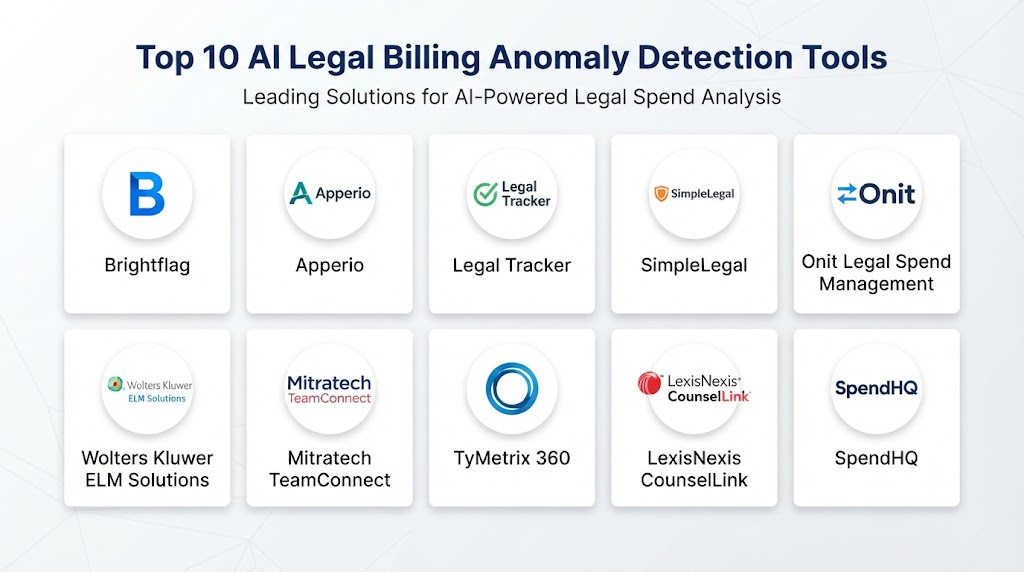
Top 10 AI Legal Billing Anomaly Detection Tools
1. Brightflag
Brightflag provides AI-powered legal spend management and invoice review solutions.
Key Features
- AI invoice review
- Billing anomaly detection
- Legal spend analytics
- Invoice validation
- Matter tracking
- Outside counsel management
- Reporting dashboards
- Billing guideline enforcement
- Workflow automation
- Legal operations analytics
Pros
- Strong AI invoice analysis
- Designed for legal spend management
- Good reporting capabilities
- Reduces manual invoice review
- Useful legal operations insights
Cons
- Enterprise-focused
- Requires implementation
- Pricing varies
Platforms
Web-based platform.
Deployment or Support
Cloud-based legal operations platform.
Security & Compliance
Security controls vary.
Integrations & Ecosystem
Legal systems, ERP platforms, matter management tools, and business applications.
Support & Community
Customer support.
2. Apperio
Apperio provides legal spend management and analytics capabilities for corporate legal teams.
Key Features
- Legal spend visibility
- Invoice analysis
- Budget tracking
- Matter analytics
- Cost forecasting
- Billing insights
- Reporting
- Workflow support
- Outside counsel management
- Financial analytics
Pros
- Strong spend visibility
- Useful legal analytics
- Improves budget control
- Good reporting
- Supports legal operations
Cons
- Focused on spend analytics
- Requires integration
- Enterprise-oriented
Platforms
Web-based platform.
Deployment or Support
Cloud-based legal spend platform.
Security & Compliance
Security controls vary.
Integrations & Ecosystem
Legal systems, finance platforms, and enterprise applications.
Support & Community
Customer support.
3. Legal Tracker
Legal Tracker provides enterprise legal management and billing management capabilities.
Key Features
- Invoice management
- Legal spend tracking
- Matter management
- Billing guidelines
- Reporting
- Workflow automation
- Legal operations analytics
- Vendor management
- Compliance tracking
- Cost management
Pros
- Established legal management platform
- Strong billing workflows
- Enterprise adoption
- Good reporting
- Supports large legal departments
Cons
- Requires configuration
- Enterprise-focused
- Implementation effort
Platforms
Web-based platform.
Deployment or Support
Cloud-based legal management platform.
Security & Compliance
Security controls vary.
Integrations & Ecosystem
Legal systems, finance tools, and enterprise applications.
Support & Community
Professional support.
4. SimpleLegal
SimpleLegal provides legal operations management and legal spend analytics.
Key Features
- Invoice review
- Legal spend management
- Matter management
- Billing workflows
- Reporting
- Budget tracking
- Vendor management
- Analytics
- Legal request management
- Workflow automation
Pros
- User-friendly platform
- Good legal spend visibility
- Strong workflow support
- Useful analytics
- Suitable for corporate legal teams
Cons
- Advanced AI features vary
- Requires configuration
- Enterprise needs may require customization
Platforms
Web-based platform.
Deployment or Support
Cloud-based legal operations platform.
Security & Compliance
Security controls vary.
Integrations & Ecosystem
Legal systems, finance tools, and business applications.
Support & Community
Customer support.
5. Onit Legal Spend Management
Onit provides legal operations and enterprise legal management solutions.
Key Features
- Invoice management
- Legal spend analytics
- Billing review
- Workflow automation
- Matter management
- Reporting
- Compliance tracking
- Legal operations tools
- Vendor management
- Analytics
Pros
- Strong enterprise workflows
- Good customization
- Broad legal operations capabilities
- Supports complex organizations
- Good integrations
Cons
- Complex setup
- Enterprise-focused
- Requires administration
Platforms
Web-based platform.
Deployment or Support
Cloud-based legal operations platform.
Security & Compliance
Enterprise controls vary.
Integrations & Ecosystem
Legal systems, ERP platforms, and enterprise applications.
Support & Community
Enterprise support.
6. Wolters Kluwer ELM Solutions
Wolters Kluwer ELM Solutions provides enterprise legal management and legal spend analytics.
Key Features
- Legal invoice management
- Spend analytics
- Matter management
- Billing compliance
- Reporting
- Workflow automation
- Legal vendor management
- Cost analysis
- Compliance monitoring
- Analytics
Pros
- Enterprise legal management expertise
- Strong reporting
- Supports large organizations
- Comprehensive workflows
- Good compliance capabilities
Cons
- Enterprise implementation
- Requires expertise
- Pricing varies
Platforms
Web-based platform.
Deployment or Support
Cloud-based enterprise platform.
Security & Compliance
Enterprise security controls.
Integrations & Ecosystem
ERP systems, legal platforms, finance applications, and enterprise tools.
Support & Community
Enterprise support.
7. Mitratech TeamConnect
Mitratech TeamConnect provides legal operations management and enterprise legal workflows.
Key Features
- Matter management
- Legal billing workflows
- Invoice review
- Reporting
- Compliance management
- Legal spend tracking
- Workflow automation
- Vendor management
- Analytics
- Documentation
Pros
- Flexible enterprise platform
- Strong workflow capabilities
- Supports complex legal teams
- Good customization
- Broad legal operations features
Cons
- Requires configuration
- Enterprise-focused
- Implementation effort
Platforms
Web-based platform.
Deployment or Support
Cloud and enterprise deployment options.
Security & Compliance
Enterprise controls vary.
Integrations & Ecosystem
Legal systems, ERP platforms, and business applications.
Support & Community
Professional support.
8. TyMetrix 360
TyMetrix 360 provides legal spend management and electronic billing capabilities.
Key Features
- Electronic billing
- Invoice review
- Spend analytics
- Matter management
- Billing guideline enforcement
- Reporting
- Legal cost management
- Workflow automation
- Vendor management
- Compliance tracking
Pros
- Strong e-billing capabilities
- Established legal spend platform
- Good reporting
- Supports large organizations
- Legal industry experience
Cons
- Enterprise-oriented
- Requires setup
- Advanced AI varies
Platforms
Web-based platform.
Deployment or Support
Cloud-based legal management platform.
Security & Compliance
Security controls vary.
Integrations & Ecosystem
Legal systems, finance platforms, and enterprise applications.
Support & Community
Professional support.
9. LexisNexis CounselLink
LexisNexis CounselLink provides legal management and billing analytics capabilities.
Key Features
- Legal invoice management
- Matter management
- Legal spend analytics
- Billing compliance
- Reporting
- Vendor management
- Workflow automation
- Cost analysis
- Legal operations support
- Data insights
Pros
- Strong legal industry background
- Good billing management
- Useful analytics
- Enterprise adoption
- Supports outside counsel management
Cons
- Enterprise-focused
- Requires configuration
- Pricing varies
Platforms
Web-based platform.
Deployment or Support
Cloud-based legal management platform.
Security & Compliance
Security controls vary.
Integrations & Ecosystem
Legal systems, finance tools, and enterprise applications.
Support & Community
Professional support.
10. SpendHQ
SpendHQ provides spend analytics and procurement intelligence capabilities that can support legal spend analysis.
Key Features
- Spend analysis
- Data classification
- Cost insights
- Supplier analytics
- Reporting
- Data visualization
- Spend optimization
- Analytics automation
- Vendor insights
- Dashboarding
Pros
- Strong spend analytics
- Useful procurement insights
- Good visualization
- Helps identify cost patterns
- Supports enterprise analysis
Cons
- Not exclusively legal-focused
- Requires data integration
- Legal workflows may need customization
Platforms
Web-based platform.
Deployment or Support
Cloud-based analytics platform.
Security & Compliance
Security controls vary.
Integrations & Ecosystem
Procurement systems, finance platforms, and enterprise applications.
Support & Community
Customer support.
Comparison Table
| Tool Name | Best For | Platform(s) Supported | Deployment | Standout Feature | Public Rating |
|---|---|---|---|---|---|
| Brightflag | AI legal invoice review | Web | Cloud | Billing anomaly detection | N/A |
| Apperio | Legal spend analytics | Web | Cloud | Spend visibility | N/A |
| Legal Tracker | Enterprise legal management | Web | Cloud | Billing workflows | N/A |
| SimpleLegal | Corporate legal operations | Web | Cloud | Legal spend management | N/A |
| Onit Legal Spend | Enterprise workflows | Web | Cloud | Custom workflows | N/A |
| Wolters Kluwer ELM | Enterprise legal management | Web | Cloud | Legal spend analytics | N/A |
| Mitratech TeamConnect | Legal operations | Web | Cloud | Workflow flexibility | N/A |
| TyMetrix 360 | E-billing management | Web | Cloud | Billing compliance | N/A |
| CounselLink | Legal spend management | Web | Cloud | Legal analytics | N/A |
| SpendHQ | Spend analytics | Web | Cloud | Cost intelligence | N/A |
Weighted Evaluation
| Tool Name | Core Features 25% | Ease of Use 15% | Integrations & Ecosystem 15% | Security & Compliance 10% | Performance & Reliability 10% | Support & Community 10% | Price/Value 15% | Total |
|---|---|---|---|---|---|---|---|---|
| Brightflag | 25 | 15 | 13 | 10 | 10 | 10 | 12 | 95 |
| Apperio | 23 | 14 | 13 | 10 | 10 | 10 | 12 | 92 |
| Legal Tracker | 24 | 12 | 15 | 10 | 10 | 10 | 10 | 91 |
| SimpleLegal | 23 | 14 | 13 | 10 | 10 | 10 | 12 | 92 |
| Onit Legal Spend | 24 | 12 | 15 | 10 | 10 | 10 | 10 | 91 |
| Wolters Kluwer ELM | 24 | 12 | 15 | 10 | 10 | 10 | 10 | 91 |
| Mitratech TeamConnect | 23 | 12 | 15 | 10 | 10 | 10 | 10 | 90 |
| TyMetrix 360 | 23 | 12 | 14 | 10 | 10 | 10 | 10 | 89 |
| CounselLink | 23 | 13 | 14 | 10 | 10 | 10 | 11 | 91 |
| SpendHQ | 22 | 14 | 13 | 9 | 10 | 10 | 12 | 90 |
Which AI Legal Billing Anomaly Detection Tool Is Right for You?
Choose Brightflag when AI-powered invoice review and anomaly detection are priorities.
Choose Apperio when legal spend visibility and forecasting matter.
Choose Legal Tracker when enterprise legal management is required.
Choose SimpleLegal when corporate legal operations workflows are important.
Choose Onit Legal Spend Management when customized enterprise processes are needed.
Choose Wolters Kluwer ELM Solutions when large-scale legal spend management is required.
Choose Mitratech TeamConnect when flexible legal workflows are important.
Choose TyMetrix 360 when electronic billing management is the priority.
Choose LexisNexis CounselLink when legal analytics and outside counsel management are needed.
Choose SpendHQ when broader spend intelligence supports legal cost analysis.
Implementation Playbook
Phase 1: Define Legal Billing Goals
- Identify billing challenges
- Define review criteria
- Establish billing guidelines
- Select stakeholders
- Set cost management objectives
Phase 2: Prepare Billing Data
- Import invoices
- Connect legal systems
- Standardize billing information
- Configure rules
- Validate historical data
Phase 3: Deploy AI Billing Analysis
- Analyze invoices
- Detect anomalies
- Generate risk scores
- Review flagged items
- Improve billing workflows
Phase 4: Measure Results
- Reduce invoice review time
- Track savings opportunities
- Improve billing compliance
- Monitor law firm performance
- Optimize processes
Phase 5: Maintain Legal Spend Governance
- Update billing rules
- Review anomaly patterns
- Improve AI models
- Maintain audit records
- Monitor legal costs
Common Mistakes
- Treating AI alerts as billing violations automatically
- Ignoring legal billing guidelines
- Using incomplete invoice data
- Failing to involve legal operations teams
- Poor system integration
- Not reviewing historical patterns
- Ignoring law firm relationships
- Overlooking security requirements
FAQs
1. What are AI Legal Billing Anomaly Detection Tools?
AI Legal Billing Anomaly Detection Tools use artificial intelligence to analyze legal invoices and identify unusual billing patterns.
2. How does AI detect billing anomalies?
AI compares billing data against historical patterns, guidelines, rates, and expected behaviors.
3. Can AI replace legal invoice reviewers?
No. AI assists reviewers by identifying potential issues, while professionals make final decisions.
4. What billing issues can AI identify?
AI can identify duplicate charges, unusual time entries, rate inconsistencies, and guideline violations.
5. Are these tools useful for corporate legal departments?
Yes. They help organizations manage outside counsel costs and improve invoice accuracy.
6. How does AI improve legal spend management?
AI provides insights into billing patterns, costs, and potential savings opportunities.
7. Can these tools integrate with legal management systems?
Many solutions integrate with matter management, ERP, and legal operations platforms.
8. Are AI legal billing tools secure?
Organizations should evaluate data protection, confidentiality controls, and security practices.
9. How accurate are AI billing anomaly detections?
Accuracy depends on data quality, billing rules, historical information, and AI model performance.
10. What should organizations consider before selecting an AI legal billing tool?
Organizations should evaluate detection accuracy, integrations, security, legal workflows, scalability, and cost.
Conclusion
AI Legal Billing Anomaly Detection Tools are transforming legal spend management by helping organizations identify billing issues, automate invoice reviews, and improve financial transparency.Brightflag, Apperio, Legal Tracker, and SimpleLegal provide strong legal billing management capabilities, while Onit, Wolters Kluwer ELM, Mitratech, and CounselLink support broader enterprise legal operations.The most effective legal billing strategy combines AI-powered analysis with professional review, clear billing guidelines, and strong vendor management practices. AI should help legal teams control costs while maintaining accuracy, fairness, and transparency.
