Introduction
AI Emergency Call Triage Assistants use artificial intelligence, natural language processing, speech analytics, and machine learning to help emergency response centers analyze incoming calls, prioritize incidents, and support faster emergency decision-making.
Emergency call centers handle thousands of critical communications involving medical emergencies, accidents, public safety incidents, fires, and urgent assistance requests. Dispatchers must quickly understand situations, identify risks, collect accurate information, and coordinate emergency responses.
Traditional emergency call handling relies heavily on human operators listening, interpreting, and manually categorizing incidents. During high-volume situations, this can create challenges such as delayed response, incomplete information capture, and difficulty prioritizing multiple emergencies.
AI-powered emergency call triage systems assist operators by analyzing caller conversations, identifying key details, classifying incident severity, extracting important information, and recommending appropriate response actions.
These tools help organizations:
- Improve emergency call response efficiency
- Prioritize critical incidents
- Reduce dispatcher workload
- Extract important information automatically
- Support faster decision-making
- Improve emergency communication quality
- Enhance public safety operations
AI emergency call triage assistants are used by:
- Emergency communication centers
- Police departments
- Fire departments
- Ambulance services
- Healthcare emergency teams
- Government safety organizations
- Public safety agencies
Modern platforms combine speech recognition, conversational AI, sentiment analysis, workflow automation, location intelligence, and real-time decision support.
The goal of these solutions is to help emergency teams respond faster while supporting accurate and consistent incident handling.
How AI Emergency Call Triage Assistants Work
Call Understanding
AI analyzes:
- Caller speech
- Conversation context
- Emergency keywords
- Voice patterns
- Background information
Speech-to-Text Processing
AI converts live conversations into:
- Transcripts
- Structured information
- Incident summaries
Incident Classification
Machine learning identifies:
- Emergency type
- Severity level
- Required response
Priority Scoring
AI evaluates:
- Risk indicators
- Caller information
- Incident details
- Urgency factors
Dispatcher Assistance
Platforms provide:
- Recommendations
- Automated summaries
- Response suggestions
- Workflow guidance
Common Use Cases
- Emergency call centers
- Medical emergency triage
- Police dispatch support
- Fire emergency response
- Disaster management
- Crisis communication
- Public safety monitoring
- Ambulance dispatch
- Incident reporting
- Government emergency services
Why AI Emergency Call Triage Assistants Matter
Faster Emergency Response
AI helps operators identify critical situations quickly.
Better Information Capture
Automated analysis reduces missing details.
Reduced Dispatcher Pressure
AI supports operators during high call volumes.
Improved Prioritization
Emergency teams can focus on the most urgent cases.
Consistent Decision Support
AI helps standardize emergency workflows.
Evaluation Criteria for Buyers
Speech Recognition Accuracy
Systems should accurately understand emergency conversations.
Real-Time Processing
AI should analyze calls with minimal delay.
Incident Classification
Platforms should correctly identify emergency categories.
Integration Capability
Important integrations include:
- Emergency dispatch systems
- Computer-aided dispatch platforms
- Communication systems
- Geographic information systems
Security and Privacy
Emergency data requires strong protection.
Reliability
Emergency systems require high availability.
Human Oversight
AI recommendations should support, not replace, trained responders.
Key Trends
AI-Assisted Dispatch Operations
Emergency centers are adopting AI to support human operators.
Real-Time Speech Analytics
AI is improving live emergency call understanding.
Automated Incident Summaries
Systems are reducing manual documentation.
Predictive Emergency Intelligence
AI is helping identify patterns in emergency response data.
Multilingual Emergency Support
AI is improving accessibility for diverse communities.
Responsible Emergency AI
Organizations are focusing on transparency and human oversight.
Methodology
The following platforms were evaluated using:
- AI call analysis capabilities
- Emergency workflow support
- Speech recognition features
- Integration capabilities
- Ease of use
- Security and privacy
- Performance and reliability
- Support and community
- Price and value
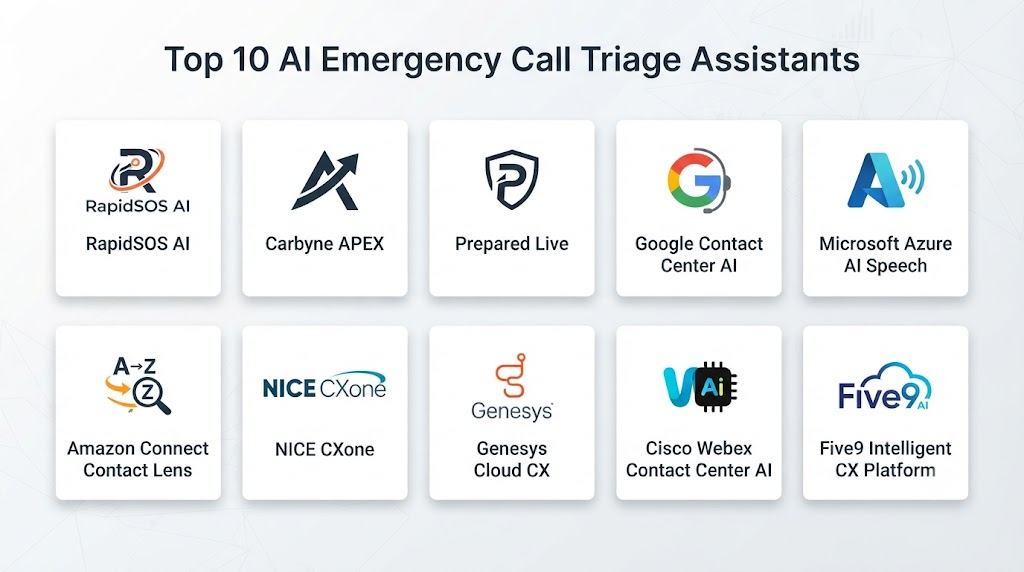
Top 10 AI Emergency Call Triage Assistants
1. RapidSOS AI
RapidSOS provides emergency communication technology and AI-powered public safety support solutions.
Key Features
- Emergency data sharing
- Caller information support
- Incident intelligence
- Real-time data access
- Emergency communication workflows
- Location intelligence
- Dispatch support
- Public safety integrations
- Analytics
- Response coordination
Pros
- Designed for emergency response
- Strong public safety ecosystem
- Improves emergency data availability
- Supports faster response
- Integrates with emergency systems
Cons
- Public safety deployment requirements
- Requires agency integration
- Availability varies by region
Platforms
Cloud-based public safety platform.
Deployment or Support
Cloud deployment.
Security & Compliance
Security controls vary.
Integrations & Ecosystem
Emergency communication systems, dispatch platforms, and public safety tools.
Support & Community
Professional support.
2. Carbyne APEX
Carbyne provides cloud-based emergency communication and response management solutions.
Key Features
- Emergency call handling
- AI-assisted communication
- Location services
- Video-enabled emergency communication
- Incident management
- Dispatcher tools
- Real-time information sharing
- Analytics
- Workflow automation
- Public safety integration
Pros
- Modern emergency communication platform
- Strong location capabilities
- Improves dispatcher awareness
- Cloud-based architecture
- Supports multiple communication channels
Cons
- Requires infrastructure integration
- Public safety focused
- Implementation effort
Platforms
Cloud platform.
Deployment or Support
Cloud deployment.
Security & Compliance
Security controls vary.
Integrations & Ecosystem
Emergency systems, dispatch platforms, and communication tools.
Support & Community
Customer support.
3. Prepared Live
Prepared provides AI-supported communication tools for emergency response teams.
Key Features
- Emergency text communication
- Video support
- Dispatcher assistance
- Digital evidence sharing
- Caller interaction tools
- Incident workflows
- Real-time communication
- Location sharing
- Analytics
- Public safety integrations
Pros
- Improves emergency communication
- Supports multiple channels
- Easy citizen interaction
- Enhances dispatcher visibility
- Modern emergency workflows
Cons
- Requires adoption by agencies
- Focused on emergency environments
- Integration planning needed
Platforms
Cloud-based platform.
Deployment or Support
Cloud deployment.
Security & Compliance
Security controls vary.
Integrations & Ecosystem
Emergency systems and communication platforms.
Support & Community
Customer support.
4. Google Contact Center AI
Google Contact Center AI provides conversational AI and agent assistance capabilities.
Key Features
- Speech recognition
- Agent assistance
- Natural language processing
- Conversation analytics
- Virtual agents
- Call summarization
- Knowledge assistance
- Workflow support
- Analytics
- Cloud integration
Pros
- Strong AI capabilities
- Advanced speech technology
- Scalable cloud platform
- Good analytics
- Flexible integrations
Cons
- Requires technical expertise
- General contact center focus
- Custom emergency workflows needed
Platforms
Cloud platform.
Deployment or Support
Google Cloud deployment.
Security & Compliance
Google Cloud security controls.
Integrations & Ecosystem
Contact centers, communication platforms, and enterprise systems.
Support & Community
Google Cloud support.
5. Microsoft Azure AI Speech
Microsoft Azure AI Speech provides speech recognition and conversational AI capabilities.
Key Features
- Speech-to-text
- Real-time transcription
- Language processing
- Voice analytics
- Custom speech models
- Translation
- AI integration
- APIs
- Analytics
- Cloud scalability
Pros
- Strong speech recognition
- Developer flexibility
- Enterprise cloud support
- Multilingual capabilities
- Scalable infrastructure
Cons
- Requires development effort
- Needs customization
- Cloud dependency
Platforms
Cloud platform.
Deployment or Support
Azure cloud deployment.
Security & Compliance
Enterprise cloud security controls.
Integrations & Ecosystem
Applications, communication systems, and AI platforms.
Support & Community
Microsoft support ecosystem.
6. Amazon Connect Contact Lens
Amazon Connect Contact Lens provides AI-powered contact center analytics.
Key Features
- Speech analytics
- Call transcription
- Sentiment analysis
- Conversation insights
- Agent assistance
- Quality monitoring
- Call summaries
- Analytics dashboards
- Workflow automation
- Cloud contact center
Pros
- Strong AWS integration
- Good speech analytics
- Scalable cloud platform
- Useful automation
- Flexible APIs
Cons
- Requires technical knowledge
- General contact center focus
- Custom emergency workflows required
Platforms
AWS cloud platform.
Deployment or Support
Cloud deployment.
Security & Compliance
AWS security controls.
Integrations & Ecosystem
AWS services, communication systems, and applications.
Support & Community
AWS support ecosystem.
7. NICE CXone
NICE CXone provides AI-powered contact center and customer interaction management capabilities.
Key Features
- Speech analytics
- AI assistance
- Interaction monitoring
- Workforce management
- Automation
- Reporting
- Call analysis
- Workflow management
- Quality management
- Cloud contact center
Pros
- Enterprise contact center capabilities
- Strong analytics
- Good automation
- Scalable platform
- Advanced reporting
Cons
- General contact center focus
- Requires configuration
- Enterprise implementation
Platforms
Cloud platform.
Deployment or Support
Cloud deployment.
Security & Compliance
Enterprise security controls.
Integrations & Ecosystem
Communication platforms, CRM systems, and enterprise applications.
Support & Community
Enterprise support.
8. Genesys Cloud CX
Genesys Cloud CX provides AI-powered customer and communication management capabilities.
Key Features
- Conversational AI
- Speech analytics
- Agent assistance
- Call routing
- Interaction analytics
- Automation
- Reporting
- Workforce tools
- Cloud communication
- Integration support
Pros
- Strong communication platform
- Good AI features
- Scalable cloud architecture
- Flexible workflows
- Enterprise adoption
Cons
- General communication platform
- Requires customization
- Implementation effort
Platforms
Cloud platform.
Deployment or Support
Cloud deployment.
Security & Compliance
Enterprise security controls.
Integrations & Ecosystem
Communication systems, CRM platforms, and business applications.
Support & Community
Enterprise support.
9. Cisco Webex Contact Center AI
Cisco provides AI-powered communication and contact center capabilities.
Key Features
- Speech analytics
- AI assistants
- Call routing
- Conversation analysis
- Reporting
- Automation
- Collaboration tools
- Cloud communication
- Workflow support
- Integration options
Pros
- Strong communication ecosystem
- Enterprise reliability
- Good integrations
- Scalable platform
- Security capabilities
Cons
- Requires configuration
- General contact center focus
- Enterprise-oriented
Platforms
Cloud platform.
Deployment or Support
Cloud deployment.
Security & Compliance
Enterprise security controls.
Integrations & Ecosystem
Cisco systems, communication tools, and enterprise platforms.
Support & Community
Cisco support ecosystem.
10. Five9 Intelligent CX Platform
Five9 provides cloud contact center AI capabilities.
Key Features
- AI-powered routing
- Speech analytics
- Call transcription
- Agent assistance
- Automation
- Reporting
- Interaction analysis
- Workflow management
- Cloud communication
- Analytics
Pros
- Strong contact center capabilities
- Good automation
- Cloud scalability
- Useful analytics
- Flexible integrations
Cons
- General contact center focus
- Requires customization
- Enterprise deployment
Platforms
Cloud platform.
Deployment or Support
Cloud deployment.
Security & Compliance
Security controls vary.
Integrations & Ecosystem
CRM systems, communication platforms, and business applications.
Support & Community
Customer support.
Comparison Table
| Tool Name | Best For | Platform(s) Supported | Deployment | Standout Feature | Public Rating |
|---|---|---|---|---|---|
| RapidSOS AI | Emergency response | Cloud | Cloud | Emergency intelligence | N/A |
| Carbyne APEX | Emergency communications | Cloud | Cloud | Location intelligence | N/A |
| Prepared Live | Digital emergency communication | Cloud | Cloud | Citizen communication | N/A |
| Google Contact Center AI | AI call assistance | Cloud | Google Cloud | Conversational AI | N/A |
| Azure AI Speech | Speech processing | Cloud | Azure | Speech recognition | N/A |
| Amazon Connect Contact Lens | Call analytics | Cloud | AWS | Conversation insights | N/A |
| NICE CXone | Contact center AI | Cloud | Cloud | Analytics automation | N/A |
| Genesys Cloud CX | Communication management | Cloud | Cloud | AI routing | N/A |
| Cisco Webex Contact Center AI | Enterprise communication | Cloud | Cloud | Collaboration tools | N/A |
| Five9 Intelligent CX | Cloud contact center | Cloud | Cloud | Call automation | N/A |
Weighted Evaluation
| Tool Name | Core Features 25% | Ease of Use 15% | Integrations & Ecosystem 15% | Security & Compliance 10% | Performance & Reliability 10% | Support & Community 10% | Price/Value 15% | Total |
|---|---|---|---|---|---|---|---|---|
| RapidSOS AI | 25 | 13 | 14 | 10 | 10 | 10 | 11 | 93 |
| Carbyne APEX | 24 | 14 | 14 | 10 | 10 | 10 | 11 | 93 |
| Prepared Live | 23 | 14 | 13 | 10 | 10 | 10 | 12 | 92 |
| Google Contact Center AI | 24 | 13 | 15 | 10 | 10 | 10 | 11 | 93 |
| Azure AI Speech | 24 | 13 | 15 | 10 | 10 | 10 | 12 | 94 |
| Amazon Connect Contact Lens | 23 | 14 | 15 | 10 | 10 | 10 | 12 | 94 |
| NICE CXone | 24 | 12 | 14 | 10 | 10 | 10 | 10 | 90 |
| Genesys Cloud CX | 24 | 13 | 15 | 10 | 10 | 10 | 10 | 92 |
| Cisco Webex Contact Center AI | 23 | 13 | 15 | 10 | 10 | 10 | 10 | 91 |
| Five9 Intelligent CX | 23 | 13 | 14 | 10 | 10 | 10 | 11 | 91 |
Which AI Emergency Call Triage Assistant Is Right for You?
Choose RapidSOS AI when dedicated emergency response intelligence is required.
Choose Carbyne APEX when modern emergency communication workflows are needed.
Choose Prepared Live when digital citizen communication is important.
Choose Google Contact Center AI when advanced conversational AI is required.
Choose Microsoft Azure AI Speech when speech intelligence capabilities are needed.
Choose Amazon Connect Contact Lens when cloud-based call analytics are preferred.
Choose NICE CXone when enterprise contact center capabilities are required.
Choose Genesys Cloud CX when communication automation is important.
Choose Cisco Webex Contact Center AI when enterprise collaboration integration matters.
Choose Five9 Intelligent CX when cloud communication automation is needed.
Implementation Playbook
Phase 1: Define Emergency Response Goals
- Identify call center challenges
- Define emergency categories
- Establish response workflows
- Review data requirements
- Set performance goals
Phase 2: Prepare Communication Systems
- Connect emergency channels
- Integrate dispatch systems
- Configure speech processing
- Establish security controls
- Test workflows
Phase 3: Deploy AI Assistance
- Enable transcription
- Configure incident classification
- Train AI models
- Create alert workflows
- Monitor performance
Phase 4: Measure Outcomes
- Improve response times
- Reduce dispatcher workload
- Analyze call quality
- Improve accuracy
- Review incidents
Phase 5: Maintain Emergency AI Systems
- Update models
- Review workflows
- Monitor privacy
- Improve training data
- Maintain reliability
Common Mistakes
- Using AI without human oversight
- Ignoring emergency privacy requirements
- Poor speech recognition configuration
- Lack of dispatcher training
- Weak integration planning
- Not monitoring false alerts
- Ignoring accessibility needs
- Over-automating critical decisions
FAQs
1. What are AI Emergency Call Triage Assistants?
AI Emergency Call Triage Assistants use artificial intelligence to analyze emergency calls, classify incidents, and support dispatch decisions.
2. How does AI help emergency operators?
AI provides transcription, summaries, risk indicators, and decision support during calls.
3. Can AI replace emergency dispatchers?
No. AI supports trained operators but does not replace human judgment.
4. What types of emergencies can AI identify?
AI can help classify medical emergencies, accidents, fires, and public safety incidents.
5. Can AI analyze calls in real time?
Many platforms provide real-time speech analysis and assistance.
6. Are emergency AI systems secure?
Organizations should evaluate encryption, privacy controls, and security practices.
7. Can these tools support multiple languages?
Many AI speech platforms provide multilingual capabilities.
8. Can AI integrate with dispatch systems?
Many solutions integrate with emergency communication and operational systems.
9. How accurate are AI emergency call assistants?
Accuracy depends on speech quality, AI models, environment, and configuration.
10. What should organizations consider before selecting an AI emergency call triage solution?
Organizations should evaluate accuracy, reliability, security, integrations, scalability, and human oversight.
Conclusion
AI Emergency Call Triage Assistants are helping emergency organizations improve response operations by analyzing calls faster, extracting critical information, and supporting dispatch teams with intelligent recommendations.RapidSOS, Carbyne, Prepared, Azure AI Speech, and Amazon Connect provide valuable emergency communication and AI capabilities, while enterprise contact center platforms support broader communication automation.The most effective emergency AI strategy combines artificial intelligence with trained professionals, reliable infrastructure, privacy protection, and clear operational procedures. AI should help emergency teams respond faster and make better decisions while keeping human expertise at the center.
