Introduction
AI Misinformation Detection Tools use artificial intelligence, natural language processing, machine learning, fact verification techniques, and content analysis technologies to identify misleading, false, manipulated, or unreliable information across digital platforms.
The rapid growth of online content has made misinformation a major challenge for governments, media organizations, businesses, researchers, and online communities. False claims, manipulated media, misleading articles, and synthetic content can spread quickly through social networks and digital channels.
Traditional fact-checking methods often depend on manual research and human verification, which can be slow when dealing with large volumes of information. AI-powered misinformation detection platforms analyze content patterns, sources, context, language signals, and external references to help identify potentially inaccurate information.
These tools help organizations:
- Detect misleading content
- Analyze information credibility
- Identify manipulated media
- Support fact-checking workflows
- Reduce misinformation risks
- Improve content moderation
- Strengthen digital trust
AI misinformation detection solutions are used by:
- News organizations
- Social media platforms
- Government agencies
- Research institutions
- Online communities
- Cybersecurity teams
- Content moderation teams
Modern platforms combine NLP, machine learning, knowledge graphs, source analysis, claim verification, image analysis, and AI-generated content detection.
The goal of these solutions is to help organizations evaluate information quality while supporting responsible digital communication.
How AI Misinformation Detection Works
Content Collection
AI systems analyze:
- Articles
- Social media posts
- Videos
- Images
- Documents
- Online discussions
Language Analysis
NLP models evaluate:
- Writing patterns
- Claims
- Context
- Sentiment
- Language signals
Source Evaluation
AI examines:
- Source reputation
- Historical reliability
- Publication patterns
- References
Claim Verification
Systems compare claims against:
- Trusted databases
- Knowledge sources
- Verified information
Risk Assessment
AI provides:
- Credibility scores
- Risk indicators
- Content classifications
Common Use Cases
- News verification
- Social media moderation
- Election information monitoring
- Brand reputation protection
- Academic research
- Online community management
- AI-generated content detection
- Public communication monitoring
- Cybersecurity intelligence
- Content quality assessment
Why AI Misinformation Detection Tools Matter
Faster Fact Checking
AI helps analyze large amounts of information quickly.
Improved Content Moderation
Platforms can identify potentially harmful content faster.
Better Information Quality
Organizations can improve trust in digital content.
Reduced Manual Effort
AI assists researchers and moderators.
Protection Against Manipulated Content
AI helps identify misleading text, images, and media.
Evaluation Criteria for Buyers
Detection Accuracy
Tools should correctly identify misleading information while reducing false positives.
AI Analysis Capability
Platforms should analyze text, images, videos, and context.
Source Intelligence
Solutions should evaluate content credibility.
Integration Support
Important integrations include:
- Social platforms
- Publishing systems
- Content management systems
- Research databases
- Security platforms
Explainability
Organizations need understandable reasons behind AI classifications.
Scalability
Solutions should handle large content volumes.
Security and Privacy
Content analysis systems should protect sensitive information.
Key Trends
AI-Generated Content Detection
Organizations are developing methods to identify synthetic content.
Multimodal Misinformation Analysis
AI is analyzing text, images, audio, and video together.
Real-Time Content Monitoring
Platforms are moving toward continuous information analysis.
Knowledge Graph Verification
AI systems are improving fact verification through connected information networks.
Responsible AI Moderation
Organizations are focusing on transparency and fairness.
Human-AI Collaboration
AI is supporting human fact-checkers rather than replacing them.
Methodology
The following platforms were evaluated using:
- AI detection capabilities
- Fact-checking support
- Content analysis features
- Multimodal capabilities
- Integration support
- Ease of use
- Security and privacy
- Performance and reliability
- Support and community
- Price and value
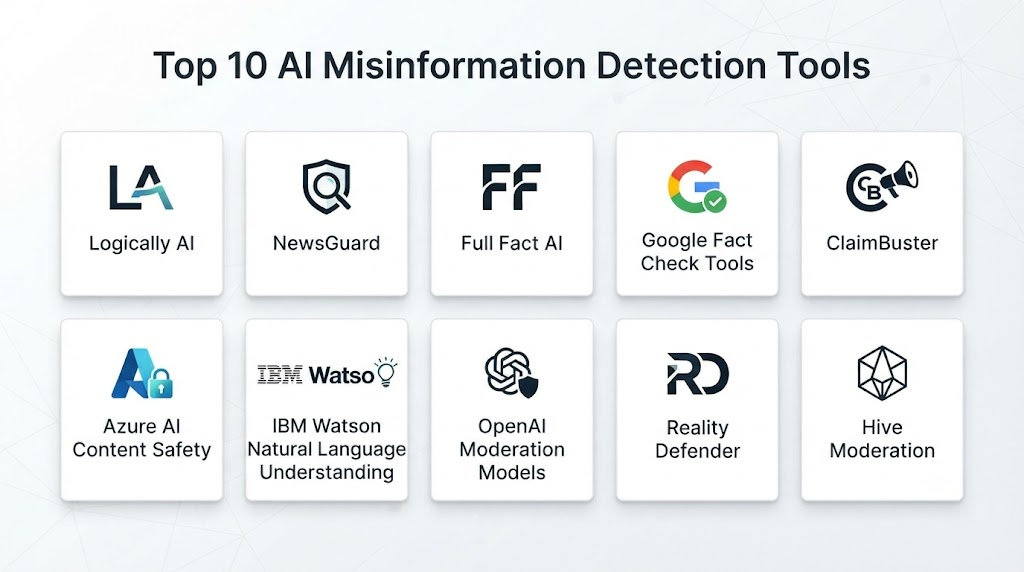
Top 10 AI Misinformation Detection Tools
1. Logically AI
Logically AI provides artificial intelligence solutions for misinformation detection and information integrity.
Key Features
- Claim analysis
- Content monitoring
- AI misinformation detection
- Source analysis
- Fact-checking assistance
- Social media monitoring
- Risk analysis
- Investigation support
- Analytics
- Content intelligence
Pros
- Focused on information integrity
- AI-powered analysis
- Supports large-scale monitoring
- Useful investigation workflows
- Multi-source analysis
Cons
- Enterprise-focused
- Requires configuration
- Advanced features may require expertise
Platforms
Cloud-based platform.
Deployment or Support
Cloud deployment.
Security & Compliance
Security controls vary.
Integrations & Ecosystem
Media platforms, monitoring systems, and data sources.
Support & Community
Professional support.
2. NewsGuard
NewsGuard provides credibility ratings and information quality analysis.
Key Features
- Website credibility analysis
- Source evaluation
- Reliability ratings
- Editorial criteria assessment
- Content intelligence
- Browser-based tools
- Research support
- Monitoring
- Media analysis
- Reporting
Pros
- Human-reviewed credibility assessments
- Useful for publishers
- Strong source analysis
- Supports media literacy
- Clear evaluation approach
Cons
- Focuses mainly on sources
- Requires updates
- Coverage varies
Platforms
Web-based platform.
Deployment or Support
Cloud-based access.
Security & Compliance
Security controls vary.
Integrations & Ecosystem
Browsers, publishing platforms, and information systems.
Support & Community
Customer support.
3. Full Fact AI
Full Fact AI provides automated fact-checking and claim detection capabilities.
Key Features
- Claim detection
- Fact-checking assistance
- NLP analysis
- Content monitoring
- Research support
- Automated alerts
- Data analysis
- Verification workflows
- Reporting
- Information tracking
Pros
- Strong fact-checking focus
- Supports researchers
- Automated claim discovery
- Useful for media organizations
- Research-oriented
Cons
- Requires verification workflows
- Specialized use cases
- Human review needed
Platforms
Cloud-based platform.
Deployment or Support
Cloud deployment.
Security & Compliance
Security controls vary.
Integrations & Ecosystem
Media systems, research platforms, and content tools.
Support & Community
Professional support.
4. Google Fact Check Tools
Google provides tools and data resources for discovering fact-check information.
Key Features
- Fact-check search
- Claim discovery
- Structured data support
- Verification resources
- Search integration
- Information retrieval
- Research support
- Content analysis
- Publisher tools
- Data access
Pros
- Broad information ecosystem
- Useful research capabilities
- Large-scale search infrastructure
- Accessible tools
- Supports publishers
Cons
- Depends on available fact checks
- Not a complete moderation platform
- Requires external verification
Platforms
Web-based platform.
Deployment or Support
Online services.
Security & Compliance
Google security controls.
Integrations & Ecosystem
Search systems, publishers, and data platforms.
Support & Community
Developer and user community.
5. ClaimBuster
ClaimBuster provides AI-based claim detection and analysis capabilities.
Key Features
- Claim detection
- Text analysis
- NLP processing
- Credibility scoring
- Research support
- Data analysis
- Automated identification
- API access
- Content evaluation
- Academic research tools
Pros
- Research-focused
- AI claim detection
- Useful for analysts
- Supports automation
- Developer-friendly
Cons
- Requires technical expertise
- Limited general consumer use
- Requires integration
Platforms
Cloud and API platforms.
Deployment or Support
Cloud deployment.
Security & Compliance
Security controls vary.
Integrations & Ecosystem
Research systems and applications.
Support & Community
Research community support.
6. Azure AI Content Safety
Azure AI Content Safety provides AI-powered content analysis and moderation capabilities.
Key Features
- Text analysis
- Image analysis
- Content classification
- Safety detection
- Risk scoring
- API integration
- Moderation workflows
- AI model support
- Reporting
- Enterprise integration
Pros
- Strong AI infrastructure
- Developer-friendly APIs
- Enterprise scalability
- Multimodal capabilities
- Flexible deployment
Cons
- General safety platform
- Requires configuration
- Cloud dependency
Platforms
Cloud platform.
Deployment or Support
Azure cloud deployment.
Security & Compliance
Enterprise cloud security controls.
Integrations & Ecosystem
Applications, content platforms, and enterprise systems.
Support & Community
Microsoft support ecosystem.
7. IBM Watson Natural Language Understanding
IBM Watson provides AI-powered text analysis capabilities.
Key Features
- Text classification
- Entity extraction
- Sentiment analysis
- Language understanding
- Content analysis
- AI models
- Analytics
- API access
- Knowledge extraction
- Reporting
Pros
- Strong NLP capabilities
- Enterprise-ready
- Flexible APIs
- Good text analysis
- Scalable platform
Cons
- Requires customization
- Technical expertise needed
- General NLP focus
Platforms
Cloud platform.
Deployment or Support
Cloud deployment.
Security & Compliance
Enterprise security controls.
Integrations & Ecosystem
Enterprise applications, APIs, and data systems.
Support & Community
Enterprise support.
8. OpenAI Moderation Models
OpenAI provides AI moderation capabilities for identifying potentially harmful or unsafe content.
Key Features
- Content classification
- Text analysis
- Safety detection
- API integration
- Automated moderation
- Risk identification
- AI workflows
- Content evaluation
- Application integration
- Monitoring
Pros
- Advanced AI models
- Flexible integration
- Fast content analysis
- Developer-friendly
- Scalable
Cons
- Requires implementation
- Needs application-specific setup
- Not a complete fact-checking system
Platforms
API-based platform.
Deployment or Support
Cloud-based integration.
Security & Compliance
Security controls vary.
Integrations & Ecosystem
Applications, platforms, and digital services.
Support & Community
Developer support.
9. Reality Defender
Reality Defender provides AI-powered detection capabilities for manipulated media.
Key Features
- Deepfake detection
- Synthetic media analysis
- Video analysis
- Audio analysis
- Image analysis
- Risk scoring
- Media verification
- Detection workflows
- Reporting
- Security integration
Pros
- Focused on synthetic media detection
- Multimodal analysis
- Supports security teams
- Useful for media verification
- Advanced detection capabilities
Cons
- Specialized platform
- Requires integration
- Emerging technology area
Platforms
Cloud platform.
Deployment or Support
Cloud deployment.
Security & Compliance
Security controls vary.
Integrations & Ecosystem
Security platforms, media systems, and investigation tools.
Support & Community
Customer support.
10. Hive Moderation
Hive Moderation provides AI content moderation capabilities.
Key Features
- Text moderation
- Image analysis
- Video moderation
- Content classification
- AI detection
- API integration
- Risk scoring
- Automated workflows
- Content monitoring
- Reporting
Pros
- Multimodal moderation
- API-focused platform
- Scalable content analysis
- Supports large platforms
- Automation capabilities
Cons
- Requires integration
- General moderation focus
- Configuration needed
Platforms
Cloud platform.
Deployment or Support
Cloud deployment.
Security & Compliance
Security controls vary.
Integrations & Ecosystem
Content platforms, applications, and digital services.
Support & Community
Customer support.
Comparison Table
| Tool Name | Best For | Platform(s) Supported | Deployment | Standout Feature | Public Rating |
|---|---|---|---|---|---|
| Logically AI | Information integrity | Cloud | Cloud | AI misinformation analysis | N/A |
| NewsGuard | Source credibility | Web | Cloud | Trust ratings | N/A |
| Full Fact AI | Fact checking | Cloud | Cloud | Claim verification | N/A |
| Google Fact Check Tools | Research support | Web | Online | Fact search | N/A |
| ClaimBuster | Claim detection | API | Cloud | NLP analysis | N/A |
| Azure AI Content Safety | Content moderation | Cloud | Azure | AI safety analysis | N/A |
| IBM Watson NLU | Text intelligence | Cloud | Cloud | NLP capabilities | N/A |
| OpenAI Moderation Models | AI content safety | API | Cloud | AI classification | N/A |
| Reality Defender | Synthetic media detection | Cloud | Cloud | Deepfake detection | N/A |
| Hive Moderation | Content moderation | Cloud | Cloud | Multimodal analysis | N/A |
Weighted Evaluation
| Tool Name | Core Features 25% | Ease of Use 15% | Integrations & Ecosystem 15% | Security & Compliance 10% | Performance & Reliability 10% | Support & Community 10% | Price/Value 15% | Total |
|---|---|---|---|---|---|---|---|---|
| Logically AI | 25 | 13 | 14 | 10 | 10 | 10 | 11 | 93 |
| NewsGuard | 23 | 15 | 13 | 10 | 10 | 10 | 12 | 93 |
| Full Fact AI | 24 | 13 | 13 | 10 | 10 | 10 | 12 | 92 |
| Google Fact Check Tools | 22 | 15 | 15 | 10 | 10 | 10 | 13 | 95 |
| ClaimBuster | 23 | 12 | 14 | 10 | 10 | 10 | 12 | 91 |
| Azure AI Content Safety | 24 | 13 | 15 | 10 | 10 | 10 | 12 | 94 |
| IBM Watson NLU | 23 | 12 | 15 | 10 | 10 | 10 | 11 | 91 |
| OpenAI Moderation Models | 24 | 14 | 15 | 10 | 10 | 10 | 12 | 95 |
| Reality Defender | 23 | 13 | 13 | 10 | 10 | 10 | 11 | 90 |
| Hive Moderation | 23 | 14 | 14 | 10 | 10 | 10 | 12 | 93 |
Which AI Misinformation Detection Tool Is Right for You?
Choose Logically AI when organizations need dedicated misinformation intelligence.
Choose NewsGuard when source credibility assessment is important.
Choose Full Fact AI when automated fact-checking support is required.
Choose Google Fact Check Tools when research-based verification is needed.
Choose ClaimBuster when claim detection and analysis are priorities.
Choose Azure AI Content Safety when enterprise content moderation is required.
Choose IBM Watson NLU when advanced text analysis is needed.
Choose OpenAI Moderation Models when AI-powered content classification is required.
Choose Reality Defender when synthetic media detection is important.
Choose Hive Moderation when large-scale content moderation is needed.
Implementation Playbook
Phase 1: Define Information Integrity Goals
- Identify misinformation risks
- Define content sources
- Establish review processes
- Select detection requirements
- Set success metrics
Phase 2: Prepare Data Sources
- Connect content channels
- Collect historical examples
- Configure AI models
- Establish verification sources
- Define governance policies
Phase 3: Deploy AI Detection
- Enable content analysis
- Configure risk scoring
- Create review workflows
- Integrate moderation tools
- Monitor performance
Phase 4: Measure Results
- Improve detection accuracy
- Reduce harmful content
- Monitor false positives
- Review user feedback
- Optimize workflows
Phase 5: Maintain Responsible AI
- Update models
- Review decisions
- Monitor bias
- Improve transparency
- Maintain human oversight
Common Mistakes
- Treating AI predictions as final truth
- Ignoring human verification
- Poor source evaluation
- Lack of transparency
- Not updating detection models
- Ignoring cultural context
- Weak privacy practices
- Over-moderating legitimate content
FAQs
1. What are AI Misinformation Detection Tools?
AI Misinformation Detection Tools use artificial intelligence to analyze content and identify potentially false or misleading information.
2. How does AI detect misinformation?
AI analyzes language patterns, sources, claims, context, and available information.
3. Can AI identify all false information?
No. AI supports detection but human review and verification remain important.
4. What types of misinformation can AI detect?
AI can help analyze misleading text, manipulated media, false claims, and synthetic content.
5. Are these tools used by media organizations?
Yes. News organizations and researchers use AI tools to support verification processes.
6. Can AI detect AI-generated content?
Some platforms provide AI-generated content and synthetic media detection capabilities.
7. Are misinformation detection tools accurate?
Accuracy depends on models, data quality, context, and human review.
8. Can these tools integrate with social platforms?
Many solutions provide APIs and integration options.
9. How can organizations avoid unfair moderation?
They should use transparency, human oversight, and responsible AI practices.
10. What should organizations consider before selecting an AI misinformation detection tool?
Organizations should evaluate accuracy, explainability, integrations, scalability, security, and cost.
Conclusion
AI Misinformation Detection Tools are becoming important for maintaining trust in digital information environments. These platforms help organizations analyze content, identify suspicious claims, detect manipulated media, and support fact-checking operations.Logically AI, Full Fact AI, Google Fact Check Tools, Azure AI Content Safety, and OpenAI Moderation Models provide strong AI-based analysis capabilities, while specialized platforms support source verification and synthetic media detection.The most effective misinformation detection strategy combines AI technology with human expertise, transparent processes, reliable sources, and responsible moderation practices. AI should help improve information quality while protecting open and trustworthy digital communication.
