Introduction
AI Legislative Drafting Assistants use artificial intelligence, natural language processing, legal knowledge systems, document automation, and language analysis to help lawmakers, government agencies, policy teams, and legal professionals create, review, and improve legislative documents.
Drafting legislation is a complex process that requires precision, consistency, legal interpretation, policy alignment, and extensive review. Traditional legislative drafting often involves multiple stakeholders, lengthy revisions, manual research, and detailed compliance checks.
AI-powered legislative drafting assistants support these workflows by analyzing legal documents, suggesting language improvements, identifying inconsistencies, comparing existing laws, and helping users structure legislative proposals.
These tools help organizations:
- Accelerate legislative drafting
- Improve document consistency
- Support legal research
- Identify conflicting provisions
- Automate document analysis
- Improve policy workflows
- Reduce administrative effort
AI legislative drafting solutions are used by:
- Government legislative bodies
- Policy departments
- Legal offices
- Regulatory agencies
- Parliamentary teams
- Public administration organizations
- Legal research institutions
Modern platforms combine AI language models, legal databases, document automation, semantic search, compliance analysis, and workflow management.
The goal of these solutions is to help policymakers and legal teams create clearer, more consistent, and better-informed legislative documents while maintaining human oversight.
How AI Legislative Drafting Assistants Work
Document Analysis
AI systems analyze:
- Existing laws
- Regulations
- Policy documents
- Legislative proposals
- Legal references
Language Assistance
AI helps with:
- Draft structure
- Legal terminology
- Clause improvement
- Formatting consistency
Legal Research Support
AI identifies:
- Related legislation
- Similar provisions
- Historical references
- Regulatory impacts
Review Assistance
Platforms provide:
- Conflict detection
- Missing section alerts
- Compliance suggestions
- Document comparisons
Continuous Improvement
AI improves through:
- Legal document libraries
- User feedback
- Updated regulations
- Review outcomes
Common Use Cases
- Bill drafting support
- Regulatory document creation
- Policy development
- Legislative research
- Amendment analysis
- Legal language review
- Government documentation
- Compliance documentation
- Public policy analysis
- Parliamentary workflows
Why AI Legislative Drafting Assistants Matter
Faster Draft Preparation
AI helps legal teams reduce repetitive drafting work.
Improved Consistency
AI supports standardized legal language and formatting.
Better Research
AI helps users locate relevant legal information quickly.
Reduced Administrative Work
Automation improves document management efficiency.
Better Policy Collaboration
AI supports collaboration among lawmakers, lawyers, and policy teams.
Evaluation Criteria for Buyers
Legal Language Capability
Tools should understand legal terminology and structures.
Document Intelligence
Platforms should analyze complex legal documents.
Research Support
Solutions should support:
- Legal search
- Document comparison
- Reference discovery
- Knowledge retrieval
Drafting Assistance
Important features include:
- Clause suggestions
- Document templates
- Revision support
- Formatting assistance
Security and Privacy
Legislative documents may contain sensitive information.
Explainability
AI recommendations should be understandable.
Integration Capability
Important integrations include:
- Document management systems
- Legal research databases
- Government platforms
- Workflow systems
Key Trends
AI-Assisted Policy Development
Governments are exploring AI to improve policy workflows.
Legal Language Automation
AI is helping standardize and improve legal documents.
Semantic Legal Search
AI is improving access to legislative knowledge.
Automated Compliance Review
AI is supporting regulatory consistency checks.
Human-in-the-Loop Drafting
Organizations are combining AI assistance with expert review.
Responsible Government AI
Transparency and accountability are becoming critical.
Methodology
The following platforms were evaluated using:
- AI drafting capabilities
- Legal document analysis
- Research support
- Automation features
- Integration capabilities
- Security
- Reliability
- Ease of use
- Support
- Price and value
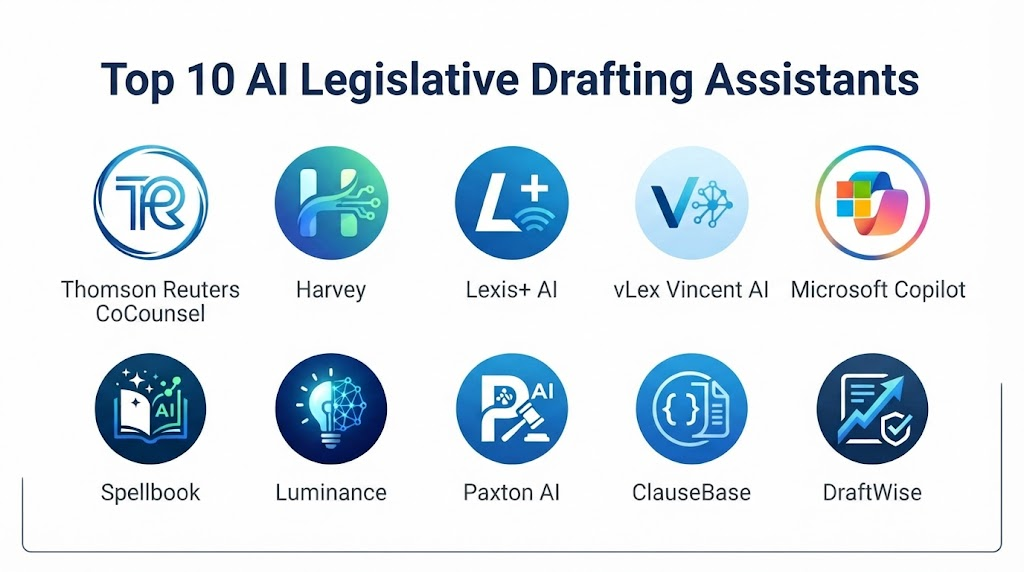
Top 10 AI Legislative Drafting Assistants
1. Harvey AI
Harvey AI provides AI-powered legal assistance for drafting, analysis, and legal workflows.
Key Features
- Legal document drafting
- Legal research assistance
- Document analysis
- Language improvement
- Workflow support
- AI reasoning
- Legal knowledge assistance
- Document summarization
- Collaboration tools
- Enterprise controls
Pros
- Strong legal AI capabilities
- Useful drafting support
- Good document analysis
- Enterprise adoption
- Flexible workflows
Cons
- Requires legal oversight
- Enterprise-focused
- Pricing varies
Platforms
Cloud-based platform.
Deployment or Support
Cloud deployment.
Security & Compliance
Enterprise security controls.
Integrations & Ecosystem
Legal workflows, document systems, and enterprise applications.
Support & Community
Enterprise support.
2. CoCounsel by Thomson Reuters
CoCounsel provides AI-powered legal research and document assistance.
Key Features
- Legal research
- Document review
- Draft assistance
- Summarization
- Legal analysis
- Case research
- Workflow automation
- Knowledge retrieval
- Collaboration
- Reporting
Pros
- Strong legal research foundation
- Trusted legal information ecosystem
- Good document analysis
- Enterprise-ready
- Research efficiency
Cons
- Requires subscription
- Legal expertise still required
- Enterprise pricing
Platforms
Cloud platform.
Deployment or Support
Cloud deployment.
Security & Compliance
Enterprise security controls.
Integrations & Ecosystem
Legal databases, document platforms, and professional workflows.
Support & Community
Professional support.
3. Lexis+ AI
Lexis+ AI provides legal research and drafting assistance.
Key Features
- Legal research
- Draft generation
- Document analysis
- Case information search
- Legal summaries
- Citation support
- AI assistance
- Knowledge discovery
- Workflow support
- Reporting
Pros
- Strong legal database access
- Research capabilities
- Drafting assistance
- Professional legal workflows
- Reliable legal content
Cons
- Requires user expertise
- Subscription-based
- Focused on legal professionals
Platforms
Cloud platform.
Deployment or Support
Cloud deployment.
Security & Compliance
Enterprise security controls.
Integrations & Ecosystem
Legal research systems and professional tools.
Support & Community
Professional support.
4. Microsoft Copilot for Legal
Microsoft provides AI assistance through its enterprise productivity ecosystem.
Key Features
- Document drafting
- Legal document analysis
- Summarization
- Research assistance
- Workflow automation
- Collaboration
- Knowledge management
- Productivity support
- Enterprise integration
- AI assistance
Pros
- Strong enterprise ecosystem
- Integration with productivity tools
- Scalable deployment
- Familiar user experience
- Security controls
Cons
- Requires configuration
- General-purpose AI capabilities
- Legal customization needed
Platforms
Cloud platform.
Deployment or Support
Cloud deployment.
Security & Compliance
Enterprise security controls.
Integrations & Ecosystem
Microsoft applications, document systems, and enterprise platforms.
Support & Community
Enterprise support.
5. Westlaw Precision AI
Westlaw Precision AI provides AI-supported legal research capabilities.
Key Features
- Legal search
- Document analysis
- Legal summaries
- Research assistance
- Citation analysis
- Knowledge discovery
- Draft support
- Case analysis
- Workflow tools
- Reporting
Pros
- Strong legal research database
- Reliable legal information
- Professional workflows
- Research efficiency
- Trusted ecosystem
Cons
- Subscription cost
- Requires legal expertise
- Focused on legal research
Platforms
Cloud platform.
Deployment or Support
Cloud deployment.
Security & Compliance
Enterprise security controls.
Integrations & Ecosystem
Legal research systems and professional applications.
Support & Community
Professional support.
6. vLex Vincent AI
vLex provides AI-powered legal research and analysis capabilities.
Key Features
- Legal research
- Document analysis
- Case discovery
- Legal summaries
- AI search
- Citation analysis
- Knowledge management
- Draft assistance
- Workflow support
- Analytics
Pros
- Broad legal information access
- AI research capabilities
- Global legal coverage
- Good search functionality
- Document intelligence
Cons
- Requires legal knowledge
- Subscription-based
- Research-focused
Platforms
Cloud platform.
Deployment or Support
Cloud deployment.
Security & Compliance
Security controls vary.
Integrations & Ecosystem
Legal databases and professional tools.
Support & Community
Professional support.
7. Luminance
Luminance provides AI-powered legal document analysis.
Key Features
- Document review
- Legal analysis
- Contract intelligence
- Document comparison
- Risk identification
- Data extraction
- Workflow automation
- Analytics
- Collaboration
- Reporting
Pros
- Strong document analysis
- AI-powered review
- Useful for legal teams
- Good automation
- Enterprise capabilities
Cons
- Requires setup
- Focused on document workflows
- Implementation effort
Platforms
Cloud platform.
Deployment or Support
Cloud deployment.
Security & Compliance
Enterprise security controls.
Integrations & Ecosystem
Document systems, legal platforms, and enterprise applications.
Support & Community
Enterprise support.
8. Spellbook
Spellbook provides AI assistance for legal drafting.
Key Features
- Draft suggestions
- Legal language improvement
- Document review
- Clause assistance
- AI writing support
- Contract analysis
- Document editing
- Workflow support
- Templates
- Collaboration
Pros
- Easy drafting assistance
- Useful legal writing support
- Simple interface
- Productivity improvement
- Good document workflows
Cons
- Requires review
- Mainly drafting-focused
- Advanced government workflows vary
Platforms
Cloud platform.
Deployment or Support
Cloud deployment.
Security & Compliance
Security controls vary.
Integrations & Ecosystem
Document platforms and legal workflows.
Support & Community
Customer support.
9. ContractPodAi
ContractPodAi provides AI-powered legal workflow automation.
Key Features
- Document automation
- Legal workflows
- AI review
- Contract analysis
- Document management
- Reporting
- Collaboration
- Compliance support
- Templates
- Automation
Pros
- Strong workflow automation
- Good document management
- AI capabilities
- Enterprise support
- Flexible platform
Cons
- Enterprise-focused
- Requires configuration
- Implementation effort
Platforms
Cloud platform.
Deployment or Support
Cloud deployment.
Security & Compliance
Enterprise security controls.
Integrations & Ecosystem
Enterprise applications, document systems, and legal platforms.
Support & Community
Enterprise support.
10. ChatGPT Enterprise
ChatGPT Enterprise provides AI assistance for document creation, analysis, and knowledge workflows.
Key Features
- Draft assistance
- Document summarization
- Research support
- Text analysis
- Knowledge assistance
- Workflow automation
- Collaboration
- Custom AI assistants
- Enterprise controls
- Data analysis
Pros
- Flexible AI capabilities
- Strong language understanding
- Custom assistant support
- Broad use cases
- Enterprise controls
Cons
- Requires legal governance
- Needs careful prompting
- Legal validation required
Platforms
Cloud platform.
Deployment or Support
Cloud deployment.
Security & Compliance
Enterprise security controls.
Integrations & Ecosystem
Enterprise applications, document systems, and workflows.
Support & Community
Enterprise support.
Comparison Table
| Tool Name | Best For | Platform(s) Supported | Deployment | Standout Feature | Public Rating |
|---|---|---|---|---|---|
| Harvey AI | Legal drafting | Cloud | Cloud | Legal AI assistance | N/A |
| CoCounsel | Legal research | Cloud | Cloud | Research automation | N/A |
| Lexis+ AI | Legal professionals | Cloud | Cloud | Legal knowledge access | N/A |
| Microsoft Copilot for Legal | Enterprise productivity | Cloud | Cloud | Workflow integration | N/A |
| Westlaw Precision AI | Legal research | Cloud | Cloud | Legal database intelligence | N/A |
| vLex Vincent AI | Global legal research | Cloud | Cloud | AI legal search | N/A |
| Luminance | Document analysis | Cloud | Cloud | Document intelligence | N/A |
| Spellbook | Drafting support | Cloud | Cloud | AI writing assistance | N/A |
| ContractPodAi | Legal workflows | Cloud | Cloud | Automation | N/A |
| ChatGPT Enterprise | AI assistants | Cloud | Cloud | Flexible AI support | N/A |
Weighted Evaluation
| Tool Name | Core Features 25% | Ease of Use 15% | Integrations & Ecosystem 15% | Security & Compliance 10% | Performance & Reliability 10% | Support & Community 10% | Price/Value 15% | Total |
|---|---|---|---|---|---|---|---|---|
| Harvey AI | 25 | 13 | 14 | 10 | 10 | 10 | 11 | 93 |
| CoCounsel | 24 | 13 | 15 | 10 | 10 | 10 | 11 | 93 |
| Lexis+ AI | 24 | 13 | 15 | 10 | 10 | 10 | 10 | 92 |
| Microsoft Copilot | 24 | 14 | 15 | 10 | 10 | 10 | 12 | 95 |
| Westlaw Precision AI | 24 | 12 | 15 | 10 | 10 | 10 | 10 | 91 |
| vLex Vincent AI | 23 | 13 | 14 | 10 | 10 | 10 | 11 | 91 |
| Luminance | 23 | 13 | 14 | 10 | 10 | 10 | 11 | 91 |
| Spellbook | 22 | 15 | 13 | 10 | 10 | 10 | 12 | 92 |
| ContractPodAi | 23 | 12 | 14 | 10 | 10 | 10 | 11 | 90 |
| ChatGPT Enterprise | 24 | 14 | 15 | 10 | 10 | 10 | 12 | 95 |
Which AI Legislative Drafting Assistant Is Right for You?
Choose Harvey AI when specialized legal AI drafting support is required.
Choose CoCounsel when AI-powered legal research is important.
Choose Lexis+ AI when access to legal knowledge resources is needed.
Choose Microsoft Copilot for Legal when enterprise productivity integration matters.
Choose Westlaw Precision AI when professional legal research is the priority.
Choose vLex Vincent AI when global legal research is needed.
Choose Luminance when document analysis and review are important.
Choose Spellbook when drafting assistance is the main requirement.
Choose ContractPodAi when legal workflow automation is needed.
Choose ChatGPT Enterprise when flexible AI assistants and document workflows are required.
Implementation Playbook
Phase 1: Define Legislative AI Goals
- Identify drafting challenges
- Define review requirements
- Establish governance rules
- Identify stakeholders
- Set success metrics
Phase 2: Prepare Legal Data
- Organize legislative documents
- Connect legal repositories
- Define access controls
- Prepare templates
- Establish security policies
Phase 3: Deploy AI Assistance
- Configure AI workflows
- Enable document analysis
- Create drafting processes
- Train users
- Test outputs
Phase 4: Measure Results
- Reduce drafting time
- Improve document consistency
- Increase research efficiency
- Monitor quality
- Improve collaboration
Phase 5: Maintain Responsible AI
- Review AI-generated content
- Maintain human oversight
- Update legal references
- Monitor accuracy
- Improve governance
Common Mistakes
- Using AI without legal review
- Treating AI output as final legislation
- Poor data governance
- Lack of transparency
- Ignoring legal context
- Weak security controls
- Not training users
- Failing to monitor AI performance
FAQs
1. What are AI Legislative Drafting Assistants?
AI Legislative Drafting Assistants help lawmakers and legal teams create, review, and improve legislative documents using artificial intelligence.
2. Can AI write complete laws automatically?
AI can assist drafting, but human lawmakers and legal experts must review and approve legislative content.
3. How does AI help legislative teams?
AI helps with research, document analysis, drafting suggestions, and consistency checks.
4. Who uses AI legislative tools?
Government agencies, legal departments, policymakers, and legislative research teams use these solutions.
5. Can AI analyze existing laws?
Yes. AI can review legal documents and identify related provisions or patterns.
6. Are AI legislative tools secure?
Organizations should evaluate privacy, access controls, and security practices.
7. Can AI identify conflicting regulations?
Many AI legal tools can assist with identifying inconsistencies and related documents.
8. Does AI replace legislative experts?
No. AI supports experts by reducing repetitive work and improving research.
9. Can these tools integrate with government systems?
Many platforms support integrations with document and workflow systems.
10. What should organizations consider before selecting an AI legislative drafting assistant?
Organizations should evaluate accuracy, security, explainability, integrations, governance, and cost.
Conclusion
AI Legislative Drafting Assistants are helping governments and legal organizations modernize policy development through intelligent document analysis, research support, and drafting automation.Harvey AI, CoCounsel, Lexis+ AI, Microsoft Copilot, Westlaw Precision AI, and ChatGPT Enterprise provide powerful capabilities for improving legislative workflows.The most effective approach combines AI assistance with expert legal review, transparent processes, strong governance, and responsible implementation. AI helps legislative teams work more efficiently while maintaining the accuracy, accountability, and human judgment required for public policy decisions.
