Introduction
Modern agriculture operates in an environment of constant change and unpredictability. Farmers face daily challenges that include shifting weather patterns, limited water availability, potential pest and disease risks, soil variation, and increasing labor requirements. Managing these variables while attempting to secure reliable crop productivity requires careful planning and continuous decision-making. To help navigate these complexities, modern farming increasingly turns to advanced digital technologies. Platforms like AIUniverse.xyz highlight how Artificial Intelligence has emerged as a supportive tool capable of processing large amounts of agricultural data to help farmers make more informed operational decisions. While AI cannot eliminate the natural uncertainties inherent in farming, it provides structured insights that can help support better resource management and crop yield improvement over time.
What Is AI in Agriculture?
The term AI in agriculture refers to the use of computer systems, machine learning models, and smart tools to perform tasks that traditionally required human intelligence and extensive manual observation. These technologies can process diverse agricultural datasets and identify complex patterns that may be difficult to detect through visual inspection alone.
The typical workflow moves through a clear sequence:
Data -> AI Model -> Analysis -> Recommendation -> Farmer Decision
It is important to understand that AI generally acts as a decision-support mechanism rather than a replacement for human farmers. The final operational choice always rests with the agricultural professional, who combines digital insights with local experience and field observations.
Why Crop Yield Matters
Crop yield refers to the measured output of agricultural production per unit of land, typically expressed in weight or volume per acre. Improving yield is a primary objective for many agricultural producers because it directly influences food production levels, farm profitability, and overall economic stability.
At the same time, higher yield should not be treated as the sole measure of agricultural success. Sustainable farming requires balancing productivity with resource efficiency, soil health, water conservation, and long-term environmental protection. True agricultural progress focuses on producing sufficient food while preserving the natural resources that make farming possible.
How AI Can Help Improve Crop Yield
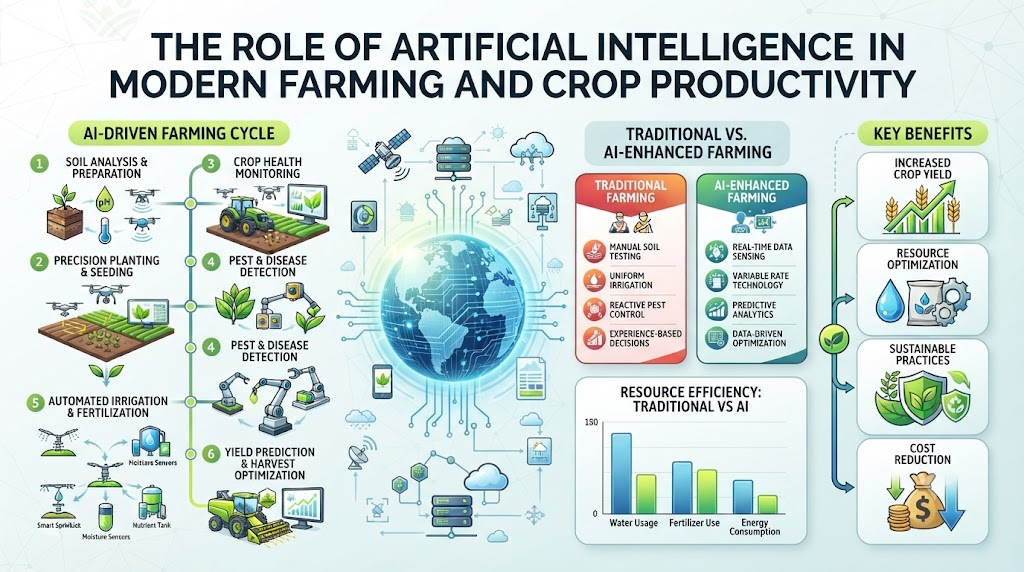
Crop Monitoring
AI systems can continuously analyze images and sensor streams to monitor how crops develop from planting to harvest. These systems can track plant growth rates, detect early signs of crop stress, and highlight field variability, allowing farmers to address localized issues before they impact total production.
Yield Prediction
Machine learning models can evaluate historical crop records alongside current weather and soil data to estimate potential harvest outputs. These models help producers plan storage, logistics, and market sales. However, it is essential to remember that these predictions are data-based estimates rather than absolute guarantees.
Disease Detection
Computer vision technologies can examine crop images to identify visual irregularities associated with plant diseases. Successful detection depends heavily on image quality, training data accuracy, and local crop conditions. AI does not guarantee a correct diagnosis for every disease from a single snapshot, but it can flag potential problems for human review.
Pest Detection
By combining data from field sensors, weather stations, and camera traps, AI can help identify pest-related patterns and population trends, giving farmers an early warning to inspect specific zones of their fields.
Weed Detection
Advanced computer vision can help distinguish crops from unwanted vegetation in selective agricultural settings, supporting more targeted weed management practices.
Irrigation Management
AI models can integrate real-time soil moisture readings, upcoming weather forecasts, and historical crop needs to suggest more efficient irrigation schedules, helping conserve water while supporting plant health.
Role of Machine Learning in Agriculture
Machine learning is a subset of artificial intelligence where computer algorithms learn from examples and historical data rather than following rigid, pre-written rules. In farming, these models train on past agricultural data to recognize patterns and make predictions on new information.
The learning cycle follows a straightforward path:
Training Data -> Model -> New Data -> Prediction
Practical examples include forecasting seasonal yields, classifying plant diseases, categorizing crop types, analyzing soil health metrics, and generating irrigation recommendations. These models process numbers and statistics to assist growers in anticipating future field conditions.
Role of Computer Vision
Computer vision enables digital systems to interpret, process, and analyze visual information captured by smartphones, drones, field cameras, and orbiting satellites. In agriculture, these vision systems help identify subtle changes in crop health, detect disease symptoms on leaves, spot weed distribution, and map field variations.
Image-based analysis, however, has limitations. System performance can be influenced by varying natural light, camera hardware quality, sudden weather changes, and image clarity. Consequently, visual AI tools work best when treated as supplementary observation aids.
AI and Precision Agriculture
Precision agriculture involves managing crops and soil with targeted accuracy rather than applying uniform treatments across an entire field. AI supports this approach by processing data collected from GPS-enabled equipment, drones, satellite imagery, and soil sensors.
By delivering location-based insights, precision agriculture helps producers apply water, nutrients, and crop protection products only where needed, improving operational efficiency and supporting better resource management.
AI for Soil and Weather Analysis
Environmental conditions dictate agricultural success. AI systems can process massive datasets containing historical weather patterns, real-time temperature, humidity, rainfall records, and detailed soil characteristics.
These analytical insights help farmers determine optimal planting dates, plan irrigation cycles, and assess environmental risks. However, weather forecasts generated by models remain subject to natural atmospheric variability and should never be viewed as perfectly accurate.
Practical Example
Consider a farmer managing a large corn field. The farm’s installed monitoring network continuously collects soil moisture readings, localized weather updates, and periodic drone imagery.
An AI-supported management platform processes this incoming data and flags a specific section of the field where crop growth appears stunted and soil moisture is unexpectedly low. The system sends an alert to the farmer. The farmer reviews the recommendation, walks out to inspect the flagged zone, discovers a blocked irrigation line, and promptly repairs it.
This scenario demonstrates AI functioning as a practical decision-support tool, helping identify a hidden problem before it causes widespread damage.
Benefits of AI in Agriculture
- Improved crop monitoring across large operational areas
- Earlier identification of potential field problems
- Enhanced resource management for water and inputs
- Data-driven decision support for daily farm activities
- More efficient irrigation scheduling and water conservation
- Better-informed yield forecasting and harvest planning
- Reduced manual monitoring effort for expansive fields
- Potential reduction in agricultural resource waste
Challenges and Limitations
Integrating AI into agriculture comes with notable hurdles. Many farming regions struggle with limited data availability, poor-quality datasets, and unreliable internet connectivity. Furthermore, advanced hardware and software can carry high initial costs, presenting adoption barriers for small-scale farmers.
Model accuracy also varies. An AI algorithm trained on data from one geographic region or specific soil type may perform poorly when deployed in a different environment. Additional challenges include weather unpredictability, lack of technical training, data privacy concerns, and the difficulty of integrating new tools with traditional farming practices.
How Farmers Can Adopt AI Responsibly
- Start by identifying a specific, manageable farming problem to solve.
- Collect reliable and consistent farm data over time.
- Choose technology tools that match your farm size and budget.
- Validate all AI recommendations with direct field observations.
- Maintain human oversight for every final operational decision.
- Provide adequate training for farm workers before deploying new tools.
- Monitor model performance and review recommendations regularly.
- Protect your farm and operational data from unauthorized access.
- Avoid relying blindly on automated predictions without personal verification.
Future of AI in Agriculture
The future of agriculture will likely see more refined crop monitoring systems, advanced satellite analysis, and edge AI devices operating directly on field hardware. Researchers continue to develop AI-assisted irrigation tools, digital twins that simulate farm ecosystems, and improved yield forecasting models.
While autonomous agricultural machinery and specialized farm robots are advancing, fully autonomous, human-free farms will not become universal in the near future. The evolution of agricultural technology remains grounded in supporting human farmers rather than replacing them.
FAQs
- What is AI in agriculture?
AI in agriculture involves using computer systems and machine learning models to analyze farm data, recognize patterns, and support farmers in making more informed decisions.
- How can AI improve crop yield?
AI supports crop yield improvement by helping farmers monitor plant health, detect potential diseases early, optimize irrigation, and manage field resources more efficiently.
- How is machine learning used in farming?
Machine learning models analyze historical agricultural data to recognize trends and assist with tasks like yield forecasting, weather analysis, and soil evaluation.
- How can AI help predict crop yield?
AI systems evaluate historical production records, weather data, and current plant health indicators to generate yield estimates, though these numbers remain predictions rather than guarantees.
- Can AI detect crop diseases?
Yes, computer vision tools can analyze images of crops to identify visual signs that may indicate disease, helping farmers spot issues early for closer inspection.
- How does AI support precision agriculture?
AI processes location-specific data from sensors, drones, and satellites, allowing farmers to manage different zones of a field based on their unique conditions.
- Can AI help farmers manage irrigation?
AI can combine soil moisture data and weather forecasts to recommend efficient watering schedules that conserve water while meeting crop needs.
- What data does AI use in agriculture?
AI systems utilize soil data, weather information, satellite and drone imagery, crop photos, farm sensor readings, and historical production records.
- What are the challenges of using AI in farming?
Key challenges include limited data quality, high technology costs, internet connectivity issues, regional performance differences, and the need for technical expertise.
- What is the future of AI in agriculture?
The future points toward more accurate monitoring tools, edge AI devices, advanced satellite analytics, and sophisticated decision-support systems that continue to assist human growers.
Conclusion
Artificial Intelligence in agriculture represents a powerful collection of digital tools designed to support modern farming practices. By assisting with crop monitoring, yield prediction, disease detection, irrigation management, and precision agriculture, AI helps producers make sense of complex environmental data. Because agricultural success depends on variables like weather, soil, and human decision-making, AI should be viewed as a reliable decision-support technology rather than a guaranteed solution for increasing crop yields. Maintaining human expertise and hands-on field validation remains essential for sustainable and successful farming.
