Introduction
AI Dependency Upgrade Assistants help development teams manage, update, and secure software dependencies by automatically identifying outdated libraries, analyzing compatibility risks, suggesting upgrade paths, and assisting with migration changes. Modern applications often rely on hundreds or thousands of open-source packages, making dependency management a complex and time-consuming process. AI-powered dependency tools improve this process by understanding project context, detecting vulnerabilities, generating upgrade recommendations, and reducing manual maintenance effort. Real-world use cases include automated dependency updates, security vulnerability remediation, framework migration support, reducing technical debt, improving application stability, and maintaining modern software stacks. Buyers should evaluate dependency detection accuracy, upgrade automation, security scanning, repository integration, language support, CI/CD compatibility, and enterprise governance features.
Best for
Software development teams, DevOps organizations, security teams, and enterprises managing large application ecosystems.
Not ideal for
Small projects with very few dependencies or teams that prefer completely manual dependency management workflows.
Key Trends
- Increased automation of dependency management
- AI-powered vulnerability remediation
- Automated pull request creation
- Dependency risk prioritization
- Integration with CI/CD workflows
- Support for multiple programming ecosystems
- AI-assisted migration planning
- Focus on open-source software security
- Reduction of technical debt through automation
- Enterprise dependency governance
Methodology
- Selected tools based on dependency management capabilities and AI assistance
- Evaluated vulnerability detection, automation, integrations, security, and scalability
- Considered solutions for developers, security teams, and enterprises
- Prioritized tools supporting automated upgrades and repository workflows
- Reviewed customization, reporting, and enterprise readiness
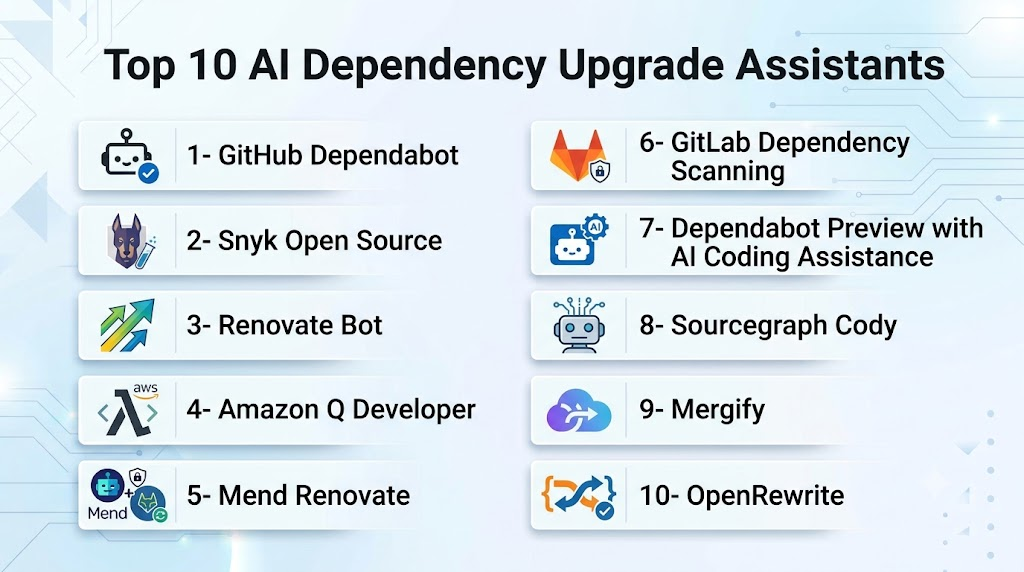
Top 10 AI Dependency Upgrade Assistants
1- GitHub Dependabot
Verdict: Widely adopted dependency management assistant integrated with GitHub.
Short Description: GitHub Dependabot automatically monitors dependencies, identifies vulnerabilities, and creates update suggestions to help developers maintain secure software projects.
Key Features:
- Automated dependency updates
- Security vulnerability alerts
- Pull request generation
- Repository integration
- Dependency monitoring
Pros:
- Native GitHub integration
- Easy adoption
Cons:
- Limited advanced AI customization
- Best within GitHub ecosystem
Deployment: Cloud-based
Security & Compliance: Enterprise security controls
Integrations & Ecosystem: GitHub repositories and workflows
Support & Community: Large developer community
Pricing Model: Included with GitHub plans
Best-Fit Scenarios: GitHub-based development teams
2- Snyk Open Source
Verdict: Security-focused dependency upgrade assistant.
Short Description: Snyk Open Source helps developers identify vulnerable dependencies and provides upgrade recommendations to improve application security.
Key Features:
- Dependency vulnerability scanning
- Upgrade recommendations
- Risk prioritization
- Developer feedback
- CI/CD integration
Pros:
- Strong security capabilities
- Developer-friendly workflows
Cons:
- Primarily security-focused
- Advanced features require paid plans
Deployment: Cloud-based
Security & Compliance: Security-focused platform
Integrations & Ecosystem: Git platforms, CI/CD tools
Support & Community: Security community
Pricing Model: Subscription-based
Best-Fit Scenarios: Secure dependency management
3- Renovate Bot
Verdict: Flexible automated dependency update platform.
Short Description: Renovate automates dependency updates across multiple ecosystems with customizable upgrade rules and workflows.
Key Features:
- Automated pull requests
- Multi-language support
- Dependency monitoring
- Update scheduling
- Custom configuration
Pros:
- Highly configurable
- Supports many ecosystems
Cons:
- Requires configuration effort
- Technical setup needed
Deployment: Cloud and self-hosted
Security & Compliance: Depends on implementation
Integrations & Ecosystem: GitHub, GitLab, repositories
Support & Community: Open-source community
Pricing Model: Open-source and enterprise options
Best-Fit Scenarios: Engineering teams needing flexibility
4- Amazon Q Developer
Verdict: AI coding assistant with dependency upgrade support.
Short Description: Amazon Q Developer helps developers analyze applications, modernize code, and receive AI-assisted recommendations for dependency and framework updates.
Key Features:
- Application modernization
- Code analysis
- Upgrade recommendations
- Developer assistance
- AWS integration
Pros:
- Strong AI capabilities
- Enterprise cloud integration
Cons:
- Best for AWS environments
- Broader dependency workflows may require additional tools
Deployment: Cloud-based
Security & Compliance: AWS enterprise security standards
Integrations & Ecosystem: AWS services and IDEs
Support & Community: AWS ecosystem
Pricing Model: Subscription-based
Best-Fit Scenarios: AWS development teams
5- Mend Renovate
Verdict: Enterprise dependency management and security platform.
Short Description: Mend Renovate helps organizations automate dependency updates while identifying open-source security risks.
Key Features:
- Dependency discovery
- Automated updates
- Security analysis
- Policy management
- Compliance reporting
Pros:
- Enterprise governance features
- Strong security focus
Cons:
- Complex enterprise setup
- Higher cost
Deployment: Cloud and enterprise
Security & Compliance: Enterprise security controls
Integrations & Ecosystem: Development platforms and CI/CD tools
Support & Community: Enterprise support
Pricing Model: Subscription-based
Best-Fit Scenarios: Large organizations
6- GitLab Dependency Scanning
Verdict: Integrated dependency security management for GitLab users.
Short Description: GitLab Dependency Scanning helps teams detect vulnerable packages and manage dependency risks within the DevOps lifecycle.
Key Features:
- Dependency vulnerability detection
- Security reports
- Pipeline integration
- Package analysis
- Compliance support
Pros:
- Native GitLab integration
- Full DevOps workflow support
Cons:
- Best for GitLab users
- Advanced capabilities depend on plans
Deployment: Cloud and enterprise
Security & Compliance: Enterprise security controls
Integrations & Ecosystem: GitLab DevOps platform
Support & Community: GitLab community
Pricing Model: Subscription-based
Best-Fit Scenarios: GitLab development teams
7- Dependabot Preview with AI Coding Assistance
Verdict: Automated dependency updates enhanced by AI workflows.
Short Description: Dependency automation combined with AI coding assistants helps developers understand upgrade impacts and resolve compatibility issues.
Key Features:
- Dependency monitoring
- Upgrade suggestions
- Compatibility analysis
- Code modification support
- Repository workflows
Pros:
- Simplifies upgrades
- Works well with developer workflows
Cons:
- Requires validation
- AI capabilities depend on connected tools
Deployment: Cloud-based
Security & Compliance: Enterprise controls
Integrations & Ecosystem: Git repositories and AI coding tools
Support & Community: Developer ecosystem
Pricing Model: Tool dependent
Best-Fit Scenarios: Teams modernizing applications
8- Sourcegraph Cody
Verdict: AI assistant for understanding dependency impact in large codebases.
Short Description: Sourcegraph Cody helps developers analyze repositories, understand dependencies, and make informed upgrade decisions.
Key Features:
- Codebase understanding
- Dependency analysis assistance
- Code explanation
- Repository search
- Migration support
Pros:
- Excellent large-codebase understanding
- Strong developer assistance
Cons:
- Requires setup
- Enterprise-focused
Deployment: Cloud and enterprise
Security & Compliance: Enterprise security controls
Integrations & Ecosystem: Git repositories and IDEs
Support & Community: Enterprise support
Pricing Model: Subscription-based
Best-Fit Scenarios: Large engineering organizations
9- Mergify
Verdict: Automation platform for dependency update workflows.
Short Description: Mergify helps teams automate pull request management, including dependency update workflows and merge automation.
Key Features:
- Pull request automation
- Dependency workflow management
- Merge rules
- CI/CD integration
- Team collaboration
Pros:
- Strong workflow automation
- Improves development efficiency
Cons:
- Not a dedicated dependency scanner
- Requires configuration
Deployment: Cloud-based
Security & Compliance: Enterprise options
Integrations & Ecosystem: GitHub and development workflows
Support & Community: Developer support
Pricing Model: Subscription-based
Best-Fit Scenarios: Teams automating repository workflows
10- OpenRewrite
Verdict: Automated code transformation platform for dependency migrations.
Short Description: OpenRewrite helps developers automatically modify code during framework upgrades, dependency migrations, and modernization projects.
Key Features:
- Automated code transformations
- Dependency migration support
- Large-scale refactoring
- Upgrade recipes
- Build integration
Pros:
- Powerful modernization capabilities
- Good for large migrations
Cons:
- Requires technical expertise
- More focused on transformations
Deployment: Self-hosted and enterprise
Security & Compliance: Depends on implementation
Integrations & Ecosystem: Build systems and repositories
Support & Community: Open-source community
Pricing Model: Open-source and enterprise options
Best-Fit Scenarios: Large application modernization
Comparison Table
| Platform | Dependency Detection | Upgrade Automation | Security Analysis | CI/CD Integration | Best Use |
|---|---|---|---|---|---|
| GitHub Dependabot | High | High | High | Excellent | GitHub projects |
| Snyk Open Source | High | High | Very High | High | Secure dependencies |
| Renovate Bot | High | Very High | Medium | High | Custom workflows |
| Amazon Q Developer | Medium | Medium | High | High | AWS modernization |
| Mend Renovate | Very High | High | Very High | High | Enterprise security |
| GitLab Dependency Scanning | High | Medium | High | Excellent | GitLab teams |
| AI Dependency Workflows | High | High | Medium | High | Modernization |
| Sourcegraph Cody | High | Medium | Medium | High | Large codebases |
| Mergify | Medium | High | Medium | High | PR automation |
| OpenRewrite | High | Very High | Medium | High | Migration projects |
Evaluation & Scoring Table
| Platform | Dependency Management 25% | Security 15% | Automation 15% | Integrations 15% | AI Assistance 10% | Ease 10% | Value 10% | Total |
|---|---|---|---|---|---|---|---|---|
| GitHub Dependabot | 24 | 14 | 15 | 15 | 8 | 10 | 10 | 96 |
| Snyk Open Source | 24 | 15 | 14 | 14 | 9 | 9 | 9 | 94 |
| Renovate Bot | 25 | 12 | 15 | 14 | 8 | 9 | 10 | 93 |
| Amazon Q Developer | 21 | 14 | 12 | 14 | 10 | 9 | 9 | 89 |
| Mend Renovate | 25 | 15 | 14 | 14 | 9 | 8 | 8 | 93 |
| GitLab Dependency Scanning | 23 | 14 | 13 | 15 | 8 | 9 | 9 | 91 |
| AI Dependency Workflows | 22 | 12 | 14 | 13 | 10 | 8 | 9 | 88 |
| Sourcegraph Cody | 23 | 12 | 12 | 14 | 10 | 8 | 8 | 87 |
| Mergify | 20 | 11 | 14 | 14 | 8 | 10 | 9 | 86 |
| OpenRewrite | 24 | 11 | 15 | 13 | 8 | 8 | 9 | 88 |
Which AI Dependency Upgrade Assistant Is Right for You?
- GitHub Projects: GitHub Dependabot
- Security-Focused Teams: Snyk Open Source, Mend Renovate
- Highly Custom Workflows: Renovate Bot
- AWS Applications: Amazon Q Developer
- GitLab Organizations: GitLab Dependency Scanning
- Large Application Migrations: OpenRewrite, Sourcegraph Cody
- Automated Pull Request Management: Mergify
Common Mistakes
- Automatically merging dependency updates without testing
- Ignoring compatibility issues
- Not monitoring dependency security risks
- Failing to define update policies
- Skipping developer validation
Frequently Asked Questions
What are AI dependency upgrade assistants?
They are tools that use automation and AI capabilities to identify, recommend, and manage software dependency updates.
Why are dependency upgrade tools important?
They help organizations maintain secure, updated, and reliable software systems.
Can these tools automatically update dependencies?
Yes. Many create update suggestions or automated pull requests.
Do dependency tools detect security vulnerabilities?
Many include vulnerability scanning and risk prioritization features.
Can AI tools handle dependency conflicts?
Some provide compatibility analysis and upgrade recommendations.
Which programming languages are supported?
Support varies, but many tools cover JavaScript, Python, Java, Go, and other ecosystems.
Do these tools integrate with CI/CD pipelines?
Yes. Most support automated development workflows.
Are dependency upgrade assistants secure for enterprises?
Enterprise solutions provide security controls, policies, and access management.
Can startups use dependency automation tools?
Yes. Many provide scalable options for smaller teams.
Do these tools reduce technical debt?
Yes. They help teams keep libraries and frameworks updated.
Can AI dependency tools replace developers?
No. Developers should review upgrades before production deployment.
How should teams adopt these tools?
Start with important repositories, validate updates, and gradually increase automation.
Conclusion
AI Dependency Upgrade Assistants are helping organizations manage software dependencies more efficiently by automating updates, identifying risks, and reducing maintenance effort. Tools such as GitHub Dependabot, Snyk Open Source, Renovate, and Mend Renovate provide different approaches for security management, automation, and enterprise dependency governance.
