Introduction
AI Refactoring Assistants use artificial intelligence to help developers improve existing code by restructuring, optimizing, simplifying, and modernizing software without changing its intended behavior. These tools analyze source code, identify improvement opportunities, suggest cleaner implementations, automate repetitive modifications, and support large-scale modernization projects. As software systems grow more complex, maintaining code quality and reducing technical debt becomes challenging. AI-powered refactoring assistants help engineering teams improve maintainability, readability, performance, and development efficiency. Real-world use cases include legacy application modernization, code cleanup, framework migration, performance improvement, technical debt reduction, and improving developer productivity. Buyers should evaluate refactoring accuracy, programming language support, IDE integration, code understanding, automation capabilities, security controls, and scalability.
Best for
Software developers, engineering teams, enterprises maintaining large applications, and organizations working on modernization initiatives.
Not ideal for
Small projects with simple codebases or teams expecting fully automated code transformation without developer review.
Key Trends
- Increased adoption of AI-assisted software modernization
- Automated code cleanup and optimization
- AI-powered technical debt reduction
- Legacy application transformation
- Integration with developer IDEs
- Automated framework migration support
- Improved code understanding using large language models
- Enterprise focus on secure code transformation
- AI-assisted performance optimization
- Integration with DevOps workflows
Methodology
- Selected tools based on AI refactoring capabilities and developer adoption
- Evaluated code transformation, language support, automation, integrations, and security
- Considered solutions for individual developers, teams, and enterprises
- Prioritized tools supporting modern development workflows
- Reviewed customization, scalability, and enterprise readiness
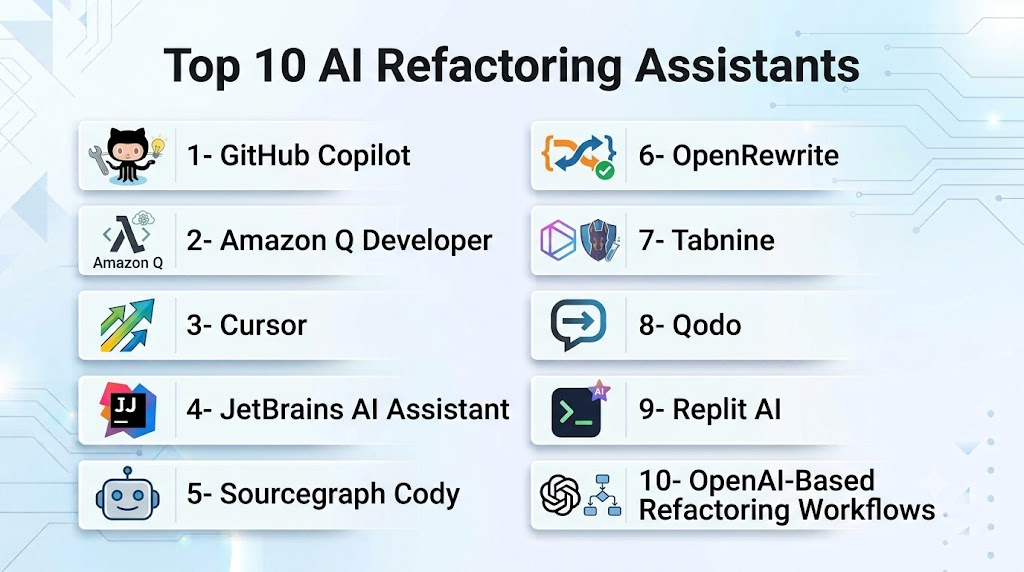
Top 10 AI Refactoring Assistants
1- GitHub Copilot
Verdict: Popular AI assistant for intelligent code improvement and transformation.
Short Description: GitHub Copilot helps developers refactor code by suggesting improvements, simplifying logic, explaining code, and generating cleaner implementations inside development environments.
Key Features:
- Code restructuring suggestions
- Code explanation
- Optimization recommendations
- Automated code generation
- IDE integration
Pros:
- Strong developer adoption
- Excellent IDE support
Cons:
- Requires human review
- Suggestions may vary by language
Deployment: Cloud-based with IDE plugins
Security & Compliance: Enterprise security controls
Integrations & Ecosystem: GitHub, VS Code, JetBrains IDEs
Support & Community: Large developer community
Pricing Model: Subscription-based
Best-Fit Scenarios: General software development teams
2- Amazon Q Developer
Verdict: AI modernization assistant for enterprise application improvement.
Short Description: Amazon Q Developer assists developers with code transformation, modernization, optimization, and application migration tasks.
Key Features:
- Code modernization
- Refactoring suggestions
- Application analysis
- Debugging support
- AWS migration assistance
Pros:
- Strong enterprise capabilities
- Cloud modernization support
Cons:
- Best for AWS environments
- Limited outside AWS workflows
Deployment: Cloud-based
Security & Compliance: AWS enterprise security standards
Integrations & Ecosystem: AWS services, IDEs, developer tools
Support & Community: AWS ecosystem
Pricing Model: Subscription-based
Best-Fit Scenarios: AWS application modernization
3- Cursor
Verdict: AI-first coding environment with strong refactoring capabilities.
Short Description: Cursor helps developers modify and improve existing code by understanding project context and applying AI-powered transformations.
Key Features:
- Context-aware editing
- Code restructuring
- Repository understanding
- Natural language commands
- Debugging support
Pros:
- Strong codebase understanding
- Fast developer workflow
Cons:
- Requires adopting a new editor
- Enterprise features vary
Deployment: Desktop IDE
Security & Compliance: Depends on configuration
Integrations & Ecosystem: VS Code ecosystem
Support & Community: Growing developer community
Pricing Model: Subscription-based
Best-Fit Scenarios: AI-native development workflows
4- JetBrains AI Assistant
Verdict: Native AI refactoring support for JetBrains IDE users.
Short Description: JetBrains AI Assistant provides code improvement, explanation, and transformation capabilities directly inside JetBrains development environments.
Key Features:
- Code restructuring
- Refactoring suggestions
- Documentation generation
- Code explanation
- IDE integration
Pros:
- Excellent JetBrains integration
- Familiar developer workflow
Cons:
- Limited outside JetBrains ecosystem
- Subscription-based
Deployment: IDE-integrated
Security & Compliance: Enterprise security options
Integrations & Ecosystem: IntelliJ IDEA, PyCharm, JetBrains tools
Support & Community: JetBrains community
Pricing Model: Subscription-based
Best-Fit Scenarios: JetBrains developers
5- Sourcegraph Cody
Verdict: AI refactoring assistant for large and complex codebases.
Short Description: Sourcegraph Cody helps developers understand repositories, identify improvement areas, and safely modify large-scale software systems.
Key Features:
- Codebase understanding
- Repository search
- Refactoring assistance
- Code explanation
- Enterprise controls
Pros:
- Excellent for large repositories
- Strong contextual understanding
Cons:
- Requires setup
- Enterprise-focused
Deployment: Cloud and enterprise
Security & Compliance: Enterprise security controls
Integrations & Ecosystem: Git repositories, IDEs
Support & Community: Enterprise support
Pricing Model: Subscription-based
Best-Fit Scenarios: Large engineering organizations
6- OpenRewrite
Verdict: Automated code transformation platform for large-scale modernization.
Short Description: OpenRewrite provides automated refactoring recipes that help developers migrate frameworks, update dependencies, and modernize applications.
Key Features:
- Automated code transformation
- Migration recipes
- Dependency upgrades
- Large-scale refactoring
- Build integration
Pros:
- Powerful modernization capabilities
- Good for enterprise migrations
Cons:
- Requires technical expertise
- More rule-based than conversational AI
Deployment: Self-hosted and enterprise
Security & Compliance: Depends on implementation
Integrations & Ecosystem: Build systems and repositories
Support & Community: Open-source community
Pricing Model: Open-source and enterprise options
Best-Fit Scenarios: Enterprise modernization projects
7- Tabnine
Verdict: Privacy-focused AI coding assistant with refactoring support.
Short Description: Tabnine helps developers improve code quality through AI suggestions, code completion, and transformation assistance.
Key Features:
- Code improvement suggestions
- Code completion
- Private AI models
- Team customization
- IDE support
Pros:
- Strong privacy controls
- Enterprise-friendly
Cons:
- Limited dedicated refactoring workflows
- Less automation than specialized tools
Deployment: Cloud and enterprise
Security & Compliance: Enterprise security controls
Integrations & Ecosystem: IDEs and development tools
Support & Community: Enterprise support
Pricing Model: Subscription-based
Best-Fit Scenarios: Secure development teams
8- Qodo
Verdict: AI-powered code quality improvement assistant.
Short Description: Qodo helps developers analyze code, improve implementation quality, generate tests, and support refactoring workflows.
Key Features:
- Code analysis
- Quality suggestions
- Test generation
- Code understanding
- Developer workflow integration
Pros:
- AI-focused development workflow
- Good testing support
Cons:
- Emerging ecosystem
- Requires validation
Deployment: Cloud and IDE-based
Security & Compliance: Enterprise options available
Integrations & Ecosystem: IDEs and Git workflows
Support & Community: Developer community
Pricing Model: Subscription-based
Best-Fit Scenarios: Development teams improving code quality
9- Replit AI
Verdict: Accessible AI coding assistant for rapid code improvement.
Short Description: Replit AI helps developers understand, modify, and improve code inside a cloud development environment.
Key Features:
- Code transformation
- Code explanation
- Debugging assistance
- AI suggestions
- Cloud IDE workflow
Pros:
- Beginner-friendly
- Easy access
Cons:
- Limited enterprise capabilities
- Platform dependency
Deployment: Cloud IDE
Security & Compliance: Platform-dependent
Integrations & Ecosystem: Replit environment
Support & Community: Developer community
Pricing Model: Subscription-based
Best-Fit Scenarios: Beginners and prototypes
10- OpenAI-Based Refactoring Workflows
Verdict: Flexible AI approach for customized code transformation.
Short Description: Large language model-based workflows help developers analyze code, improve structure, modernize implementations, and automate refactoring tasks.
Key Features:
- Code transformation
- Code explanation
- Custom automation
- Migration support
- API integration
Pros:
- Highly flexible
- Customizable workflows
Cons:
- Requires engineering effort
- Needs careful validation
Deployment: API and custom environments
Security & Compliance: Depends on implementation
Integrations & Ecosystem: Development platforms and APIs
Support & Community: Developer ecosystem
Pricing Model: Usage-based
Best-Fit Scenarios: Custom modernization workflows
Comparison Table
| Platform | Refactoring Capability | Code Understanding | IDE Integration | Automation | Best Use |
|---|---|---|---|---|---|
| GitHub Copilot | High | High | Excellent | High | General development |
| Amazon Q Developer | High | High | High | High | AWS modernization |
| Cursor | Very High | Very High | High | High | AI-native coding |
| JetBrains AI Assistant | High | High | Excellent | Medium | JetBrains users |
| Sourcegraph Cody | Very High | Very High | High | High | Large codebases |
| OpenRewrite | Very High | High | Medium | Very High | Enterprise migration |
| Tabnine | Medium | High | High | Medium | Secure teams |
| Qodo | High | High | High | Medium | Code quality |
| Replit AI | Medium | Medium | Medium | Medium | Learning/prototyping |
| AI Workflows | High | High | Flexible | High | Custom solutions |
Evaluation & Scoring Table
| Platform | Refactoring Quality 25% | Code Understanding 15% | Automation 15% | Integrations 15% | Security 10% | Ease 10% | Value 10% | Total |
|---|---|---|---|---|---|---|---|---|
| GitHub Copilot | 24 | 14 | 14 | 15 | 9 | 10 | 9 | 95 |
| Amazon Q Developer | 24 | 14 | 14 | 14 | 10 | 9 | 9 | 94 |
| Cursor | 25 | 15 | 15 | 14 | 9 | 10 | 9 | 97 |
| JetBrains AI Assistant | 23 | 14 | 13 | 15 | 9 | 10 | 8 | 92 |
| Sourcegraph Cody | 25 | 15 | 14 | 14 | 10 | 8 | 8 | 94 |
| OpenRewrite | 25 | 13 | 15 | 13 | 9 | 8 | 9 | 92 |
| Tabnine | 21 | 13 | 11 | 14 | 10 | 9 | 9 | 87 |
| Qodo | 22 | 13 | 12 | 13 | 9 | 10 | 9 | 88 |
| Replit AI | 20 | 11 | 11 | 11 | 8 | 10 | 10 | 81 |
| AI Workflows | 23 | 14 | 14 | 12 | 8 | 8 | 9 | 88 |
Which AI Refactoring Assistant Is Right for You?
- Individual Developers: GitHub Copilot, Cursor
- Enterprise Modernization: OpenRewrite, Sourcegraph Cody, Amazon Q Developer
- JetBrains Users: JetBrains AI Assistant
- Security-Focused Teams: Tabnine
- Large Codebases: Sourcegraph Cody, OpenRewrite
- Custom Refactoring Workflows: AI-based solutions
Common Mistakes
- Applying AI refactoring without code review
- Ignoring application behavior changes
- Refactoring without testing
- Not measuring code quality improvements
- Using AI tools without security guidelines
Frequently Asked Questions
What are AI refactoring assistants?
They are AI-powered tools that help developers improve, restructure, and modernize existing code.
Can AI refactoring tools rewrite entire applications?
Some can assist with large transformations, but human review and testing remain necessary.
Do AI refactoring assistants reduce technical debt?
Yes. They help identify improvement opportunities and automate repetitive cleanup tasks.
Which programming languages are supported?
Support depends on the tool, but many work with popular languages such as Java, Python, JavaScript, and C++.
Can AI refactoring tools improve code performance?
Some provide optimization suggestions, but performance changes require validation.
Are AI refactoring tools safe for enterprise code?
Many provide enterprise security controls and privacy options.
Do these tools integrate with IDEs?
Yes. Most support popular development environments.
Can AI refactoring assistants migrate frameworks?
Some tools support framework upgrades and modernization workflows.
Do AI tools replace developers during refactoring?
No. They assist developers by reducing manual effort.
Can startups use AI refactoring tools?
Yes. Many provide scalable options for smaller teams.
How accurate are AI refactoring suggestions?
Accuracy depends on code complexity, language support, and tool capabilities.
How should organizations adopt AI refactoring tools?
Start with small projects, validate changes, and gradually expand usage.
Conclusion
AI Refactoring Assistants are helping development teams improve software quality, reduce technical debt, and modernize applications more efficiently. Tools such as GitHub Copilot, Cursor, Sourcegraph Cody, and OpenRewrite provide different approaches for code improvement, modernization, and automated transformation.
