Introduction
AI Voice Support Agents use artificial intelligence, speech recognition, natural language processing, and conversational automation to handle customer conversations through voice channels. These tools help businesses automate phone support, manage customer inquiries, assist human agents, and provide personalized voice interactions at scale.
Traditional call centers often require significant human resources to manage repetitive customer requests, appointment scheduling, troubleshooting, and information queries. AI-powered voice support agents help organizations reduce response times, provide 24/7 availability, analyze conversations, and improve customer service efficiency while allowing human agents to focus on complex issues.
Real-world use cases:
- Automated customer phone support
- Appointment scheduling and reminders
- Order and account assistance
- Customer verification workflows
- Call routing and qualification
- Technical support assistance
- Voice-based FAQ handling
- Sales and lead qualification
- Multilingual customer conversations
- Agent assistance and call summarization
Evaluation Criteria for Buyers:
- Speech recognition accuracy
- Natural conversation quality
- Voice response performance
- CRM and helpdesk integration
- Call automation capabilities
- Human agent handoff support
- Security and compliance controls
- Scalability and reliability
Best for
Customer service teams, enterprises, healthcare organizations, financial services, ecommerce businesses, and companies managing high call volumes.
Not ideal for
Highly sensitive conversations requiring complete human empathy or organizations without structured customer support workflows.
Key Trends
- Growth of conversational voice AI
- AI-powered call center automation
- Real-time speech understanding
- Personalized customer interactions
- Voice analytics and sentiment analysis
- Multilingual voice support
- Integration with CRM systems
- AI-assisted human agents
- Automated appointment and service workflows
- Enterprise adoption of voice automation
Methodology
- Selected tools based on AI voice support capabilities
- Evaluated speech quality, automation, integrations, scalability, and security
- Considered solutions for enterprises, startups, and customer service teams
- Prioritized platforms supporting real-time voice interactions
- Reviewed customization, analytics, and deployment options
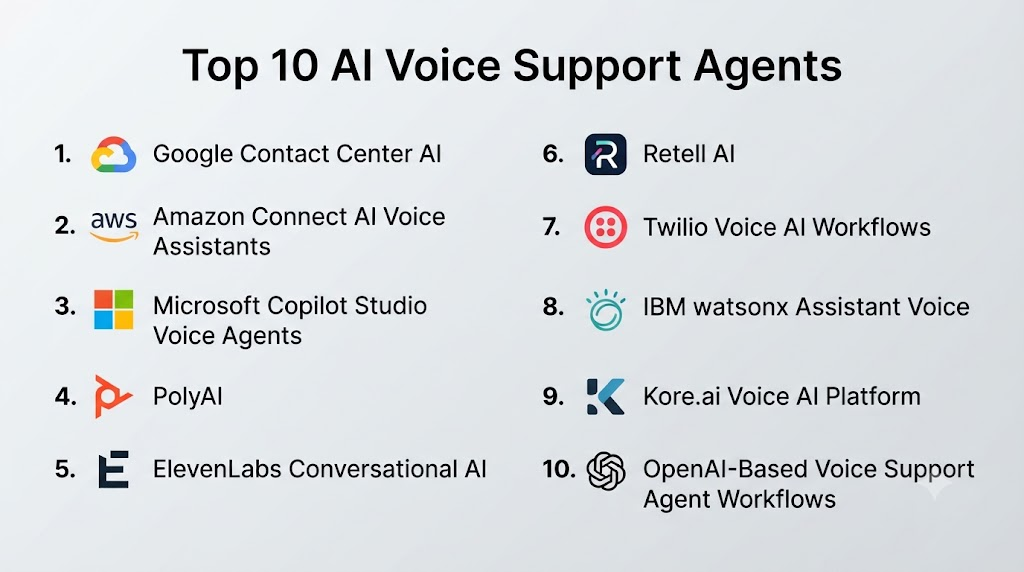
Top 10 AI Voice Support Agents
1- Google Contact Center AI
Verdict: Enterprise conversational AI platform for automated voice customer support.
Short Description: Google Contact Center AI helps organizations build intelligent voice assistants that understand customer requests, automate conversations, and support contact center operations.
Key Features:
- AI voice conversations
- Speech recognition
- Virtual agents
- Agent assistance
- Conversation analytics
Pros:
- Strong AI capabilities
- Enterprise scalability
Cons:
- Requires technical implementation
- Enterprise-focused pricing
Deployment: Cloud-based
Security & Compliance: Enterprise cloud security controls
Integrations & Ecosystem: Contact center platforms and business systems
Support & Community: Enterprise support
Pricing Model: Usage-based
Best-Fit Scenarios: Large contact centers
2- Amazon Connect AI Voice Assistants
Verdict: Cloud contact center platform with AI-powered voice automation.
Short Description: Amazon Connect AI capabilities help businesses automate customer calls, improve agent productivity, and manage voice support workflows.
Key Features:
- Voice automation
- Call routing
- Customer interactions
- Agent assistance
- Contact center analytics
Pros:
- Strong cloud integration
- Flexible scaling
Cons:
- Best within AWS ecosystem
- Requires configuration expertise
Deployment: Cloud-based
Security & Compliance: AWS security standards
Integrations & Ecosystem: AWS services and contact center tools
Support & Community: AWS ecosystem
Pricing Model: Usage-based
Best-Fit Scenarios: Cloud contact centers
3- Microsoft Copilot Studio Voice Agents
Verdict: Enterprise AI voice agent platform integrated with Microsoft workflows.
Short Description: Microsoft Copilot Studio helps organizations create AI-powered voice assistants connected with business data, applications, and customer workflows.
Key Features:
- Voice conversations
- Custom AI agents
- Workflow automation
- Knowledge integration
- Enterprise connectors
Pros:
- Strong enterprise ecosystem
- Flexible customization
Cons:
- Requires configuration
- Best within Microsoft environments
Deployment: Cloud-based
Security & Compliance: Microsoft enterprise security
Integrations & Ecosystem: Microsoft services and business applications
Support & Community: Microsoft ecosystem
Pricing Model: Subscription-based
Best-Fit Scenarios: Enterprise organizations
4- PolyAI
Verdict: Enterprise conversational voice AI platform for customer service automation.
Short Description: PolyAI helps businesses automate natural voice conversations and handle complex customer interactions through AI-powered voice agents.
Key Features:
- Natural voice conversations
- Customer intent understanding
- Call automation
- Enterprise workflows
- Analytics
Pros:
- High-quality voice interactions
- Enterprise-focused
Cons:
- Higher implementation effort
- Mainly enterprise-oriented
Deployment: Cloud-based
Security & Compliance: Enterprise security controls
Integrations & Ecosystem: Contact center platforms
Support & Community: Enterprise support
Pricing Model: Enterprise subscription
Best-Fit Scenarios: Large businesses
5- ElevenLabs Conversational AI
Verdict: Advanced voice AI platform focused on realistic speech experiences.
Short Description: ElevenLabs Conversational AI enables organizations to create AI voice agents with natural speech generation and interactive conversations.
Key Features:
- Realistic voice generation
- Conversational AI
- Voice customization
- Multilingual support
- Voice workflows
Pros:
- High-quality voice output
- Strong conversational experience
Cons:
- Requires integration effort
- Enterprise controls vary
Deployment: Cloud-based
Security & Compliance: Platform-dependent
Integrations & Ecosystem: Voice applications and APIs
Support & Community: Developer community
Pricing Model: Usage-based
Best-Fit Scenarios: Voice experiences and assistants
6- Retell AI
Verdict: Developer-focused platform for building AI voice agents.
Short Description: Retell AI helps developers create voice assistants for customer support, sales, and automated calling workflows.
Key Features:
- Voice agent creation
- Real-time conversations
- Call automation
- API integration
- Conversation monitoring
Pros:
- Developer-friendly
- Flexible customization
Cons:
- Requires technical setup
- Enterprise features vary
Deployment: Cloud-based
Security & Compliance: Depends on implementation
Integrations & Ecosystem: APIs and communication platforms
Support & Community: Developer community
Pricing Model: Usage-based
Best-Fit Scenarios: Custom voice applications
7- Twilio Voice AI Workflows
Verdict: Communication platform for building AI-powered voice support solutions.
Short Description: Twilio Voice AI workflows help businesses create automated voice interactions using communication APIs and AI integrations.
Key Features:
- Voice automation
- Call management
- API integrations
- Customer workflows
- Communication analytics
Pros:
- Flexible communication infrastructure
- Developer ecosystem
Cons:
- Requires development effort
- AI capabilities depend on integrations
Deployment: Cloud-based
Security & Compliance: Enterprise security options
Integrations & Ecosystem: Communication platforms and APIs
Support & Community: Developer community
Pricing Model: Usage-based
Best-Fit Scenarios: Custom voice solutions
8- IBM watsonx Assistant Voice
Verdict: Enterprise conversational AI platform with voice capabilities.
Short Description: IBM watsonx Assistant helps organizations create AI assistants that support voice conversations, customer service workflows, and business automation.
Key Features:
- Voice interactions
- Natural language understanding
- Knowledge integration
- Enterprise workflows
- Analytics
Pros:
- Enterprise security focus
- Strong AI capabilities
Cons:
- Requires implementation expertise
- Complex deployments
Deployment: Cloud and enterprise
Security & Compliance: Enterprise security controls
Integrations & Ecosystem: Business applications and contact centers
Support & Community: Enterprise support
Pricing Model: Subscription-based
Best-Fit Scenarios: Enterprise support operations
9- Kore.ai Voice AI Platform
Verdict: Enterprise conversational AI platform for automated customer interactions.
Short Description: Kore.ai helps organizations build intelligent voice assistants for customer service, employee support, and business automation.
Key Features:
- Voice automation
- Conversation workflows
- Enterprise integrations
- Analytics
- Multi-channel support
Pros:
- Enterprise-ready platform
- Strong customization
Cons:
- Requires setup effort
- Advanced features need expertise
Deployment: Cloud-based
Security & Compliance: Enterprise controls
Integrations & Ecosystem: Business applications and contact centers
Support & Community: Enterprise support
Pricing Model: Subscription-based
Best-Fit Scenarios: Large organizations
10- OpenAI-Based Voice Support Agent Workflows
Verdict: Flexible AI approach for creating customized voice support systems.
Short Description: AI-powered voice workflows combine speech recognition, language models, customer data, and business systems to create custom voice assistants.
Key Features:
- Natural voice conversations
- Customer support automation
- Knowledge retrieval
- Custom workflows
- API integrations
Pros:
- Highly customizable
- Supports different industries
Cons:
- Requires engineering effort
- Needs monitoring and governance
Deployment: API and custom environments
Security & Compliance: Depends on implementation
Integrations & Ecosystem: CRM, communication tools, APIs
Support & Community: Developer ecosystem
Pricing Model: Usage-based
Best-Fit Scenarios: Custom enterprise voice solutions
Comparison Table
| Platform | Voice Quality | AI Understanding | Automation | Integrations | Best Use |
|---|---|---|---|---|---|
| Google Contact Center AI | Very High | Very High | High | Excellent | Enterprise contact centers |
| Amazon Connect AI | High | High | High | Excellent | Cloud support teams |
| Microsoft Copilot Studio | High | High | Very High | Excellent | Enterprise workflows |
| PolyAI | Very High | Very High | High | High | Complex voice support |
| ElevenLabs Conversational AI | Very High | High | High | Medium | Natural voice experiences |
| Retell AI | High | High | High | High | Custom voice apps |
| Twilio Voice AI | High | High | High | Very High | Developer solutions |
| IBM watsonx Assistant | High | High | High | High | Enterprise automation |
| Kore.ai | High | High | Very High | High | Business automation |
| OpenAI Workflows | Very High | Very High | Very High | Custom | Custom solutions |
Evaluation & Scoring Table
| Platform | Voice Quality 25% | AI Capability 15% | Automation 15% | Integrations 15% | Security 10% | Ease 10% | Value 10% | Total |
|---|---|---|---|---|---|---|---|---|
| Google Contact Center AI | 25 | 15 | 14 | 15 | 10 | 8 | 9 | 96 |
| Amazon Connect AI | 23 | 14 | 14 | 15 | 10 | 9 | 9 | 94 |
| Microsoft Copilot Studio | 23 | 14 | 15 | 15 | 10 | 8 | 9 | 94 |
| PolyAI | 25 | 15 | 14 | 13 | 9 | 8 | 8 | 92 |
| ElevenLabs Conversational AI | 25 | 14 | 13 | 11 | 8 | 9 | 9 | 89 |
| Retell AI | 23 | 14 | 14 | 13 | 8 | 10 | 9 | 91 |
| Twilio Voice AI | 22 | 13 | 14 | 15 | 9 | 9 | 9 | 91 |
| IBM watsonx Assistant | 23 | 13 | 14 | 14 | 10 | 8 | 8 | 90 |
| Kore.ai | 23 | 14 | 15 | 14 | 9 | 8 | 8 | 91 |
| OpenAI Workflows | 25 | 15 | 15 | 12 | 8 | 8 | 9 | 92 |
Which AI Voice Support Agent Is Right for You?
- Enterprise Contact Centers: Google Contact Center AI, PolyAI
- AWS-Based Organizations: Amazon Connect AI
- Microsoft Ecosystem Users: Microsoft Copilot Studio
- Custom Voice Applications: Retell AI, Twilio Voice AI
- Natural Voice Experiences: ElevenLabs Conversational AI
- Enterprise Automation: IBM watsonx Assistant, Kore.ai
- Custom AI Voice Workflows: OpenAI-based solutions
Common Mistakes
- Deploying voice agents without testing conversations
- Ignoring escalation workflows
- Using poor-quality knowledge sources
- Not monitoring customer satisfaction
- Automating sensitive conversations without review
Frequently Asked Questions
What are AI voice support agents?
They are AI-powered systems that handle customer conversations through voice channels.
Can AI voice agents replace call center agents?
No. They automate repetitive tasks while supporting human agents.
How do AI voice agents understand customers?
They use speech recognition and natural language processing to interpret conversations.
Can AI voice agents provide 24/7 support?
Yes. They can handle customer interactions continuously.
Do AI voice agents integrate with CRM systems?
Many support CRM, helpdesk, and business application integrations.
Can AI voice agents handle multiple languages?
Many platforms support multilingual voice conversations.
Are AI voice support agents secure?
Organizations should review privacy, access controls, and compliance requirements.
Can businesses customize AI voice conversations?
Yes. Most platforms allow custom workflows and responses.
Do AI voice agents support human handoff?
Many provide escalation to human support representatives.
Can startups use AI voice support agents?
Yes. They help automate customer communication efficiently.
Can AI voice agents analyze calls?
Many provide conversation analytics and performance insights.
How should companies adopt AI voice agents?
Start with simple workflows, test performance, and expand gradually.
Conclusion
AI Voice Support Agents are transforming customer service by enabling automated conversations, faster responses, and scalable support operations. Platforms such as Google Contact Center AI, Amazon Connect AI, Microsoft Copilot Studio, and PolyAI provide different approaches for organizations adopting intelligent voice automation.
