Introduction
AI Integration Test Generation Tools help development teams automatically create, maintain, and optimize tests that validate interactions between different software components, APIs, databases, services, and external systems. These tools use artificial intelligence to understand application architecture, generate realistic test scenarios, identify integration failures, and improve overall software reliability. As modern applications rely heavily on microservices, APIs, cloud platforms, and distributed systems, integration testing has become more complex and time-consuming. AI-powered testing solutions help teams reduce manual effort, improve test coverage, and detect issues earlier in the development lifecycle. Real-world use cases include API testing, microservices validation, CI/CD quality checks, cloud application testing, regression testing, and enterprise software integration. Buyers should evaluate API support, AI test generation accuracy, automation capabilities, CI/CD integration, security features, scalability, and reporting capabilities.
Best for
Software engineering teams, DevOps teams, QA organizations, and enterprises managing complex applications with multiple integrations.
Not ideal for
Small applications with limited integrations or teams requiring fully autonomous testing without developer and QA validation.
Key Trends
- Growth of AI-powered automated testing workflows
- Increased adoption of API and microservice testing
- AI-driven test scenario generation
- Automated regression testing improvements
- Integration with CI/CD pipelines
- Shift toward continuous testing practices
- Better support for cloud-native applications
- AI-assisted failure analysis and debugging
- Increased focus on quality engineering
- Enterprise adoption of intelligent testing platforms
Methodology
- Selected tools based on AI testing capabilities and industry adoption
- Evaluated integration testing, API support, automation, security, and scalability
- Considered solutions for developers, QA teams, and enterprises
- Prioritized tools supporting CI/CD and modern application architectures
- Reviewed customization, reporting, and workflow integration capabilities
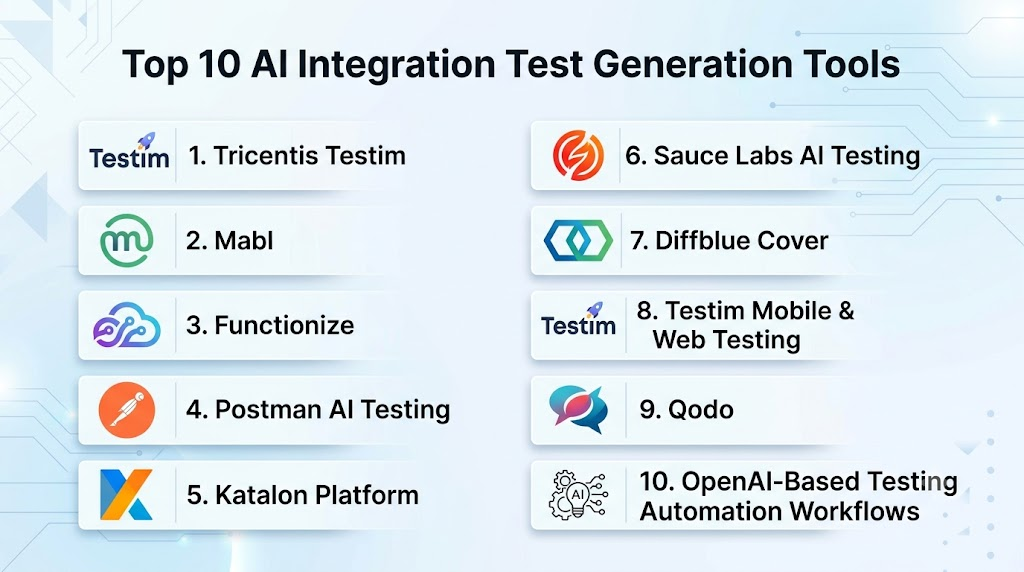
Top 10 AI Integration Test Generation Tools
1- Tricentis Testim
Verdict: AI-powered integration testing platform for enterprise applications.
Short Description: Tricentis Testim uses AI to create stable automated tests, reduce maintenance effort, and support complex application testing workflows.
Key Features:
- AI-based test creation
- Self-healing tests
- Regression testing
- Web and application testing
- CI/CD integration
Pros:
- Strong enterprise capabilities
- Reduces test maintenance effort
Cons:
- Higher enterprise cost
- Requires setup and training
Deployment: Cloud-based
Security & Compliance: Enterprise security controls
Integrations & Ecosystem: CI/CD tools, testing frameworks
Support & Community: Enterprise support
Pricing Model: Subscription-based
Best-Fit Scenarios: Large QA teams and enterprises
2- Mabl
Verdict: AI-driven continuous integration testing platform.
Short Description: Mabl helps teams generate and maintain automated integration tests using machine learning and intelligent test analysis.
Key Features:
- AI-powered test creation
- Browser and API testing
- Automated test maintenance
- Visual testing
- CI/CD integration
Pros:
- Easy adoption
- Strong continuous testing workflow
Cons:
- Limited advanced customization
- Cloud dependency
Deployment: Cloud-based
Security & Compliance: Enterprise security options
Integrations & Ecosystem: DevOps tools, CI/CD platforms
Support & Community: Customer support
Pricing Model: Subscription-based
Best-Fit Scenarios: Agile development teams
3- Functionize
Verdict: AI-powered intelligent testing platform for complex applications.
Short Description: Functionize uses AI and machine learning to create, execute, and maintain automated integration tests across applications.
Key Features:
- Natural language test creation
- AI test maintenance
- Cross-browser testing
- API testing
- Test analytics
Pros:
- Strong AI automation
- Reduces manual testing effort
Cons:
- Expensive for small teams
- Learning curve
Deployment: Cloud-based
Security & Compliance: Enterprise security standards
Integrations & Ecosystem: CI/CD and testing platforms
Support & Community: Enterprise support
Pricing Model: Subscription-based
Best-Fit Scenarios: Enterprise application testing
4- Postman AI Testing
Verdict: AI-enhanced API integration testing platform.
Short Description: Postman provides API testing, automation, collaboration, and AI-assisted workflows for validating service integrations.
Key Features:
- API test generation
- API workflow automation
- Request analysis
- Collection-based testing
- CI/CD integration
Pros:
- Strong API ecosystem
- Developer-friendly
Cons:
- Mainly API-focused
- Complex enterprise workflows may need additional tools
Deployment: Cloud and desktop
Security & Compliance: Enterprise security controls
Integrations & Ecosystem: APIs, CI/CD tools, developer workflows
Support & Community: Large developer community
Pricing Model: Subscription-based
Best-Fit Scenarios: API-driven applications
5- Katalon Platform
Verdict: Comprehensive AI-assisted testing platform.
Short Description: Katalon provides automated testing capabilities for web, API, mobile, and enterprise applications with AI-powered assistance.
Key Features:
- API testing
- Web and mobile testing
- Automated test creation
- Test reporting
- CI/CD integration
Pros:
- Broad testing coverage
- Supports multiple application types
Cons:
- Advanced features require paid plans
- Can require configuration effort
Deployment: Cloud and enterprise
Security & Compliance: Enterprise controls
Integrations & Ecosystem: DevOps tools and testing frameworks
Support & Community: Large user community
Pricing Model: Subscription-based
Best-Fit Scenarios: QA teams needing multiple testing types
6- Sauce Labs AI Testing
Verdict: Cloud testing platform with intelligent automation capabilities.
Short Description: Sauce Labs helps teams test applications across browsers, devices, and environments using AI-assisted testing workflows.
Key Features:
- Automated testing
- Cross-platform validation
- API testing support
- Test analytics
- CI/CD integration
Pros:
- Strong cloud infrastructure
- Wide testing coverage
Cons:
- Pricing can increase at scale
- Advanced features require configuration
Deployment: Cloud-based
Security & Compliance: Enterprise security standards
Integrations & Ecosystem: CI/CD tools and development platforms
Support & Community: Enterprise support
Pricing Model: Subscription-based
Best-Fit Scenarios: Cloud application testing
7- Diffblue Cover
Verdict: AI-powered automated testing for software components.
Short Description: Diffblue Cover generates automated tests using AI analysis, helping teams validate application behavior and integration points.
Key Features:
- Automated test generation
- Java application testing
- Regression testing
- Code analysis
- CI/CD support
Pros:
- High automation level
- Strong Java support
Cons:
- Language limitations
- Enterprise-focused pricing
Deployment: Cloud and enterprise
Security & Compliance: Enterprise controls
Integrations & Ecosystem: Java frameworks and CI/CD tools
Support & Community: Enterprise support
Pricing Model: Subscription-based
Best-Fit Scenarios: Java enterprise applications
8- Testim Mobile & Web Testing
Verdict: AI-powered stable automation for modern applications.
Short Description: Testim uses AI techniques to improve test stability and automate integration workflows across applications.
Key Features:
- AI test maintenance
- Automated workflows
- Regression testing
- Application monitoring
- Collaboration tools
Pros:
- Reduces flaky tests
- Easy collaboration
Cons:
- Limited specialized testing scenarios
- Cloud dependency
Deployment: Cloud-based
Security & Compliance: Enterprise options
Integrations & Ecosystem: CI/CD and testing tools
Support & Community: Customer support
Pricing Model: Subscription-based
Best-Fit Scenarios: Agile software teams
9- Qodo
Verdict: AI-assisted testing and quality improvement platform.
Short Description: Qodo helps developers create tests, validate code changes, and improve software reliability using AI-based analysis.
Key Features:
- Test generation
- Code understanding
- Quality analysis
- IDE integration
- Development workflow support
Pros:
- Developer-focused approach
- Strong AI testing capabilities
Cons:
- Emerging enterprise adoption
- Requires validation
Deployment: Cloud and IDE-based
Security & Compliance: Enterprise options available
Integrations & Ecosystem: IDEs and Git workflows
Support & Community: Developer community
Pricing Model: Subscription-based
Best-Fit Scenarios: Developer-focused testing workflows
10- OpenAI-Based Testing Automation Workflows
Verdict: Flexible AI approach for custom integration testing.
Short Description: AI-based testing workflows using large language models can generate integration scenarios, analyze failures, and automate testing processes.
Key Features:
- Natural language test creation
- Scenario generation
- Failure analysis
- Custom automation
- API integration
Pros:
- Highly flexible
- Customizable workflows
Cons:
- Requires engineering effort
- Needs validation
Deployment: API and custom environments
Security & Compliance: Depends on implementation
Integrations & Ecosystem: APIs, testing frameworks, CI/CD
Support & Community: Developer ecosystem
Pricing Model: Usage-based
Best-Fit Scenarios: Custom enterprise testing solutions
Comparison Table
| Platform | AI Test Generation | API Testing | CI/CD Integration | Automation | Best Use |
|---|---|---|---|---|---|
| Tricentis Testim | High | High | High | High | Enterprise testing |
| Mabl | High | Medium | High | High | Agile teams |
| Functionize | Very High | High | High | High | Complex applications |
| Postman | Medium | Very High | High | Medium | API testing |
| Katalon | High | High | High | High | QA teams |
| Sauce Labs | Medium | High | High | Medium | Cloud testing |
| Diffblue Cover | Very High | Medium | High | High | Java applications |
| Testim | High | Medium | High | High | Web applications |
| Qodo | High | Medium | High | High | Developer testing |
| AI Automation Workflows | High | High | Medium | High | Custom solutions |
Evaluation & Scoring Table
| Platform | Test Quality 25% | API Support 15% | Automation 15% | Integration 15% | Security 10% | Ease 10% | Value 10% | Total |
|---|---|---|---|---|---|---|---|---|
| Tricentis Testim | 24 | 14 | 15 | 15 | 9 | 9 | 8 | 94 |
| Mabl | 23 | 13 | 14 | 14 | 9 | 10 | 9 | 92 |
| Functionize | 25 | 14 | 15 | 14 | 9 | 8 | 8 | 93 |
| Postman | 22 | 15 | 12 | 15 | 9 | 10 | 10 | 93 |
| Katalon | 23 | 15 | 14 | 14 | 9 | 9 | 9 | 93 |
| Sauce Labs | 22 | 14 | 13 | 14 | 9 | 9 | 9 | 90 |
| Diffblue Cover | 24 | 10 | 15 | 14 | 9 | 9 | 8 | 89 |
| Testim | 22 | 12 | 14 | 14 | 9 | 10 | 9 | 90 |
| Qodo | 23 | 12 | 14 | 13 | 9 | 10 | 9 | 90 |
| AI Automation Workflows | 24 | 14 | 13 | 12 | 8 | 8 | 9 | 88 |
Which AI Integration Test Generation Tool Is Right for You?
- Enterprise QA Teams: Tricentis Testim, Functionize, Katalon
- API-First Applications: Postman, Mabl
- Java Applications: Diffblue Cover
- Developer-Centric Testing: Qodo, AI automation workflows
- Cloud Application Testing: Sauce Labs
- Agile Teams: Mabl, Testim
Common Mistakes
- Relying completely on generated tests
- Ignoring integration complexity
- Not validating AI-generated scenarios
- Missing security testing requirements
- Failing to maintain test documentation
Frequently Asked Questions
What are AI integration test generation tools?
They are AI-powered platforms that automatically create and maintain tests for validating interactions between applications, APIs, and services.
How are integration tests different from unit tests?
Integration tests verify communication between components, while unit tests validate individual code sections.
Can AI generate API integration tests?
Yes. Many AI testing tools can create API workflows and validate service interactions.
Do AI integration testing tools support CI/CD pipelines?
Most enterprise solutions integrate with automated development and deployment workflows.
Can AI tools reduce testing time?
Yes. They automate repetitive test creation and maintenance tasks.
Are AI-generated integration tests accurate?
They improve productivity but require developer and QA validation.
Which industries use AI integration testing tools?
Software, finance, healthcare, e-commerce, and enterprise technology organizations commonly use them.
Can these tools test microservices?
Yes. Many support API-based and distributed application testing.
Do AI testing tools support multiple programming languages?
Support depends on the platform, but many cover popular development languages.
Are AI integration testing tools secure?
Enterprise solutions provide security controls, privacy options, and access management.
Can startups use AI integration testing tools?
Yes. Many offer scalable plans suitable for smaller teams.
How should teams adopt AI integration testing tools?
Start with important workflows, validate generated tests, and gradually expand automation.
Conclusion
AI Integration Test Generation Tools are helping organizations improve software reliability by automating complex testing workflows across APIs, services, and applications. Platforms such as Tricentis Testim, Functionize, Postman, and Katalon provide different approaches based on testing requirements, application complexity, and team maturity.
