Introduction
As organizations increasingly adopt Large Language Models (LLMs), AI agents, chatbots, copilots, and Retrieval-Augmented Generation (RAG) applications, securing AI interactions has become a top priority. Unlike traditional applications, generative AI systems can be manipulated through prompt injection, jailbreak attempts, malicious user inputs, data exfiltration attacks, and harmful content generation. These threats can expose confidential information, bypass safety controls, or cause AI systems to behave in unintended ways.
Prompt Security & Injection Defense tools are designed to protect AI applications by detecting, filtering, monitoring, and mitigating these risks before they reach the underlying language model. These platforms act as security layers between users and AI models, enforcing policies, validating prompts, scanning responses, monitoring conversations, and preventing prompt injection attacks. Many solutions also provide observability, compliance reporting, AI firewall capabilities, and integrations with enterprise security infrastructure.
As organizatios deploy AI across customer service, software development, healthcare, finance, legal services, and internal productivity platforms, securing AI interactions is no longer optional. A robust prompt security strategy helps protect sensitive data, improve AI reliability, maintain regulatory compliance, and build user trust.
Common Use Cases
- Protecting enterprise chatbots from prompt injection attacks
- Securing Retrieval-Augmented Generation (RAG) applications
- Preventing jailbreak attempts against LLMs
- Detecting malicious prompts before reaching AI models
- Filtering harmful or sensitive AI responses
- Monitoring AI conversations for security risks
- Enforcing organizational AI usage policies
- Protecting confidential business information
- Securing AI-powered customer support systems
- Monitoring AI agents operating autonomously
What to Evaluate Before Choosing a Prompt Security Tool
When comparing prompt security platforms, consider the following criteria:
- Prompt injection detection accuracy
- Jailbreak prevention capabilities
- AI firewall functionality
- Real-time prompt inspection
- Response filtering
- Policy enforcement
- Sensitive data detection
- RAG security features
- AI observability and monitoring
- Integration with LLM providers
- API performance and latency
- Deployment flexibility
- Security administration
- Audit logging
- Enterprise scalability
Best For
Prompt Security & Injection Defense tools are ideal for:
- AI platform teams
- Enterprise security teams
- AI engineering teams
- LLMOps teams
- DevSecOps engineers
- Software developers
- Financial institutions
- Healthcare providers
- Government organizations
- SaaS companies deploying AI
- Organizations building AI agents
- Enterprises using customer-facing AI applications
Not Ideal For
These tools may not be necessary for:
- Organizations experimenting with offline AI prototypes
- Small internal AI projects without external users
- Educational AI demonstrations
- Teams using AI only for basic productivity tasks with minimal security exposure
What’s Changed in Prompt Security & Injection Defense Tools
Prompt security has evolved rapidly as organizations deploy increasingly sophisticated AI applications. Modern security platforms now protect entire AI workflows rather than simply filtering prompts.
Key developments include:
- AI firewalls have become dedicated security layers positioned between users and language models.
- Protection now extends beyond prompt injection to include jailbreak detection, sensitive data leakage prevention, and malicious output filtering.
- Security platforms increasingly support autonomous AI agents that perform multi-step reasoning and tool usage.
- RAG security has become a major focus, protecting vector databases and retrieved knowledge from manipulation.
- Real-time policy enforcement now prevents unsafe prompts before they reach AI models.
- AI observability dashboards provide visibility into prompt activity, security events, latency, and blocked attacks.
- Organizations increasingly require explainable security decisions rather than simple block-or-allow responses.
- Multi-model security platforms now protect applications using several language models simultaneously.
- Enterprise platforms increasingly integrate with existing cybersecurity operations and Security Information and Event Management (SIEM) solutions.
- AI security platforms now include compliance reporting, governance dashboards, and audit-ready documentation.
- Adaptive threat detection uses machine learning to identify evolving prompt injection techniques.
- Organizations increasingly monitor both prompts and generated responses to reduce overall AI risk.
Quick Buyer Checklist
Before selecting a Prompt Security & Injection Defense platform, verify that it provides the following capabilities.
Prompt Protection
- Prompt injection detection
- Jailbreak prevention
- Prompt validation
- Prompt sanitization
- Prompt risk scoring
AI Firewall
- Real-time request inspection
- Policy enforcement
- Threat blocking
- Prompt filtering
- Response filtering
Data Protection
- Sensitive data detection
- Personally identifiable information (PII) protection
- Confidential information masking
- Data leakage prevention
- Secure prompt handling
Model Support
- Hosted AI models
- Bring Your Own Model (BYO Model)
- Open-source LLM compatibility
- Multi-model environments
- AI agent protection
RAG Security
- Knowledge source validation
- Retrieval monitoring
- Secure document access
- Vector database compatibility
- Context filtering
Evaluation
- Prompt testing
- Security testing
- Attack simulation
- Human review workflows
- Continuous validation
Observability
- Prompt logging
- Security dashboards
- Threat analytics
- Latency monitoring
- Audit reports
Administration
- Role-Based Access Control (RBAC)
- Single Sign-On (SSO)
- User permissions
- Audit logs
- Security policy management
Performance
- Low latency
- API scalability
- Enterprise availability
- Monitoring
- Automation
Vendor Strategy
- Open APIs
- SDK availability
- Cloud compatibility
- Integration ecosystem
- Long-term product roadmap
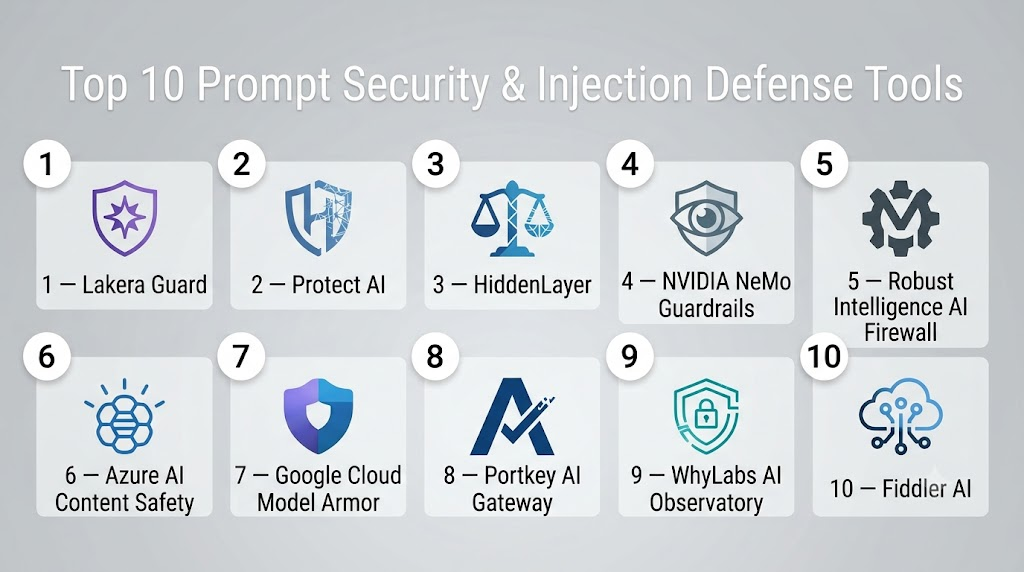
Top 10 Prompt Security & Injection Defense Tools
1. Lakera Guard
One-line verdict: Best for enterprises requiring dedicated real-time protection against prompt injection, jailbreaks, and malicious AI interactions.
Short Description
Lakera Guard is one of the leading AI security platforms focused specifically on protecting generative AI applications from prompt injection attacks, jailbreak attempts, data leakage, and unsafe AI interactions. It acts as an AI firewall that analyzes prompts before they reach the underlying language model.
Standout Capabilities
- Prompt injection detection
- Jailbreak prevention
- AI firewall
- Malicious prompt detection
- Sensitive data protection
- Policy enforcement
- Risk scoring
- Enterprise monitoring
AI-Specific Depth
- Model Support: Multi-model environments
- RAG / Knowledge Integration: Supports enterprise AI workflows
- Evaluation: Security testing and attack detection
- Guardrails: Prompt filtering, policy enforcement, jailbreak detection
- Observability: Security dashboards, threat monitoring, attack analytics
Pros
- Excellent prompt injection detection
- Fast real-time threat analysis
- Enterprise-ready AI firewall capabilities
Cons
- Enterprise-focused deployment
- Public pricing not available
- Advanced configuration may require security expertise
Security & Compliance
- SSO/SAML: Supported
- RBAC: Supported
- Audit Logs: Supported
- Encryption: Supported
- Data Retention Controls: Available
- Certifications: Not publicly stated
Deployment & Platforms
- Web
- Cloud
- API-based deployment
Integrations & Ecosystem
Lakera Guard integrates with enterprise AI platforms and security infrastructure to secure LLM applications.
- REST APIs
- Enterprise AI platforms
- LLM applications
- Security monitoring systems
- Cloud environments
Pricing Model
Enterprise subscription. Pricing is not publicly stated.
Best-Fit Scenarios
- Enterprise AI chatbots
- Customer-facing AI applications
- AI security programs
2. Protect AI
One-line verdict: Best for organizations securing the entire machine learning and generative AI supply chain.
Short Description
Protect AI provides enterprise AI security solutions covering model security, AI governance, vulnerability management, prompt protection, and AI supply chain security. It helps organizations identify security risks across the complete AI lifecycle.
Standout Capabilities
- AI security platform
- Prompt protection
- Model vulnerability scanning
- AI supply chain security
- AI governance
- Security monitoring
- Threat detection
- Risk assessment
AI-Specific Depth
- Model Support: Proprietary, open-source, and BYO models
- RAG / Knowledge Integration: Varies / N/A
- Evaluation: AI vulnerability assessment
- Guardrails: Security policies and AI protection
- Observability: Security monitoring dashboards
Pros
- Comprehensive AI security platform
- Covers more than prompt protection
- Strong enterprise security capabilities
Cons
- Broad platform may exceed smaller organizations’ needs
- Enterprise deployment
- Pricing not publicly stated
Security & Compliance
- SSO/SAML: Supported
- RBAC: Supported
- Audit Logs: Available
- Encryption: Supported
- Certifications: Not publicly stated
Deployment & Platforms
- Cloud
- Enterprise
Integrations & Ecosystem
- APIs
- ML platforms
- Security platforms
- Cloud infrastructure
- Enterprise monitoring
Pricing Model
Enterprise licensing.
Best-Fit Scenarios
- Enterprise AI security
- AI governance
- Machine learning operations
3. HiddenLayer
One-line verdict: Best for enterprises protecting AI models from adversarial attacks and production security threats.
Short Description
HiddenLayer focuses on AI model security by protecting machine learning systems from adversarial attacks, prompt manipulation, model theft, and production AI threats. It provides continuous monitoring across AI deployments.
Standout Capabilities
- AI threat detection
- Adversarial defense
- Prompt attack monitoring
- AI model protection
- Threat intelligence
- Security analytics
- Production monitoring
- Incident response
AI-Specific Depth
- Model Support: Multi-model
- RAG / Knowledge Integration: Varies / N/A
- Evaluation: Security assessments
- Guardrails: AI protection policies
- Observability: Threat monitoring dashboards
Pros
- Strong AI threat intelligence
- Excellent production monitoring
- Enterprise-focused security
Cons
- Advanced implementation
- Enterprise pricing
- Best suited for mature AI environments
Security & Compliance
- SSO/SAML: Available
- RBAC: Supported
- Audit Logs: Supported
- Encryption: Supported
- Certifications: Not publicly stated
Deployment & Platforms
- Cloud
- Enterprise
Integrations & Ecosystem
- APIs
- SIEM platforms
- AI infrastructure
- Security operations
- Enterprise monitoring
Pricing Model
Enterprise licensing.
Best-Fit Scenarios
- Financial services
- Healthcare AI
- Enterprise production AI
4. NVIDIA NeMo Guardrails
One-line verdict: Best for developers building secure conversational AI applications with customizable guardrails.
Short Description
NVIDIA NeMo Guardrails is an open framework that enables developers to build conversational AI systems with programmable safety rules, conversation policies, and guardrails to reduce hallucinations and mitigate prompt injection attacks.
Standout Capabilities
- Conversation guardrails
- Prompt filtering
- Policy management
- Custom safety workflows
- LLM security controls
- Developer extensibility
- Open architecture
- AI workflow protection
AI-Specific Depth
- Model Support: Open-source and compatible LLMs
- RAG / Knowledge Integration: Compatible with RAG applications
- Evaluation: Conversation validation
- Guardrails: Custom programmable guardrails
- Observability: Varies depending on deployment
Pros
- Highly customizable
- Developer-friendly
- Open framework
Cons
- Requires technical expertise
- Limited enterprise management features
- Operational monitoring depends on implementation
Security & Compliance
- SSO/SAML: Varies
- RBAC: Varies
- Audit Logs: Varies
- Encryption: Deployment dependent
- Certifications: Not publicly stated
Deployment & Platforms
- Linux
- Cloud
- Self-hosted
Integrations & Ecosystem
- Python
- LangChain
- LlamaIndex
- NVIDIA AI ecosystem
- APIs
Pricing Model
Open-source with enterprise deployment options.
Best-Fit Scenarios
- AI developers
- Custom chatbot development
- Open-source AI projects
5. Robust Intelligence AI Firewall
One-line verdict: Best for enterprises seeking comprehensive AI firewall protection and production AI security.
Short Description
Robust Intelligence AI Firewall helps organizations protect generative AI systems from prompt injection attacks, jailbreak attempts, malicious outputs, and unsafe model behavior through automated security enforcement and continuous monitoring.
Standout Capabilities
- AI firewall
- Prompt inspection
- Jailbreak prevention
- Response validation
- AI risk scoring
- Continuous monitoring
- Governance reporting
- Policy enforcement
AI-Specific Depth
- Model Support: Multi-model
- RAG / Knowledge Integration: Enterprise integrations
- Evaluation: AI security testing
- Guardrails: Prompt filtering, response filtering, policy controls
- Observability: AI monitoring dashboards, attack analytics
Pros
- Enterprise-grade AI firewall
- Strong security automation
- Excellent operational visibility
Cons
- Enterprise licensing
- Advanced deployment planning recommended
- Pricing is not publicly stated
Security & Compliance
- SSO/SAML: Supported
- RBAC: Supported
- Audit Logs: Supported
- Encryption: Supported
- Data Retention Controls: Available
- Certifications: Not publicly stated
Deployment & Platforms
- Cloud
- Enterprise
Integrations & Ecosystem
Robust Intelligence integrates with enterprise AI infrastructure and security operations to provide centralized protection across production AI deployments.
- Enterprise APIs
- Cloud AI services
- Security monitoring
- SIEM platforms
- AI application infrastructure
Pricing Model
Enterprise subscription. Pricing is not publicly stated.
Best-Fit Scenarios
6. Azure AI Content Safety
One-line verdict: Best for organizations using Microsoft Azure that need built-in content moderation, prompt filtering, and AI safety controls.
Short Description
Azure AI Content Safety is Microsoft’s AI safety service designed to detect harmful prompts, moderate AI-generated content, and help organizations build secure generative AI applications. It provides configurable safety filters, risk detection, and policy enforcement for applications powered by large language models.
Standout Capabilities
- Prompt safety analysis
- Harmful content detection
- AI content moderation
- Prompt risk classification
- Configurable safety thresholds
- API-based deployment
- Enterprise policy enforcement
- Responsible AI integration
AI-Specific Depth
- Model Support: Microsoft-hosted AI models and supported integrations
- RAG / Knowledge Integration: Compatible with Azure AI applications
- Evaluation: Prompt validation and content safety assessment
- Guardrails: Content filtering, prompt inspection, safety policies
- Observability: Usage analytics, safety dashboards, moderation logs
Pros
- Excellent integration with Azure AI services
- Strong enterprise security controls
- Easy deployment within Microsoft environments
Cons
- Best suited for Azure-based infrastructures
- Limited flexibility outside Microsoft ecosystems
- Advanced enterprise licensing may be required
Security & Compliance
- SSO/SAML: Supported through Microsoft Entra ID
- RBAC: Supported
- Audit Logs: Supported
- Encryption: Supported
- Data Retention Controls: Available
- Certifications: Not publicly stated
Deployment & Platforms
- Web
- Cloud
- API
Integrations & Ecosystem
Azure AI Content Safety integrates seamlessly with Microsoft’s AI, cloud, and security ecosystem.
- Azure OpenAI Service
- Azure AI Studio
- Azure AI Foundry
- Microsoft Security
- Microsoft Defender
- Enterprise APIs
Pricing Model
Usage-based cloud pricing. Enterprise agreements vary.
Best-Fit Scenarios
- Azure AI deployments
- Enterprise copilots
- Customer-facing AI assistants
7. Google Cloud Model Armor
One-line verdict: Best for Google Cloud users requiring AI safety, prompt filtering, and policy enforcement.
Short Description
Google Cloud Model Armor provides security controls for generative AI applications by inspecting prompts, filtering unsafe inputs, enforcing AI safety policies, and protecting AI systems against prompt manipulation and harmful outputs.
Standout Capabilities
- Prompt inspection
- AI safety filtering
- Policy enforcement
- Harmful content detection
- Prompt protection
- AI risk management
- Cloud-native deployment
- Enterprise monitoring
AI-Specific Depth
- Model Support: Google AI models and supported cloud services
- RAG / Knowledge Integration: Google Cloud integrations
- Evaluation: Prompt validation and AI safety testing
- Guardrails: Prompt filtering, policy enforcement, content safety
- Observability: AI monitoring dashboards and safety reports
Pros
- Strong integration with Google Cloud
- Built-in AI safety controls
- Enterprise scalability
Cons
- Primarily designed for Google Cloud users
- Limited multi-cloud governance capabilities
- Public pricing varies by deployment
Security & Compliance
- SSO/SAML: Supported
- RBAC: Supported
- Audit Logs: Supported
- Encryption: Supported
- Data Retention Controls: Available
- Certifications: Not publicly stated
Deployment & Platforms
- Cloud
- Web
- API
Integrations & Ecosystem
- Google Cloud
- Vertex AI
- Enterprise APIs
- Cloud Monitoring
- Google Security services
Pricing Model
Consumption-based cloud pricing.
Best-Fit Scenarios
- Google Cloud AI
- Enterprise chatbots
- AI safety initiatives
8. Portkey AI Gateway
One-line verdict: Best for developers seeking AI gateway management, prompt security, observability, and multi-model routing.
Short Description
Portkey AI Gateway is an AI gateway platform that provides centralized prompt management, AI observability, security controls, request routing, caching, guardrails, and monitoring across multiple large language model providers.
Standout Capabilities
- AI gateway
- Prompt management
- Multi-model routing
- AI observability
- Prompt logging
- Guardrails
- Cost optimization
- Request analytics
AI-Specific Depth
- Model Support: Proprietary, open-source, and BYO models
- RAG / Knowledge Integration: Compatible with enterprise RAG systems
- Evaluation: Prompt monitoring and testing
- Guardrails: Prompt validation and security rules
- Observability: Request traces, latency metrics, token analytics
Pros
- Excellent developer experience
- Strong multi-model management
- Rich observability features
Cons
- Requires technical implementation
- Focused primarily on AI gateway management
- Enterprise pricing not publicly stated
Security & Compliance
- SSO/SAML: Available
- RBAC: Supported
- Audit Logs: Supported
- Encryption: Supported
- Certifications: Not publicly stated
Deployment & Platforms
- Cloud
- API
- Developer platforms
Integrations & Ecosystem
Portkey integrates with numerous AI providers and developer ecosystems.
- OpenAI
- Anthropic
- Google AI
- Azure OpenAI
- LangChain
- LlamaIndex
- REST APIs
Pricing Model
Tiered subscription with enterprise options.
Best-Fit Scenarios
- AI platform engineering
- Multi-model deployments
- Enterprise AI gateways
9. WhyLabs AI Observatory
One-line verdict: Best for organizations monitoring AI quality, prompt behavior, and production AI reliability.
Short Description
WhyLabs AI Observatory helps organizations monitor AI systems in production by providing observability, anomaly detection, prompt monitoring, model health tracking, and security insights across machine learning and generative AI applications.
Standout Capabilities
- AI observability
- Prompt monitoring
- Drift detection
- Data quality monitoring
- Model health tracking
- AI analytics
- Threat detection
- Operational dashboards
AI-Specific Depth
- Model Support: Multi-model environments
- RAG / Knowledge Integration: Compatible with enterprise AI pipelines
- Evaluation: Production monitoring and validation
- Guardrails: Policy monitoring and anomaly detection
- Observability: Prompt traces, latency metrics, performance dashboards
Pros
- Strong production monitoring
- Excellent observability
- Helpful operational analytics
Cons
- Primarily focused on monitoring
- Additional governance tools may be required
- Enterprise implementation recommended
Security & Compliance
- SSO/SAML: Supported
- RBAC: Supported
- Audit Logs: Supported
- Encryption: Supported
- Certifications: Not publicly stated
Deployment & Platforms
- Cloud
- API
Integrations & Ecosystem
- ML platforms
- Data pipelines
- Cloud AI services
- Enterprise monitoring
- APIs
Pricing Model
Subscription-based enterprise licensing.
Best-Fit Scenarios
- Production AI monitoring
- AI operations
- Enterprise observability
10. Fiddler AI
One-line verdict: Best for enterprises combining AI observability, explainability, monitoring, and responsible AI governance.
Short Description
Fiddler AI is an enterprise AI observability platform that provides monitoring, explainability, bias detection, prompt monitoring, model evaluation, and governance capabilities across machine learning and generative AI applications.
Standout Capabilities
- AI observability
- Prompt monitoring
- Explainability
- Bias detection
- Model monitoring
- Performance analytics
- Governance reporting
- Operational dashboards
AI-Specific Depth
- Model Support: Proprietary, open-source, and BYO models
- RAG / Knowledge Integration: Compatible with enterprise AI architectures
- Evaluation: Model evaluation, prompt monitoring, validation
- Guardrails: Governance policies and operational controls
- Observability: Prompt traces, latency monitoring, AI dashboards
Pros
- Comprehensive AI observability
- Strong enterprise monitoring
- Mature governance capabilities
Cons
- Enterprise-focused platform
- Pricing not publicly stated
- Advanced implementation requires planning
Security & Compliance
- SSO/SAML: Supported
- RBAC: Supported
- Audit Logs: Supported
- Encryption: Supported
- Data Retention Controls: Available
- Certifications: Not publicly stated
Deployment & Platforms
- Cloud
- Hybrid
- Enterprise
Integrations & Ecosystem
Fiddler AI integrates with enterprise AI infrastructure to provide end-to-end AI monitoring and governance.
- APIs
- ML platforms
- Cloud providers
- Data engineering pipelines
- Business intelligence tools
Pricing Model
Enterprise subscription. Pricing is not publicly stated.
Best-Fit Scenarios
- Enterprise AI monitoring
- Responsible AI initiatives
- Production generative AI systems
Comparison Table
| Tool | Best For | Deployment | Model Flexibility | Strength | Watch-Out | Public Rating |
|---|---|---|---|---|---|---|
| Lakera Guard | Enterprise AI security | Cloud | Multi-model | Prompt injection detection | Enterprise pricing | N/A |
| Protect AI | AI supply chain security | Cloud | BYO, Multi-model | End-to-end AI security | Broad enterprise focus | N/A |
| HiddenLayer | AI threat detection | Cloud | Multi-model | AI threat intelligence | Enterprise implementation | N/A |
| NVIDIA NeMo Guardrails | Developers | Self-hosted, Cloud | Open-source | Custom guardrails | Requires technical expertise | N/A |
| Robust Intelligence AI Firewall | Enterprise AI firewall | Cloud | Multi-model | AI firewall protection | Enterprise deployment | N/A |
| Azure AI Content Safety | Microsoft environments | Cloud | Hosted | Content moderation | Azure ecosystem focus | N/A |
| Google Cloud Model Armor | Google Cloud users | Cloud | Hosted | AI safety controls | Google Cloud dependency | N/A |
| Portkey AI Gateway | AI platform teams | Cloud | BYO, Multi-model | AI gateway & observability | Developer-focused | N/A |
| WhyLabs AI Observatory | Production AI monitoring | Cloud | Multi-model | AI observability | Monitoring-first platform | N/A |
| Fiddler AI | Enterprise AI governance | Cloud, Hybrid | BYO, Multi-model | Explainability & monitoring | Enterprise licensing | N/A |
Scoring & Evaluation (Transparent Rubric)
The following scores compare platforms using a consistent evaluation framework. These scores are intended to help buyers compare capabilities rather than represent official vendor ratings. Organizations should perform their own testing before making purchasing decisions.
| Tool | Core | Reliability / Eval | Guardrails | Integrations | Ease | Performance / Cost | Security / Admin | Support | Weighted Total |
|---|---|---|---|---|---|---|---|---|---|
| Lakera Guard | 9.8 | 9.6 | 9.8 | 9.2 | 9.0 | 9.1 | 9.6 | 9.2 | 9.42 |
| Protect AI | 9.7 | 9.5 | 9.4 | 9.4 | 8.8 | 8.9 | 9.5 | 9.2 | 9.30 |
| Robust Intelligence AI Firewall | 9.6 | 9.4 | 9.6 | 9.1 | 8.8 | 8.9 | 9.5 | 9.0 | 9.24 |
| Microsoft Azure AI Content Safety | 9.2 | 9.0 | 9.5 | 9.5 | 9.2 | 9.0 | 9.4 | 9.1 | 9.18 |
| Google Cloud Model Armor | 9.2 | 9.0 | 9.5 | 9.3 | 9.1 | 9.0 | 9.3 | 9.0 | 9.14 |
| Fiddler AI | 9.1 | 9.4 | 8.8 | 9.2 | 8.8 | 8.8 | 9.2 | 9.0 | 9.02 |
| WhyLabs AI Observatory | 9.0 | 9.3 | 8.8 | 9.0 | 8.9 | 8.9 | 9.0 | 8.9 | 8.98 |
| Portkey AI Gateway | 9.0 | 8.9 | 8.9 | 9.4 | 9.1 | 9.2 | 8.8 | 8.8 | 8.99 |
| HiddenLayer | 9.1 | 9.2 | 8.9 | 8.8 | 8.7 | 8.8 | 9.2 | 8.9 | 8.95 |
| NVIDIA NeMo Guardrails | 8.9 | 8.8 | 9.2 | 8.7 | 8.4 | 8.7 | 8.6 | 8.8 | 8.76 |
Small & Medium Businesses (SMBs)
SMBs increasingly deploy AI across customer support, marketing, HR, and internal productivity. They need reliable security without excessive implementation complexity.
Important capabilities include:
- Prompt filtering
- Basic AI firewall protection
- Monitoring dashboards
- API integrations
- Cost-effective deployment
- Security reporting
Recommended Tools
- Azure AI Content Safety
- Google Cloud Model Armor
- Portkey AI Gateway
These platforms balance security, usability, and operational efficiency.
Mid-Market Organizations
Growing businesses often operate multiple AI applications across departments. Security teams require centralized visibility, policy management, and continuous monitoring.
Look for:
- AI observability
- Prompt monitoring
- Enterprise APIs
- Multi-model support
- Governance reporting
- Threat analytics
Recommended Tools
- WhyLabs AI Observatory
- Fiddler AI
- Lakera Guard
These platforms provide broader visibility while remaining manageable for expanding organizations.
Enterprise Organizations
Large enterprises require comprehensive AI security capable of protecting numerous applications across multiple cloud providers, AI models, and business units.
Enterprise priorities include:
- AI firewall protection
- Prompt injection detection
- Multi-model governance
- Centralized dashboards
- Security automation
- Compliance reporting
- Enterprise integrations
- Continuous monitoring
Recommended Tools
- Lakera Guard
- Protect AI
- Robust Intelligence AI Firewall
- HiddenLayer
These solutions provide enterprise-scale protection with advanced governance and operational security.
Regulated Industries
Organizations operating in highly regulated sectors face additional security and compliance obligations. AI applications must demonstrate accountability, transparency, and strong security controls.
Industries include:
- Banking
- Financial Services
- Insurance
- Healthcare
- Government
- Public Sector
- Legal Services
- Telecommunications
- Critical Infrastructure
Key requirements include:
- Comprehensive audit logs
- Data protection
- Prompt monitoring
- Explainability
- Policy enforcement
- AI governance
- Human oversight
- Continuous monitoring
Recommended Tools
- Protect AI
- Lakera Guard
- Fiddler AI
- HiddenLayer
These platforms are well suited for organizations where AI security and regulatory compliance are business-critical.
Budget vs Premium
Budget-Friendly Options
Organizations beginning their AI security journey should prioritize:
- Easy deployment
- Prompt filtering
- Basic monitoring
- API integrations
- Open architecture
Recommended solutions include:
- NVIDIA NeMo Guardrails
- Portkey AI Gateway
Premium Enterprise Platforms
Organizations running mission-critical AI systems benefit from platforms offering:
- AI firewalls
- Threat intelligence
- Multi-model governance
- Security automation
- Enterprise integrations
- Executive reporting
Leading enterprise platforms include:
- Lakera Guard
- Protect AI
- Robust Intelligence AI Firewall
- HiddenLayer
Build vs Buy
Some organizations consider building internal AI security layers. While custom solutions offer maximum flexibility, they require significant engineering resources and ongoing maintenance.
Build Your Own When
- AI applications are highly specialized.
- Security requirements are unique.
- Engineering teams have extensive AI expertise.
- Existing platforms cannot satisfy internal requirements.
Buy a Commercial Platform When
- Faster deployment is needed.
- Enterprise support is important.
- Compliance requirements are increasing.
- AI deployments are growing rapidly.
- Continuous updates are required against evolving prompt attack techniques.
For most enterprises, purchasing an established AI security platform significantly reduces operational risk and implementation time.
Implementation Playbook (30 / 60 / 90 Days)
Deploying Prompt Security & Injection Defense successfully requires a phased approach. Organizations should begin with visibility, expand into enforcement, and finally optimize for enterprise-scale operations.
First 30 Days — Assessment & Pilot
Objectives
- Inventory AI applications
- Identify security risks
- Deploy initial protection
- Establish baseline metrics
Activities
- Identify all LLM applications
- Classify AI workloads
- Configure prompt filtering
- Enable security logging
- Define prompt security policies
- Train development teams
- Document governance responsibilities
Success Metrics
- AI inventory completed
- Pilot security deployed
- Baseline attack metrics established
- Security dashboards operational
Next 60 Days — Secure & Expand
Objectives
- Strengthen security
- Expand AI coverage
- Improve governance
- Standardize protection
Activities
- Configure RBAC
- Enable SSO
- Implement audit logging
- Conduct prompt injection testing
- Perform red-team exercises
- Secure RAG pipelines
- Validate guardrail policies
- Introduce prompt version control
Success Metrics
- Multiple AI applications protected
- Security policies standardized
- Governance workflows documented
- Threat detection validated
Final 90 Days — Optimize & Scale
Objectives
- Enterprise deployment
- Continuous monitoring
- Security optimization
- Governance maturity
Activities
- Expand protection organization-wide
- Optimize latency
- Fine-tune security policies
- Automate incident response
- Improve observability
- Review blocked attacks
- Establish executive reporting
- Implement continuous improvement
Success Metrics
- Enterprise-wide AI protection
- Reduced security incidents
- Faster threat response
- Comprehensive observability
- Continuous governance reporting
Common Mistakes & How to Avoid Them
Organizations frequently underestimate the complexity of securing generative AI systems. Avoid these common mistakes:
- Assuming traditional web security protects AI applications.
- Ignoring prompt injection vulnerabilities.
- Not monitoring AI-generated responses.
- Failing to secure Retrieval-Augmented Generation pipelines.
- Allowing unrestricted AI tool access.
- Storing sensitive prompts without proper controls.
- Skipping red-team testing.
- Not monitoring AI agents after deployment.
- Ignoring latency introduced by security layers.
- Failing to establish AI security ownership.
- Overlooking third-party AI services.
- Not reviewing audit logs regularly.
- Becoming dependent on a single AI provider without abstraction.
- Treating AI security as a one-time implementation rather than an ongoing operational process.
Frequently Asked Questions
What is Prompt Security?
Prompt Security protects AI systems from malicious prompts, prompt injection attacks, jailbreak attempts, data leakage, and unsafe AI interactions.
What is Prompt Injection?
Prompt injection is an attack where malicious instructions attempt to manipulate a language model into ignoring its intended behavior or revealing restricted information.
Why are AI Firewalls important?
AI firewalls inspect prompts and responses before they reach AI models or users, helping block malicious inputs, enforce policies, and reduce security risks.
Can Prompt Security protect AI agents?
Yes. Modern prompt security platforms increasingly support autonomous AI agents by monitoring prompts, tool usage, and generated responses.
Do these tools support multiple AI models?
Many enterprise platforms support proprietary models, open-source models, and Bring Your Own Model (BYO Model) environments.
Can Prompt Security protect RAG applications?
Yes. Many platforms provide protections for Retrieval-Augmented Generation applications by validating retrieved content and filtering malicious context.
Do Prompt Security platforms reduce hallucinations?
Some solutions help reduce unsafe outputs through guardrails and policy enforcement, but they do not eliminate hallucinations entirely.
Is Prompt Security only for large enterprises?
No. Small businesses and startups deploying customer-facing AI applications can also benefit from prompt filtering and AI security controls.
Can these platforms monitor AI conversations?
Yes. Many solutions provide conversation monitoring, threat analytics, prompt logging, and operational dashboards.
Do these tools replace traditional cybersecurity?
No. They complement existing cybersecurity controls by addressing AI-specific threats that conventional security solutions are not designed to detect.
How difficult is implementation?
Cloud-based services can often be deployed quickly, while enterprise AI security platforms generally require structured planning and integration with existing infrastructure.
What should organizations evaluate before purchasing?
Organizations should compare prompt injection detection, AI firewall capabilities, guardrails, monitoring, latency, integrations, deployment flexibility, scalability, security controls, and operational visibility.
Conclusion
Generative AI is transforming how organizations interact with customers, employees, and data, but it also introduces an entirely new category of security risks. Prompt injection attacks, jailbreak attempts, malicious instructions, sensitive data leakage, and unsafe AI behaviors require dedicated protection beyond traditional cybersecurity tools. Prompt Security & Injection Defense platforms provide the specialized controls needed to secure modern AI applications while maintaining performance and user experience.
