Introduction
Artificial Intelligence is transforming industries by automating processes, improving decision-making, enhancing customer experiences, and enabling entirely new business models. As AI systems become more powerful and widely deployed, governments and regulatory bodies have introduced frameworks to ensure these technologies are developed and used responsibly. One of the most significant regulations is the European Union AI Act, which establishes a risk-based approach to AI governance and places new responsibilities on organizations that develop, deploy, or use AI systems.
AI Compliance Management (EU AI Act) tools help organizations manage these regulatory obligations efficiently. Rather than relying on spreadsheets and manual documentation, these platforms centralize AI governance, automate compliance workflows, maintain AI inventories, perform risk assessments, track policy adherence, and generate audit-ready documentation. They also help organizations establish responsible AI practices by monitoring AI systems throughout their lifecycle.
Whether an organization develops AI models internally or integrates third-party AI services, compliance management has become an essential component of enterprise AI strategy. These platforms reduce regulatory risks while improving transparency, accountability, and trust in AI-powered applications.
Common Use Cases
- Managing compliance with the EU AI Act
- Building enterprise AI governance programs
- Maintaining AI system inventories
- Performing AI risk assessments
- Documenting AI lifecycle activities
- Managing human oversight requirements
- Supporting internal and external audits
- Monitoring responsible AI policies
- Managing third-party AI vendor risks
- Preparing regulatory compliance reports
What to Evaluate Before Choosing an AI Compliance Management Tool
When comparing AI compliance platforms, buyers should evaluate the following criteria:
- Coverage of AI governance frameworks
- EU AI Act readiness
- AI inventory and asset management
- Automated risk assessment capabilities
- Compliance workflow automation
- Audit trail and documentation features
- Policy management
- Human oversight workflows
- Security and access controls
- Reporting and dashboards
- Integration capabilities
- Scalability for enterprise AI adoption
Best For
AI Compliance Management tools are ideal for:
- Enterprise organizations
- Financial institutions
- Healthcare providers
- Insurance companies
- Government agencies
- AI software vendors
- Technology companies
- Compliance teams
- Legal departments
- Risk management teams
- AI governance offices
- CTOs, CIOs, CISOs, and Chief Compliance Officers
Not Ideal For
These platforms may not be necessary for:
- Small businesses using only basic AI productivity tools
- Individual freelancers experimenting with AI
- Organizations without regulated AI use cases
- Teams requiring only simple AI usage guidelines instead of enterprise governance
What’s Changed in AI Compliance Management (EU AI Act) Tools
AI compliance platforms have evolved significantly as organizations expand their use of generative AI, AI agents, and large language models. Modern platforms now focus on continuous governance rather than one-time compliance projects.
Key developments include:
- AI inventories have become automated, helping organizations discover and classify AI systems across departments.
- AI governance platforms now support the complete AI lifecycle, from development and deployment to retirement.
- Risk classification aligned with the EU AI Act has become a standard capability.
- Agentic AI governance is emerging to monitor autonomous AI workflows and decision-making.
- Multimodal AI systems require expanded documentation covering text, images, audio, and video models.
- Continuous compliance monitoring is replacing periodic manual assessments.
- Human oversight workflows now include approvals, escalation paths, accountability tracking, and review histories.
- AI vendor governance has become increasingly important as organizations adopt multiple external AI services.
- Privacy controls, retention policies, and data residency options are major purchasing considerations.
- Governance reporting has become more automated, reducing manual documentation efforts.
- Explainability documentation is increasingly integrated into compliance workflows.
- Enterprise organizations are consolidating AI governance with cybersecurity, privacy, and enterprise risk management.
Quick Buyer Checklist
Before selecting an AI Compliance Management platform, verify that it supports the following capabilities.
Governance
- AI inventory management
- AI asset registration
- Policy management
- Regulatory mapping
- Governance workflows
- Human oversight documentation
Risk Management
- AI risk classification
- High-risk AI identification
- Risk scoring
- Mitigation planning
- Continuous monitoring
Privacy
- Data retention controls
- Data residency options
- Encryption
- Privacy policy enforcement
- Sensitive data protection
AI Model Support
- Hosted AI models
- Bring Your Own Model (BYO Model)
- Open-source model compatibility
- Multi-model environments
- Model version tracking
Evaluation
- Prompt testing
- Regression testing
- Human review workflows
- Model validation
- Performance monitoring
Guardrails
- Policy enforcement
- AI usage restrictions
- Prompt injection awareness
- Safety controls
- Human approval checkpoints
Observability
- Activity logs
- Governance dashboards
- Compliance reporting
- Audit evidence generation
- AI lifecycle visibility
Administration
- Role-Based Access Control (RBAC)
- Single Sign-On (SSO)
- Approval workflows
- Organization-wide dashboards
- Administrative controls
Cost & Operations
- Enterprise scalability
- Flexible deployment
- API availability
- Workflow automation
- Vendor support
Vendor Strategy
- Open APIs
- Integration ecosystem
- Export capabilities
- Reduced vendor lock-in
- Long-term product roadmap
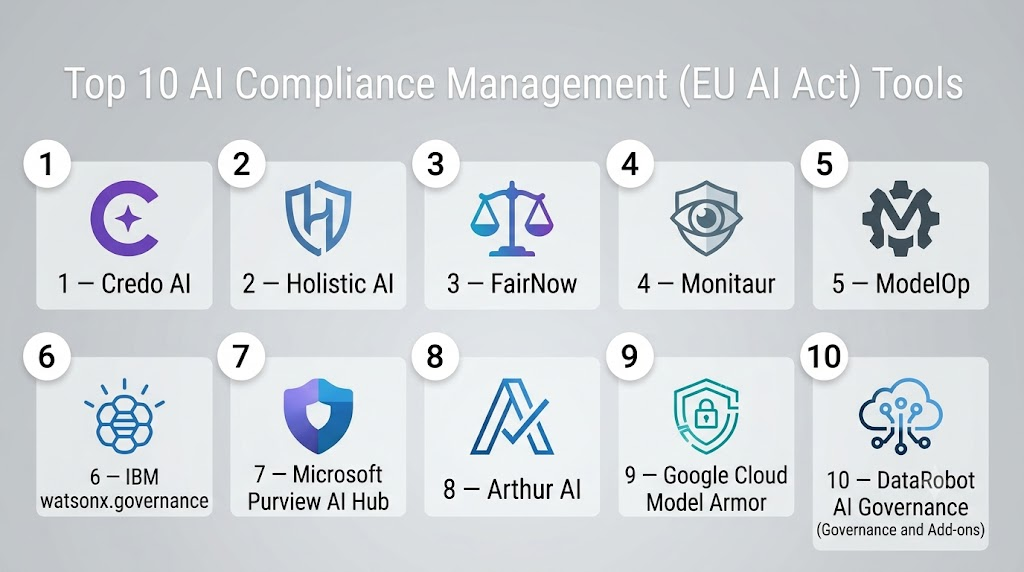
Top 10 AI Compliance Management (EU AI Act) Tools
1. Credo AI
One-line verdict: Best for large enterprises seeking comprehensive AI governance, regulatory compliance, and responsible AI management.
Short Description
Credo AI is a leading AI governance platform designed to help organizations manage AI risks, automate compliance workflows, maintain AI inventories, and operationalize responsible AI practices. It supports organizations throughout the entire AI lifecycle, making it easier to align with regulatory frameworks such as the EU AI Act while improving internal governance.
Standout Capabilities
- Enterprise AI inventory management
- Automated AI risk assessments
- Responsible AI governance workflows
- AI policy management
- Compliance documentation
- AI lifecycle tracking
- Audit-ready reporting
- Executive governance dashboards
AI-Specific Depth
- Model Support: Multi-model environments
- RAG / Knowledge Integration: Varies / N/A
- Evaluation: Risk assessments, governance reviews, human approval workflows
- Guardrails: AI policy enforcement and governance controls
- Observability: Governance dashboards and compliance reporting
Pros
- Excellent enterprise AI governance capabilities
- Strong documentation and audit support
- Comprehensive compliance workflows
Cons
- Primarily designed for enterprise organizations
- Implementation requires governance planning
- Pricing is not publicly stated
Security & Compliance
- SSO/SAML: Supported
- RBAC: Supported
- Audit Logs: Available
- Encryption: Supported
- Data Retention Controls: Available
- Certifications: Not publicly stated
Deployment & Platforms
- Web
- Cloud
Integrations & Ecosystem
Credo AI integrates with enterprise governance and compliance ecosystems to centralize AI oversight and policy management.
- Enterprise APIs
- Governance platforms
- Risk management tools
- Documentation systems
- Identity management solutions
Pricing Model
Enterprise subscription. Pricing is not publicly stated.
Best-Fit Scenarios
- Enterprise AI governance
- Financial services
- Organizations preparing for AI regulatory compliance
2. Holistic AI
One-line verdict: Best for organizations seeking AI governance, regulatory readiness, and responsible AI assessments.
Short Description
Holistic AI provides governance software and advisory capabilities that help organizations evaluate AI risks, implement governance frameworks, monitor regulatory compliance, and improve transparency across AI deployments.
Standout Capabilities
- AI governance assessments
- Risk monitoring
- Responsible AI evaluations
- AI inventory management
- Governance reporting
- Vendor AI assessments
- Compliance dashboards
- Policy mapping
AI-Specific Depth
- Model Support: Multi-model
- RAG / Knowledge Integration: Varies / N/A
- Evaluation: AI governance assessments
- Guardrails: Policy-based governance controls
- Observability: Governance reporting dashboards
Pros
- Strong AI governance expertise
- Comprehensive risk management
- Useful executive reporting
Cons
- Enterprise-focused implementation
- Public pricing unavailable
- Advanced deployments may require consulting
Security & Compliance
- SSO/SAML: Available
- RBAC: Supported
- Audit Logs: Supported
- Encryption: Supported
- Data Retention Controls: Available
- Certifications: Not publicly stated
Deployment & Platforms
- Web
- Cloud
Integrations & Ecosystem
- Enterprise APIs
- Governance platforms
- Compliance workflows
- Reporting tools
- Risk management solutions
Pricing Model
Enterprise subscription.
Best-Fit Scenarios
- Enterprise AI governance
- Regulatory readiness
- Responsible AI initiatives
3. FairNow
One-line verdict: Best for organizations building responsible AI programs with structured governance and compliance documentation.
Short Description
FairNow enables organizations to manage AI governance through centralized inventories, policy management, documentation, and compliance workflows. The platform helps teams operationalize responsible AI principles while preparing for evolving regulatory requirements.
Standout Capabilities
- AI inventory management
- Governance documentation
- Compliance workflows
- AI lifecycle tracking
- Policy management
- Human oversight workflows
- Risk documentation
- Governance dashboards
AI-Specific Depth
- Model Support: Multi-model
- RAG / Knowledge Integration: Varies / N/A
- Evaluation: Governance documentation and reviews
- Guardrails: Policy workflows
- Observability: Governance dashboards
Pros
- Easy-to-manage governance documentation
- Strong AI inventory capabilities
- Well suited for responsible AI programs
Cons
- Public pricing unavailable
- Enterprise onboarding required
- Smaller ecosystem compared to larger vendors
Security & Compliance
- SSO/SAML: Available
- RBAC: Supported
- Audit Logs: Supported
- Encryption: Supported
- Certifications: Not publicly stated
Deployment & Platforms
- Web
- Cloud
Integrations & Ecosystem
- APIs
- Compliance platforms
- Governance tools
- Documentation systems
- Workflow automation
Pricing Model
Enterprise subscription.
Best-Fit Scenarios
- Responsible AI governance
- Compliance documentation
- Enterprise governance initiatives
4. Monitaur
One-line verdict: Best for enterprises requiring AI governance combined with continuous monitoring and explainability.
Short Description
Monitaur helps organizations govern AI by combining compliance documentation, model monitoring, explainability, audit readiness, and operational governance into a single platform.
Standout Capabilities
- AI model inventory
- Explainability support
- Compliance documentation
- Governance dashboards
- Continuous monitoring
- Risk management
- Audit reporting
- Policy management
AI-Specific Depth
- Model Support: Multi-model
- RAG / Knowledge Integration: Varies / N/A
- Evaluation: Continuous governance reviews
- Guardrails: Governance controls
- Observability: AI monitoring dashboards
Pros
- Strong AI monitoring capabilities
- Useful explainability support
- Well suited for regulated industries
Cons
- Enterprise implementation effort
- Public pricing unavailable
- Best for mature AI programs
Security & Compliance
- SSO/SAML: Supported
- RBAC: Supported
- Audit Logs: Available
- Encryption: Supported
- Certifications: Not publicly stated
Deployment & Platforms
- Web
- Cloud
Integrations & Ecosystem
- APIs
- Enterprise AI platforms
- Monitoring systems
- Governance tools
- Reporting solutions
Pricing Model
Enterprise licensing.
Best-Fit Scenarios
- AI governance
- Financial institutions
- Healthcare organizations
5. ModelOp
One-line verdict: Best for enterprises managing AI, machine learning, and generative AI governance at scale.
Short Description
ModelOp is an enterprise AI governance platform that helps organizations manage AI inventories, govern machine learning models, automate policy enforcement, and monitor compliance across multiple AI environments.
Standout Capabilities
- Enterprise AI inventory
- Model governance
- AI lifecycle management
- Policy enforcement
- Operational monitoring
- Regulatory reporting
- Approval workflows
- Executive dashboards
AI-Specific Depth
- Model Support: Multi-model and BYO Model
- RAG / Knowledge Integration: Varies / N/A
- Evaluation: Governance workflows and monitoring
- Guardrails: Policy enforcement
- Observability: Operational dashboards and reporting
Pros
- Strong enterprise governance platform
- Excellent lifecycle management
- Flexible integration capabilities
Cons
- Designed primarily for large organizations
- Implementation requires planning
- Pricing is not publicly stated
Security & Compliance
- SSO/SAML: Supported
- RBAC: Supported
- Audit Logs: Available
- Encryption: Supported
- Data Retention Controls: Available
- Certifications: Not publicly stated
Deployment & Platforms
- Web
- Cloud
- Hybrid
Integrations & Ecosystem
ModelOp integrates with enterprise AI infrastructure, governance systems, and machine learning platforms to provide centralized oversight across the AI lifecycle.
- Enterprise APIs
- ML platforms
- Cloud AI services
- Workflow automation
- Governance platforms
- Reporting tools
Pricing Model
Enterprise licensing. Pricing is not publicly stated.
Best-Fit Scenarios
- Enterprise AI governance
- Multi-model AI environments
- Large organizations managing AI at scale
6. IBM watsonx.governance
One-line verdict: Best for large enterprises requiring end-to-end AI governance, lifecycle management, and regulatory compliance across multiple AI environments.
Short Description
IBM watsonx.governance is an enterprise AI governance solution designed to help organizations monitor, govern, and document AI systems throughout their lifecycle. It supports responsible AI initiatives by providing policy enforcement, model monitoring, risk management, explainability support, and governance workflows for both traditional machine learning and generative AI applications.
Standout Capabilities
- Enterprise AI governance framework
- AI lifecycle management
- Model inventory and catalog
- Risk and compliance monitoring
- Explainability support
- Policy management workflows
- Governance dashboards
- Automated documentation
AI-Specific Depth
- Model Support: Proprietary, open-source, and BYO model environments
- RAG / Knowledge Integration: Supports enterprise integrations; vector database compatibility varies
- Evaluation: Model validation, governance reviews, human approval workflows
- Guardrails: AI policy enforcement and governance controls
- Observability: Model performance monitoring, governance dashboards, operational metrics
Pros
- Comprehensive enterprise governance capabilities
- Strong AI lifecycle management
- Supports both predictive and generative AI governance
Cons
- Enterprise deployment may require planning
- Advanced features may require specialized expertise
- Pricing is not publicly stated
Security & Compliance
- SSO/SAML: Supported
- RBAC: Supported
- Audit Logs: Supported
- Encryption: Supported
- Data Retention Controls: Available
- Certifications: Not publicly stated
Deployment & Platforms
- Web
- Cloud
- Hybrid
Integrations & Ecosystem
IBM watsonx.governance integrates with enterprise AI ecosystems and governance infrastructures.
- Enterprise APIs
- IBM AI portfolio
- Machine learning platforms
- Data governance solutions
- Workflow automation
- Identity management
Pricing Model
Enterprise subscription. Pricing is not publicly stated.
Best-Fit Scenarios
- Large enterprise AI governance
- Regulated industries
- Organizations operating multiple AI platforms
7. Microsoft Purview AI Hub
One-line verdict: Best for Microsoft-centric organizations managing AI governance, compliance, and data protection at enterprise scale.
Short Description
Microsoft Purview AI Hub helps organizations discover, monitor, and govern AI applications across Microsoft environments. It extends Microsoft’s data governance capabilities into AI governance by providing visibility into AI usage, compliance monitoring, security controls, and policy management.
Standout Capabilities
- AI asset discovery
- AI governance dashboards
- Data governance integration
- Compliance monitoring
- Sensitive data protection
- Risk visibility
- Policy management
- Enterprise reporting
AI-Specific Depth
- Model Support: Microsoft-hosted models and supported external AI services
- RAG / Knowledge Integration: Microsoft ecosystem integrations
- Evaluation: Governance monitoring and policy validation
- Guardrails: Data protection policies and governance controls
- Observability: AI usage monitoring and governance reporting
Pros
- Excellent integration with Microsoft services
- Strong security and compliance ecosystem
- Familiar experience for Microsoft customers
Cons
- Best suited for Microsoft environments
- Less flexible outside Microsoft ecosystems
- Advanced licensing may be required
Security & Compliance
- SSO/SAML: Supported
- RBAC: Supported
- Audit Logs: Supported
- Encryption: Supported
- Data Retention Controls: Available
- Certifications: Not publicly stated
Deployment & Platforms
- Web
- Cloud
Integrations & Ecosystem
Microsoft Purview AI Hub integrates naturally with Microsoft’s productivity, cloud, and security ecosystem.
- Microsoft 365
- Azure
- Microsoft Copilot
- Microsoft Security
- Microsoft Defender
- Microsoft Entra ID
- APIs
Pricing Model
Subscription-based enterprise licensing.
Best-Fit Scenarios
- Microsoft-first enterprises
- Corporate governance programs
- Enterprise compliance initiatives
8. Arthur AI
One-line verdict: Best for organizations requiring AI monitoring, explainability, and governance across production AI systems.
Short Description
Arthur AI provides monitoring and governance capabilities for machine learning and generative AI applications. It helps organizations detect model drift, monitor AI quality, improve explainability, and maintain operational governance throughout production deployments.
Standout Capabilities
- AI model monitoring
- Drift detection
- Explainability dashboards
- Bias monitoring
- Performance analytics
- Governance reporting
- Risk monitoring
- Production AI visibility
AI-Specific Depth
- Model Support: Multi-model environments
- RAG / Knowledge Integration: Varies / N/A
- Evaluation: Model quality monitoring and production evaluation
- Guardrails: Monitoring-based governance controls
- Observability: Model traces, latency insights, operational dashboards
Pros
- Excellent production monitoring
- Strong explainability features
- Useful operational visibility
Cons
- Focuses more on monitoring than complete governance
- Enterprise implementation recommended
- Pricing is not publicly stated
Security & Compliance
- SSO/SAML: Available
- RBAC: Supported
- Audit Logs: Supported
- Encryption: Supported
- Certifications: Not publicly stated
Deployment & Platforms
- Web
- Cloud
Integrations & Ecosystem
Arthur AI integrates with enterprise AI infrastructure for production monitoring.
- APIs
- Machine learning platforms
- Cloud AI services
- Monitoring pipelines
- Enterprise workflows
Pricing Model
Enterprise licensing.
Best-Fit Scenarios
- AI production monitoring
- Model explainability
- Regulated AI deployments
9. Google Cloud Model Armor
One-line verdict: Best for organizations using Google Cloud AI services that need built-in AI safety and governance controls.
Short Description
Google Cloud Model Armor provides security and governance capabilities that help organizations protect generative AI applications from unsafe inputs and outputs. It focuses on prompt protection, content safety, policy enforcement, and secure AI interactions within Google Cloud environments.
Standout Capabilities
- Prompt protection
- Content safety filtering
- AI policy enforcement
- Risk reduction
- Security controls
- Enterprise governance
- AI safety monitoring
- Cloud-native integration
AI-Specific Depth
- Model Support: Google AI models and supported environments
- RAG / Knowledge Integration: Google Cloud integrations
- Evaluation: Policy validation and content evaluation
- Guardrails: Prompt protection and safety filtering
- Observability: AI safety reporting and governance dashboards
Pros
- Strong AI safety capabilities
- Native Google Cloud integration
- Useful guardrail implementation
Cons
- Primarily focused on Google Cloud
- Less suitable for multi-cloud governance
- Public pricing varies by deployment
Security & Compliance
- SSO/SAML: Supported through Google Cloud
- RBAC: Supported
- Audit Logs: Supported
- Encryption: Supported
- Data Retention Controls: Available
- Certifications: Not publicly stated
Deployment & Platforms
- Web
- Cloud
Integrations & Ecosystem
- Google Cloud
- Vertex AI
- Google security services
- Enterprise APIs
- Cloud monitoring
Pricing Model
Cloud consumption-based pricing. Enterprise agreements may vary.
Best-Fit Scenarios
- Google Cloud customers
- AI safety initiatives
- Enterprise generative AI deployments
10. DataRobot AI Governance
One-line verdict: Best for enterprises governing machine learning and generative AI across business operations.
Short Description
DataRobot AI Governance extends the company’s enterprise AI platform with governance capabilities that help organizations manage AI inventories, monitor models, document compliance activities, and implement responsible AI practices throughout deployment.
Standout Capabilities
- AI inventory management
- Governance dashboards
- AI lifecycle documentation
- Risk monitoring
- Model performance tracking
- Explainability support
- Compliance reporting
- Workflow automation
AI-Specific Depth
- Model Support: Proprietary, open-source, and BYO model environments
- RAG / Knowledge Integration: Varies / N/A
- Evaluation: Model validation, monitoring, governance reviews
- Guardrails: Governance policies and operational controls
- Observability: Performance monitoring, operational dashboards, AI metrics
Pros
- Strong enterprise AI governance
- Comprehensive model monitoring
- Mature AI lifecycle management
Cons
- Enterprise-focused platform
- Learning curve for advanced capabilities
- Pricing is not publicly stated
Security & Compliance
- SSO/SAML: Supported
- RBAC: Supported
- Audit Logs: Supported
- Encryption: Supported
- Data Retention Controls: Available
- Certifications: Not publicly stated
Deployment & Platforms
- Web
- Cloud
- Hybrid
Integrations & Ecosystem
DataRobot integrates with enterprise AI and data ecosystems to centralize AI governance.
- Enterprise APIs
- Machine learning platforms
- Cloud providers
- Data engineering pipelines
- Workflow automation
- Business intelligence tools
Pricing Model
Enterprise subscription. Pricing is not publicly stated.
Best-Fit Scenarios
- Enterprise AI governance
- Machine learning operations
- Responsible AI initiatives
Comparison Table
| Tool | Best For | Deployment | Model Flexibility | Primary Strength | Watch-Out | Public Rating |
|---|---|---|---|---|---|---|
| Credo AI | Enterprise AI governance | Cloud | Multi-model | AI governance automation | Enterprise-focused | N/A |
| Holistic AI | Responsible AI governance | Cloud | Multi-model | Risk assessments | Public pricing unavailable | N/A |
| FairNow | Governance documentation | Cloud | Multi-model | AI inventories | Smaller ecosystem | N/A |
| Monitaur | AI monitoring & governance | Cloud | Multi-model | Explainability | Enterprise implementation | N/A |
| ModelOp | Enterprise AI lifecycle governance | Cloud, Hybrid | BYO, Multi-model | Lifecycle governance | Complex deployment | N/A |
| IBM watsonx.governance | Enterprise governance | Cloud, Hybrid | Proprietary, BYO, Multi-model | End-to-end governance | Enterprise complexity | N/A |
| Microsoft Purview AI Hub | Microsoft ecosystem | Cloud | Hosted | Microsoft integration | Best inside Microsoft ecosystem | N/A |
| Arthur AI | AI monitoring | Cloud | Multi-model | Production monitoring | Monitoring-first platform | N/A |
| Google Cloud Model Armor | AI safety | Cloud | Hosted | Prompt protection | Google Cloud focused | N/A |
| DataRobot AI Governance | Enterprise AI governance | Cloud, Hybrid | Proprietary, BYO | AI lifecycle governance | Enterprise licensing | N/A |
Scoring & Evaluation (Transparent Rubric)
The following scores are comparative rather than absolute. They evaluate each platform across governance capabilities, AI-specific features, usability, integrations, operational maturity, and enterprise readiness. The weighted totals are intended to help buyers compare platforms using consistent criteria rather than represent official vendor ratings.
| Tool | Core | Reliability / Eval | Guardrails | Integrations | Ease | Performance / Cost | Security / Admin | Support | Weighted Total |
|---|---|---|---|---|---|---|---|---|---|
| Credo AI | 9.8 | 9.5 | 9.5 | 9.2 | 8.8 | 8.9 | 9.6 | 9.2 | 9.33 |
| IBM watsonx.governance | 9.7 | 9.5 | 9.3 | 9.5 | 8.5 | 8.8 | 9.6 | 9.3 | 9.30 |
| ModelOp | 9.5 | 9.3 | 9.2 | 9.4 | 8.6 | 8.8 | 9.4 | 9.1 | 9.17 |
| Microsoft Purview AI Hub | 9.2 | 9.0 | 9.3 | 9.7 | 9.1 | 8.9 | 9.7 | 9.2 | 9.16 |
| DataRobot AI Governance | 9.3 | 9.2 | 9.0 | 9.2 | 8.8 | 8.8 | 9.3 | 9.0 | 9.08 |
| Holistic AI | 9.1 | 9.2 | 8.9 | 8.9 | 8.9 | 8.6 | 9.2 | 8.8 | 8.98 |
| Monitaur | 8.9 | 9.3 | 8.7 | 8.8 | 8.7 | 8.7 | 9.0 | 8.8 | 8.91 |
| Arthur AI | 8.8 | 9.4 | 8.6 | 8.9 | 8.8 | 8.8 | 8.9 | 8.8 | 8.89 |
| FairNow | 8.8 | 8.9 | 8.8 | 8.7 | 8.9 | 8.5 | 9.0 | 8.7 | 8.81 |
| Google Cloud Model Armor | 8.7 | 8.8 | 9.5 | 8.8 | 8.9 | 9.0 | 9.2 | 8.7 | 8 |
Which AI Compliance Management (EU AI Act) Tool Is Right for You?
Selecting the right AI compliance management platform depends on your organization’s size, AI maturity, regulatory obligations, technical capabilities, and long-term governance strategy. There is no single solution that fits every business. Some organizations prioritize governance documentation, while others focus on AI monitoring, policy enforcement, explainability, or enterprise-wide compliance automation.
The following recommendations can help narrow your options based on your business requirements.
Solo / Freelancer
Independent consultants, AI developers, startups, and freelancers typically have limited governance requirements. Investing in a large enterprise platform may create unnecessary complexity and cost.
Instead, focus on solutions that provide:
- Basic AI inventory management
- Simple documentation workflows
- Policy templates
- Governance checklists
- Risk assessment guidance
Recommended Tools
- FairNow
- Holistic AI
- Google Cloud Model Armor (for Google Cloud users)
These platforms offer practical governance capabilities without requiring a large compliance team.
Small & Medium Businesses (SMBs)
Growing organizations often deploy AI across multiple departments but still operate with relatively small compliance teams. They need governance platforms that are easy to deploy while providing sufficient automation to reduce manual effort.
Look for:
- Automated documentation
- AI inventory management
- Risk assessment workflows
- Compliance reporting
- Simple integrations
- Role-based administration
Recommended Tools
- Holistic AI
- FairNow
- Microsoft Purview AI Hub (for Microsoft environments)
These solutions balance governance functionality with ease of implementation.
Mid-Market Organizations
As AI adoption expands, governance becomes more complex. Organizations managing dozens of AI systems need centralized visibility, policy enforcement, and continuous monitoring.
Key priorities include:
- AI lifecycle management
- Enterprise governance
- Automated workflows
- Compliance dashboards
- Vendor AI management
- Human oversight tracking
Recommended Tools
- ModelOp
- Credo AI
- IBM watsonx.governance
- DataRobot AI Governance
These platforms support structured governance while remaining scalable for future growth.
Enterprise Organizations
Large enterprises typically operate hundreds of AI systems across multiple business units, cloud environments, and geographic regions. Governance must extend beyond documentation to include operational controls, continuous monitoring, executive reporting, and regulatory readiness.
Enterprise buyers should prioritize:
- Complete AI inventories
- Policy automation
- Enterprise workflows
- Cross-functional governance
- Executive dashboards
- Multi-cloud support
- AI lifecycle management
- Automated audit evidence
Recommended Tools
- Credo AI
- IBM watsonx.governance
- ModelOp
- DataRobot AI Governance
These platforms provide comprehensive governance capabilities suitable for enterprise-scale AI deployments.
Regulated Industries
Organizations operating in regulated industries face additional requirements regarding transparency, accountability, documentation, security, and audit readiness.
Examples include:
- Banking
- Financial Services
- Insurance
- Healthcare
- Pharmaceuticals
- Government
- Public Sector
- Telecommunications
- Critical Infrastructure
Important capabilities include:
- Detailed audit logs
- Governance documentation
- Human oversight
- Risk management
- AI explainability
- Policy enforcement
- Compliance reporting
- Access controls
Recommended Tools
- Credo AI
- IBM watsonx.governance
- Monitaur
- ModelOp
These solutions provide mature governance capabilities for highly regulated environments.
Budget vs Premium
Budget-Friendly Options
Organizations beginning their AI governance journey should prioritize:
- Easy deployment
- Basic governance
- AI inventories
- Compliance documentation
- Simple reporting
Good choices include:
- FairNow
- Holistic AI
Premium Enterprise Platforms
Organizations operating AI at scale benefit from platforms offering:
- Advanced governance automation
- Enterprise security
- Multi-cloud support
- Executive reporting
- AI lifecycle management
- Continuous monitoring
Leading premium solutions include:
- Credo AI
- IBM watsonx.governance
- ModelOp
- DataRobot AI Governance
Build vs Buy
Some organizations consider developing internal AI governance solutions. While custom development offers flexibility, it also requires significant investment in engineering, maintenance, legal expertise, and regulatory monitoring.
Build Your Own When
- Governance requirements are highly specialized.
- Internal engineering resources are available.
- Existing governance platforms cannot meet business needs.
- AI systems are tightly integrated with proprietary infrastructure.
Buy a Commercial Platform When
- Regulatory compliance is a priority.
- Faster implementation is needed.
- Governance expertise is limited.
- Multiple AI systems require centralized oversight.
- Long-term maintenance should be minimized.
For most organizations, purchasing an established governance platform is more practical than building and maintaining a custom solution.
Implementation Playbook (30 / 60 / 90 Days)
Successfully implementing an AI compliance platform requires more than software deployment. Organizations should establish governance processes, define responsibilities, and continuously improve compliance practices.
First 30 Days — Assessment & Pilot
Objectives
- Identify existing AI systems
- Build an AI inventory
- Define governance policies
- Select pilot projects
- Assign governance roles
Activities
- Inventory AI applications
- Classify AI risk levels
- Identify high-risk systems
- Create governance documentation
- Configure user roles
- Define approval workflows
- Establish success metrics
Success Metrics
- AI inventory completed
- Pilot governance workflows operational
- Initial compliance reports generated
- Executive stakeholders engaged
Next 60 Days — Secure & Expand
Objectives
- Strengthen governance
- Expand platform adoption
- Improve monitoring
- Standardize documentation
Activities
- Configure RBAC
- Enable SSO
- Implement audit logging
- Deploy policy enforcement
- Introduce evaluation workflows
- Establish prompt version control
- Begin red-team exercises
- Train governance teams
Success Metrics
- Governance workflows automated
- Human oversight documented
- Security controls validated
- AI policies standardized
Final 90 Days — Optimize & Scale
Objectives
- Enterprise rollout
- Continuous governance
- Operational optimization
- Executive reporting
Activities
- Expand governance across departments
- Optimize compliance workflows
- Improve monitoring dashboards
- Automate evidence generation
- Monitor AI operational metrics
- Refine incident response procedures
- Review governance KPIs
- Establish continuous improvement cycles
Success Metrics
- Enterprise-wide AI inventory
- Automated compliance reporting
- Reduced governance overhead
- Improved audit readiness
- Continuous AI monitoring
Common Mistakes & How to Avoid Them
Organizations frequently underestimate the complexity of AI governance. Avoiding the following mistakes significantly improves long-term compliance success.
- Treating AI governance as a one-time compliance project.
- Failing to maintain an accurate AI inventory.
- Ignoring third-party AI vendors.
- Deploying AI without documented human oversight.
- Skipping regular AI risk assessments.
- Relying entirely on manual compliance documentation.
- Not monitoring AI systems after deployment.
- Failing to establish clear governance ownership.
- Ignoring prompt injection and adversarial attacks.
- Allowing unrestricted access to sensitive AI systems.
- Not implementing evaluation and validation processes.
- Underestimating data retention requirements.
- Failing to generate audit-ready evidence.
- Becoming locked into proprietary platforms without considering portability.
Frequently Asked Questions
What is an AI Compliance Management tool?
An AI Compliance Management tool helps organizations document, monitor, govern, and manage AI systems throughout their lifecycle while supporting compliance with regulatory requirements such as the EU AI Act and internal governance policies.
Why is AI governance becoming important?
Organizations increasingly rely on AI for critical business decisions. Governance ensures AI systems remain transparent, accountable, secure, and aligned with legal and organizational requirements.
Do these platforms only support the EU AI Act?
No. Many platforms also support broader responsible AI initiatives, enterprise governance programs, internal AI policies, and other regulatory frameworks.
Can small businesses benefit from AI governance platforms?
Yes. Small organizations deploying AI in regulated environments or customer-facing applications can benefit from structured governance and compliance documentation.
What is an AI inventory?
An AI inventory is a centralized catalog of AI systems, models, applications, vendors, and related documentation used throughout an organization.
What are AI guardrails?
AI guardrails are policies, controls, and technical mechanisms that help ensure AI systems operate safely, responsibly, and within approved organizational guidelines.
Can these tools monitor generative AI applications?
Many modern governance platforms support governance and monitoring for generative AI deployments, although supported capabilities vary by vendor.
Is self-hosting available?
Some enterprise platforms offer cloud, hybrid, or self-managed deployment options, while others are delivered primarily as cloud services. Availability varies by vendor.
Do these platforms help with AI evaluations?
Many platforms include governance reviews, validation workflows, model monitoring, and documentation that support AI evaluation processes.
How do these tools improve audit readiness?
They automate documentation, maintain audit trails, record governance activities, and generate reports that simplify internal and external compliance reviews.
Can organizations use multiple AI models?
Yes. Many enterprise governance platforms support multi-model environments that include proprietary, open-source, and externally hosted AI models.
How difficult is implementation?
Implementation complexity depends on organizational size, AI maturity, existing governance processes, and the selected platform. Enterprise deployments generally require structured planning and stakeholder collaboration.
What should organizations evaluate before purchasing?
Important considerations include governance capabilities, AI inventory management, security, integrations, scalability, reporting, monitoring, policy management, and long-term vendor support.
Conclusion
Artificial intelligence is becoming deeply integrated into modern business operations, making governance and regulatory compliance essential rather than optional. Organizations must understand not only how AI systems perform but also how they are developed, monitored, documented, and managed throughout their lifecycle. AI Compliance Management platforms provide the structure needed to reduce operational risk, improve transparency, and prepare for evolving regulatory expectations.
