Introduction
AI Code Assistants help developers write, review, debug, optimize, and maintain software by using artificial intelligence to understand programming languages, code patterns, and development workflows. These tools provide features such as intelligent code completion, automated documentation, bug detection, test generation, and natural language-based coding support. As software development becomes more complex, AI coding assistants help teams improve productivity, reduce repetitive work, and accelerate delivery cycles. Real-world use cases include application development, code modernization, debugging, test automation, learning new frameworks, and improving developer workflows. Buyers evaluating AI code assistants should consider supported languages, IDE integrations, code quality, security controls, privacy options, customization, collaboration features, and pricing.
Best for
Developers, engineering teams, startups, and enterprises looking to improve software development productivity and code quality.
Not ideal for
Organizations requiring fully autonomous coding without human review or teams working in highly restricted environments without AI access.
Key Trends
- Growth of AI-powered software development workflows
- Integration with popular IDEs and developer platforms
- AI-assisted debugging and code review
- Natural language programming becoming more common
- Enterprise focus on secure AI coding environments
- Automated test generation and documentation
- Support for multiple programming languages
- Integration with DevOps and CI/CD workflows
- Increased focus on code privacy and governance
- Custom AI models for organization-specific coding practices
Methodology
- Selected tools based on developer adoption, capabilities, and ecosystem support
- Evaluated code generation, debugging, integrations, security, performance, and pricing
- Considered solutions for individual developers, teams, and enterprises
- Prioritized tools with strong IDE support and workflow integration
- Reviewed customization, collaboration, and enterprise readiness
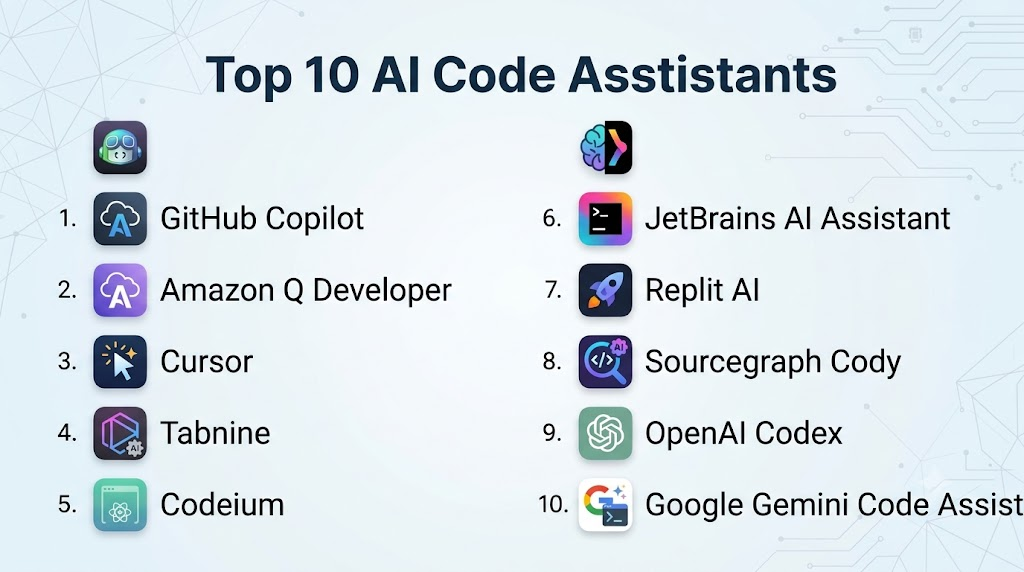
Top 10 AI Code Assistants
1- GitHub Copilot
Verdict: Leading AI coding assistant for modern development workflows.
Short Description: GitHub Copilot provides AI-powered code suggestions, chat assistance, and development support directly inside popular coding environments.
Key Features:
- Real-time code completion
- AI coding chat
- Code explanation and refactoring
- Test generation assistance
- IDE integrations
Pros:
- Strong developer ecosystem
- Excellent IDE integration
Cons:
- Subscription cost
- Requires code review for accuracy
Deployment: Cloud-based with IDE extensions
Security & Compliance: Enterprise security controls
Integrations & Ecosystem: GitHub, VS Code, JetBrains, development tools
Support & Community: Large developer community
Pricing Model: Subscription-based
Best-Fit Scenarios: Individual developers and enterprise engineering teams
2- Amazon Q Developer
Verdict: Enterprise AI coding assistant integrated with AWS workflows.
Short Description: Amazon Q Developer helps developers build, troubleshoot, and optimize applications with AI assistance across AWS environments.
Key Features:
- Code generation
- Application modernization
- AWS service guidance
- Debugging support
- Developer chat assistance
Pros:
- Strong AWS integration
- Enterprise-focused security
Cons:
- Best experience within AWS ecosystem
- Limited outside AWS workflows
Deployment: Cloud-based
Security & Compliance: AWS enterprise security standards
Integrations & Ecosystem: AWS services, IDEs, developer tools
Support & Community: AWS support ecosystem
Pricing Model: Subscription-based
Best-Fit Scenarios: AWS developers and cloud teams
3- Cursor
Verdict: AI-first coding environment for accelerated development.
Short Description: Cursor provides an AI-powered code editor designed for code generation, editing, debugging, and project understanding.
Key Features:
- AI code generation
- Codebase understanding
- Natural language editing
- Debugging assistance
- Repository analysis
Pros:
- Deep codebase awareness
- Developer-friendly experience
Cons:
- Requires adapting to a new editor
- Enterprise features vary
Deployment: Desktop application
Security & Compliance: Depends on deployment model
Integrations & Ecosystem: VS Code ecosystem compatibility
Support & Community: Growing developer community
Pricing Model: Subscription-based
Best-Fit Scenarios: Developers seeking AI-native coding workflows
4- Tabnine
Verdict: Privacy-focused AI coding assistant for teams.
Short Description: Tabnine provides AI code completion with emphasis on customization, privacy, and enterprise deployment options.
Key Features:
- Code completion
- Private AI models
- Team customization
- Multiple language support
- Enterprise controls
Pros:
- Strong privacy focus
- Customization options
Cons:
- Smaller ecosystem
- Suggestions may vary by language
Deployment: Cloud and enterprise environments
Security & Compliance: Enterprise security controls
Integrations & Ecosystem: IDE plugins and development tools
Support & Community: Enterprise support
Pricing Model: Subscription-based
Best-Fit Scenarios: Security-conscious development teams
5- Codeium
Verdict: Accessible AI coding assistant with broad language support.
Short Description: Codeium provides AI-powered code completion, chat, and development assistance for multiple programming environments.
Key Features:
- Code suggestions
- AI chat
- Code explanations
- IDE extensions
- Multiple language support
Pros:
- Easy adoption
- Supports many developers and languages
Cons:
- Enterprise capabilities vary
- Advanced workflows may require customization
Deployment: Cloud-based
Security & Compliance: Enterprise options available
Integrations & Ecosystem: IDE integrations
Support & Community: Developer community
Pricing Model: Free and paid options
Best-Fit Scenarios: Developers and small teams
6- JetBrains AI Assistant
Verdict: AI coding support integrated into JetBrains IDEs.
Short Description: JetBrains AI Assistant provides coding help directly within JetBrains development environments.
Key Features:
- Code generation
- Documentation creation
- Code explanation
- Refactoring assistance
- IDE integration
Pros:
- Excellent JetBrains integration
- Familiar developer workflow
Cons:
- Best suited for JetBrains users
- Limited outside ecosystem
Deployment: IDE-integrated
Security & Compliance: Enterprise security options
Integrations & Ecosystem: IntelliJ IDEA, PyCharm, JetBrains tools
Support & Community: JetBrains community
Pricing Model: Subscription-based
Best-Fit Scenarios: JetBrains developers
7- Replit AI
Verdict: AI-powered coding assistant for rapid application development.
Short Description: Replit AI helps developers create, modify, and deploy applications through AI-assisted coding workflows.
Key Features:
- Code generation
- Debugging assistance
- Project creation
- Browser-based development
- Collaboration tools
Pros:
- Beginner-friendly
- Integrated development environment
Cons:
- Less suitable for complex enterprise systems
- Platform dependency
Deployment: Cloud-based
Security & Compliance: Platform-dependent
Integrations & Ecosystem: Replit environment
Support & Community: Developer community
Pricing Model: Subscription-based
Best-Fit Scenarios: Learners, startups, rapid prototypes
8- Sourcegraph Cody
Verdict: AI assistant focused on understanding large codebases.
Short Description: Sourcegraph Cody helps developers search, understand, and modify complex software repositories using AI.
Key Features:
- Codebase search
- Code explanation
- AI chat
- Repository understanding
- Enterprise controls
Pros:
- Strong large-codebase support
- Enterprise-friendly
Cons:
- Requires setup for large environments
- Best for complex repositories
Deployment: Cloud and enterprise
Security & Compliance: Enterprise security controls
Integrations & Ecosystem: Git repositories and development tools
Support & Community: Enterprise support
Pricing Model: Subscription-based
Best-Fit Scenarios: Large engineering organizations
9- OpenAI Codex
Verdict: Advanced AI coding model for software generation tasks.
Short Description: OpenAI Codex provides AI-powered programming capabilities for generating, understanding, and transforming code.
Key Features:
- Code generation
- Programming assistance
- Code explanation
- Automation workflows
- API-based integration
Pros:
- Strong coding capabilities
- Flexible integration options
Cons:
- Requires developer validation
- Usage costs vary
Deployment: Cloud/API-based
Security & Compliance: Enterprise controls depending on implementation
Integrations & Ecosystem: APIs and developer platforms
Support & Community: Developer ecosystem
Pricing Model: Usage-based
Best-Fit Scenarios: AI-powered development workflows
10- Google Gemini Code Assist
Verdict: Cloud-integrated AI coding assistant for developers.
Short Description: Google Gemini Code Assist provides AI-powered coding support across development environments with Google Cloud integration.
Key Features:
- Code completion
- Code generation
- Debugging assistance
- Cloud development support
- Developer chat
Pros:
- Strong Google Cloud integration
- Enterprise-ready features
Cons:
- Best within Google ecosystem
- Feature availability varies
Deployment: Cloud-based
Security & Compliance: Google Cloud security standards
Integrations & Ecosystem: Google Cloud, IDEs, developer tools
Support & Community: Google developer ecosystem
Pricing Model: Subscription-based
Best-Fit Scenarios: Google Cloud developers and enterprises
Comparison Table
| Platform | Code Generation | IDE Support | Security | Enterprise Features | Deployment |
|---|---|---|---|---|---|
| GitHub Copilot | High | Excellent | High | High | Cloud |
| Amazon Q Developer | High | High | High | High | Cloud |
| Cursor | High | High | Medium | Medium | Desktop |
| Tabnine | High | High | High | High | Cloud/Enterprise |
| Codeium | High | High | Medium | Medium | Cloud |
| JetBrains AI Assistant | High | Excellent | High | Medium | IDE |
| Replit AI | Medium | Medium | Medium | Medium | Cloud |
| Sourcegraph Cody | High | High | High | High | Cloud/Enterprise |
| OpenAI Codex | High | Flexible | High | Medium | API |
| Gemini Code Assist | High | High | High | High | Cloud |
Evaluation & Scoring Table
| Platform | Coding Quality 25% | IDE Integration 15% | Security 15% | Enterprise Features 15% | Ease 10% | Performance 10% | Value 10% | Total |
|---|---|---|---|---|---|---|---|---|
| GitHub Copilot | 25 | 15 | 14 | 15 | 10 | 10 | 9 | 98 |
| Amazon Q Developer | 24 | 14 | 15 | 15 | 9 | 10 | 9 | 96 |
| Cursor | 24 | 14 | 12 | 12 | 10 | 10 | 9 | 91 |
| Tabnine | 22 | 14 | 15 | 14 | 9 | 9 | 9 | 92 |
| Codeium | 22 | 14 | 12 | 12 | 10 | 9 | 10 | 89 |
| JetBrains AI Assistant | 23 | 15 | 14 | 12 | 10 | 9 | 8 | 91 |
| Replit AI | 20 | 12 | 11 | 10 | 10 | 9 | 10 | 82 |
| Sourcegraph Cody | 23 | 14 | 15 | 15 | 8 | 9 | 8 | 92 |
| OpenAI Codex | 24 | 13 | 13 | 12 | 9 | 10 | 9 | 90 |
| Gemini Code Assist | 23 | 14 | 14 | 14 | 9 | 10 | 9 | 93 |
Which AI Code Assistant Is Right for You?
- Individual Developers: GitHub Copilot, Cursor, Codeium
- Enterprise Engineering Teams: GitHub Copilot, Amazon Q Developer, Sourcegraph Cody
- AWS Development Teams: Amazon Q Developer
- Google Cloud Teams: Gemini Code Assist
- Security-Focused Organizations: Tabnine, Sourcegraph Cody
- Large Codebase Management: Sourcegraph Cody
- Beginner Developers: Replit AI, Codeium
Common Mistakes
- Accepting AI-generated code without review
- Ignoring security and privacy controls
- Using AI tools without coding standards
- Expecting complete autonomous development
- Not training developers on effective usage
Frequently Asked Questions
What are AI code assistants?
AI code assistants are tools that help developers write, review, debug, and improve software using artificial intelligence.
Can AI code assistants replace developers?
No. They support developers by improving productivity but still require human review and decision-making.
Which AI code assistant is most popular?
GitHub Copilot is one of the widely adopted AI coding assistants among developers and organizations.
Do AI coding assistants support multiple programming languages?
Yes. Most support popular languages including Python, JavaScript, Java, C++, and many others.
Are AI code assistants secure for enterprise use?
Many provide enterprise security controls, privacy options, and administrative features.
Can AI assistants generate tests?
Yes. Many tools can help create unit tests, test cases, and debugging suggestions.
Do AI coding assistants work with IDEs?
Yes. Most integrate with VS Code, JetBrains IDEs, Visual Studio, and other development environments.
Can organizations customize AI coding assistants?
Some enterprise solutions support customization, private models, and organization-specific configurations.
Are AI code assistants useful for beginners?
Yes. They can help beginners understand code concepts and learn programming faster.
Can AI assistants improve developer productivity?
Yes. They reduce repetitive coding tasks and accelerate development workflows.
Do AI coding assistants create security risks?
They can introduce risks if generated code is not reviewed or if sensitive code is improperly shared.
How should teams adopt AI coding assistants?
Teams should start with guidelines, security reviews, training, and controlled adoption.
Conclusion
AI Code Assistants are transforming software development by helping developers write better code faster, automate repetitive tasks, and improve collaboration. Tools like GitHub Copilot, Amazon Q Developer, Sourcegraph Cody, and Gemini Code Assist provide different capabilities for individual developers, startups, and enterprise engineering teams. Choosing the right assistant depends on coding requirements, security expectations, IDE preferences, and organizational workflows.
