Introduction
Content authenticity verification tools are designed to determine whether digital content is real, manipulated, AI-generated, or tampered with. In a world where generative AI can produce highly realistic text, images, audio, and video, verifying authenticity has become critical for trust, safety, and compliance.
These tools work by analyzing metadata, cryptographic signatures, media fingerprints, generation patterns, model watermarks, and behavioral signals. Some systems validate provenance (where content came from), while others detect AI generation or deepfake manipulation.
Organizations use these tools to protect against misinformation, fraud, identity theft, brand impersonation, fake news, synthetic media abuse, and document forgery.
Common use cases include journalism verification, social media moderation, enterprise compliance, digital forensics, AI-generated content detection, and media authentication in legal workflows.
Buyers should evaluate detection accuracy, multimodal support, watermark detection capability, cryptographic verification, real-time analysis, API availability, false-positive rate, scalability, and integration with existing content pipelines.
Best for: media companies, enterprises, security teams, compliance officers, government agencies, social platforms, and financial institutions.
Not ideal for: casual users who only need basic plagiarism checks or lightweight content validation without security or legal requirements.
What’s Changed in Content Authenticity Verification
- Shift from metadata to cryptographic verification: Systems now rely on signed content credentials instead of editable metadata.
- AI-generated content explosion: Detection systems must now handle text, images, video, audio, and multimodal synthetic content.
- Deepfake detection has become mainstream: Especially in political, financial, and identity-sensitive environments.
- Real-time verification is required: Social platforms need instant detection at upload time.
- Watermark-aware detection systems are emerging: Tools now detect invisible AI watermarks embedded in content.
- Cross-platform authenticity standards are growing: Content provenance is being standardized across industries.
- Multimodal verification is critical: A single post may include text, images, and video that must be jointly validated.
- Adversarial manipulation is increasing: Attackers try to remove metadata or re-generate content to evade detection.
- Enterprise audit requirements are stricter: Logs, explainability, and evidence trails are mandatory in regulated industries.
- Synthetic identity fraud is rising: Verification systems must detect AI-generated faces and documents.
- Browser-level verification tools are growing: Authentication is moving closer to content consumption points.
- API-first architectures dominate: Verification is embedded directly into publishing and moderation pipelines.
Quick Buyer Checklist
- Confirm support for text, image, audio, video, and document verification.
- Check whether the system uses AI detection, watermark detection, or cryptographic provenance.
- Evaluate false positive and false negative rates in real-world conditions.
- Determine whether real-time API verification is available.
- Review support for deepfake detection (face, voice, video).
- Check metadata integrity validation and EXIF analysis capabilities.
- Confirm support for C2PA or content credentials standards.
- Evaluate scalability for high-volume content streams.
- Assess explainability of detection results.
- Check integration with CMS, moderation, or security systems.
- Verify audit logs and reporting capabilities.
- Determine resistance to adversarial evasion techniques.
- Evaluate model update frequency and dataset freshness.
- Confirm privacy handling and data retention policies.
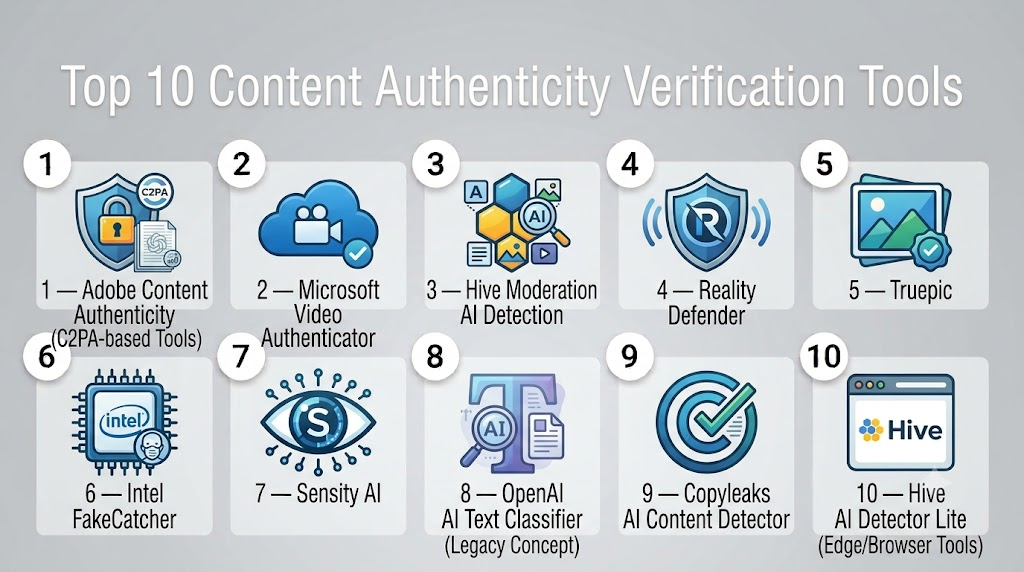
Top 10 Content Authenticity Verification Tools
1 — Adobe Content Authenticity (C2PA-based Tools)
One-line verdict: Best for cryptographically verifiable content provenance using industry-wide authenticity standards.
Short description:
Adobe’s content authenticity ecosystem uses C2PA standards to attach cryptographic metadata to digital content, allowing users to verify origin, editing history, and authenticity of images and media.
Standout Capabilities
- Cryptographic content credentials (C2PA standard)
- Tracks creation, editing, and modification history
- Tamper-evident metadata signatures
- Image and media provenance tracking
- Integration with creative workflows
- Verification of content origin
- Supports publishing and media ecosystems
- Standardized authenticity framework
AI-Specific Depth
- Model support: N/A (content-level verification system)
- RAG / knowledge integration: N/A
- Evaluation: Integrity validation, metadata verification, tamper detection
- Guardrails: Not a safety system
- Observability: Content history logs, verification status, metadata lineage
Pros
- Strong industry standard adoption
- Cryptographically secure provenance tracking
- Works across creative workflows
Cons
- Requires ecosystem adoption for full effectiveness
- Not designed to detect all AI-generated content
- Metadata stripping can reduce effectiveness
Security & Compliance
Built around cryptographic verification and signed metadata. Compliance capabilities depend on deployment environment.
Deployment & Platforms
- Creative software ecosystems
- Cloud-based content pipelines
- Media publishing systems
Integrations & Ecosystem
- Adobe Creative Cloud
- C2PA-compatible tools
- Digital asset management systems
- Publishing platforms
Pricing Model
Not publicly stated for full enterprise ecosystem.
Best-Fit Scenarios
- Journalism and media authenticity
- Enterprise content verification
- Legal-grade media provenance
2 — Microsoft Video Authenticator
One-line verdict: Best for detecting manipulated images and deepfake videos using forensic analysis.
Short description:
Microsoft Video Authenticator analyzes images and videos to detect signs of manipulation, blending artifacts, and synthetic generation.
Standout Capabilities
- Deepfake detection for video content
- Image manipulation analysis
- Frame-by-frame forensic scoring
- Confidence-based authenticity scoring
- Media integrity evaluation
- Real-time analysis capabilities
- Designed for identity verification use cases
- Lightweight verification approach
AI-Specific Depth
- Model support: Image and video analysis models
- RAG / knowledge integration: N/A
- Evaluation: Manipulation score, confidence rating, frame inconsistency detection
- Guardrails: N/A
- Observability: Detection results, confidence metrics, forensic indicators
Pros
- Strong focus on deepfake detection
- Easy-to-use verification workflow
- Useful for identity verification scenarios
Cons
- Limited to image and video
- Does not verify text authenticity
- Accuracy depends on manipulation type
Security & Compliance
Designed for forensic validation use cases; enterprise controls vary.
Deployment & Platforms
- Mobile and cloud-based usage
- Video processing pipelines
- API-based integration (varies)
Integrations & Ecosystem
- Identity verification systems
- Media moderation pipelines
- Security workflows
Pricing Model
Not publicly stated.
Best-Fit Scenarios
- Deepfake detection
- Identity verification
- Media authentication workflows
3 — Hive Moderation AI Detection
One-line verdict: Best for large-scale AI-generated content detection across text, image, audio, and video.
Short description:
Hive provides AI moderation and content classification tools that detect synthetic media, unsafe content, and manipulated digital assets across multiple formats.
Standout Capabilities
- AI-generated content detection
- Multimodal moderation (text, image, video, audio)
- Real-time API processing
- Toxicity and safety classification
- Deepfake detection signals
- Scalable moderation pipelines
- Enterprise-grade moderation workflows
- Batch and streaming support
AI-Specific Depth
- Model support: Proprietary detection models
- RAG / knowledge integration: N/A
- Evaluation: Confidence scores, classification outputs, risk levels
- Guardrails: Content safety and policy enforcement signals
- Observability: Moderation logs, detection metadata, API responses
Pros
- Strong multimodal coverage
- Scales for high-volume platforms
- Easy API integration
Cons
- Not fully transparent model internals
- False positives possible in edge cases
- Enterprise pricing model may vary
Security & Compliance
Enterprise moderation controls and logging available; exact certifications are not publicly stated.
Deployment & Platforms
- Cloud API
- Real-time and batch processing
- Web dashboard
Integrations & Ecosystem
- Social platforms
- CMS systems
- Content pipelines
- Security tools
Pricing Model
Usage-based enterprise API pricing.
Best-Fit Scenarios
- Social media moderation
- Marketplace content verification
- Large-scale AI content filtering
4 — Reality Defender
One-line verdict: Best for enterprise-grade deepfake detection and synthetic media defense.
Short description:
Reality Defender focuses on detecting deepfakes, synthetic audio, manipulated video, and AI-generated identity fraud across enterprise systems.
Standout Capabilities
- Deepfake detection across media types
- Synthetic audio and voice detection
- Real-time fraud detection signals
- API-first architecture
- Identity verification support
- Enterprise integration workflows
- Continuous model updates
- Multi-layer detection pipelines
AI-Specific Depth
- Model support: Proprietary multimodal detection models
- RAG / knowledge integration: N/A
- Evaluation: Fraud probability scores, synthetic detection confidence
- Guardrails: Identity fraud prevention signals
- Observability: Detection logs, risk scores, audit outputs
Pros
- Strong enterprise fraud focus
- Multimodal deepfake coverage
- Real-time detection capability
Cons
- Not open-source
- Pricing not publicly stated
- Requires integration effort
Security & Compliance
Enterprise security controls available depending on deployment.
Deployment & Platforms
- Cloud API
- Enterprise integrations
- Real-time streaming pipelines
Integrations & Ecosystem
- Fraud detection systems
- Identity verification platforms
- Security operations tools
Pricing Model
Not publicly stated.
Best-Fit Scenarios
- Financial fraud detection
- Identity verification systems
- Deepfake prevention in enterprises
5 — Truepic
One-line verdict: Best for verified capture and secure image authenticity from the point of creation.
Short description:
Truepic focuses on capturing images and videos with built-in authenticity verification at the moment of capture, ensuring tamper-proof media provenance.
Standout Capabilities
- Verified media capture at source
- Tamper-proof image and video metadata
- Secure camera-based authentication
- Chain-of-custody tracking
- Authenticity verification API
- Mobile-first capture tools
- Enterprise compliance support
- Media integrity assurance
AI-Specific Depth
- Model support: N/A
- RAG / knowledge integration: N/A
- Evaluation: Capture integrity verification, tamper detection
- Guardrails: N/A
- Observability: Media provenance logs, capture metadata
Pros
- Strong capture-level authenticity
- Prevents manipulation at source
- Useful for legal evidence workflows
Cons
- Requires adoption at capture time
- Limited retrospective verification
- Ecosystem dependency
Security & Compliance
Designed for evidentiary-grade media verification.
Deployment & Platforms
- Mobile applications
- Cloud verification APIs
- Enterprise systems
Integrations & Ecosystem
- Insurance workflows
- Legal documentation systems
- Compliance platforms
Pricing Model
Enterprise pricing not publicly stated.
Best-Fit Scenarios
- Insurance claims verification
- Legal evidence capture
- Field inspection authenticity
6 — Intel FakeCatcher
One-line verdict: Best for real-time deepfake video detection using physiological signal analysis.
Short description:
FakeCatcher detects deepfakes by analyzing subtle biological signals in video such as blood flow patterns and facial micro-signals.
Standout Capabilities
- Real-time deepfake detection
- Physiological signal analysis
- Video frame-level evaluation
- High-speed inference
- AI-generated video classification
- Research-backed detection approach
- Scalable architecture
- Cloud-based deployment options
AI-Specific Depth
- Model support: Video analysis models
- RAG / knowledge integration: N/A
- Evaluation: Deepfake probability scores, signal consistency metrics
- Guardrails: N/A
- Observability: Frame-level detection outputs
Pros
- Innovative biological signal approach
- Fast detection pipeline
- Strong research foundation
Cons
- Limited to video
- Requires compute resources
- Not a general content verifier
Security & Compliance
Not publicly stated in detail.
Deployment & Platforms
- Cloud-based inference
- Video processing systems
Integrations & Ecosystem
- Media platforms
- Security monitoring systems
- Identity verification tools
Pricing Model
Not publicly stated.
Best-Fit Scenarios
- Video deepfake detection
- Real-time content validation
- Security monitoring systems
7 — Sensity AI
One-line verdict: Best for monitoring and detecting deepfakes across online platforms at scale.
Short description:
Sensity AI specializes in detecting synthetic media, deepfakes, and manipulated visual content across the internet.
Standout Capabilities
- Large-scale deepfake monitoring
- Image and video authenticity detection
- Social media scanning capabilities
- AI-generated media classification
- Threat intelligence reporting
- Identity impersonation detection
- Continuous model updates
- Enterprise monitoring dashboards
AI-Specific Depth
- Model support: Proprietary detection models
- RAG / knowledge integration: N/A
- Evaluation: Detection scores, threat classification
- Guardrails: N/A
- Observability: Monitoring dashboards, alerts, logs
Pros
- Strong monitoring capabilities
- Focus on synthetic media threats
- Useful for brand protection
Cons
- Not open-source
- Pricing not transparent
- Limited technical customization
Security & Compliance
Enterprise-grade monitoring controls.
Deployment & Platforms
- Cloud-based platform
- API integrations
Integrations & Ecosystem
- Brand protection systems
- Security operations centers
- Social media monitoring tools
Pricing Model
Not publicly stated.
Best-Fit Scenarios
- Brand impersonation detection
- Deepfake threat monitoring
- Online misinformation tracking
8 — OpenAI AI Text Classifier (Legacy Concept)
One-line verdict: Best for experimental detection of AI-generated text patterns (historical/limited use).
Short description:
This tool was designed to classify whether text is likely AI-generated or human-written using statistical patterns.
Standout Capabilities
- AI text probability classification
- Lightweight text analysis
- Pattern-based detection
- Simple API interface concept
- Research-focused system
AI-Specific Depth
- Model support: Text classification models
- RAG / knowledge integration: N/A
- Evaluation: AI-likelihood scoring
- Guardrails: N/A
- Observability: Probability outputs
Pros
- Simple detection concept
- Easy to interpret outputs
- Lightweight system design
Cons
- Limited accuracy in modern AI systems
- Not actively maintained as a primary tool
- Easily bypassed by paraphrasing
Security & Compliance
Not publicly stated.
Deployment & Platforms
- API-based concept system
Integrations & Ecosystem
- Content moderation tools
- Educational systems
Pricing Model
Not publicly stated.
Best-Fit Scenarios
- Experimental AI text detection
- Academic analysis
- Lightweight screening
9 — Copyleaks AI Content Detector
One-line verdict: Best for enterprise plagiarism plus AI-generated content detection in text-heavy environments.
Short description:
Copyleaks provides plagiarism detection combined with AI-generated content detection for academic, enterprise, and publishing workflows.
Standout Capabilities
- AI-generated text detection
- Plagiarism scanning
- Multilingual support
- API-based integration
- Document-level analysis
- Educational integrity tools
- Enterprise reporting
- Batch processing support
AI-Specific Depth
- Model support: Text analysis models
- RAG / knowledge integration: N/A
- Evaluation: AI probability scores, similarity metrics
- Guardrails: N/A
- Observability: Scan reports and detection logs
Pros
- Strong plagiarism + AI detection combo
- Easy enterprise integration
- Widely used in education
Cons
- Focused mainly on text
- False positives in paraphrased content
- Limited multimodal coverage
Security & Compliance
Enterprise compliance controls available; exact certifications vary.
Deployment & Platforms
- Cloud API
- Web dashboard
Integrations & Ecosystem
- LMS systems
- Publishing platforms
- Enterprise document systems
Pricing Model
Subscription-based enterprise model.
Best-Fit Scenarios
- Academic integrity verification
- Publishing authenticity checks
- Enterprise document screening
10 — Hive AI Detector Lite (Edge/Browser Tools)
One-line verdict: Best for lightweight real-time AI content detection in browser and edge environments.
Short description:
A simplified version of Hive’s detection ecosystem designed for quick AI-content checks in browser-based workflows.
Standout Capabilities
- Fast AI content detection
- Lightweight browser integration
- Basic multimodal checks
- Quick risk scoring
- Simple API calls
- Content classification signals
- Real-time response
- Developer-friendly usage
AI-Specific Depth
- Model support: Lightweight detection models
- RAG / knowledge integration: N/A
- Evaluation: Confidence scores and classification outputs
- Guardrails: Basic content safety indicators
- Observability: Simple detection logs
Pros
- Extremely fast checks
- Easy integration
- Lightweight deployment
Cons
- Limited accuracy vs enterprise tools
- Not suitable for high-stakes verification
- Minimal explainability
Security & Compliance
Not publicly stated.
Deployment & Platforms
- Browser-based tools
- API access
Integrations & Ecosystem
- CMS plugins
- Browser extensions
- Content workflows
Pricing Model
Freemium or usage-based (varies).
Best-Fit Scenarios
- Quick content screening
- Browser-based verification
- Lightweight moderation workflows
Comparison Table
| Tool Name | Best For | Deployment | Coverage | Strength | Watch-Out | Public Rating |
|---|---|---|---|---|---|---|
| Adobe C2PA | Content provenance | Cloud/creative tools | Multimodal | Cryptographic trust | Ecosystem dependency | N/A |
| Microsoft Video Authenticator | Deepfake detection | Cloud/mobile | Image/video | Forensic analysis | Limited scope | N/A |
| Hive Moderation | AI content detection | API/cloud | Multimodal | Scalable moderation | Black-box models | N/A |
| Reality Defender | Enterprise fraud detection | Cloud/API | Multimodal | Deepfake defense | Cost not public | N/A |
| Truepic | Verified capture | Mobile/cloud | Images/video | Source authenticity | Requires capture adoption | N/A |
| Intel FakeCatcher | Real-time deepfake detection | Cloud | Video | Biological signals | Video-only | N/A |
| Sensity AI | Deepfake monitoring | Cloud | Multimodal | Threat intelligence | Not transparent pricing | N/A |
| OpenAI Classifier | AI text detection | API concept | Text | Lightweight detection | Obsolete accuracy | N/A |
| Copyleaks | Plagiarism + AI detection | Cloud/API | Text | Education + enterprise | Text-only focus | N/A |
| Hive Lite | Fast screening | Browser/API | Multimodal | Speed | Lower accuracy | N/A |
Scoring & Evaluation
Scoring is based on detection capability, multimodal coverage, real-time performance, robustness to manipulation, enterprise readiness, integration depth, and explainability.
No tool provides perfect authenticity verification alone. Strong systems combine provenance (C2PA-style), AI detection (Hive/Reality Defender), and capture-level verification (Truepic).
| Tool | Core | Reliability | Coverage | Integrations | Ease | Performance | Security/Admin | Support | Weighted Total |
|---|---|---|---|---|---|---|---|---|---|
| Adobe C2PA | 10 | 9 | 9 | 9 | 8 | 8 | 9 | 9 | 8.80 |
| Microsoft Video Authenticator | 8 | 8 | 7 | 7 | 8 | 8 | 7 | 8 | 7.75 |
| Hive Moderation | 9 | 9 | 10 | 9 | 9 | 9 | 9 | 9 | 9.00 |
| Reality Defender | 9 | 9 | 10 | 9 | 8 | 9 | 9 | 8 | 8.85 |
| Truepic | 9 | 9 | 9 | 8 | 8 | 8 | 9 | 8 | 8.55 |
| Intel FakeCatcher | 8 | 8 | 9 | 7 | 8 | 9 | 7 | 8 | 8.05 |
| Sensity AI | 8 | 8 | 9 | 8 | 8 | 8 | 8 | 8 | 8.10 |
| OpenAI Classifier | 6 | 6 | 6 | 7 | 9 | 9 | 6 | 7 | 6.95 |
| Copyleaks | 8 | 8 | 8 | 9 | 9 | 8 | 8 | 9 | 8.25 |
| Hive Lite | 7 | 7 | 7 | 8 | 9 | 10 | 7 | 7 | 7.30 |
Which Content Authenticity Tool Is Right for You?
Solo / Freelancer
Use lightweight tools like Copyleaks or Hive Lite. These provide quick checks for AI-generated text or basic media verification without complex infrastructure.
SMB
Small businesses should combine Copyleaks (text) with Hive Moderation (multimodal). This provides balanced coverage for websites, marketing content, and user submissions.
Mid-Market
Mid-market companies should introduce structured verification pipelines using Hive Moderation or Reality Defender alongside C2PA-style provenance tracking.
Enterprise
Enterprises require a layered stack:
- C2PA for provenance
- Reality Defender for fraud detection
- Hive Moderation for content screening
- Truepic for capture-level verification
Regulated Industries
Finance, healthcare, and government must prioritize cryptographic provenance (C2PA), audit logs, and deepfake detection systems with strict false-positive controls.
Budget vs Premium
Open APIs and lightweight detectors reduce cost but may lack accuracy. Enterprise-grade systems provide stronger guarantees but require integration and governance overhead.
Build vs Buy
Building detection systems is rarely effective due to rapid adversarial evolution. Most organizations should adopt vendor solutions combined with internal governance layers.
Implementation Playbook
30 Days
- Identify content types (text, image, video, audio)
- Choose detection API (Hive or Copyleaks)
- Integrate basic authenticity checks
- Log all verification results
- Establish baseline false-positive rates
60 Days
- Add multimodal verification
- Integrate C2PA or metadata tracking
- Build moderation pipelines
- Add confidence scoring thresholds
- Define escalation rules for suspicious content
90 Days
- Deploy deepfake detection systems
- Add provenance tracking for all content
- Implement audit logging and reporting
- Create human review workflows
- Test adversarial manipulation resistance
Common Mistakes and How to Avoid Them
- Relying only on AI detection scores
- Ignoring metadata stripping attacks
- Not verifying multimodal content together
- Over-trusting watermark detection alone
- Failing to track content provenance
- Using text-only tools for video/audio content
- Ignoring false positives in moderation workflows
- Not updating detection models regularly
- Skipping human review for high-risk content
- Lack of integration with publishing pipelines
- Not logging verification decisions
- Assuming detection equals proof
- No fallback system when detection fails
- Treating authenticity tools as standalone solutions
FAQs
1. What is content authenticity verification?
It is the process of validating whether digital content is real, AI-generated, or manipulated using detection, metadata, or cryptographic methods.
2. What is the difference between detection and provenance?
Detection identifies whether content is fake or AI-generated, while provenance tracks where content came from and how it was created.
3. Can AI-generated content always be detected?
No. Detection improves safety but can be bypassed using paraphrasing, re-generation, or editing.
4. What is C2PA?
C2PA is a cryptographic standard that attaches verifiable provenance metadata to digital content.
5. Do watermarking systems guarantee authenticity?
No. They help identify origin but can be weakened or removed in some cases.
6. Which tool is best for deepfake detection?
Reality Defender, Hive Moderation, and Microsoft Video Authenticator are commonly used.
7. Can these tools detect all AI-generated text?
No. Text detection is probabilistic and not fully reliable.
8. Are these tools real-time?
Many enterprise tools support real-time APIs, especially for moderation and fraud detection.
9. What is synthetic media?
Synthetic media is content generated or manipulated using AI, including deepfakes and AI-written text.
10. Can authenticity tools be used in legal cases?
Yes, but typically combined with forensic analysis and provenance evidence.
11. Do these tools store user data?
Policies vary by vendor; organizations must verify retention and usage policies.
12. Can provenance replace detection?
No. Both are needed for strong authenticity verification.
13. Are these tools expensive?
Enterprise-grade systems can be costly; lightweight APIs are more affordable.
14. Can attackers bypass these systems?
Yes, adversarial techniques can reduce detection accuracy.
15. What is the future of content authenticity?
It will combine cryptographic provenance, AI detection, and real-time verification across platforms.
Conclusion
Content authenticity verification tools are becoming essential infrastructure for the digital world. As AI-generated content becomes indistinguishable from human-created media, organizations must adopt layered verification systems combining detection, provenance, and cryptographic validation.
