Introduction
AI Security Posture Management platforms help organizations discover, assess, monitor, and reduce risks across their AI systems. These platforms give security teams visibility into AI models, applications, agents, data flows, prompts, plugins, APIs, and user interactions so they can understand where AI risk exists and how to control it.
As companies adopt generative AI, copilots, RAG applications, autonomous agents, and third-party AI tools, traditional cloud security and application security tools are no longer enough. AI systems introduce new risks such as prompt injection, data leakage, model abuse, unsafe tool access, shadow AI usage, weak governance, unapproved model deployment, and lack of auditability.
Common use cases include discovering AI assets, identifying shadow AI tools, monitoring model access, detecting sensitive-data exposure, reviewing AI agent permissions, assessing third-party AI risk, enforcing governance policies, and preparing audit evidence.
Buyers should evaluate discovery depth, AI risk coverage, runtime visibility, integration with cloud and SaaS environments, policy enforcement, data protection, model inventory, agent security, reporting, ease of deployment, and security administration.
Best for: CISOs, security teams, cloud security teams, AI governance leaders, DevSecOps teams, compliance teams, and enterprises deploying AI across multiple departments.
Not ideal for: very small teams using only simple internal AI experiments without sensitive data, production access, agents, or external users. In those cases, basic AI usage policies and manual review may be enough at the beginning.
What’s Changed in AI Security Posture Management Platforms
- AI systems are now business infrastructure, not just experiments.
- Shadow AI usage has become a major security and governance concern.
- AI agents now need identity, permission, and activity monitoring.
- Prompt injection and indirect prompt injection are now common testing requirements.
- RAG systems need visibility into documents, vector stores, permissions, and retrieval behavior.
- Security teams need inventory across models, datasets, prompts, plugins, APIs, and agents.
- AI risk is now linked with cloud posture, SaaS posture, data security, and application security.
- Runtime monitoring is becoming more important than static policy checks.
- Sensitive-data leakage through AI tools is a major enterprise concern.
- Model supply-chain security is becoming part of AI posture management.
- Governance teams need audit evidence for AI usage, ownership, approvals, and controls.
- AI security platforms are moving from point solutions to full lifecycle protection.
Quick Buyer Checklist
- Can the platform discover all AI models, apps, agents, and third-party tools?
- Does it identify shadow AI usage across cloud, browser, SaaS, and enterprise systems?
- Does it map sensitive data flowing into AI tools?
- Can it monitor prompts, responses, files, APIs, and tool calls?
- Does it support AI agent identity and permission visibility?
- Can it detect prompt injection, jailbreaks, data leakage, and unsafe outputs?
- Does it integrate with cloud platforms, SaaS apps, SIEM, SOAR, IAM, and data security tools?
- Does it provide risk scoring and prioritization?
- Can it enforce policies or only report findings?
- Does it support audit logs, RBAC, SSO, and admin controls?
- Can it support regulated environments?
- Does it provide clear remediation guidance?
- Can findings be exported to ticketing and governance workflows?
- Does it reduce AI risk without slowing innovation too much?
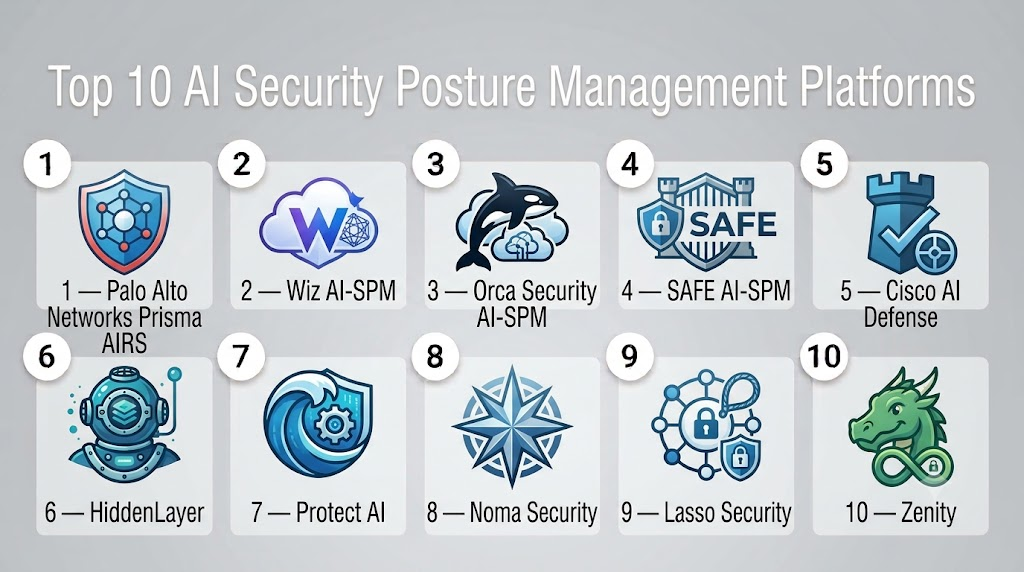
Top 10 AI Security Posture Management Platforms
1 — Palo Alto Networks Prisma AIRS
One-line verdict: Best for enterprises needing AI posture, runtime security, and cloud-native AI protection in one platform.
Short description:
Prisma AIRS is designed to help organizations secure AI applications, agents, models, and data across cloud and enterprise environments. It focuses on visibility, posture management, runtime protection, and AI-specific threat prevention.
Standout Capabilities
- AI asset discovery and inventory
- AI posture management for models, data, and applications
- Runtime security for AI applications
- Prompt injection and AI threat detection
- AI agent and tool-use visibility
- Cloud security integration
- Policy-based AI risk management
- Enterprise-grade reporting and governance
AI-Specific Depth
- Model support: Hosted, cloud-based, and enterprise AI model environments
- RAG / knowledge integration: Supports AI application and data-flow visibility
- Evaluation: AI risk assessment, posture analysis, and security findings
- Guardrails: Prompt injection protection, data leakage controls, and runtime policies
- Observability: AI activity monitoring, risk dashboards, alerts, and posture reports
Pros
- Strong fit for large cloud-first enterprises
- Combines AI posture with runtime security
- Integrates well with broader security operations
Cons
- May be complex for smaller teams
- Best value often depends on existing Palo Alto ecosystem
- Pricing is not publicly stated
Security & Compliance
Enterprise security controls may include RBAC, SSO, audit logs, policy management, and cloud security integrations. Certifications and data residency details should be verified directly.
Deployment & Platforms
- Cloud-based enterprise platform
- Cloud, SaaS, and AI application environments
- Hybrid support may vary by deployment
Integrations & Ecosystem
Prisma AIRS fits into enterprise cloud security and security operations workflows.
- Cloud platforms
- SIEM and SOAR tools
- Identity systems
- AI applications
- Data security platforms
- Runtime security workflows
- Enterprise policy systems
Pricing Model
Commercial enterprise pricing. Exact pricing is not publicly stated.
Best-Fit Scenarios
- Securing AI across complex cloud environments
- Monitoring AI agents and AI applications
- Unifying AI posture with enterprise security operations
2 — Wiz AI-SPM
One-line verdict: Best for cloud security teams that want AI risk visibility inside existing cloud posture workflows.
Short description:
Wiz AI-SPM helps security teams discover and assess AI services, models, data stores, pipelines, and risks inside cloud environments. It extends cloud security posture management into AI-specific assets and attack paths.
Standout Capabilities
- AI asset discovery in cloud environments
- AI pipeline and model visibility
- Sensitive-data exposure analysis
- Cloud attack-path mapping
- AI infrastructure risk detection
- Integration with cloud-native security workflows
- Risk prioritization and remediation guidance
- Developer and security team collaboration
AI-Specific Depth
- Model support: Cloud AI services, model endpoints, and AI infrastructure
- RAG / knowledge integration: Can help identify data sources and cloud-connected AI assets
- Evaluation: Posture findings, cloud risk analysis, and exposure prioritization
- Guardrails: Focuses more on posture and exposure than prompt-level guardrails
- Observability: Asset inventory, risk graph, cloud posture dashboards, and alerts
Pros
- Strong cloud-native visibility
- Useful for identifying AI attack paths
- Fits existing cloud security workflows
Cons
- Runtime AI behavior coverage may depend on integrations
- Less focused on deep prompt testing than red-team tools
- Best suited for cloud-heavy organizations
Security & Compliance
Enterprise-grade administration, access controls, and audit capabilities may be available depending on deployment. Certifications should be verified directly.
Deployment & Platforms
- Cloud-based platform
- Multi-cloud environments
- SaaS security workflows
Integrations & Ecosystem
Wiz is commonly used with cloud infrastructure, security workflows, and developer environments.
- AWS
- Microsoft Azure
- Google Cloud
- Kubernetes
- CI/CD pipelines
- Ticketing systems
- SIEM tools
Pricing Model
Commercial enterprise pricing. Exact pricing is not publicly stated.
Best-Fit Scenarios
- Discovering AI assets in cloud environments
- Prioritizing AI risks through attack paths
- Extending CNAPP programs into AI security
3 — Orca Security AI-SPM
One-line verdict: Best for organizations that want agentless cloud visibility with AI model and tool risk discovery.
Short description:
Orca Security provides AI-SPM capabilities as part of its cloud security platform. It helps teams identify AI models, AI tools, exposed data, misconfigurations, and risk paths across cloud environments.
Standout Capabilities
- Agentless cloud visibility
- AI model and AI tool inventory
- Risk prioritization across cloud assets
- Sensitive-data exposure detection
- Misconfiguration and vulnerability context
- Attack-path analysis
- AI-related cloud risk dashboards
- Security workflow integrations
AI-Specific Depth
- Model support: Cloud AI models, AI services, and related workloads
- RAG / knowledge integration: Visibility into cloud data sources and connected AI systems
- Evaluation: Cloud posture checks, exposure analysis, and risk prioritization
- Guardrails: Primarily posture-focused rather than prompt-level enforcement
- Observability: Cloud asset maps, AI risk dashboards, alerts, and remediation views
Pros
- Agentless approach reduces deployment friction
- Strong cloud security context
- Useful for AI asset discovery and prioritization
Cons
- Prompt-level and model-behavior testing may require other tools
- Best suited for cloud environments
- Exact AI feature depth may vary by plan
Security & Compliance
Enterprise controls may include identity integration, RBAC, audit logs, and reporting. Specific certifications should be verified directly.
Deployment & Platforms
- Cloud-based platform
- Agentless cloud scanning
- Multi-cloud environments
Integrations & Ecosystem
Orca works well with cloud and security operations environments.
- AWS
- Microsoft Azure
- Google Cloud
- Kubernetes
- Ticketing tools
- SIEM platforms
- DevSecOps workflows
Pricing Model
Commercial enterprise pricing. Exact pricing is not publicly stated.
Best-Fit Scenarios
- Agentless discovery of AI cloud risk
- Cloud posture programs expanding into AI
- Prioritizing exposed AI assets and data paths
4 — SAFE AI-SPM
One-line verdict: Best for enterprises that want AI risk quantification and posture management for AI vendor exposure.
Short description:
SAFE AI-SPM focuses on identifying and quantifying enterprise risk from AI usage, AI vendors, and AI-enabled business tools. It helps organizations understand exposure, prioritize risk, and manage AI security posture at an executive level.
Standout Capabilities
- AI risk quantification
- AI vendor and third-party exposure visibility
- Enterprise AI usage risk assessment
- Risk scoring and prioritization
- Governance-oriented reporting
- Executive dashboards
- AI security posture monitoring
- Business-risk mapping
AI-Specific Depth
- Model support: Public AI tools, enterprise AI vendors, and AI-enabled applications
- RAG / knowledge integration: Varies / N/A
- Evaluation: Risk scoring, exposure analysis, and security posture assessment
- Guardrails: Focuses on posture and risk governance rather than direct runtime guardrails
- Observability: Risk dashboards, vendor exposure reports, and posture metrics
Pros
- Strong executive risk visibility
- Useful for AI vendor governance
- Helps translate AI security into business risk
Cons**
- Less focused on deep technical red teaming
- Runtime enforcement may require other controls
- Feature availability may vary by deployment
Security & Compliance
Enterprise administration and audit features may be available. Specific certifications, data residency, and retention controls should be verified directly.
Deployment & Platforms
- Cloud-based enterprise platform
- Risk management and security governance workflows
- SaaS and vendor exposure analysis
Integrations & Ecosystem
SAFE fits into cyber risk, governance, and security leadership workflows.
- Risk management systems
- Vendor risk workflows
- Security dashboards
- Enterprise AI inventories
- Governance reporting
- Security operations processes
- Compliance workflows
Pricing Model
Commercial enterprise pricing. Exact pricing is not publicly stated.
Best-Fit Scenarios
- Measuring enterprise AI risk
- Managing AI vendor exposure
- Reporting AI security posture to leadership
5 — Cisco AI Defense
One-line verdict: Best for large enterprises needing AI discovery, validation, and runtime protection across business environments.
Short description:
Cisco AI Defense helps organizations discover AI applications, validate models and agents, enforce policies, and manage AI security risk. It is designed for enterprise-wide AI security and governance use cases.
Standout Capabilities
- AI application and asset discovery
- Model and agent validation
- Automated AI security testing
- Runtime protection and policy enforcement
- Shadow AI visibility
- Enterprise AI governance controls
- Security operations integration
- Centralized AI risk management
AI-Specific Depth
- Model support: Enterprise AI applications, models, and agents
- RAG / knowledge integration: Supports connected AI application assessment
- Evaluation: AI validation, automated red teaming, and risk assessment
- Guardrails: Policy enforcement, runtime controls, and AI threat prevention
- Observability: AI usage visibility, risk dashboards, alerts, and validation reports
Pros
- Broad AI security lifecycle coverage
- Strong fit for large enterprise security teams
- Combines posture, testing, and runtime controls
Cons
- May be too broad for small teams
- Commercial pricing is not publicly stated
- Requires enterprise implementation planning
Security & Compliance
Enterprise controls may include identity integration, policy management, audit logs, access controls, and reporting. Certifications should be verified directly.
Deployment & Platforms
- Enterprise cloud platform
- Hybrid and network-integrated environments may vary
- Web-based management console
Integrations & Ecosystem
Cisco AI Defense is designed to align with enterprise security and network protection workflows.
- Security operations tools
- Enterprise identity systems
- Cloud AI services
- AI applications
- Runtime protection systems
- Network security controls
- Governance workflows
Pricing Model
Commercial enterprise pricing. Exact pricing is not publicly stated.
Best-Fit Scenarios
- Enterprise-wide AI security governance
- AI agent validation and runtime defense
- Managing shadow AI and AI application risk
6 — HiddenLayer
One-line verdict: Best for organizations focused on model security, model scanning, AI asset protection, and runtime threat defense.
Short description:
HiddenLayer provides an AI security platform focused on protecting machine learning models and AI applications from threats such as model theft, adversarial abuse, supply-chain attacks, and runtime compromise.
Standout Capabilities
- AI model scanning
- AI asset discovery
- Model threat detection
- Automated red teaming
- Runtime AI protection
- Model supply-chain security
- AI vulnerability management
- Security-focused dashboards and alerts
AI-Specific Depth
- Model support: Proprietary models, third-party models, ML systems, and AI applications
- RAG / knowledge integration: Application-level support may vary
- Evaluation: Model scanning, red teaming, and threat analysis
- Guardrails: Runtime protection and AI threat prevention
- Observability: Model risk dashboards, runtime alerts, threat reports, and AI asset inventory
Pros
- Strong AI model security focus
- Covers predeployment and runtime risks
- Useful for security-sensitive AI deployments
Cons**
- Broader governance workflows may require integration
- Pricing is not publicly stated
- Implementation depth depends on model environment
Security & Compliance
Enterprise controls may include access management, auditability, and deployment security options. Exact certifications and residency details should be verified directly.
Deployment & Platforms
- Enterprise platform
- Cloud and hybrid deployment options may vary
- Model and application security environments
Integrations & Ecosystem
HiddenLayer integrates AI security into model development, deployment, and security operations.
- Model registries
- Cloud environments
- AI applications
- Security operations tools
- Data science workflows
- Runtime security systems
- Governance dashboards
Pricing Model
Commercial enterprise pricing. Exact pricing is not publicly stated.
Best-Fit Scenarios
- Protecting proprietary models
- Scanning third-party AI models
- Monitoring AI systems for runtime threats
7 — Protect AI
One-line verdict: Best for securing the AI supply chain, model artifacts, AI/ML pipelines, and open-source AI components.
Short description:
Protect AI focuses on AI and machine learning security across the development lifecycle. It helps organizations scan model artifacts, assess AI supply-chain risk, identify vulnerabilities, and protect ML pipelines.
Standout Capabilities
- AI/ML supply-chain security
- Model scanning and vulnerability detection
- ML pipeline risk assessment
- Open-source AI component security
- Model artifact inspection
- AI bill of materials support
- Security research and threat intelligence
- Developer-focused AI security workflows
AI-Specific Depth
- Model support: ML models, model artifacts, open-source models, and AI pipelines
- RAG / knowledge integration: Varies / N/A
- Evaluation: Vulnerability scanning, artifact analysis, and supply-chain checks
- Guardrails: Focuses more on supply-chain security than prompt guardrails
- Observability: Scan results, vulnerability findings, pipeline risk reports, and asset metadata
Pros
- Strong focus on AI supply-chain security
- Useful for model artifact inspection
- Developer-friendly approach to AI risk
Cons**
- Less focused on runtime prompt monitoring
- Governance features may require integration
- Exact product packaging may vary
Security & Compliance
Security controls depend on deployment and product edition. Certifications are not publicly stated.
Deployment & Platforms
- Cloud and enterprise deployment options may vary
- Developer and security workflows
- AI/ML pipeline environments
Integrations & Ecosystem
Protect AI fits into model development, CI/CD, and security workflows.
- Model registries
- CI/CD pipelines
- Open-source model repositories
- ML development environments
- Vulnerability management tools
- Security operations workflows
- Governance platforms
Pricing Model
Commercial pricing and open-source tools may be available. Exact pricing is not publicly stated.
Best-Fit Scenarios
- Securing AI model supply chains
- Scanning model artifacts before deployment
- Managing open-source AI model risk
8 — Noma Security
One-line verdict: Best for organizations needing AI lifecycle security across data, models, pipelines, applications, and agents.
Short description:
Noma Security focuses on AI security posture management across the AI development and deployment lifecycle. It helps organizations discover AI assets, detect risks, manage governance, and secure AI systems from development to production.
Standout Capabilities
- AI asset inventory
- AI lifecycle risk visibility
- Model and pipeline security assessment
- AI application posture management
- Governance and policy workflows
- Risk prioritization
- Data and model exposure visibility
- AI security reporting
AI-Specific Depth
- Model support: AI models, applications, pipelines, and agents
- RAG / knowledge integration: Varies by implementation
- Evaluation: AI posture assessment, lifecycle risk analysis, and governance checks
- Guardrails: Posture-focused controls; runtime guardrails may vary
- Observability: Asset inventory, risk dashboards, posture reports, and governance evidence
Pros
- Purpose-built for AI-SPM use cases
- Covers lifecycle visibility rather than only runtime security
- Good fit for governance-oriented security teams
Cons**
- Market maturity should be evaluated during proof of concept
- Exact integrations may vary
- Pricing is not publicly stated
Security & Compliance
Enterprise controls may include RBAC, audit logs, policy management, and governance workflows. Certifications are not publicly stated.
Deployment & Platforms
- Cloud-based enterprise platform
- AI lifecycle and security governance environments
- Hybrid support may vary
Integrations & Ecosystem
Noma Security is designed to connect with AI engineering and security systems.
- AI development pipelines
- Model registries
- Cloud platforms
- Security workflows
- Governance tools
- Data platforms
- Enterprise dashboards
Pricing Model
Commercial enterprise pricing. Exact pricing is not publicly stated.
Best-Fit Scenarios
- Building an AI-SPM program
- Mapping AI assets and risks
- Governing AI from development to production
9 — Lasso Security
One-line verdict: Best for securing enterprise LLM applications, GenAI usage, prompt flows, and AI data exposure.
Short description:
Lasso Security focuses on protecting enterprise generative AI usage and applications. It helps organizations monitor LLM interactions, detect sensitive-data exposure, manage AI risk, and secure GenAI workflows.
Standout Capabilities
- Enterprise GenAI usage visibility
- Prompt and response monitoring
- Sensitive-data leakage detection
- AI application risk management
- Policy enforcement for LLM usage
- Shadow AI visibility
- Runtime monitoring for AI interactions
- Security reporting and alerts
AI-Specific Depth
- Model support: LLM applications, enterprise GenAI tools, and model APIs
- RAG / knowledge integration: Varies by deployment
- Evaluation: Prompt and response risk analysis, usage monitoring, and policy checks
- Guardrails: Sensitive-data controls, prompt monitoring, and policy enforcement
- Observability: AI interaction logs, alerts, usage dashboards, and data-risk reports
Pros
- Strong focus on LLM security
- Useful for GenAI visibility and data protection
- Practical for enterprise AI usage monitoring
Cons**
- Less focused on traditional ML model supply-chain security
- Coverage depends on integrations
- Pricing is not publicly stated
Security & Compliance
Enterprise controls may include access management, audit logs, and data protection policies. Certifications should be verified directly.
Deployment & Platforms
- Cloud-based enterprise platform
- AI application and SaaS monitoring workflows
- API-based integrations
Integrations & Ecosystem
Lasso Security fits into enterprise LLM monitoring and data-protection workflows.
- LLM applications
- SaaS AI tools
- Data security tools
- Browser or gateway controls
- Security dashboards
- SIEM platforms
- Governance systems
Pricing Model
Commercial enterprise pricing. Exact pricing is not publicly stated.
Best-Fit Scenarios
- Monitoring enterprise GenAI usage
- Preventing sensitive-data leakage into LLMs
- Managing policy controls for AI tools
10 — Zenity
One-line verdict: Best for securing AI agents, low-code automation, SaaS copilots, and business-user-built AI workflows.
Short description:
Zenity focuses on securing AI agents, copilots, low-code/no-code applications, and automation workflows used by business teams. It helps security teams discover risky automations, monitor AI-driven workflows, and reduce exposure from citizen-developed systems.
Standout Capabilities
- AI agent discovery
- Low-code/no-code application security
- SaaS automation risk visibility
- Business-user workflow monitoring
- Copilot and agent governance
- Permission and data-flow analysis
- Risk prioritization
- Security posture dashboards
AI-Specific Depth
- Model support: AI agents, copilots, and SaaS automation workflows
- RAG / knowledge integration: Varies / N/A
- Evaluation: Workflow risk assessment, permission analysis, and automation security checks
- Guardrails: Policy enforcement and exposure reduction for agentic workflows
- Observability: Agent inventory, workflow maps, permission insights, and posture dashboards
Pros
- Strong fit for business-user AI adoption
- Useful for discovering risky AI automations
- Covers agentic workflows beyond traditional ML systems
Cons**
- Less focused on model-level scanning
- May not replace cloud AI-SPM tools
- Best suited for SaaS and automation-heavy environments
Security & Compliance
Enterprise controls may include identity integration, audit logs, role-based administration, and policy reporting. Certifications should be verified directly.
Deployment & Platforms
- Cloud-based enterprise platform
- SaaS and low-code/no-code environments
- Business application ecosystems
Integrations & Ecosystem
Zenity integrates with business automation, SaaS, and security workflows.
- Low-code platforms
- SaaS applications
- Copilot environments
- Workflow automation tools
- Identity systems
- Security operations platforms
- Governance dashboards
Pricing Model
Commercial enterprise pricing. Exact pricing is not publicly stated.
Best-Fit Scenarios
- Securing AI agents in SaaS workflows
- Managing low-code AI risk
- Discovering risky business-user automation
Comparison Table
| Tool Name | Best For | Deployment | Model Flexibility | Strength | Watch-Out | Public Rating |
|---|---|---|---|---|---|---|
| Palo Alto Prisma AIRS | Enterprise AI posture and runtime security | Cloud / Hybrid | Multi-model | Full AI security lifecycle | Enterprise complexity | N/A |
| Wiz AI-SPM | Cloud AI risk visibility | Cloud | Cloud AI services | AI attack-path context | Runtime depth may vary | N/A |
| Orca AI-SPM | Agentless cloud AI discovery | Cloud | Cloud AI services | Fast cloud visibility | Prompt testing limited | N/A |
| SAFE AI-SPM | AI risk quantification | Cloud | AI vendors and tools | Business-risk reporting | Less technical testing | N/A |
| Cisco AI Defense | Enterprise AI discovery and protection | Cloud / Hybrid | Multi-model | Discovery plus runtime defense | Requires planning | N/A |
| HiddenLayer | Model and runtime AI security | Cloud / Hybrid | Models and AI apps | Model security depth | Packaging varies | N/A |
| Protect AI | AI supply-chain security | Cloud / Hybrid | ML models and artifacts | Model artifact scanning | Runtime coverage varies | N/A |
| Noma Security | AI lifecycle posture | Cloud | Models, apps, pipelines | Purpose-built AI-SPM | Maturity should be evaluated | N/A |
| Lasso Security | GenAI usage security | Cloud | LLM apps and APIs | Data leakage visibility | Less ML supply-chain focus | N/A |
| Zenity | AI agents and SaaS automation | Cloud | Agents and copilots | Business workflow security | Not model-level focused | N/A |
Scoring & Evaluation
The following scoring is comparative, not absolute. It is based on AI asset discovery, posture visibility, AI-specific threat coverage, integrations, ease of use, runtime awareness, security administration, and suitability for enterprise governance.
A high score does not mean the platform is the best choice for every organization. Some platforms are stronger in cloud visibility, while others are better for LLM usage monitoring, model supply-chain security, or agent governance.
Organizations should run a proof of concept using real AI applications, real data flows, existing cloud environments, and internal governance requirements before making a final decision.
| Tool | Core | Reliability/Eval | Guardrails | Integrations | Ease | Perf/Cost | Security/Admin | Support | Weighted Total |
|---|---|---|---|---|---|---|---|---|---|
| Palo Alto Prisma AIRS | 9 | 9 | 9 | 9 | 8 | 7 | 10 | 9 | 8.75 |
| Wiz AI-SPM | 9 | 8 | 7 | 10 | 9 | 8 | 9 | 9 | 8.55 |
| Orca AI-SPM | 8 | 8 | 7 | 9 | 9 | 8 | 9 | 8 | 8.20 |
| SAFE AI-SPM | 8 | 8 | 7 | 8 | 8 | 8 | 9 | 8 | 7.95 |
| Cisco AI Defense | 9 | 9 | 9 | 9 | 8 | 7 | 10 | 9 | 8.75 |
| HiddenLayer | 9 | 8 | 9 | 8 | 7 | 7 | 9 | 8 | 8.20 |
| Protect AI | 8 | 8 | 7 | 8 | 8 | 8 | 8 | 8 | 7.90 |
| Noma Security | 8 | 8 | 8 | 8 | 8 | 8 | 8 | 7 | 7.95 |
| Lasso Security | 8 | 8 | 9 | 8 | 8 | 8 | 8 | 8 | 8.10 |
| Zenity | 8 | 7 | 8 | 8 | 8 | 8 | 8 | 8 | 7.80 |
Top 3 for Developerstect AI for model artifact and AI supply-chain security.
- Wiz AI-SPM for cloud-native AI development visibility.
- HiddenLayer for model scanning and AI security testing.
Which AI Security Posture Management Platform Is Right for You?
Solo / Freelancer
Solo developers usually do not need a full AI-SPM platform unless they are handling sensitive data or building AI applications for clients. A lightweight approach may include secure model selection, prompt testing, basic logging, and clear data-handling rules.
If working with enterprise clients, consider tools that provide evidence, model inventory, and security reports. Protect AI may be useful for model artifact scanning, while Lasso-style monitoring can help when handling GenAI workflows.
SMB
Small and medium businesses should focus on visibility first. Many AI risks begin with employees using unapproved tools, uploading sensitive information, or connecting AI assistants to business systems without security review.
Good starting options include Lasso Security for GenAI usage visibility, Orca AI-SPM for cloud visibility, and Noma Security for AI lifecycle posture. SMBs should avoid buying an overly complex enterprise platform before defining ownership, policies, and risk thresholds.
Mid-Market
Mid-market companies usually have multiple AI initiatives across product, marketing, support, data, engineering, and security teams. They need stronger inventory, policy enforcement, vendor risk review, and integration with existing security tools.
Wiz AI-SPM, Orca AI-SPM, HiddenLayer, Protect AI, and Lasso Security can each fit different parts of the problem. A mid-market company may need more than one tool if it must cover cloud AI assets, LLM usage, model artifacts, and agent workflows.
Enterprise
Enterprises need centralized AI security governance. The platform should discover AI assets, map data exposure, identify risks, monitor runtime behavior, support approvals, and provide audit-ready reporting.
Palo Alto Prisma AIRS and Cisco AI Defense are strong enterprise options because they combine posture management with broader security controls. Wiz AI-SPM is especially useful for cloud-heavy enterprises. HiddenLayer and Protect AI are strong additions where model security and AI supply-chain risk are major concerns.
Regulated Industries
Finance, healthcare, insurance, government, telecom, and critical infrastructure organizations should prioritize auditability, data protection, access controls, and traceability.
Important requirements include:
- AI asset inventory
- Data-flow visibility
- Sensitive-data controls
- Audit logs
- RBAC and SSO
- Vendor risk tracking
- Model approval workflows
- Runtime monitoring
- Incident response integration
- Evidence export for compliance reviews
No regulated organization should rely only on employee AI usage policies. Technical monitoring and governance evidence are required.
Budget vs Premium
Budget-focused teams should begin with the highest-risk AI workflows and avoid trying to secure everything at once. Start with discovery, data leakage monitoring, and basic governance.
Premium enterprise platforms provide stronger integrations, automation, posture dashboards, and support. They are more suitable when AI is widely deployed across cloud, SaaS, applications, and business workflows.
Build vs Buy
Build internal AI posture controls when the environment is highly custom, the security team has strong AI expertise, and the organization can maintain integrations over time.
Buy a platform when AI adoption is growing quickly, multiple teams are using different tools, audit evidence is required, and security teams need fast visibility.
A hybrid approach often works best: use a commercial AI-SPM platform for inventory and governance, while internal teams build custom tests and policies for business-specific risks.
Implementation Playbook
First 30 Days: Discovery and Pilot
- Identify all known AI applications, models, agents, and third-party AI tools.
- Select one business unit or cloud environment for a pilot.
- Define AI risk categories such as data leakage, unauthorized access, prompt injection, model exposure, and shadow AI.
- Connect the AI-SPM platform to cloud, SaaS, IAM, and security systems.
- Build an initial AI asset inventory.
- Identify sensitive data flowing into AI tools.
- Review user permissions and agent access.
- Create risk ownership for each discovered AI asset.
- Define success metrics such as visibility coverage, critical findings, and remediation time.
- Produce the first AI posture report.
First 60 Days: Policy and Control Hardening
- Define approved and restricted AI tools.
- Create policies for sensitive-data use in AI systems.
- Add AI security checks to development workflows.
- Prioritize high-risk AI assets based on data sensitivity and business impact.
- Integrate findings with ticketing systems.
- Review model supply-chain risks.
- Test prompt injection and data leakage scenarios.
- Add runtime monitoring for critical AI applications.
- Train security, engineering, and business teams on AI risk categories.
- Establish review processes for new AI projects.
First 90 Days: Governance and Scale
- Expand coverage across more cloud accounts, SaaS tools, and AI applications.
- Create formal AI security posture dashboards.
- Add executive reporting for AI risk.
- Connect AI findings to incident response workflows.
- Implement recurring AI posture reviews.
- Create AI vendor risk processes.
- Monitor agent permissions and tool access continuously.
- Add approval gates for production AI applications.
- Build audit-ready evidence for compliance teams.
- Measure remediation trends and risk reduction.
- Review platform effectiveness and integration gaps.
- Plan advanced testing such as AI red teaming and runtime attack simulation.
Common Mistakes and How to Avoid Them
- Only tracking approved AI tools: Shadow AI is often where the biggest risk appears.
- Ignoring AI agents: Agents need identity, permissions, activity logs, and shutdown controls.
- Treating AI-SPM as only cloud posture: AI risk also exists in SaaS, browsers, APIs, data stores, and workflows.
- No sensitive-data visibility: Teams must know what data enters AI systems.
- No ownership model: Every AI asset should have a business owner and technical owner.
- Relying only on policy documents: Written rules are not enough without technical monitoring.
- Ignoring prompt injection: AI applications must be tested against direct and indirect manipulation.
- No runtime visibility: Static inventory cannot detect live abuse or unsafe behavior.
- Skipping third-party AI vendor review: External AI tools can create privacy and compliance exposure.
- Not integrating with SIEM or ticketing: Findings must flow into normal security operations.
- Overblocking innovation: Security controls should guide safe AI adoption, not stop all usage.
- No audit trail: Regulated teams need evidence, not just dashboards.
- Ignoring model supply-chain risk: Pretrained models, datasets, plugins, and packages can introduce hidden threats.
- No review after model changes: AI posture must be reassessed after model, prompt, data, or agent updates.
FAQs
1. What is AI Security Posture Management?
AI Security Posture Management is the process of discovering, assessing, monitoring, and improving the security posture of AI systems. It covers models, applications, agents, data flows, prompts, APIs, and third-party AI tools.
2. Why do companies need AI-SPM?
Companies need AI-SPM because AI systems introduce risks that traditional security tools may not fully detect. These include prompt injection, sensitive-data leakage, shadow AI usage, unsafe agents, model exposure, and weak governance.
3. Is AI-SPM the same as CSPM?
No. CSPM focuses on cloud security posture, while AI-SPM focuses on AI-specific risks. Some platforms combine both because AI systems often run inside cloud environments.
4. What is shadow AI?
Shadow AI refers to unapproved AI tools, models, agents, or applications used inside an organization without security review. It can expose sensitive data and create compliance risks.
5. Can AI-SPM detect prompt injection?
Some platforms can detect or help manage prompt injection risk, especially when they include runtime monitoring or AI application security features. Others focus more on inventory and posture, so coverage varies.
6. Does AI-SPM protect AI agents?
Many modern AI-SPM platforms are expanding into AI agent security. Important features include agent discovery, permission mapping, tool-call monitoring, and activity logs.
7. Can AI-SPM prevent data leakage?
AI-SPM can help identify and reduce data leakage risk by monitoring sensitive data flows, detecting unsafe usage, and enforcing policies. Full prevention may require integration with DLP, identity, and runtime controls.
8. Is AI-SPM only for large enterprises?
No. SMBs can also benefit, especially when employees use public AI tools or when AI applications process customer data. However, smaller teams should start with focused visibility and data protection.
9. What should be included in an AI asset inventory?
An AI asset inventory should include models, applications, agents, prompts, datasets, vector databases, APIs, plugins, SaaS AI tools, owners, permissions, deployment environments, and data classifications.
10. How is AI-SPM different from AI red teaming?
AI-SPM continuously monitors and manages AI security posture. AI red teaming actively attacks AI systems to find weaknesses. Strong programs often use both.
11. Can AI-SPM help with compliance?
Yes. AI-SPM can provide asset inventory, risk reports, audit logs, policy evidence, data-flow visibility, and governance records. Exact compliance value depends on the platform and how it is implemented.
12. What is the biggest AI-SPM challenge?
The biggest challenge is getting complete visibility across cloud, SaaS, internal applications, third-party AI tools, and business-user-built agents. AI adoption often spreads faster than security teams can track manually.
13. Should AI-SPM integrate with SIEM?
Yes. Critical AI security events should flow into SIEM, SOAR, ticketing, and incident response workflows so security teams can investigate and respond quickly.
14. Can one platform solve all AI security risks?
No. AI-SPM is important, but it should be combined with AI red teaming, runtime security, data protection, identity governance, secure development, and human review for high-risk workflows.
15. How often should AI posture be reviewed?
AI posture should be reviewed continuously and after major changes to models, prompts, data sources, permissions, agents, integrations, or deployment environments.
Conclusion
AI Security Posture Management platforms are becoming essential because AI adoption is spreading across cloud environments, SaaS applications, internal tools, agents, and business workflows. Without visibility, organizations cannot know which AI systems exist, what data they touch, who owns them, or how risky they are.
The best platform depends on the organization’s environment. Palo Alto Prisma AIRS and Cisco AI Defense are strong enterprise options for broad AI security. Wiz AI-SPM and Orca AI-SPM are strong for cloud AI visibility. HiddenLayer and Protect AI are valuable for model security and AI supply-chain protection. Lasso Security and Zenity are strong where GenAI usage, agents, and SaaS workflows are major risks.
