Introduction
AI Technical Writing Assistants use artificial intelligence to help developers, engineers, technical writers, and organizations create, improve, and maintain technical documentation. These tools assist with API documentation, developer guides, product manuals, knowledge bases, architecture documents, troubleshooting guides, and internal technical content.
Creating high-quality technical documentation requires accuracy, consistency, and collaboration between engineering and documentation teams. AI-powered technical writing assistants reduce documentation effort by generating drafts, simplifying complex concepts, improving readability, summarizing technical information, and maintaining documentation standards.
Real-world use cases:
- Creating API documentation
- Generating developer guides
- Writing product documentation
- Simplifying complex technical explanations
- Creating troubleshooting articles
- Updating knowledge bases
- Summarizing engineering documents
- Generating documentation from code
- Improving documentation quality
- Supporting developer onboarding
Evaluation Criteria for Buyers:
- Technical accuracy
- Documentation generation quality
- Code and repository integration
- Content customization options
- Collaboration capabilities
- Knowledge base support
- Security and enterprise controls
- Workflow automation
Best for
Technical writers, software teams, developers, product organizations, and enterprises managing large documentation ecosystems.
Not ideal for
Teams requiring fully automated documentation without human review or projects involving highly regulated technical content.
Key Trends
- AI-generated developer documentation
- Documentation automation from source code
- AI-powered API documentation
- Knowledge base optimization
- Automated content updates
- Developer experience improvement
- Natural language technical explanations
- Integration with engineering workflows
- AI-assisted content maintenance
- Enterprise documentation modernization
Methodology
- Selected tools based on AI technical writing capabilities
- Evaluated documentation quality, integrations, automation, collaboration, and scalability
- Considered solutions for developers, technical writers, and enterprises
- Prioritized tools supporting modern documentation workflows
- Reviewed usability, security, and customization options
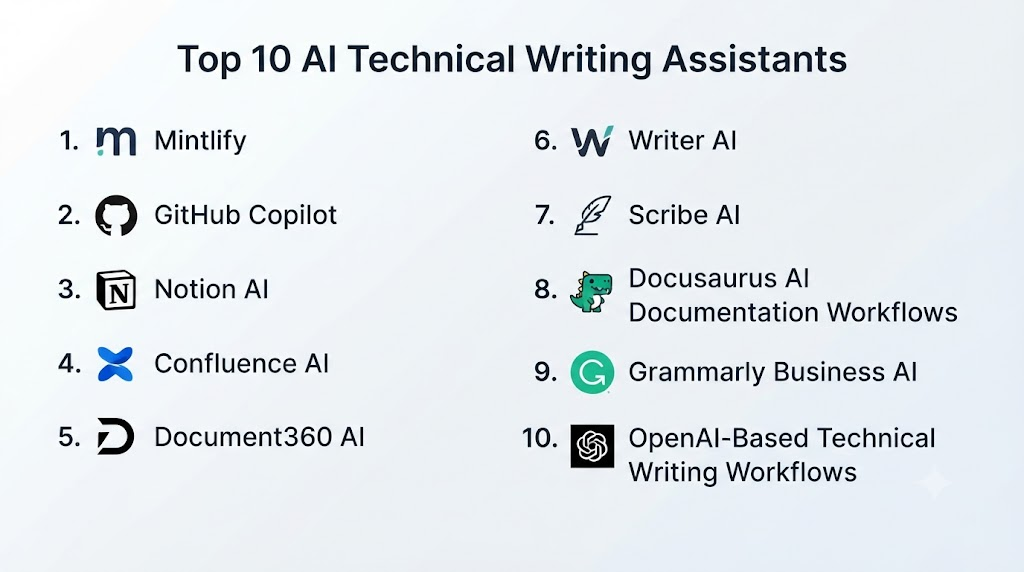
Top 10 AI Technical Writing Assistants
1- Mintlify
Verdict: AI-powered documentation platform designed for modern developer documentation.
Short Description: Mintlify helps engineering teams create developer documentation using AI-assisted writing, automation, and documentation management workflows.
Key Features:
- AI documentation generation
- Developer documentation
- Code-aware content creation
- Documentation hosting
- Content organization
Pros:
- Developer-focused experience
- Modern documentation workflow
Cons:
- Best suited for technical teams
- Requires documentation structure
Deployment: Cloud-based
Security & Compliance: Enterprise security options
Integrations & Ecosystem: Git workflows and developer tools
Support & Community: Developer community
Pricing Model: Subscription-based
Best-Fit Scenarios: Developer documentation teams
2- GitHub Copilot
Verdict: AI coding assistant supporting documentation creation from code and development workflows.
Short Description: GitHub Copilot helps developers generate documentation, explain code, create comments, and improve technical content.
Key Features:
- Code explanation
- Documentation generation
- Comment creation
- Repository understanding
- Developer workflow integration
Pros:
- Strong developer adoption
- Excellent code context
Cons:
- Not a dedicated writing platform
- Requires review for accuracy
Deployment: Cloud and IDE-based
Security & Compliance: Enterprise security controls
Integrations & Ecosystem: GitHub and developer tools
Support & Community: Large developer community
Pricing Model: Subscription-based
Best-Fit Scenarios: Developer teams
3- Notion AI
Verdict: Flexible AI writing assistant for technical documentation and knowledge management.
Short Description: Notion AI helps teams create technical documents, internal guides, meeting notes, and knowledge resources.
Key Features:
- AI writing assistance
- Document generation
- Knowledge management
- Content summarization
- Collaboration
Pros:
- Flexible documentation workflows
- Easy collaboration
Cons:
- Less developer-specific
- Requires manual organization
Deployment: Cloud-based
Security & Compliance: Enterprise security controls
Integrations & Ecosystem: Productivity tools
Support & Community: Large user community
Pricing Model: Subscription-based
Best-Fit Scenarios: Internal documentation teams
4- Confluence AI
Verdict: Enterprise documentation assistant for technical teams.
Short Description: Confluence AI helps organizations create, summarize, and manage technical documentation, knowledge articles, and engineering content.
Key Features:
- AI document creation
- Knowledge management
- Technical content improvement
- Collaboration tools
- Search assistance
Pros:
- Enterprise-ready platform
- Strong collaboration features
Cons:
- Best within Atlassian ecosystem
- Requires setup
Deployment: Cloud and enterprise
Security & Compliance: Enterprise security standards
Integrations & Ecosystem: Jira and Atlassian tools
Support & Community: Enterprise support
Pricing Model: Subscription-based
Best-Fit Scenarios: Enterprise documentation teams
5- Document360 AI
Verdict: AI-powered knowledge base and technical documentation platform.
Short Description: Document360 helps organizations create, organize, and maintain documentation portals with AI-assisted content management.
Key Features:
- Knowledge base creation
- AI content assistance
- Documentation management
- Search optimization
- Version control
Pros:
- Strong knowledge base features
- Good documentation organization
Cons:
- More knowledge-base focused
- Enterprise features require setup
Deployment: Cloud-based
Security & Compliance: Enterprise security options
Integrations & Ecosystem: Business applications and documentation tools
Support & Community: Customer support
Pricing Model: Subscription-based
Best-Fit Scenarios: Customer documentation teams
6- Writer AI
Verdict: Enterprise AI writing platform for technical and business documentation.
Short Description: Writer AI helps organizations create consistent technical content using AI writing assistance and governance controls.
Key Features:
- AI content generation
- Style consistency
- Documentation assistance
- Content review
- Enterprise controls
Pros:
- Strong governance features
- Good enterprise workflows
Cons:
- Less developer-specific
- Requires configuration
Deployment: Cloud-based
Security & Compliance: Enterprise security controls
Integrations & Ecosystem: Business platforms and workflows
Support & Community: Enterprise support
Pricing Model: Subscription-based
Best-Fit Scenarios: Large organizations
7- Scribe AI
Verdict: AI-powered documentation tool for creating process guides.
Short Description: Scribe AI helps teams automatically create step-by-step documentation by capturing workflows and generating instructions.
Key Features:
- Process documentation
- Workflow capture
- Step-by-step guides
- Documentation automation
- Sharing options
Pros:
- Saves documentation time
- Easy workflow creation
Cons:
- More process-focused
- Limited technical architecture documentation
Deployment: Cloud-based
Security & Compliance: Enterprise options available
Integrations & Ecosystem: Productivity platforms
Support & Community: User community
Pricing Model: Subscription-based
Best-Fit Scenarios: Process documentation teams
8- Docusaurus AI Documentation Workflows
Verdict: Developer documentation framework enhanced with AI capabilities.
Short Description: Docusaurus supports documentation websites while AI workflows help teams generate, organize, and maintain technical content.
Key Features:
- Documentation websites
- Markdown support
- Version management
- Developer workflows
- Custom AI integration
Pros:
- Highly customizable
- Popular among developers
Cons:
- Requires technical setup
- AI needs additional tools
Deployment: Self-hosted and cloud
Security & Compliance: Depends on implementation
Integrations & Ecosystem: Git repositories and developer tools
Support & Community: Open-source community
Pricing Model: Free and customization-based
Best-Fit Scenarios: Developer portals
9- Grammarly Business AI
Verdict: AI writing assistant for improving technical content quality.
Short Description: Grammarly Business AI helps teams improve clarity, grammar, tone, and consistency across technical documents.
Key Features:
- Writing improvement
- Content suggestions
- Style guidance
- Grammar assistance
- Team standards
Pros:
- Improves readability
- Easy adoption
Cons:
- Not technical documentation focused
- Limited code integration
Deployment: Cloud-based
Security & Compliance: Enterprise controls
Integrations & Ecosystem: Writing platforms and business tools
Support & Community: User community
Pricing Model: Subscription-based
Best-Fit Scenarios: Content improvement teams
10- OpenAI-Based Technical Writing Workflows
Verdict: Flexible AI approach for customized technical documentation automation.
Short Description: Large language model-based workflows help teams generate manuals, API documentation, engineering guides, and technical explanations.
Key Features:
- Documentation generation
- Technical explanations
- Content summarization
- Code documentation
- Custom workflows
Pros:
- Highly customizable
- Supports different documentation needs
Cons:
- Requires workflow design
- Needs technical validation
Deployment: API and custom environments
Security & Compliance: Depends on implementation
Integrations & Ecosystem: APIs, repositories, documentation platforms
Support & Community: Developer ecosystem
Pricing Model: Usage-based
Best-Fit Scenarios: Custom enterprise documentation
Comparison Table
| Platform | AI Writing | Code Understanding | Documentation Management | Collaboration | Best Use |
|---|---|---|---|---|---|
| Mintlify | Very High | High | High | High | Developer docs |
| GitHub Copilot | High | Very High | Medium | High | Code documentation |
| Notion AI | High | Medium | High | Excellent | Internal docs |
| Confluence AI | High | Medium | Very High | Excellent | Enterprise docs |
| Document360 AI | High | Medium | Very High | High | Knowledge bases |
| Writer AI | High | Medium | High | High | Enterprise content |
| Scribe AI | High | Low | High | High | Process guides |
| Docusaurus AI | Medium | High | High | Medium | Developer portals |
| Grammarly Business AI | Medium | Low | Medium | High | Writing quality |
| OpenAI Workflows | Very High | High | Custom | Custom | Automation |
Evaluation & Scoring Table
| Platform | Content Quality 25% | AI Capability 15% | Integrations 15% | Documentation 15% | Security 10% | Ease 10% | Value 10% | Total |
|---|---|---|---|---|---|---|---|---|
| Mintlify | 25 | 14 | 14 | 15 | 9 | 10 | 9 | 96 |
| GitHub Copilot | 24 | 15 | 15 | 12 | 9 | 10 | 9 | 94 |
| Notion AI | 23 | 14 | 13 | 15 | 9 | 10 | 10 | 94 |
| Confluence AI | 24 | 13 | 15 | 15 | 10 | 9 | 9 | 95 |
| Document360 AI | 23 | 13 | 13 | 15 | 9 | 9 | 9 | 91 |
| Writer AI | 23 | 14 | 13 | 13 | 10 | 9 | 9 | 91 |
| Scribe AI | 22 | 13 | 12 | 14 | 9 | 10 | 9 | 89 |
| Docusaurus AI | 21 | 12 | 13 | 14 | 8 | 8 | 10 | 86 |
| Grammarly Business AI | 21 | 12 | 12 | 12 | 9 | 10 | 9 | 85 |
| OpenAI Workflows | 25 | 15 | 12 | 15 | 8 | 8 | 9 | 92 |
Which AI Technical Writing Assistant Is Right for You?
- Developer Documentation: Mintlify, GitHub Copilot
- Enterprise Knowledge Management: Confluence AI, Document360 AI
- Internal Technical Documents: Notion AI
- Developer Portals: Docusaurus AI workflows
- Writing Quality Improvement: Grammarly Business AI
- Custom Documentation Automation: OpenAI-based workflows
Common Mistakes
- Publishing AI-generated documentation without review
- Ignoring technical accuracy
- Not maintaining documentation updates
- Using inconsistent writing standards
- Failing to connect documentation with engineering workflows
Frequently Asked Questions
What are AI technical writing assistants?
They are AI-powered tools that help create, improve, and maintain technical documentation.
Can AI generate developer documentation?
Yes. AI tools can create guides, explanations, and documentation drafts from technical information.
Can AI write API documentation?
Many AI tools can assist with API descriptions and developer documentation.
Do AI writing assistants understand code?
Some tools can analyze code and generate explanations or documentation.
Are AI-generated technical documents accurate?
They require expert review to ensure technical correctness.
Can enterprises use AI technical writing tools?
Yes. Many provide security and collaboration features for organizations.
Do these tools integrate with developer workflows?
Many integrate with repositories, documentation platforms, and collaboration tools.
Can AI maintain documentation automatically?
Some tools can assist with updates when connected to development workflows.
Do AI writing tools replace technical writers?
No. They help writers improve speed and maintain consistency.
Can startups benefit from AI documentation tools?
Yes. They help create documentation faster with limited resources.
Can AI simplify complex technical topics?
Yes. AI can rewrite technical information into easier explanations.
How should teams adopt AI writing assistants?
Start with documentation drafts, review quality, and gradually automate workflows.
Conclusion
AI Technical Writing Assistants are transforming documentation workflows by helping teams create clearer, faster, and more consistent technical content. Tools such as Mintlify, GitHub Copilot, Notion AI, and Confluence AI provide different approaches for developer documentation, enterprise knowledge management, and technical communication.
