Introduction
AI Release Notes & Changelog Generators use artificial intelligence to automatically create, summarize, and organize software updates, product changes, bug fixes, feature announcements, and technical improvements. These tools analyze commits, pull requests, tickets, deployments, and development activities to generate clear release communication for developers, customers, and internal teams.
Maintaining accurate release notes manually can be time-consuming, especially for teams releasing software frequently. AI-powered changelog tools help organizations improve transparency, reduce documentation effort, and ensure that important updates are communicated consistently. These solutions support engineering teams, product managers, developer advocates, and customer-facing teams by converting technical changes into understandable release information.
Real-world use cases:
- Generating release notes from Git commits and pull requests
- Creating customer-friendly product updates
- Automating changelog maintenance
- Summarizing sprint and release activities
- Improving developer communication
- Supporting SaaS product announcements
- Creating internal engineering reports
- Tracking software evolution over time
Evaluation Criteria for Buyers:
- Accuracy of AI-generated summaries
- Integration with Git platforms and issue trackers
- Customization options
- Support for technical and non-technical audiences
- Automation capabilities
- Collaboration features
- Security and enterprise controls
- Workflow integration
Best for
Software companies, SaaS teams, product managers, engineering teams, and organizations managing frequent releases.
Not ideal for
Teams with very limited release activity or organizations requiring completely manual documentation processes.
Key Trends
- AI-generated software documentation
- Automated changelog creation from development activity
- Integration with Git and project management platforms
- Customer-focused release communication
- AI summarization of technical changes
- Automated product update workflows
- Better developer-product collaboration
- Continuous delivery documentation automation
- Integration with CI/CD pipelines
- Personalized release communication
Methodology
- Selected tools based on AI release documentation capabilities
- Evaluated automation, integrations, customization, usability, and scalability
- Considered solutions for developers, product teams, and enterprises
- Prioritized tools supporting modern software delivery workflows
- Reviewed collaboration, security, and workflow compatibility
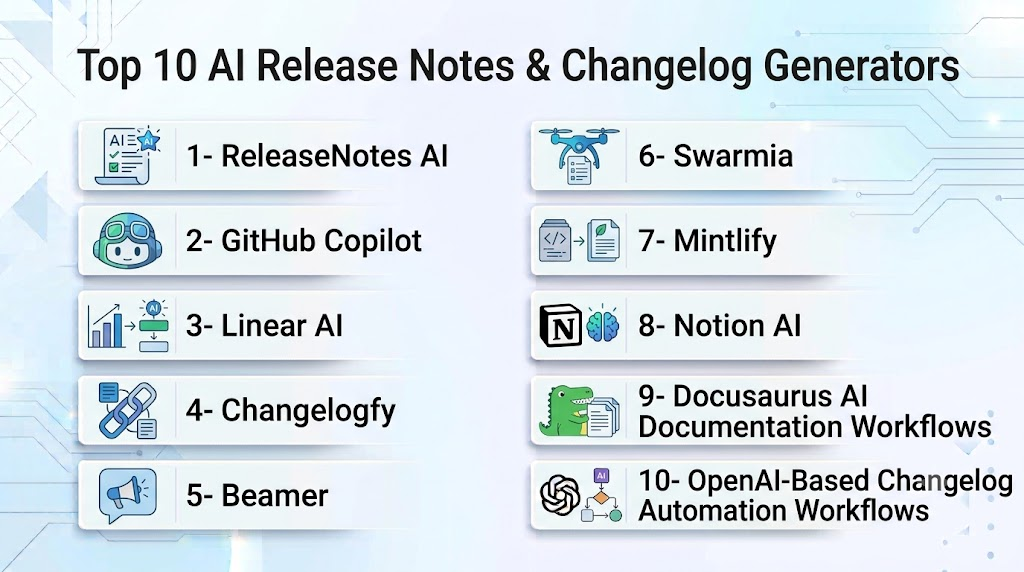
Top 10 AI Release Notes & Changelog Generators
1- ReleaseNotes AI
Verdict: AI-powered release communication assistant for software teams.
Short Description: ReleaseNotes AI helps teams automatically generate release summaries by analyzing development changes and converting technical updates into readable announcements.
Key Features:
- AI release summaries
- Change categorization
- Product update generation
- Automated documentation
- Release communication support
Pros:
- Reduces manual writing effort
- Improves release consistency
Cons:
- Requires accurate source data
- Complex releases may need editing
Deployment: Cloud-based
Security & Compliance: Platform security controls
Integrations & Ecosystem: Development workflows and repositories
Support & Community: Product support
Pricing Model: Subscription-based
Best-Fit Scenarios: SaaS product teams
2- GitHub Copilot
Verdict: AI coding assistant that can help generate release summaries from development activity.
Short Description: GitHub Copilot helps teams summarize commits, pull requests, and technical changes into structured release communication.
Key Features:
- Change summarization
- Pull request analysis
- Documentation assistance
- Developer workflow integration
- Code context understanding
Pros:
- Strong GitHub integration
- Familiar developer workflow
Cons:
- Not a dedicated changelog platform
- Requires review
Deployment: Cloud and IDE-based
Security & Compliance: Enterprise security controls
Integrations & Ecosystem: GitHub and development tools
Support & Community: Large developer community
Pricing Model: Subscription-based
Best-Fit Scenarios: Engineering teams
3- Linear AI
Verdict: AI-assisted product management and release communication platform.
Short Description: Linear AI helps teams summarize issues, projects, and completed work to support release updates and product communication.
Key Features:
- Issue summarization
- Project updates
- Release tracking
- Team collaboration
- Product workflows
Pros:
- Strong product workflow integration
- Good team collaboration
Cons:
- More project-focused
- Requires workflow adoption
Deployment: Cloud-based
Security & Compliance: Enterprise controls
Integrations & Ecosystem: Development and project tools
Support & Community: Product community
Pricing Model: Subscription-based
Best-Fit Scenarios: Product engineering teams
4- Changelogfy
Verdict: Customer-facing changelog and product update platform.
Short Description: Changelogfy helps companies create, manage, and publish product updates, announcements, and release communication.
Key Features:
- Public changelogs
- Product announcements
- User notifications
- Release organization
- Feedback collection
Pros:
- Good customer communication
- Easy publishing workflow
Cons:
- Limited developer automation
- Less focused on code analysis
Deployment: Cloud-based
Security & Compliance: Platform security options
Integrations & Ecosystem: Product platforms and websites
Support & Community: Customer support
Pricing Model: Subscription-based
Best-Fit Scenarios: SaaS companies
5- Beamer
Verdict: Product announcement and user communication platform.
Short Description: Beamer helps companies communicate new features, updates, and improvements through customer-facing release channels.
Key Features:
- Product announcements
- Release communication
- User targeting
- Feedback collection
- Notification management
Pros:
- Strong customer communication
- Easy adoption
Cons:
- Not focused on engineering changes
- Requires manual inputs
Deployment: Cloud-based
Security & Compliance: Enterprise options available
Integrations & Ecosystem: Product and marketing tools
Support & Community: Customer support
Pricing Model: Subscription-based
Best-Fit Scenarios: Customer-facing updates
6- Swarmia
Verdict: Engineering analytics platform with AI-assisted development insights.
Short Description: Swarmia helps engineering teams understand development activity and create visibility into software delivery progress.
Key Features:
- Engineering metrics
- Development insights
- Delivery tracking
- Team analytics
- Workflow reporting
Pros:
- Strong engineering visibility
- Useful for delivery reporting
Cons:
- Not primarily a changelog tool
- Requires engineering metrics setup
Deployment: Cloud-based
Security & Compliance: Enterprise security options
Integrations & Ecosystem: Git platforms and engineering tools
Support & Community: Engineering community
Pricing Model: Subscription-based
Best-Fit Scenarios: Engineering organizations
7- Mintlify
Verdict: AI documentation platform supporting release documentation workflows.
Short Description: Mintlify helps teams create technical documentation and developer updates using AI-assisted content generation.
Key Features:
- AI documentation
- Developer content generation
- Technical explanations
- Documentation hosting
- Content organization
Pros:
- Strong developer documentation
- Modern documentation experience
Cons:
- Not dedicated to changelogs
- Requires documentation workflows
Deployment: Cloud-based
Security & Compliance: Security options available
Integrations & Ecosystem: Git workflows and developer tools
Support & Community: Developer community
Pricing Model: Subscription-based
Best-Fit Scenarios: Developer platforms
8- Notion AI
Verdict: Flexible AI workspace for creating release notes and product documentation.
Short Description: Notion AI helps teams summarize project updates, organize release information, and create structured changelog content.
Key Features:
- AI writing assistance
- Document summarization
- Team collaboration
- Knowledge management
- Templates
Pros:
- Flexible documentation workflows
- Easy collaboration
Cons:
- Requires manual organization
- Not engineering-specific
Deployment: Cloud-based
Security & Compliance: Enterprise security controls
Integrations & Ecosystem: Productivity tools
Support & Community: Large user community
Pricing Model: Subscription-based
Best-Fit Scenarios: Internal documentation teams
9- Docusaurus AI Documentation Workflows
Verdict: Developer documentation framework enhanced with AI workflows.
Short Description: Docusaurus enables teams to build documentation websites while AI tools assist with generating and maintaining release documentation.
Key Features:
- Documentation websites
- Version management
- Markdown support
- Developer workflows
- Custom AI integration
Pros:
- Flexible and customizable
- Strong developer adoption
Cons:
- Requires technical setup
- AI requires additional tools
Deployment: Self-hosted and cloud
Security & Compliance: Depends on implementation
Integrations & Ecosystem: Git repositories and developer tools
Support & Community: Open-source community
Pricing Model: Free and customization-based
Best-Fit Scenarios: Developer documentation teams
10- OpenAI-Based Changelog Automation Workflows
Verdict: Custom AI approach for automated release documentation.
Short Description: Large language model-based workflows help teams analyze commits, tickets, pull requests, and deployments to generate customized release notes.
Key Features:
- Commit analysis
- Release summaries
- Change categorization
- Custom templates
- Automation workflows
Pros:
- Highly flexible
- Supports custom processes
Cons:
- Requires implementation effort
- Needs review process
Deployment: API and custom environments
Security & Compliance: Depends on implementation
Integrations & Ecosystem: Git, project management, CI/CD tools
Support & Community: Developer ecosystem
Pricing Model: Usage-based
Best-Fit Scenarios: Enterprise automation
Comparison Table
| Platform | AI Summarization | Git Integration | Customer Updates | Automation | Best Use |
|---|---|---|---|---|---|
| ReleaseNotes AI | Very High | High | High | High | Automated releases |
| GitHub Copilot | High | Very High | Medium | Medium | Engineering teams |
| Linear AI | High | High | Medium | High | Product teams |
| Changelogfy | Medium | Medium | Very High | Medium | SaaS updates |
| Beamer | Medium | Medium | Very High | Medium | Customer communication |
| Swarmia | Medium | High | Low | Medium | Engineering insights |
| Mintlify | High | High | Medium | Medium | Developer documentation |
| Notion AI | High | Medium | Medium | Medium | Internal documentation |
| Docusaurus | Medium | High | Medium | Medium | Developer portals |
| OpenAI Workflows | Very High | High | High | Very High | Custom automation |
Evaluation & Scoring Table
| Platform | AI Quality 25% | Integrations 15% | Automation 15% | Customization 15% | Security 10% | Ease 10% | Value 10% | Total |
|---|---|---|---|---|---|---|---|---|
| ReleaseNotes AI | 25 | 14 | 15 | 14 | 9 | 10 | 9 | 96 |
| GitHub Copilot | 23 | 15 | 12 | 13 | 9 | 10 | 9 | 91 |
| Linear AI | 23 | 14 | 14 | 13 | 9 | 10 | 9 | 92 |
| Changelogfy | 21 | 12 | 12 | 14 | 9 | 10 | 9 | 87 |
| Beamer | 20 | 12 | 11 | 13 | 9 | 10 | 9 | 84 |
| Swarmia | 21 | 14 | 12 | 12 | 9 | 9 | 8 | 85 |
| Mintlify | 22 | 14 | 12 | 13 | 9 | 9 | 9 | 88 |
| Notion AI | 22 | 11 | 11 | 15 | 9 | 10 | 10 | 88 |
| Docusaurus | 20 | 13 | 11 | 15 | 8 | 8 | 10 | 85 |
| OpenAI Workflows | 25 | 13 | 15 | 15 | 8 | 8 | 9 | 93 |
Which AI Release Notes & Changelog Generator Is Right for You?
- Automated Engineering Releases: ReleaseNotes AI, GitHub Copilot
- Product Teams: Linear AI, Notion AI
- Customer-Facing Updates: Changelogfy, Beamer
- Developer Documentation: Mintlify, Docusaurus
- Enterprise Automation: OpenAI-based workflows
- Engineering Analytics: Swarmia
Common Mistakes
- Publishing AI-generated notes without review
- Ignoring customer communication needs
- Missing important technical changes
- Not defining release formats
- Failing to connect development data sources
Frequently Asked Questions
What are AI release notes generators?
They are AI tools that automatically create software release summaries from development activities.
How do AI changelog generators work?
They analyze commits, pull requests, tickets, and updates to create structured release information.
Can AI generate customer-friendly release notes?
Yes. Many tools can transform technical changes into simpler product announcements.
Do AI release tools integrate with Git platforms?
Many support Git repositories and development workflows.
Can these tools summarize pull requests?
Yes. AI can analyze pull requests and convert them into release summaries.
Are AI-generated release notes accurate?
They improve efficiency but should be reviewed before publishing.
Can startups use AI changelog tools?
Yes. They help small teams maintain consistent product updates.
Do enterprises use AI release documentation tools?
Yes. They help manage frequent software releases at scale.
Can AI create internal engineering reports?
Yes. Many tools can summarize development progress and changes.
Do AI changelog generators replace product managers?
No. They assist teams by reducing manual documentation work.
Can release notes be automated in CI/CD pipelines?
Some tools support automated workflows connected to development processes.
How should teams adopt AI release note tools?
Start with small releases, validate output, and gradually automate documentation.
Conclusion
AI Release Notes & Changelog Generators are helping software teams communicate updates faster by transforming development activity into structured release information. Tools such as ReleaseNotes AI, GitHub Copilot, Linear AI, and OpenAI-based workflows provide different approaches for engineering teams, product managers, and SaaS organizations.
