Introduction
Hospital Bed Management Systems (HBMS) are software platforms designed to optimize the allocation, utilization, and monitoring of hospital beds. In plain English, these tools help hospitals track bed occupancy, manage patient admissions and discharges, and ensure efficient utilization of resources. They also provide real-time visibility into bed availability and support operational planning.
In, hospital bed management has become critical due to rising patient volumes, increased complexity in hospital operations, and a growing need for data-driven decision-making. Real-world use cases include:
- Real-Time Bed Tracking: Monitoring bed availability across multiple wards or hospitals.
- Admission & Discharge Planning: Coordinating patient flow to reduce waiting times.
- Resource Optimization: Managing ICU, isolation, and general beds efficiently.
- Predictive Analytics: Forecasting patient admissions for operational planning.
- Integration with EHR Systems: Synchronizing patient information with bed allocation.
Buyers should evaluate:
- Real-time bed availability monitoring
- Integration with hospital information systems (HIS) and EHR
- ICU and specialty bed management
- Admission and discharge workflow automation
- Alerts and notifications for bed turnover
- Analytics and reporting
- Mobile access and dashboards
- Multi-facility or multi-site support
- Security and role-based access
- Scalability and deployment options
Best for: Hospitals, multi-site healthcare networks, and healthcare administrators.
Not ideal for: Small clinics or facilities with limited bed management needs.
Key Trends in Hospital Bed Management Systems
- AI-Powered Bed Allocation: Predictive models to optimize patient placement.
- Integration with EHR and HIS: Seamless data flow across clinical and administrative systems.
- Cloud-Based Platforms: Enabling multi-site visibility and remote management.
- IoT Sensor Integration: Real-time bed occupancy monitoring using sensors.
- Predictive Patient Flow Analytics: Forecasting admissions and discharges.
- Mobile Access & Dashboards: Operational staff can monitor bed status anywhere.
- Automated Alerts: Notifications for bed availability, cleaning, and turnover.
- Regulatory Compliance & Reporting: Supports audit trails and reporting standards.
- Scalable Multi-Facility Management: Centralized management for hospital networks.
- Flexible SaaS Pricing Models: Subscription or enterprise licensing options.
How We Selected These Tools (Methodology)
- Evaluated market adoption and mindshare in hospital networks and healthcare IT.
- Assessed feature completeness, including real-time tracking, analytics, and alerts.
- Reviewed performance and reliability signals, focusing on uptime and responsiveness.
- Analyzed security posture, including encryption, access control, and audit capabilities.
- Considered integration ecosystem with EHR, HIS, and patient flow systems.
- Measured fit across hospital sizes, from small clinics to large multi-facility networks.
- Reviewed AI, automation, and predictive analytics features.
- Assessed support, onboarding, and professional community resources.
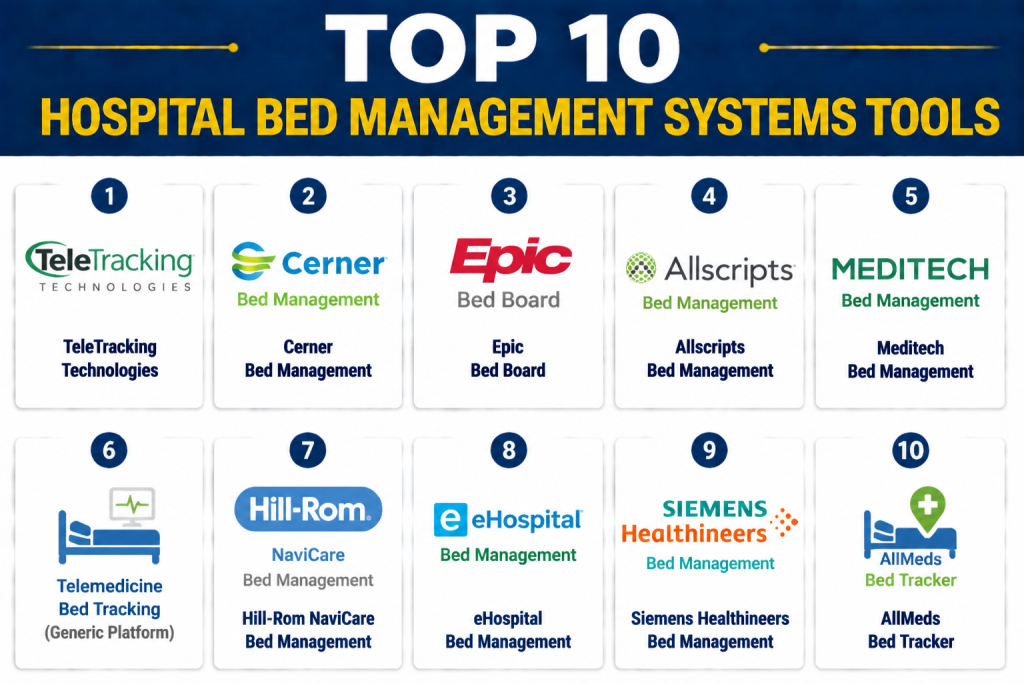
Top 10 Hospital Bed Management Systems Tools
1- TeleTracking Technologies
Short description: TeleTracking provides enterprise-level hospital bed management solutions, enabling real-time patient flow, predictive analytics, and operational efficiency across multi-site hospitals.
Key Features
- Real-time bed occupancy dashboards
- Patient admission and discharge coordination
- ICU and specialty bed tracking
- Predictive analytics for bed demand
- Integration with EHR and HIS
- Mobile dashboards for staff
Pros
- Enterprise-scale solution with robust analytics
- Supports multi-site hospital networks
Cons
- Enterprise-focused pricing
- Implementation may require professional services
Platforms / Deployment
- Web / iOS / Android
- Cloud
Security & Compliance
- Not publicly stated
Integrations & Ecosystem
- EHR/HIS integration
- API for operational dashboards
- Predictive analytics modules
Support & Community
- Vendor support and documentation
- Onboarding services
- Moderate user community
2- Cerner Bed Management
Short description: Cerner provides hospital bed management integrated within its broader healthcare IT suite, enabling coordinated patient flow and resource allocation.
Key Features
- Real-time bed availability monitoring
- Admission and discharge workflow automation
- ICU and specialty bed management
- Analytics dashboards for hospital administrators
- EHR integration
Pros
- Seamless integration with Cerner EHR
- Scalable for large hospital networks
Cons
- Enterprise-focused solution
- Training required for staff
Platforms / Deployment
- Web / iOS / Android
- Cloud
Security & Compliance
- Not publicly stated
Integrations & Ecosystem
- Cerner EHR and HIS
- API access for dashboards
- Analytics and reporting tools
Support & Community
- Vendor documentation
- Training and onboarding
- Large enterprise community
3- Epic Bed Board
Short description: Epic Bed Board is part of the Epic EHR suite, providing hospitals with real-time bed tracking, patient flow analytics, and predictive resource management.
Key Features
- Bed occupancy dashboards
- Admission and discharge tracking
- Predictive patient flow analytics
- Integration with Epic EHR
- Alerts and notifications
Pros
- Tight integration with Epic ecosystem
- Predictive analytics for operational planning
Cons
- Requires Epic EHR implementation
- Higher cost for smaller facilities
Platforms / Deployment
- Web / iOS / Android
- Cloud
Security & Compliance
- Not publicly stated
Integrations & Ecosystem
- Epic EHR
- HIS integration
- Operational dashboards
Support & Community
- Epic vendor support
- Documentation and training
- Large Epic user community
4- Allscripts Bed Management
Short description: Allscripts provides hospital bed management modules integrated with its EHR, enabling hospitals to optimize patient flow, reduce wait times, and manage ICU resources effectively.
Key Features
- Real-time bed tracking
- Admission and discharge management
- ICU and specialty bed coordination
- Predictive analytics for capacity planning
- Integration with Allscripts EHR
Pros
- Strong integration with Allscripts EHR
- Scalable for mid-size to large hospitals
Cons
- Enterprise pricing model
- Complex setup
Platforms / Deployment
- Web / iOS / Android
- Cloud
Security & Compliance
- Not publicly stated
Integrations & Ecosystem
- Allscripts EHR
- API support for analytics
- Predictive dashboards
Support & Community
- Vendor support and documentation
- Training services
- Moderate user community
5- Meditech Bed Management
Short description: Meditech offers real-time hospital bed tracking integrated with EHR, enabling operational efficiency, predictive patient flow, and multi-department visibility.
Key Features
- Real-time occupancy dashboards
- Patient admission/discharge workflow
- ICU and specialty bed monitoring
- Predictive bed demand analytics
- Integration with Meditech EHR
Pros
- Seamless EHR integration
- Provides multi-department visibility
Cons
- Limited mobile features
- Enterprise-focused pricing
Platforms / Deployment
- Web / iOS / Android
- Cloud
Security & Compliance
- Not publicly stated
Integrations & Ecosystem
- Meditech EHR
- Analytics dashboards
- API support
Support & Community
- Vendor documentation
- Training and onboarding
- Moderate community
6- Telemedicine Bed Tracking (Generic Platform)
Short description: A cloud-based hospital bed management solution designed for smaller hospitals and telemedicine-enabled facilities, focusing on real-time occupancy and patient flow optimization.
Key Features
- Real-time bed occupancy
- Admission and discharge coordination
- Alerts for bed availability
- Multi-ward and unit tracking
- Mobile dashboards
Pros
- Cost-effective for SMB hospitals
- Easy to deploy and use
Cons
- Limited analytics features
- Fewer integrations with EHR
Platforms / Deployment
- Web / iOS / Android
- Cloud
Security & Compliance
- Not publicly stated
Integrations & Ecosystem
- Basic EHR integration
- API for alerts
- Mobile dashboards
Support & Community
- Documentation
- Vendor support
- Small user community
7- Hill-Rom NaviCare Bed Management
Short description: Hill-Rom NaviCare provides real-time bed and patient flow management, focusing on ICU and specialty care units for mid to large hospitals.
Key Features
- Bed occupancy dashboards
- ICU and specialty bed tracking
- Alerts for patient discharge/transfer
- Analytics for capacity planning
- Integration with HIS and EHR
Pros
- Optimized for critical care management
- Predictive analytics for bed demand
Cons
- Enterprise pricing
- Setup may require professional services
Platforms / Deployment
- Web / iOS / Android
- Cloud
Security & Compliance
- Not publicly stated
Integrations & Ecosystem
- EHR/HIS integration
- API connectivity
- Predictive dashboards
Support & Community
- Vendor support
- Documentation and training
- Moderate user community
8- eHospital Bed Management
Short description: eHospital offers hospital bed management modules integrated with patient management and EHR systems, providing real-time occupancy and operational dashboards.
Key Features
- Bed occupancy monitoring
- Patient admission/discharge workflow
- ICU and general ward tracking
- Alerts for bed availability
- Integration with EHR
Pros
- Suitable for mid-size hospitals
- Real-time operational visibility
Cons
- Less predictive analytics
- Limited multi-site features
Platforms / Deployment
- Web / iOS / Android
- Cloud
Security & Compliance
- Not publicly stated
Integrations & Ecosystem
- EHR integration
- Analytics dashboards
- API support
Support & Community
- Documentation
- Vendor support
- Small community
9- Siemens Healthineers Bed Management
Short description: Siemens Healthineers provides hospital bed management solutions integrated with clinical and operational systems to optimize patient flow in large healthcare facilities.
Key Features
- Bed occupancy tracking
- ICU and specialty unit monitoring
- Patient admission/discharge coordination
- Predictive analytics for bed demand
- Integration with HIS and EHR
Pros
- Enterprise-grade analytics
- Optimized for multi-site hospitals
Cons
- High enterprise pricing
- Complex implementation
Platforms / Deployment
- Web / iOS / Android
- Cloud / Hybrid
Security & Compliance
- Not publicly stated
Integrations & Ecosystem
- EHR and HIS integration
- API connectivity
- Predictive dashboards
Support & Community
- Vendor documentation
- Training and professional support
- Large enterprise user base
10- AllMeds Bed Tracker
Short description: AllMeds offers an easy-to-deploy hospital bed management system for small to mid-size hospitals, focusing on real-time bed availability and patient flow optimization.
Key Features
- Real-time bed occupancy
- Admission/discharge tracking
- Alerts for bed readiness
- Multi-ward tracking
- Mobile dashboards
Pros
- Affordable and simple
- Rapid deployment for SMB hospitals
Cons
- Limited advanced analytics
- Fewer integrations with HIS/EHR
Platforms / Deployment
- Web / iOS / Android
- Cloud
Security & Compliance
- Not publicly stated
Integrations & Ecosystem
- Basic HIS/EHR integration
- Mobile dashboards
- API for alerts
Support & Community
- Documentation
- Vendor support
- Small professional community
Comparison Table (Top 10)
| Tool Name | Best For | Platform(s) Supported | Deployment | Standout Feature | Public Rating |
|---|---|---|---|---|---|
| TeleTracking Technologies | Enterprise hospitals | Web/iOS/Android | Cloud | Predictive analytics | N/A |
| Cerner Bed Management | Large hospital networks | Web/iOS/Android | Cloud | Seamless EHR integration | N/A |
| Epic Bed Board | Hospitals using Epic | Web/iOS/Android | Cloud | Real-time occupancy dashboards | N/A |
| Allscripts Bed Management | Mid-size hospitals | Web/iOS/Android | Cloud | Workflow automation | N/A |
| Meditech Bed Management | Multi-department hospitals | Web/iOS/Android | Cloud | Multi-department visibility | N/A |
| Telemedicine Bed Tracking | SMB hospitals | Web/iOS/Android | Cloud | Cost-effective deployment | N/A |
| Hill-Rom NaviCare | Critical care units | Web/iOS/Android | Cloud | ICU optimized management | N/A |
| eHospital Bed Management | Mid-size hospitals | Web/iOS/Android | Cloud | Operational dashboards | N/A |
| Siemens Healthineers Bed Mgmt | Large hospitals & networks | Web/iOS/Android | Cloud/Hybrid | Predictive analytics | N/A |
| AllMeds Bed Tracker | Small to mid-size hospitals | Web/iOS/Android | Cloud | Rapid deployment | N/A |
Evaluation & Scoring
| Tool Name | Core (25%) | Ease (15%) | Integrations (15%) | Security (10%) | Performance (10%) | Support (10%) | Value (15%) | Weighted Total |
|---|---|---|---|---|---|---|---|---|
| TeleTracking Technologies | 9 | 7 | 8 | 7 | 8 | 7 | 7 | 7.9 |
| Cerner Bed Management | 9 | 6 | 8 | 7 | 8 | 7 | 6 | 7.7 |
| Epic Bed Board | 8 | 7 | 7 | 7 | 8 | 7 | 6 | 7.2 |
| Allscripts Bed Management | 8 | 7 | 7 | 6 | 7 | 6 | 7 | 6.9 |
| Meditech Bed Management | 8 | 7 | 7 | 6 | 7 | 6 | 7 | 6.9 |
| Telemedicine Bed Tracking | 7 | 8 | 6 | 6 | 7 | 6 | 7 | 6.8 |
| Hill-Rom NaviCare | 9 | 7 | 8 | 7 | 8 | 7 | 6 | 7.7 |
| eHospital Bed Management | 7 | 8 | 6 | 6 | 7 | 6 | 7 | 6.9 |
| Siemens Healthineers Bed Mgmt | 9 | 7 | 8 | 7 | 8 | 7 | 6 | 7.7 |
| AllMeds Bed Tracker | 7 | 8 | 6 | 6 | 7 | 6 | 7 | 6.9 |
Interpretation: Higher weighted totals indicate stronger alignment with 2026+ hospital bed management requirements, including predictive analytics, multi-site monitoring, and integration with HIS/EHR systems. Scores are comparative across all tools.
Which Hospital Bed Management Tool Is Right for You?
Solo / Freelancer
Small clinics may leverage AllMeds Bed Tracker or Telemedicine Bed Tracking for easy deployment and simple bed management.
SMB
Mid-size hospitals benefit from eHospital Bed Management or Allscripts Bed Management for operational dashboards and workflow automation.
Mid-Market
Multi-department hospitals should consider Meditech Bed Management or Epic Bed Board for real-time occupancy, analytics, and predictive bed allocation.
Enterprise
Large hospital networks require TeleTracking Technologies, Cerner Bed Management, or Siemens Healthineers Bed Management for predictive analytics, multi-site monitoring, and integration with clinical systems.
Budget vs Premium
Budget-conscious hospitals may use AllMeds or Telemedicine Bed Tracking, while premium enterprise features like predictive analytics are offered by TeleTracking, Siemens, or Epic.
Feature Depth vs Ease of Use
Enterprise platforms provide deep features and predictive insights; SMB platforms focus on usability and rapid deployment.
Integrations & Scalability
Large hospitals require integration with HIS, EHR, and analytics systems, which is supported by TeleTracking, Epic, and Cerner.
Security & Compliance Needs
Hospitals handling sensitive patient data must ensure secure access, audit trails, and compliance with HIPAA and regional regulations.
Frequently Asked Questions (FAQs)
1- What pricing models are available?
Most platforms offer SaaS subscriptions, enterprise licensing, or per-bed pricing. Volume-based options may apply for large networks.
2- How long does implementation take?
SMB hospitals can deploy in a few weeks; enterprise-scale, multi-site deployments may take several months.
3- Can these tools integrate with HIS/EHR systems?
Yes, top platforms provide APIs or native integration to maintain real-time patient and bed data synchronization.
4- Are AI and predictive analytics included?
Many platforms include predictive bed allocation and patient flow analytics to optimize hospital operations.
5- Can multi-hospital networks monitor beds centrally?
Yes, cloud-based dashboards enable centralized monitoring across multiple sites or departments.
6- Are mobile apps available?
Yes, nearly all platforms provide mobile access for real-time monitoring and alerts.
7- How secure are these tools?
Enterprise-grade encryption, role-based access, and audit logging are common; certifications may be “Not publicly stated.”
8- Can SMB hospitals benefit?
Yes, solutions like AllMeds Bed Tracker or Telemedicine Bed Tracking provide cost-effective, simple deployment.
9- How do these platforms reduce patient wait times?
Real-time occupancy, predictive analytics, and automated notifications streamline bed turnover and patient placement.
10- Is predictive analytics effective for ICU beds?
Yes, enterprise tools like TeleTracking and Hill-Rom NaviCare provide ICU bed forecasting and allocation recommendations.
Conclusion
Hospital Bed Management Systems are essential for improving patient flow, optimizing resource utilization, and ensuring operational efficiency. SMB hospitals may leverage AllMeds Bed Tracker or Telemedicine Bed Tracking for simple bed management, mid-market hospitals benefit from eHospital or Meditech, and enterprise networks require TeleTracking, Epic, or Siemens for predictive analytics, multi-site dashboards, and integration with HIS/EHR systems. Start by shortlisting , run a pilot to validate bed monitoring, alerts, and integration workflows, then scale operations strategically.
