Introduction
HPC Job Schedulers are software platforms that manage and allocate computational tasks across high-performance computing clusters. These tools optimize workload distribution, maximize hardware utilization, and ensure that critical scientific, engineering, or research computations run efficiently.
High-performance computing is used across industries where large-scale simulations, data analysis, and AI workloads demand robust scheduling capabilities. HPC Job Schedulers provide automation, queue management, resource allocation, and priority handling for complex workloads.
Real-world use cases include:
- Running climate modeling simulations across supercomputers
- Genomic sequencing and bioinformatics data processing
- AI and ML model training on multi-node GPU clusters
- Financial risk modeling and analytics
- Engineering simulations for aerospace or automotive industries
Evaluation criteria for buyers include:
- Scheduling policies and fairness controls
- Resource allocation and utilization optimization
- Support for heterogeneous hardware (CPU, GPU, FPGA)
- Ease of configuration and deployment
- Automation and workflow integration
- Monitoring and reporting capabilities
- Security, authentication, and RBAC support
- Cloud and on-premises deployment flexibility
- Scalability across clusters and nodes
- Vendor support and community resources
Best for: HPC administrators, research institutions, large enterprises, and AI/ML teams with high computational workloads.
Not ideal for: Small-scale computation needs, basic server management, or workloads that do not require parallel processing.
Key Trends in HPC Job Schedulers
- Integration with AI/ML workflow orchestration tools
- Hybrid cloud and on-premises scheduling support
- GPU and accelerator-aware scheduling
- Automated workflow pipelines and batch job automation
- Real-time monitoring dashboards and analytics
- Enhanced security with SSO, MFA, and RBAC
- Support for containerized workloads (Docker, Singularity)
- Multi-cluster management and resource federation
- Predictive scheduling using historical workload data
- Flexible licensing and subscription models
How We Selected These Tools
- Evaluated market adoption and institutional usage
- Reviewed feature completeness including GPU/accelerator support
- Assessed reliability and uptime performance signals
- Verified security capabilities including encryption and access control
- Considered integrations with container platforms and AI/ML workflows
- Reviewed scalability for clusters ranging from small to large nodes
- Analyzed vendor support, documentation, and community engagement
- Evaluated adaptability to cloud, on-premises, and hybrid deployments
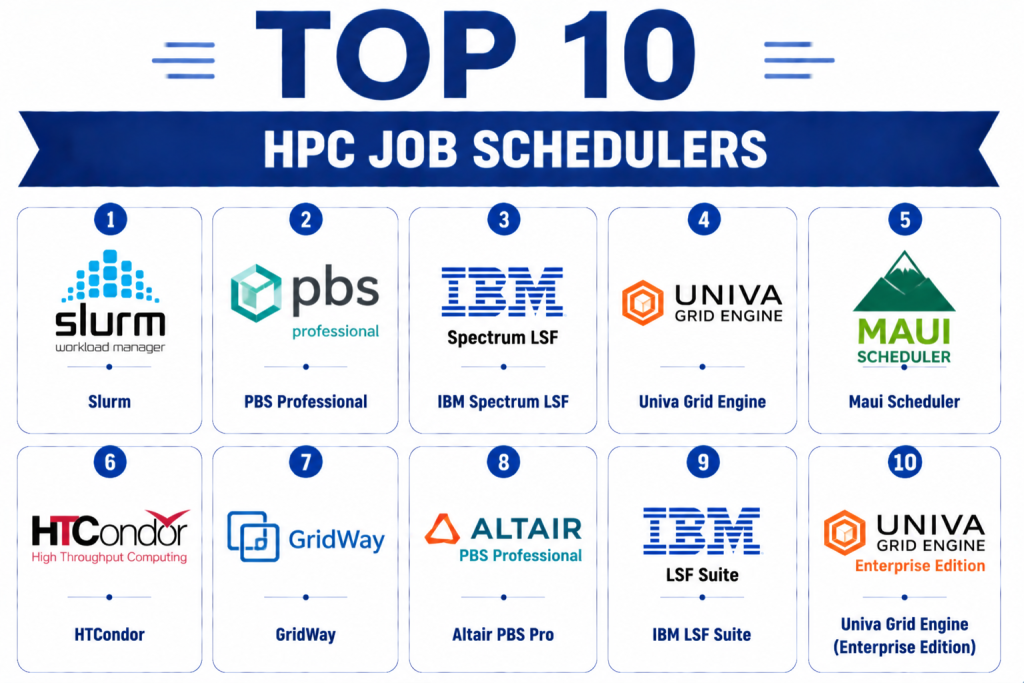
Top 10 HPC Job Schedulers
1- Slurm
Short description: Slurm is an open-source, highly scalable HPC workload manager widely used for cluster job scheduling in research and enterprise environments.
Key Features
- Scalable to large supercomputing clusters
- Advanced job queuing and prioritization
- Resource allocation across CPU and GPU nodes
- Job monitoring and reporting
- Support for heterogeneous workloads
Pros
- Open-source and cost-effective
- High scalability and flexibility
Cons
- Requires configuration expertise
- Community support may require additional resources
Platforms / Deployment
- Linux / macOS
- On-premises / Hybrid
Security & Compliance
- User authentication and role-based access control
- Not publicly stated
Integrations & Ecosystem
- Supports Docker and Singularity containers
- APIs for workflow automation
- Monitoring integrations with Grafana and Prometheus
Support & Community
- Active open-source community
- Extensive documentation and tutorials
2- PBS Professional
Short description: PBS Professional is a commercial HPC job scheduler that provides high reliability, advanced scheduling, and support for large-scale clusters.
Key Features
- Advanced workload prioritization and policies
- Resource management for heterogeneous clusters
- Cloud and on-premises job scheduling
- Reporting and analytics dashboards
- Workflow automation
Pros
- Enterprise-grade support
- Robust monitoring and reporting
Cons
- Licensing costs
- Complexity for smaller clusters
Platforms / Deployment
- Linux / Windows
- On-premises / Cloud / Hybrid
Security & Compliance
- Authentication, SSO, and RBAC
- Not publicly stated
Integrations & Ecosystem
- APIs for integration with orchestration tools
- Support for containerized workflows
- Logging and monitoring integrations
Support & Community
- Professional support tiers
- Documentation and user forums
3- IBM Spectrum LSF
Short description: IBM Spectrum LSF is an enterprise HPC scheduler designed to optimize cluster performance and automate high-volume workloads efficiently.
Key Features
- Multi-cluster workload management
- GPU and accelerator scheduling
- Job queuing and prioritization
- Real-time monitoring and analytics
- Workflow integration with AI/ML pipelines
Pros
- Enterprise support and SLAs
- High scalability for large HPC environments
Cons
- Proprietary licensing
- Steeper learning curve for new users
Platforms / Deployment
- Linux / Windows
- Cloud / On-premises / Hybrid
Security & Compliance
- RBAC, SSO, audit logging
- SOC 2 / ISO 27001
Integrations & Ecosystem
- APIs for workflow and automation
- Cloud integrations and monitoring tools
- Supports containerized workloads
Support & Community
- IBM enterprise support
- Extensive knowledge base
4- Univa Grid Engine
Short description: Univa Grid Engine is a scalable HPC scheduler for compute clusters that emphasizes high performance and efficient resource utilization.
Key Features
- Job queuing and priority scheduling
- Resource-aware scheduling across heterogeneous nodes
- Cloud bursting support
- Container and virtualized environment support
- Monitoring and reporting dashboards
Pros
- Efficient resource utilization
- Supports large, complex clusters
Cons
- Licensing costs for enterprise version
- Setup may be complex
Platforms / Deployment
- Linux / Windows
- On-premises / Cloud / Hybrid
Security & Compliance
- Authentication, RBAC
- Not publicly stated
Integrations & Ecosystem
- Integration with container platforms
- APIs for automated scheduling
- Monitoring and logging integrations
Support & Community
- Vendor support for enterprise
- Documentation and forums
5- Maui Scheduler
Short description: Maui Scheduler is a powerful HPC job scheduler for optimizing resource allocation and workload prioritization on clusters.
Key Features
- Advanced scheduling policies
- Backfill and reservation support
- Job monitoring and reporting
- Integration with popular resource managers
- Multi-cluster management
Pros
- Flexible and configurable
- Efficient resource optimization
Cons
- Requires integration with resource manager
- Steep learning curve
Platforms / Deployment
- Linux
- On-premises / Hybrid
Security & Compliance
- Not publicly stated
Integrations & Ecosystem
- Works with Slurm, Grid Engine, PBS
- APIs for workflow automation
- Logging integration
Support & Community
- Community support
- Documentation available
6- HTCondor
Short description: HTCondor is an open-source HPC scheduler designed for high-throughput computing, suitable for research and distributed clusters.
Key Features
- High-throughput scheduling
- Job queuing and prioritization
- Resource monitoring
- Integration with grid and cloud resources
- Job checkpointing and recovery
Pros
- Open-source and free
- Supports heterogeneous clusters
Cons
- Not ideal for ultra-low-latency workloads
- Requires configuration knowledge
Platforms / Deployment
- Linux / macOS
- On-premises / Cloud
Security & Compliance
- User authentication, RBAC
- Not publicly stated
Integrations & Ecosystem
- Cloud integration
- APIs for workflow and automation
- Monitoring with third-party tools
Support & Community
- Open-source community
- Extensive documentation
7- GridWay
Short description: GridWay is an open-source meta-scheduler for grid and HPC environments, focusing on multi-cluster workload distribution.
Key Features
- Job migration across clusters
- Resource-aware scheduling
- Fault-tolerant job execution
- Monitoring and reporting
- Integration with Grid Engine and PBS
Pros
- Efficient for multi-cluster environments
- Open-source and free
Cons
- Requires setup with underlying schedulers
- Limited commercial support
Platforms / Deployment
- Linux
- On-premises / Cloud
Security & Compliance
- Not publicly stated
Integrations & Ecosystem
- APIs for integration
- Supports various HPC backends
- Logging and monitoring support
Support & Community
- Community forums
- Documentation available
8- Altair PBS Pro
Short description: Altair PBS Pro is a commercial HPC job scheduler offering advanced workload management, scalability, and cloud bursting capabilities.
Key Features
- Job queuing and scheduling policies
- Resource allocation for CPUs and GPUs
- Cloud and hybrid deployment
- Monitoring dashboards
- Workflow automation
Pros
- Enterprise support and reliability
- High scalability
Cons
- Commercial licensing
- Complexity for smaller clusters
Platforms / Deployment
- Linux / Windows
- Cloud / On-premises / Hybrid
Security & Compliance
- RBAC and authentication
- Not publicly stated
Integrations & Ecosystem
- Cloud integration
- Container and workflow support
- APIs for automation
Support & Community
- Vendor enterprise support
- Knowledge base
9- IBM LSF Suite
Short description: LSF Suite provides HPC job scheduling with advanced features for resource management, analytics, and workflow integration.
Key Features
- Multi-cluster workload management
- GPU/accelerator scheduling
- Real-time monitoring
- Workflow and pipeline integration
- Reporting and analytics
Pros
- Enterprise-grade support
- Scalable for large HPC deployments
Cons
- Enterprise licensing required
- Steeper learning curve
Platforms / Deployment
- Linux / Windows
- Cloud / On-premises / Hybrid
Security & Compliance
- Encryption, RBAC, audit logs
- SOC 2 / ISO 27001
Integrations & Ecosystem
- Container and cloud integration
- APIs for automation
- Workflow orchestration
Support & Community
- IBM enterprise support
- Documentation and forums
10- Univa Grid Engine (Enterprise Edition)
Short description: Enterprise-grade Grid Engine providing advanced scheduling, workload optimization, and multi-cluster support for HPC environments.
Key Features
- Job scheduling and prioritization
- Multi-cluster workload management
- Cloud and hybrid support
- Reporting and monitoring dashboards
- Resource optimization
Pros
- Scalable and robust
- Enterprise-level support
Cons
- Commercial licensing
- Requires trained administrators
Platforms / Deployment
- Linux / Windows
- On-premises / Cloud / Hybrid
Security & Compliance
- Authentication, encryption, RBAC
- Not publicly stated
Integrations & Ecosystem
- APIs for workflow integration
- Cloud orchestration support
- Monitoring tools
Support & Community
- Vendor support
- Documentation and user forums
Comparison Table (Top 10 HPC Job Schedulers)
| Tool Name | Best For | Platform(s) Supported | Deployment | Standout Feature | Public Rating |
|---|---|---|---|---|---|
| Slurm | Open-source clusters | Linux / macOS | On-premises / Hybrid | Scalable and flexible | N/A |
| PBS Professional | Enterprise HPC | Linux / Windows | Cloud / Hybrid | Advanced scheduling policies | N/A |
| IBM Spectrum LSF | Large-scale HPC | Linux / Windows | Cloud / Hybrid | Multi-cluster management | N/A |
| Univa Grid Engine | Enterprise HPC | Linux / Windows | Cloud / Hybrid | High performance | N/A |
| Maui Scheduler | HPC optimization | Linux | On-premises / Hybrid | Advanced scheduling policies | N/A |
| HTCondor | High-throughput computing | Linux / macOS | On-premises / Cloud | High-throughput scheduling | N/A |
| GridWay | Multi-cluster scheduling | Linux | On-premises / Cloud | Multi-cluster job migration | N/A |
| Altair PBS Pro | Enterprise HPC | Linux / Windows | Cloud / Hybrid | Cloud bursting support | N/A |
| IBM LSF Suite | Enterprise & AI workloads | Linux / Windows | Cloud / Hybrid | GPU/accelerator scheduling | N/A |
| Univa Grid Engine Enterprise | Enterprise HPC | Linux / Windows | Cloud / Hybrid | Enterprise-grade scheduling | N/A |
Evaluation & Scoring of HPC Job Schedulers
| Tool Name | Core (25%) | Ease (15%) | Integrations (15%) | Security (10%) | Performance (10%) | Support (10%) | Value (15%) | Weighted Total (0–10) |
|---|---|---|---|---|---|---|---|---|
| Slurm | 9 | 7 | 8 | 7 | 9 | 7 | 8 | 8.0 |
| PBS Professional | 8 | 7 | 7 | 8 | 8 | 8 | 7 | 7.7 |
| IBM Spectrum LSF | 9 | 7 | 8 | 8 | 9 | 8 | 7 | 8.2 |
| Univa Grid Engine | 8 | 7 | 7 | 7 | 8 | 7 | 7 | 7.4 |
| Maui Scheduler | 8 | 7 | 7 | 7 | 8 | 7 | 7 | 7.4 |
| HTCondor | 8 | 7 | 7 | 7 | 8 | 7 | 7 | 7.4 |
| GridWay | 7 | 7 | 6 | 7 | 7 | 7 | 7 | 6.9 |
| Altair PBS Pro | 8 | 7 | 7 | 7 | 8 | 7 | 7 | 7.4 |
| IBM LSF Suite | 9 | 7 | 8 | 8 | 9 | 8 | 7 | 8.2 |
| Univa Grid Engine Enterprise | 9 | 7 | 8 | 8 | 9 | 8 | 7 | 8.2 |
Interpretation: Weighted totals provide a comparative overview of scheduling capabilities, integrations, performance, and enterprise readiness for HPC workloads.
Which HPC Job Scheduler Is Right for You?
Solo / Freelancer
HTCondor or Slurm for small clusters or individual research projects.
SMB
Maui Scheduler or GridWay for mid-scale clusters with flexible workload management.
Mid-Market
PBS Professional or Altair PBS Pro for enterprise-oriented HPC with cloud integration.
Enterprise
IBM Spectrum LSF, Univa Grid Engine, or LSF Suite for large-scale, high-performance clusters and AI workloads.
Budget vs Premium
Open-source solutions like Slurm or HTCondor suit cost-conscious users. Premium enterprise platforms provide SLA-backed performance, analytics, and support.
Feature Depth vs Ease of Use
Complex HPC environments benefit from IBM Spectrum LSF and Univa Grid Engine. Simpler clusters can leverage Slurm or HTCondor for efficiency.
Integrations & Scalability
Enterprise deployments require integrations with cloud platforms, containerized workloads, and analytics pipelines.
Security & Compliance Needs
Platforms with RBAC, SSO, encryption, and audit logging are essential for secure HPC environments.
Frequently Asked Questions (FAQs)
1- What is an HPC Job Scheduler?
It is a software tool that manages and schedules computational workloads across high-performance clusters efficiently.
2- Can HPC schedulers handle GPU and accelerator workloads?
Yes, enterprise-grade schedulers support heterogeneous resources, including GPUs, FPGAs, and other accelerators.
3- Are open-source HPC schedulers reliable?
Yes, platforms like Slurm and HTCondor are widely used in research and enterprise with proven reliability.
4- Do HPC schedulers support cloud integration?
Many platforms, including PBS Professional and IBM Spectrum LSF, offer cloud and hybrid deployment options.
5- Can small-scale projects benefit from HPC schedulers?
Yes, open-source solutions are ideal for small research clusters or pilot projects.
6- How secure are HPC job schedulers?
Enterprise schedulers include authentication, RBAC, encryption, and audit logging for secure deployments.
7- Do these tools support containerized workloads?
Yes, modern schedulers integrate with Docker, Singularity, and Kubernetes-based workloads.
8- Is there monitoring and reporting available?
Yes, all top schedulers provide dashboards, analytics, and real-time job monitoring.
9- What are common challenges when using HPC schedulers?
Challenges include configuration complexity, heterogeneous hardware management, and workflow orchestration.
10- How do I choose the right HPC scheduler?
Evaluate cluster size, workload type, required integrations, security needs, and available support when selecting a platform.
Conclusion
HPC Job Schedulers optimize computational workloads, enhance cluster efficiency, and enable large-scale scientific and AI workloads. Open-source options suit small deployments, while enterprise schedulers provide robust, secure, and scalable solutions. Shortlist platforms, run pilot jobs, and validate performance, integrations, and security before scaling to full HPC environments.
