Introduction
IoT Device Management Platforms are software solutions designed to manage, monitor, and secure Internet of Things (IoT) devices across networks. In simple terms, they help businesses deploy, configure, update, and maintain connected devices efficiently while ensuring security and compliance.
IoT has become integral to industries like manufacturing, healthcare, logistics, and smart cities. Managing fleets of connected devices is critical to maintain operational reliability, collect real-time data, and prevent downtime.
Real-world use cases include:
- Remote monitoring and control of industrial IoT devices
- Firmware and software updates for connected sensors and actuators
- Asset tracking and fleet monitoring in logistics
- Device security enforcement and compliance reporting
- Predictive maintenance using device telemetry
Evaluation criteria for buyers include:
- Device onboarding and provisioning
- Remote configuration and control
- Firmware and software update management
- Security and access controls
- Real-time monitoring and alerts
- Scalability across device fleets and geographies
- Integration with cloud, analytics, and ITSM platforms
- Compliance and audit capabilities
- Dashboard visualization and analytics
- Automation and AI-powered insights
Best for: IoT administrators, operations teams, industrial organizations, and large enterprises with extensive IoT deployments.
Not ideal for: Small deployments or non-critical devices where basic management or cloud-native device tools may suffice.
Key Trends in IoT Device Management Platforms
- AI-driven anomaly detection for device health
- Edge computing integration for low-latency control
- Unified platforms managing heterogeneous IoT devices
- Automated firmware and software updates
- Strong security and compliance frameworks (encryption, access control, audit logs)
- Integration with analytics, cloud, and IoT ecosystems
- Multi-cloud and hybrid deployment support
- Real-time dashboards and predictive maintenance insights
- Device lifecycle management from onboarding to decommission
- Subscription-based flexible licensing and deployment models
How We Selected These Tools
- Market adoption and customer recognition
- Completeness of features including device provisioning, monitoring, and security
- Reliability and performance signals across large IoT fleets
- Security posture and compliance readiness
- Integration and extensibility across cloud and analytics platforms
- Fit across SMB, mid-market, and enterprise organizations
- Support quality, documentation, and community engagement
- Scalability and flexibility across distributed IoT environments
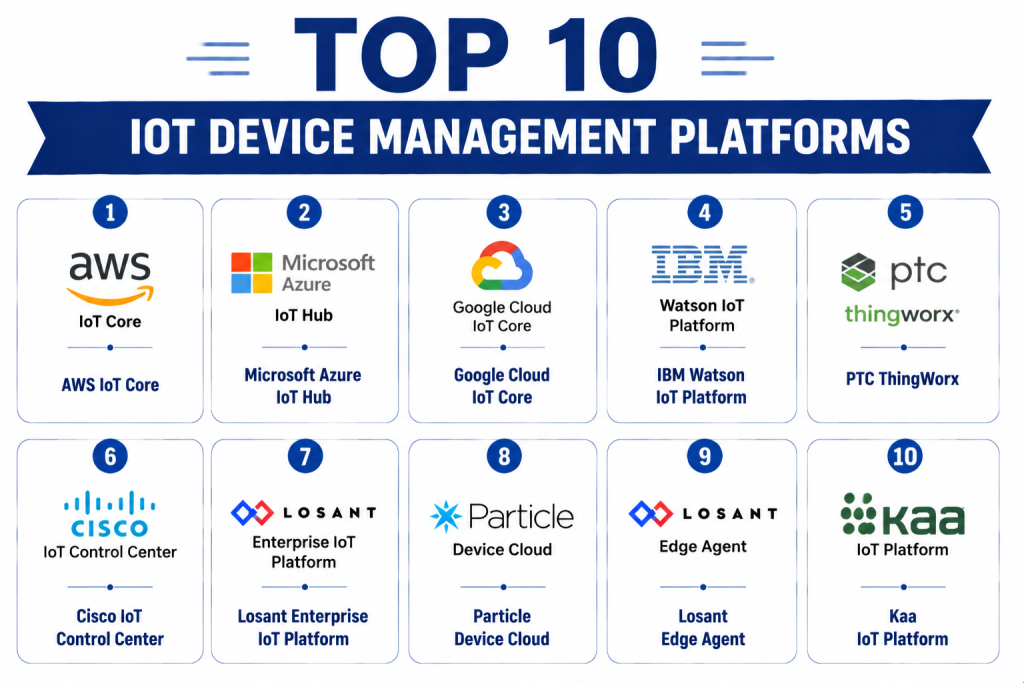
Top 10 IoT Device Management Platforms
1- AWS IoT Core
Short description: Cloud-based platform enabling secure device connectivity, management, and integration with AWS services for large-scale IoT deployments.
Key Features
- Device connectivity and provisioning
- Real-time telemetry ingestion
- Secure communication with encryption
- Integration with AWS analytics and ML services
- Policy-based access control
Pros
- Highly scalable and reliable
- Tight integration with AWS ecosystem
Cons
- Cost can escalate with large device fleets
- Requires AWS expertise
Platforms / Deployment
- Linux / Windows / macOS / iOS / Android
- Cloud
Security & Compliance
- Encryption, IAM, audit logs
- SOC 2, ISO 27001, GDPR
Integrations & Ecosystem
- AWS analytics and ML services
- Cloud storage and serverless workflows
- APIs for custom applications
Support & Community
- AWS support tiers
- Active developer community
2- Microsoft Azure IoT Hub
Short description: Enterprise-grade IoT management platform providing secure device connectivity, device twins, and remote monitoring for diverse devices.
Key Features
- Device provisioning and registry
- Bi-directional communication
- Real-time monitoring and telemetry
- Integration with Azure analytics and AI
- Automated firmware updates
Pros
- Enterprise-ready with scalability
- Strong analytics integration
Cons
- Azure-centric; may require learning curve
- Premium cost for advanced features
Platforms / Deployment
- Linux / Windows / macOS / iOS / Android
- Cloud
Security & Compliance
- SSO, encryption, RBAC
- ISO 27001, SOC 2, GDPR
Integrations & Ecosystem
- Azure cloud services
- Power BI analytics
- IoT Edge deployment
- APIs for custom extensions
Support & Community
- Microsoft enterprise support
- Large community and documentation
3- Google Cloud IoT Core
Short description: Managed service to securely connect, manage, and ingest telemetry from IoT devices into Google Cloud for analytics and machine learning applications.
Key Features
- Device registry and authentication
- Secure communication over MQTT and HTTP
- Real-time telemetry and analytics
- Integration with BigQuery and Cloud ML
- Device configuration and firmware updates
Pros
- Scales with cloud infrastructure
- Strong analytics and ML integration
Cons
- Limited to Google Cloud ecosystem
- May require expertise in cloud services
Platforms / Deployment
- Linux / Windows / macOS / iOS / Android
- Cloud
Security & Compliance
- Encryption, IAM, audit logs
- Not publicly stated
Integrations & Ecosystem
- Cloud ML, BigQuery, Dataflow
- APIs for custom IoT solutions
Support & Community
- Google Cloud support tiers
- Developer forums and documentation
4- IBM Watson IoT Platform
Short description: Provides device management, real-time monitoring, analytics, and AI-driven insights for industrial and enterprise IoT deployments.
Key Features
- Secure device connectivity
- Remote monitoring and management
- AI-driven anomaly detection
- Device analytics dashboards
- Policy-based firmware updates
Pros
- Advanced AI integration
- Strong industrial IoT capabilities
Cons
- Premium pricing for enterprise features
- Complexity may require dedicated admins
Platforms / Deployment
- Linux / Windows / macOS / iOS / Android
- Cloud / Hybrid
Security & Compliance
- Encryption, RBAC
- SOC 2, ISO 27001
Integrations & Ecosystem
- IBM Cloud analytics and AI
- IoT Edge integration
- APIs and SDKs
Support & Community
- Enterprise support tiers
- Active Watson developer community
5- PTC ThingWorx
Short description: Industrial IoT platform for device connectivity, monitoring, predictive maintenance, and analytics in manufacturing and smart operations.
Key Features
- Device onboarding and provisioning
- Real-time monitoring dashboards
- Predictive maintenance insights
- Application templates for industrial use
- Integration with ERP and MES
Pros
- Strong industrial IoT focus
- Predictive analytics capabilities
Cons
- Complex deployment for SMBs
- Premium pricing
Platforms / Deployment
- Linux / Windows / macOS / iOS / Android
- Cloud / On-premises
Security & Compliance
- Encryption, audit logs
- Not publicly stated
Integrations & Ecosystem
- ERP and MES systems
- Cloud analytics
- APIs for custom apps
Support & Community
- Vendor enterprise support
- Developer community
6- Cisco IoT Control Center
Short description: Provides device connectivity, management, and monitoring for enterprise IoT deployments with network and security integrations.
Key Features
- Device provisioning and lifecycle management
- Connectivity management (cellular & network)
- Real-time monitoring and alerts
- Security policy enforcement
- Analytics dashboards
Pros
- Enterprise-grade reliability
- Network and security integrated
Cons
- Best for Cisco network environments
- Premium cost
Platforms / Deployment
- Linux / Windows / macOS / iOS / Android
- Cloud
Security & Compliance
- Encryption, RBAC, audit logs
- Not publicly stated
Integrations & Ecosystem
- Cisco network devices
- ITSM tools
- APIs
Support & Community
- Cisco enterprise support
- Documentation and forums
7- Losant Enterprise IoT Platform
Short description: Enables IoT device management, workflow automation, and real-time data visualization for diverse enterprise use cases.
Key Features
- Device onboarding and monitoring
- Workflow and automation engine
- Real-time dashboards
- Integration with cloud analytics
- Firmware updates
Pros
- Flexible and customizable
- Low-code workflow automation
Cons
- Smaller ecosystem than cloud giants
- Premium enterprise plan
Platforms / Deployment
- Linux / Windows / macOS / iOS / Android
- Cloud / Hybrid
Security & Compliance
- Encryption, RBAC
- Not publicly stated
Integrations & Ecosystem
- Cloud analytics platforms
- APIs and webhooks
- ITSM connectors
Support & Community
- Vendor support tiers
- Developer forums
8- Particle Device Cloud
Short description: Cloud platform for managing IoT devices, firmware updates, and real-time connectivity for product and fleet monitoring.
Key Features
- Device provisioning and onboarding
- Firmware over-the-air updates
- Real-time telemetry
- Analytics dashboards
- Event-driven triggers
Pros
- Easy for connected product deployments
- Real-time monitoring
Cons
- Less suited for industrial IoT
- Feature depth limited for large enterprises
Platforms / Deployment
- Linux / Windows / macOS / iOS / Android
- Cloud
Security & Compliance
- Encryption, access controls
- Not publicly stated
Integrations & Ecosystem
- Cloud analytics
- Webhooks and APIs
- Device SDKs
Support & Community
- Documentation and community support
9- Losant Edge Agent
Short description: Edge computing platform for managing and monitoring IoT devices with local processing and automation workflows.
Key Features
- Edge device monitoring
- Local automation workflows
- Device provisioning
- Telemetry collection and analysis
- Integration with cloud dashboards
Pros
- Reduces latency for critical IoT use cases
- Supports offline operation
Cons
- Setup complexity
- Smaller ecosystem
Platforms / Deployment
- Linux / Windows / macOS
- Hybrid
Security & Compliance
- Not publicly stated
Integrations & Ecosystem
- Cloud analytics platforms
- APIs for integration
- Workflow automation
Support & Community
- Vendor support and documentation
10- Kaa IoT Platform
Short description: Open-source IoT platform for device management, monitoring, and data collection for custom IoT deployments.
Key Features
- Device provisioning and onboarding
- Real-time monitoring
- OTA firmware updates
- Data collection and analytics
- Multi-protocol support
Pros
- Open-source and customizable
- Flexible for different IoT use cases
Cons
- Requires technical expertise
- Community-based support
Platforms / Deployment
- Linux / Windows / macOS
- Cloud / On-premises
Security & Compliance
- Not publicly stated
Integrations & Ecosystem
- Cloud and analytics connectors
- APIs and SDKs
- IoT device protocols
Support & Community
- Community forums
- Documentation
Comparison Table (Top 10 IoT Device Management Platforms)
| Tool Name | Best For | Platform(s) Supported | Deployment | Standout Feature | Public Rating |
|---|---|---|---|---|---|
| AWS IoT Core | Enterprise IoT | Linux / Windows / macOS / iOS / Android | Cloud | Scalable AWS integration | N/A |
| Microsoft Azure IoT Hub | Enterprise IoT | Linux / Windows / macOS / iOS / Android | Cloud | Secure bi-directional comms | N/A |
| Google Cloud IoT Core | Cloud-native IoT | Linux / Windows / macOS / iOS / Android | Cloud | Analytics & ML integration | N/A |
| IBM Watson IoT Platform | Industrial IoT | Linux / Windows / macOS / iOS / Android | Cloud / Hybrid | AI-driven insights | N/A |
| PTC ThingWorx | Industrial IoT | Linux / Windows / macOS / iOS / Android | Cloud / On-prem | Predictive maintenance | N/A |
| Cisco IoT Control Center | Enterprise IoT | Linux / Windows / macOS / iOS / Android | Cloud | Network & security integrated | N/A |
| Losant Enterprise IoT Platform | Enterprise & mid-market | Linux / Windows / macOS / iOS / Android | Cloud / Hybrid | Low-code automation | N/A |
| Particle Device Cloud | Product IoT | Linux / Windows / macOS / iOS / Android | Cloud | OTA firmware updates | N/A |
| Losant Edge Agent | Edge computing IoT | Linux / Windows / macOS | Hybrid | Local automation workflows | N/A |
| Kaa IoT Platform | Custom IoT deployments | Linux / Windows / macOS | Cloud / On-prem | Open-source flexibility | N/A |
Evaluation & Scoring of IoT Device Management Platforms
| Tool Name | Core (25%) | Ease (15%) | Integrations (15%) | Security (10%) | Performance (10%) | Support (10%) | Value (15%) | Weighted Total (0–10) |
|---|---|---|---|---|---|---|---|---|
| AWS IoT Core | 9 | 7 | 9 | 9 | 9 | 8 | 7 | 8.6 |
| Microsoft Azure IoT Hub | 8 | 7 | 8 | 8 | 8 | 8 | 7 | 7.8 |
| Google Cloud IoT Core | 8 | 7 | 8 | 7 | 8 | 7 | 7 | 7.6 |
| IBM Watson IoT Platform | 8 | 7 | 8 | 8 | 8 | 7 | 7 | 7.8 |
| PTC ThingWorx | 8 | 7 | 7 | 7 | 8 | 7 | 7 | 7.6 |
| Cisco IoT Control Center | 8 | 7 | 7 | 7 | 8 | 7 | 7 | 7.6 |
| Losant Enterprise IoT Platform | 7 | 8 | 7 | 7 | 7 | 7 | 7 | 7.2 |
| Particle Device Cloud | 7 | 8 | 6 | 7 | 7 | 7 | 7 | 7.0 |
| Losant Edge Agent | 7 | 7 | 6 | 7 | 7 | 7 | 7 | 6.8 |
| Kaa IoT Platform | 6 | 7 | 6 | 6 | 7 | 7 | 8 | 6.8 |
Interpretation: Higher scores indicate better overall capabilities in managing, securing, and monitoring IoT devices, while balancing ease of use, integrations, and value.
Which IoT Device Management Tool Is Right for You?
Solo / Freelancer
Particle Device Cloud or Kaa IoT for small-scale or prototype deployments.
SMB
Losant Enterprise IoT Platform or Losant Edge Agent for flexible management and automation.
Mid-Market
PTC ThingWorx or Cisco IoT Control Center for scalable fleet monitoring and device orchestration.
Enterprise
AWS IoT Core, Microsoft Azure IoT Hub, or IBM Watson IoT Platform for large-scale, secure, and analytics-driven deployments.
Budget vs Premium
Budget deployments may rely on open-source Kaa IoT or Particle Cloud. Premium enterprises benefit from AWS, Azure, or IBM platforms.
Feature Depth vs Ease of Use
Complex IoT environments need AWS IoT Core, Azure IoT Hub, or PTC ThingWorx. Simpler fleets are manageable with Losant or Particle Cloud.
Integrations & Scalability
AWS, Azure, IBM, and PTC offer robust integration with cloud, analytics, and enterprise systems, supporting global scalability.
Security & Compliance Needs
Enterprises requiring strong security, encryption, and compliance (SOC 2, ISO, GDPR) should prioritize AWS, Azure, or IBM IoT platforms.
Frequently Asked Questions (FAQs)
1- What is an IoT Device Management Platform?
It’s software that enables provisioning, monitoring, updating, and securing connected IoT devices across fleets and networks.
2- Can these platforms handle large device fleets?
Yes, platforms like AWS IoT Core, Azure IoT Hub, and IBM Watson scale to millions of connected devices.
3- Do these tools support firmware updates?
Most support over-the-air (OTA) firmware updates to ensure devices are secure and up-to-date.
4- Are these platforms suitable for industrial IoT?
Yes. Platforms like PTC ThingWorx, IBM Watson, and Cisco IoT Control Center target industrial and enterprise deployments.
5- Can these tools integrate with analytics and AI services?
Yes. They connect with cloud analytics, machine learning, and operational dashboards for predictive insights.
6- How secure are IoT device management platforms?
Enterprise solutions provide encryption, access controls, RBAC, audit logging, and compliance certifications.
7- Are open-source options available?
Yes, Kaa IoT provides open-source flexibility for customized IoT deployments.
8- Do these platforms provide dashboards and alerts?
Yes, all platforms offer real-time monitoring, dashboards, and alerting for device health and performance.
9- Can small organizations benefit from these tools?
Yes, Particle Device Cloud and Losant are suitable for small-scale IoT deployments.
10- What are common adoption challenges?
Challenges include integration complexity, device heterogeneity, security management, and scaling for large fleets.
Conclusion
IoT Device Management Platforms help organizations deploy, monitor, and secure IoT devices efficiently. Selection depends on fleet size, device diversity, automation needs, and integration requirements. Small teams may favor lightweight or open-source tools, while enterprises require scalable, analytics-driven platforms. Shortlist , run pilots, and validate security and integrations before full-scale adoption.
