Introduction
That reality has shifted fundamentally due to the rapid evolution of AI in Natural Language Processing. By blending advanced computer science with linguistics, modern tech platforms can finally bridge the gap between binary code and human conversation, allowing software to interpret our words with astonishing precision. We see this technology in action every time a search engine predicts our thoughts, a chatbot resolves a customer service issue, or a virtual assistant understands a regional accent. These everyday conveniences are powered by software systems that actively learn how to process the nuance of human language. If you want to keep up with these continuous technological breakthroughs, platforms like AIUniverse provide deep dives into the tools shaping our digital tomorrow. Understanding how machines interpret human speech is now foundational knowledge for navigating our automated world.
What is Artificial Intelligence (AI)?
Artificial Intelligence, or AI, is the branch of computer science dedicated to creating systems capable of performing tasks that typically require human intelligence. Instead of relying solely on rigid, pre-programmed rules written by a software developer, an AI system learns from data. It observes patterns, evaluates outcomes, and refines its internal logic to improve its performance over time without needing manual updates.
The core idea animating modern machine intelligence is adaptability. Traditional software acts like a calculator; if you press a specific set of buttons, it will execute the exact same mechanical formula every single time. An AI system behaves more like a digital apprentice. By analyzing thousands of examples of a specific task, it begins to understand the underlying principles of that task, allowing it to handle entirely new, unseen situations successfully.
We encounter this adaptive intelligence in dozens of subtle ways throughout our ordinary daily routines:
- Streaming Platforms: Entertainment services study your viewing history to recommend films you might enjoy.
- Ride-Sharing Apps: Navigation systems calculate traffic density to predict arrival times and adjust prices instantly.
- Banking Platforms: Fraud prevention systems scan millions of transactions per second to spot anomalous spending patterns.
Ultimately, AI is about building a digital framework that can perceive its environment, process information logically, and make accurate decisions based on that processing. It transforms computers from passive execution machines into active problem-solving partners.
What is Natural Language Processing (NLP)?
Natural Language Processing, or NLP, is the specialized subfield of artificial intelligence that focuses entirely on the interaction between computers and human language. The ultimate objective of NLP is to give machines the ability to read, decipher, understand, and synthesize human languages in a way that is both valuable and contextually accurate.
To understand how a machine approaches text, imagine looking at a page written in a script you have never seen before. To your eyes, the letters are just shapes. A standard computer views English words exactly the same way—as arbitrary strings of digital characters. NLP acts as the translation layer that converts those arbitrary shapes into structured data representing meaning, intent, and emotion.
[Raw Human Text] ---> [NLP Processing Pipeline] ---> [Structured Machine Meaning]
Teaching a machine to truly comprehend human speech is an incredibly steep hill to climb because human language is fundamentally messy. Consider the unique hurdles that NLP engineers must overcome:
- Syntax Variance: Different languages use wildly divergent rules for organizing words into sentences.
- Evolving Slang: Human cultures invent new phrases and alter word meanings almost daily.
- Implicit Intent: We routinely say one thing while meaning something entirely different based on our tone.
Despite these challenges, modern NLP frameworks have advanced to the point where they can look past structural imperfections. They look at the global context of a conversation to extract the true core message hidden within our imperfect phrasing.
How AI Powers NLP
The earliest attempts at language processing relied heavily on hand-coded grammatical rules. Linguists would sit down and write thousands of “if-then” statements to help a computer parse a sentence. If a word was preceded by an article, the computer labeled it a noun. This rigid approach collapsed the moment it encountered a spelling error, a poetic metaphor, or a casual text message.
Machine Learning in NLP
The real breakthrough occurred when researchers abandoned rigid rulebooks and embraced machine learning. Instead of teaching a computer the explicit rules of grammar, engineers began feeding millions of pages of real text into statistical algorithms. The computer then calculates the mathematical probability of words appearing next to one another.
Through this statistical analysis, the software discovers that certain words share strong contextual bonds. For example, it notices that the words “bark,” “leash,” and “vet” regularly cluster around the word “dog.” The machine does not need a dictionary to tell it what a dog is; it infers the concept based entirely on the company the word keeps.
Deep Learning Models
As computing power scaled up, simple statistical equations were replaced by deep learning models. These systems utilize artificial neural networks inspired by the structure of the human brain. Neural networks process text through multiple layers of mathematical nodes, with each layer extracting a progressively higher level of abstract meaning from the text.
Input Text ---> [Layer 1: Individual Characters] ---> [Layer 2: Word Roots] ---> [Layer 3: Sentence Context] ---> Deep Understanding
In a deep learning architecture, words are converted into long strings of numbers called vectors. When words have similar meanings, their vectors sit close together in a multi-dimensional mathematical space. This allows the system to recognize that “huge” and “gigantic” mean nearly the same thing, even if the spelling is completely different.
Language Models and the Transformer Concept
The absolute pinnacle of modern AI in Natural Language Processing is the Transformer architecture. Introduced by researchers in 2017, the Transformer model completely revolutionized how machines read. Older deep learning models read sentences one word at a time, like a human reading a line of text from left to right. If a sentence was too long, the model would literally forget how the sentence started by the time it reached the end.
Transformers changed this by processing an entire paragraph all at once. They utilize a mechanism called “Self-Attention,” which allows the model to look at every single word in a sentence simultaneously and figure out how they relate to one another.
To see why this matters, consider these two sentences:
- “The bank of the river was muddy.”
- “The bank approved the small business loan.”
A primitive system might get confused by the word “bank.” A Transformer model uses self-attention to instantly connect “bank” with “river” in the first sentence, and “bank” with “loan” in the second. This allows it to effortlessly choose the correct meaning every time.
Key Components of NLP
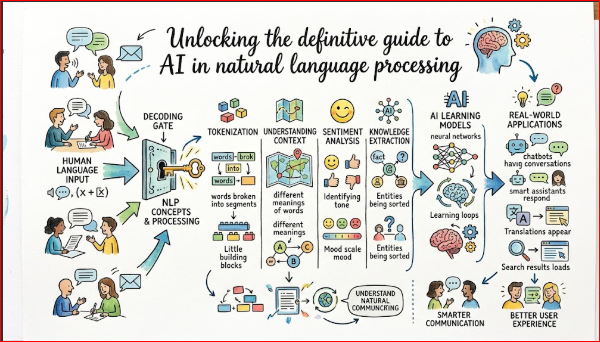
To transform a chaotic wall of human text into something an AI model can calculate, the data must pass through a highly coordinated processing pipeline. Each stage of this pipeline isolates a specific attribute of the language.
Tokenization
Tokenization is the foundational step of all language processing. It is the mechanical process of breaking down a continuous stream of text into smaller, manageable pieces called tokens. These tokens can be entire words, syllables, or even individual characters.
For example, the sentence “AI is evolving rapidly” might be split into four distinct tokens: ["AI", "is", "evolving", "rapidly"]. By isolating these pieces, the software can assign a specific mathematical identifier to each unit, making it possible to run numbers-based equations on text strings.
Sentiment Analysis
Sentiment analysis is the process of determining the emotional undertone behind a series of words. The AI scans a piece of text to figure out whether the writer’s attitude is positive, negative, or completely neutral.
This is exceptionally valuable for businesses monitoring customer feedback. An automated sentiment tool can read ten thousand product reviews in seconds, instantly flagging angry comments for customer service intervention while compiling data on what features are making users happy.
Named Entity Recognition (NER)
Named Entity Recognition acts as the locator tool of the language processing pipeline. It scans an unstructured paragraph and identifies proper nouns, sorting them into pre-defined categories such as people, organizations, locations, dates, and monetary values.
NER Example:
- Input text: “Sundar Pichai spoke at the Google headquarters in Mountain View yesterday.”
- NER Extraction:
[Sundar Pichai = Person],[Google = Organization],[Mountain View = Location],[Yesterday = Date].
Language Translation
Automated language translation has evolved far beyond replacing a word in Language A with a matching word from Language B. Modern translation components analyze the conceptual meaning of an entire paragraph before rewriting it in the target language.
This advanced approach preserves native idioms, cultural nuances, and grammatical structures. It ensures that the translated text feels completely natural to a native speaker rather than sounding like a clunky literal translation.
Speech Recognition
Speech recognition bridges the gap between spoken acoustics and written words. This component takes the analog audio waves of a human voice, strips out background interference, and converts the sound waves into a clean digital text transcript.
This process requires immense computing power. The model must instantly account for regional accents, varying vocal pitches, and the muffled audio quality of phone microphones to accurately pin down every spoken word.
Real-World Applications of NLP
We are no longer living in an era where AI in Natural Language Processing is confined to academic computer science labs. It is actively running the digital infrastructure of our global economy.
| Application | Core NLP Component | Primary Business Benefit |
| Chatbots | Sentiment Analysis & Generation | 24/7 Automated Customer Care |
| Virtual Assistants | Speech Recognition & Intent Parsing | Hands-Free Device Management |
| Search Engines | Contextual Semantic Search | Highly Relevant Information Retrieval |
| Recommendation Systems | Content Clustering & Keyword Extraction | Increased User Engagement & Retention |
| Social Media Analysis | Large-Scale Trend & Topic Modeling | Real-Time Brand Reputation Tracking |
Chatbots
Customer service interfaces have undergone a radical transformation. Traditional chat boxes were little more than interactive FAQ trees that broke down if a user typed an unexpected phrase. Modern AI chatbots engage in open-ended conversations. They can parse complex complaints, pull relevant account data, and resolve issues without human intervention.
Virtual Assistants
Smart speakers and virtual smartphone assistants rely entirely on an integrated NLP pipeline. They must constantly listen for a wake word, translate a spoken request into clear text, determine the user’s intent, execute the command, and vocalize a response in a natural human cadence.
Search Engines
Modern search engines no longer look for exact keyword matches. If you search for “how to fix a torn pair of pants,” the engine understands the underlying intent. It will confidently show you articles about sewing, patches, and fabric glue, even if those specific words were not in your original search query.
Recommendation Systems Explained
Content platforms rely heavily on language models to understand the deeper context of text documents. When you read a news article or watch a video with a text description, an NLP engine extracts core topics and entities. It matches those concepts against your profile to surface content that keeps you engaged.
Social Media Analysis
Global corporations use automated language tools to monitor what people are saying about their brands online. By scanning millions of social posts, blogs, and forums daily, companies can spot PR crises or sudden shifts in consumer preferences long before traditional surveys would reveal them.
Benefits of AI in NLP
Integrating artificial intelligence into text and speech processing has unlocked extraordinary capabilities that were completely impossible with legacy software architecture.
Endless Automation
Human teams can only read a set number of pages a day. An AI system can analyze entire libraries of documents simultaneously. This allows legal firms to audit contracts, medical institutions to scan health records, and insurance companies to process claims in a tiny fraction of the time it used to take.
A Significantly Better User Experience
Technology becomes vastly more accessible when people can interact with it using their natural voices. Users no longer need to learn complex software interfaces or memorize specific computer commands. They can simply state what they want to achieve, and the software translates that request into action.
Faster Global Communication
AI translation tools have systematically dismantled historical communication barriers. Teams distributed across multiple continents can collaborate in real time, with each member typing in their native language while the internal communication platform translates the text instantly for everyone else.
Deep Data Insights
Unstructured text data—emails, support tickets, survey responses—is a goldmine of business intelligence. AI models can sort through this unorganized data to identify recurring themes, operational bottlenecks, and emerging market trends that would otherwise remain hidden deep within corporate databases.
Challenges in NLP
Despite the breathtaking speed of recent technological progress, replicating the human capacity for language remains one of the most complex challenges in all of computer science.
Language Ambiguity
Human language is littered with homonyms, double meanings, and phrases that depend entirely on subtle context. Consider the phrase: “I saw a man with a telescope.” This simple sentence could mean you looked through a telescope and saw a man, or it could mean you saw a man who was holding a telescope. Humans use situational clues to know which interpretation makes sense; machines struggle to make those intuitive leaps.
Context Understanding
A conversation is not just a sequence of isolated sentences. It is an ongoing exchange where later remarks rely heavily on points made much earlier. While modern Transformer models are far better at retaining context than older software, they still hit an operational wall when trying to remember details buried across hundreds of pages of previous dialogue.
Data Bias
AI models do not learn in an isolated vacuum; they are trained on massive datasets compiled from books, articles, and websites written by humans. If these training texts contain historical biases, cultural stereotypes, or factual errors, the model will faithfully absorb those flaws and replicate them in its own output.
[Biased Human Internet Text] ---> [Model Training] ---> [Biased AI Outputs]
Multilingual Complexity
While dominant global languages like English, Spanish, and Mandarin enjoy massive digital datasets for training purposes, thousands of regional languages have a limited online footprint. Building accurate, highly capable language models for these low-resource languages remains an uphill battle due to the scarcity of training data.
Tools & Technologies Used in NLP
Building a modern language processing system requires a specialized ecosystem of software frameworks, machine learning codebases, and cloud computing infrastructure.
Python Libraries
Python is the uncontested programming language of choice for language engineering. Developers rely on several specialized open-source libraries to construct their processing workflows:
- NLTK (Natural Language Toolkit): A classic library used for basic text prep, stemming, and grammatical tagging.
- SpaCy: A fast, production-ready framework built specifically to handle industrial-scale text analysis.
- Hugging Face Transformers: The industry standard library for downloading and fine-tuning cutting-edge, pre-trained language models.
AI Models
The industry has moved decisively toward using massive, pre-trained base models. These frameworks are trained on colossal web-scale text datasets by major research institutions. Developers can take these base models and customize them for specific niche tasks, such as medical analysis or legal compliance, using a fraction of the data and compute power originally required.
Cloud AI Services
For teams that prefer not to build, train, and host their own custom models, major cloud providers offer turn-key text and speech APIs. These managed cloud services allow developers to integrate sentiment analysis, document translation, and speech-to-text capabilities into their apps with just a few simple lines of code.
Future of AI in NLP
We are standing at the absolute precipice of a brand-new era in human-computer interaction. The models under active development today will make the applications of the past few years look incredibly primitive.
Smarter AI Assistants
The next generation of virtual assistants will not just react to basic voice commands. They will be highly proactive agents capable of handling multi-step workflows, such as checking your calendar, coordinating open times with a colleague, booking a dinner table, and sending out calendar invites completely autonomously.
Fluid Real-Time Translation
We are rapidly approaching a future where two people speaking completely different languages will be able to hold a seamless, real-time voice conversation through wearable audio earbuds, experiencing no noticeable lag or synthetic distortion.
Truly Human-Like Conversations
Future language models will exhibit a much deeper grasp of human psychology, conversational pacing, and emotional nuance. They will chat fluidly without repeating phrases, dropping context, or generating awkward, robotic responses.
Multimodal AI Systems
The sharp division between text, audio, and video processing is dissolving completely. Future systems will be natively multimodal, meaning they can process text, listen to audio tones, and watch a video feed simultaneously. This will give them a far richer, more comprehensive understanding of the human environment.
          ┌─── Text Input
          ├─── Audio Stream  ───> [Multimodal AI Engine] ───> Unified Contextual Understanding
          └─── Video Feed
FAQ Section
1.What is the difference between AI and NLP?
Artificial Intelligence is the broad, overarching scientific field focused on building smart machines capable of reasoning and decision-making. Natural Language Processing is a specific subfield of AI focused exclusively on teaching those machines how to read, understand, and generate human language.
2.How do machines understand sarcasm in text?
Machines identify sarcasm by analyzing contextual clues, sentence structure, and word combinations that conflict with each other. For example, if a model identifies highly negative context paired with overly positive words like “Oh, fantastic, another flat tire,” it can infer that the true sentiment is negative.
3.Can NLP models work with any language?
In theory, yes, NLP models can be trained to process any language. However, the accuracy of the model depends heavily on the volume of training data available. Languages with a massive online presence have highly accurate models, while regional languages with less digital text are more challenging to support.
4.What is a transformer model in AI?
A Transformer model is an advanced neural network architecture that processes entire sentences all at once rather than word by word. It uses a mechanism called self-attention to analyze how all the words in a text relate to each other simultaneously, which provides a dramatic boost in speed and contextual understanding.
5.Are customer service chatbots fully automated by NLP?
Yes, many modern customer service chatbots are fully automated using NLP frameworks. They parse the user’s incoming message, identify the core intent, look up relevant database info, and generate an appropriate, human-like response without needing any manual human oversight.
6.How does data bias affect language models?
Data bias happens when an AI model is trained on texts that contain human prejudices, stereotypes, or factual inaccuracies. Because the software learns purely by mimicking its training data, it will inevitably repeat those same biased viewpoints or unfair assumptions in its own text outputs.
7.What are the best programming languages for NLP?
Python is the undisputed industry standard for NLP development due to its clean syntax and its massive ecosystem of specialized machine learning libraries. Other languages like Java, C++, and JavaScript are occasionally used for specific infrastructure components or mobile integrations.
8.Will AI completely replace human translators?
While AI translation tools are becoming incredibly fast and accurate for everyday business communication, they still lack a deep, intuitive grasp of cultural nuance, creative wordplay, and literary style. Human translators will remain vital for nuanced creative works, legal text, and high-stakes diplomatic communications.
Conclusion
The journey of AI in Natural Language Processing has been nothing short of spectacular. We have moved rapidly from an era of brittle, hand-coded grammar rulebooks to an age of fluid, web-scale neural networks that can write poetry, debug software code, and converse with us like a peer. This technology has successfully turned human language from an impenetrable barrier into an accessible, flexible data asset for digital systems.
The future scope of this field is boundless. As models grow increasingly multimodal and contextual awareness continues to expand, the friction between human intent and computer execution will vanish entirely. We are moving toward a world where technology adapts completely to our natural ways of communicating, rather than forcing us to adapt to the rigid logic of machines.
