Introduction
Service Catalog Platforms are specialized software systems designed to centralize, standardize, and streamline the delivery of services across an organization. They provide a single interface for employees, IT teams, and external stakeholders to request, track, and manage services efficiently. In , the focus on automation, AI-driven workflows, and seamless integrations has made service catalog platforms essential for digital transformation initiatives. These platforms help organizations reduce service delivery times, improve visibility into service consumption, and enforce governance and compliance policies.
Real-world use cases include:
- IT service request management for internal employees.
- HR self-service portals for onboarding, payroll, and benefits.
- Facilities and asset management requests in large enterprises.
- Finance and procurement service requests, including approvals and tracking.
- Customer-facing support portals for product or service inquiries.
What buyers should evaluate:
- Ease of catalog creation and management.
- Integration with existing ITSM, ERP, and collaboration tools.
- Automation and AI capabilities for routing and approvals.
- Scalability across teams and departments.
- Security features, compliance, and auditability.
- Reporting, analytics, and dashboards.
- Mobile accessibility and user experience.
- Pricing models and deployment flexibility.
Best for: IT teams, HR departments, facilities management, mid-market to enterprise organizations that handle multiple internal services.
Not ideal for: Small teams with minimal service requests or companies relying on simple ticketing systems that do not require catalogized workflows.
Key Trends in Service Catalog Platforms
- Increased adoption of AI for automated request routing, approvals, and chatbot-guided submissions.
- Low-code/no-code platforms enabling business users to design and manage catalogs without IT support.
- Greater integration with workflow automation and ITSM platforms to unify operations.
- Mobile-first interfaces to support on-the-go employees and remote workforces.
- Enhanced self-service options for employees and external customers.
- Cloud-first deployment models with hybrid support for sensitive data.
- Data-driven analytics for optimization of service requests and SLA performance.
- Compliance monitoring and audit-ready reporting built-in for SOC, ISO, and GDPR standards.
- Subscription-based and usage-based pricing models for flexibility and cost control.
- Focus on cross-departmental service catalog standardization to reduce redundancies.
How We Selected These Tools (Methodology)
- Market adoption and mindshare: Tools widely adopted in enterprise and mid-market segments.
- Feature completeness: Coverage of core service catalog capabilities and workflow automation.
- Reliability/performance signals: Customer satisfaction, uptime, and scalability indicators.
- Security posture signals: Encryption, SSO, role-based access, audit logging, and compliance.
- Integrations/ecosystem: Compatibility with ITSM, ERP, HR, and other enterprise systems.
- Customer fit across segments: Suitability for SMB, mid-market, and enterprise organizations.
- Innovation and roadmap: AI features, low-code capabilities, and mobile experience.
- Support and documentation quality: Training, onboarding, and community engagement.
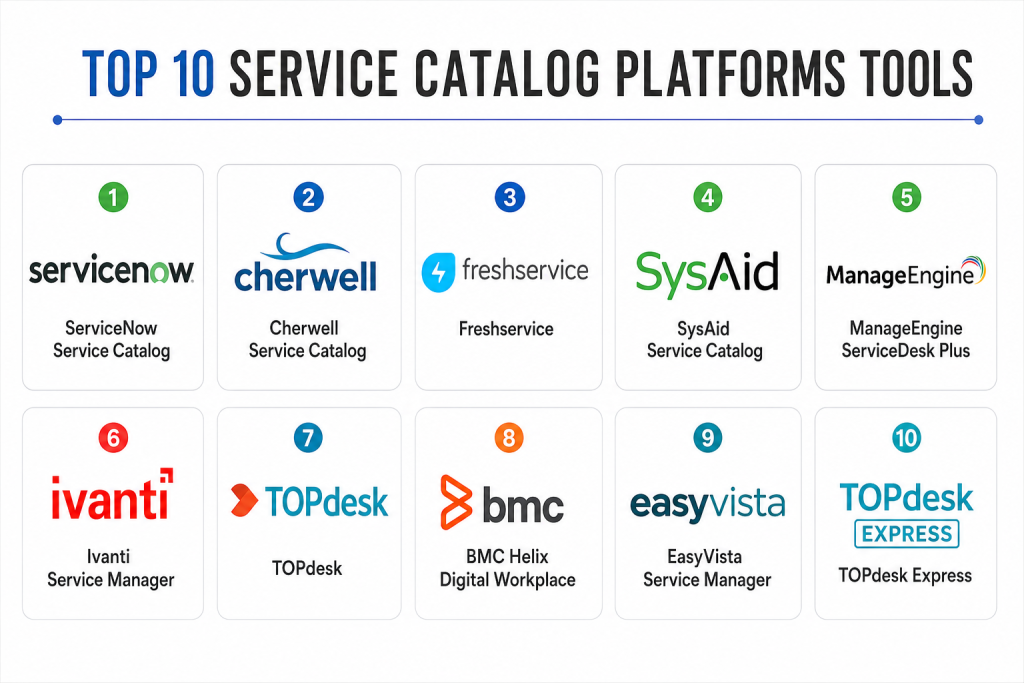
Top 10 Service Catalog Platforms Tools
1- ServiceNow Service Catalog
Short description : ServiceNow Service Catalog enables organizations to define, publish, and manage service offerings in a centralized portal. Targeted at mid-market to enterprise organizations, it supports IT, HR, and facilities requests, with AI-driven workflow automation and integration with the broader ServiceNow ecosystem.
Key Features
- AI-driven request routing and approvals.
- Customizable self-service portals.
- Integration with ITSM, HR, and facilities workflows.
- Automated SLA tracking and reporting.
- Low-code workflow builder.
- Mobile-friendly interface.
- Role-based access control and governance.
Pros
- Highly scalable for large enterprises.
- Strong ecosystem with extensive integrations.
- Robust reporting and analytics.
Cons
- Complex implementation and onboarding.
- Can be expensive for smaller teams.
- Requires IT expertise for advanced customization.
Platforms / Deployment
- Web, iOS, Android
- Cloud / Hybrid
Security & Compliance
- SSO/SAML, MFA, encryption, audit logs, RBAC
- SOC 2, ISO 27001, GDPR
Integrations & Ecosystem
ServiceNow supports a wide range of integrations for ITSM, HR, and operations automation.
- ITSM modules
- ERP systems
- Collaboration tools
- API and plugin extensions
- Third-party workflow connectors
Support & Community
- Extensive documentation and training materials.
- Enterprise-grade support tiers.
- Active user community and knowledge forums.
2- Cherwell Service Catalog
Short description : Cherwell Service Catalog provides flexible, low-code service management for IT, HR, and facilities. It allows organizations to configure services quickly, automate workflows, and deliver a unified self-service experience.
Key Features
- Drag-and-drop catalog builder.
- Workflow automation and approval routing.
- Multi-department service support.
- Analytics dashboards and reporting.
- Mobile access and portal customization.
- Integration with ITSM and ERP systems.
- Role-based access management.
Pros
- Low-code platform accelerates deployment.
- Flexible and customizable workflows.
- Good mid-market adoption.
Cons
- Limited AI automation compared to larger platforms.
- Onboarding can require consulting.
- Fewer native integrations than ServiceNow.
Platforms / Deployment
- Web, Windows, iOS, Android
- Cloud / Self-hosted / Hybrid
Security & Compliance
- SSO/SAML, encryption, audit logs
- Not publicly stated for certifications
Integrations & Ecosystem
Supports ITSM, HR, and ERP integrations with API availability.
- Jira, Salesforce
- Active Directory
- Third-party workflow connectors
Support & Community
- Standard documentation and online community.
- Paid support plans available.
- Moderate community engagement.
3- Freshservice
Short description : Freshservice combines service catalog management with ITSM capabilities. Designed for SMBs and mid-market companies, it emphasizes ease of use, fast onboarding, and AI-based automation for request handling and approvals.
Key Features
- Intuitive drag-and-drop service catalog.
- AI-powered ticket routing and suggestions.
- Workflow automation for approvals.
- Pre-built templates for IT, HR, and facilities.
- SLA tracking and dashboards.
- Mobile and web access.
- Integration with major collaboration tools.
Pros
- Easy to deploy and user-friendly.
- Strong automation for SMB environments.
- Affordable pricing for smaller teams.
Cons
- Limited advanced customization for large enterprises.
- Some integrations require additional setup.
- AI capabilities less sophisticated than enterprise platforms.
Platforms / Deployment
- Web, iOS, Android
- Cloud
Security & Compliance
- SSO, encryption, audit logs
- Not publicly stated for certifications
Integrations & Ecosystem
Freshservice integrates with productivity and collaboration tools.
- Microsoft Teams, Slack
- Jira, Salesforce
- API and webhook support
Support & Community
- Documentation, live chat, and email support.
- Active online user community.
- Standard onboarding guides.
4- SysAid Service Catalog
Short description : SysAid Service Catalog provides IT service automation and request management, focusing on small to mid-sized organizations. It offers a clean interface for end-users and automated workflows for IT teams.
Key Features
- Customizable service request templates.
- Workflow automation and approvals.
- SLA management and reporting.
- Multi-channel support (web, email, mobile).
- Knowledge base integration.
- Role-based access control.
- Integration with ITSM and monitoring tools.
Pros
- Simple and intuitive interface.
- Fast deployment and low training overhead.
- Affordable for SMBs.
Cons
- Less suitable for large enterprise scalability.
- Limited AI-driven automation.
- Integration options are moderate.
Platforms / Deployment
- Web, Windows, iOS, Android
- Cloud / Self-hosted
Security & Compliance
- SSO, RBAC, encryption
- Not publicly stated
Integrations & Ecosystem
Integrates with ITSM, monitoring, and productivity tools.
- Jira, Slack, Microsoft 365
- Email workflow triggers
- API access for custom integrations
Support & Community
- Documentation and ticket-based support.
- Community forums available.
- Moderate adoption in SMBs.
5- ManageEngine ServiceDesk Plus
Short description : ManageEngine ServiceDesk Plus offers a service catalog within a full ITSM platform. Known for strong automation, reporting, and multi-departmental support, it serves mid-market to enterprise organizations.
Key Features
- IT, HR, and facilities service catalogs.
- Automation and workflow templates.
- SLA tracking and reporting dashboards.
- Self-service portal customization.
- Mobile and web support.
- Integration with ITSM and Active Directory.
- Knowledge base linking.
Pros
- Comprehensive ITSM platform.
- Strong automation and reporting.
- Flexible deployment options.
Cons
- Steeper learning curve for non-IT users.
- Customization may require IT expertise.
- UI is functional but less modern than competitors.
Platforms / Deployment
- Web, Windows, iOS, Android
- Cloud / On-premises / Hybrid
Security & Compliance
- SSO, encryption, audit logs
- Not publicly stated
Integrations & Ecosystem
- Integration with ERP, ITSM, and directory services.
- APIs for custom workflows
- Collaboration tools like Slack and Teams
Support & Community
- Documentation, live support, and forums.
- Strong enterprise community.
- Training modules available.
6- Ivanti Service Manager
Short description : Ivanti Service Manager delivers service catalog and ITSM capabilities, focusing on large enterprises and complex workflows. Offers automation, self-service, and AI-driven insights for service requests.
Key Features
- Multi-department service catalogs.
- Workflow automation with approvals.
- AI recommendations for routing and resolution.
- SLA and KPI dashboards.
- Integration with ERP and ITSM systems.
- Mobile access and self-service portal.
- Role-based security controls.
Pros
- Enterprise-grade scalability.
- Strong AI and automation.
- Broad integration ecosystem.
Cons
- Implementation can be lengthy.
- Expensive for smaller organizations.
- Requires IT team involvement for configuration.
Platforms / Deployment
- Web, iOS, Android
- Cloud / On-premises / Hybrid
Security & Compliance
- SSO, MFA, RBAC, encryption
- Not publicly stated
Integrations & Ecosystem
Integrates with ITSM, ERP, and productivity suites.
- Active Directory, SAP
- Collaboration platforms
- API extensions for custom workflows
Support & Community
- Enterprise support tiers and training.
- Strong user community.
- Extensive documentation.
7- TOPdesk
Short description : TOPdesk provides a unified service catalog platform with ITSM and facilities management capabilities. Designed for mid-market and enterprise, it emphasizes ease of use and self-service.
Key Features
- Multi-channel service requests.
- Self-service portal with automation.
- Workflow and approval management.
- Knowledge base integration.
- SLA tracking and reporting.
- Mobile app support.
- Integration with ITSM and collaboration tools.
Pros
- User-friendly and intuitive.
- Strong self-service capabilities.
- Flexible deployment options.
Cons
- Limited advanced AI features.
- Customization requires technical expertise.
- Integration options are moderate.
Platforms / Deployment
- Web, iOS, Android
- Cloud / On-premises / Hybrid
Security & Compliance
- SSO, RBAC, encryption
- Not publicly stated
Integrations & Ecosystem
Supports ITSM and productivity tool integrations.
- Jira, Microsoft Teams
- API and webhooks
- Active Directory
Support & Community
- Documentation and community forums.
- Paid support tiers available.
- Moderate adoption globally.
8- BMC Helix Digital Workplace
Short description : BMC Helix provides a service catalog as part of its digital workplace platform. It combines AI-driven service delivery with ITSM and employee experience tools for enterprise-scale organizations.
Key Features
- AI-driven service request recommendations.
- Centralized multi-department catalog.
- Workflow automation and approvals.
- SLA tracking and analytics.
- Mobile-first interface.
- Integration with ITSM and collaboration tools.
- Role-based security.
Pros
- Enterprise-grade AI capabilities.
- Comprehensive integration ecosystem.
- Strong analytics and reporting.
Cons
- Complex onboarding process.
- High cost for smaller organizations.
- Requires dedicated IT management.
Platforms / Deployment
- Web, iOS, Android
- Cloud / Hybrid
Security & Compliance
- SSO, MFA, RBAC, encryption
- SOC 2, ISO 27001, GDPR
Integrations & Ecosystem
Integrates with ITSM, ERP, and collaboration suites.
- Jira, Salesforce, SAP
- API access for automation
- Active Directory
Support & Community
- Enterprise support and training programs.
- Active professional community.
- Documentation is comprehensive.
9- EasyVista Service Manager
Short description : EasyVista Service Manager focuses on simple, low-code service catalog management for SMB and mid-market organizations. It emphasizes self-service, automation, and AI-driven recommendations for common service requests.
Key Features
- Low-code service catalog builder.
- AI-powered request suggestions.
- Workflow and approval automation.
- Mobile-friendly self-service portal.
- Reporting and dashboards.
- Integration with ITSM and collaboration tools.
- Role-based access.
Pros
- Simple and easy to use.
- Quick deployment and onboarding.
- Affordable for smaller teams.
Cons
- Limited enterprise-level customization.
- AI features are basic.
- Moderate integration options.
Platforms / Deployment
- Web, iOS, Android
- Cloud / Hybrid
Security & Compliance
- SSO, encryption, RBAC
- Not publicly stated
Integrations & Ecosystem
Integrates with collaboration and ITSM tools.
- Slack, Teams
- Jira
- API access
Support & Community
- Documentation, live support, and community forums.
- Moderate user community.
- Onboarding resources available.
10- TOPdesk Express
Short description : TOPdesk Express is a lightweight service catalog and ITSM platform for small businesses. Provides self-service and workflow automation with minimal setup.
Key Features
- Simple service request management.
- Pre-built workflow templates.
- Mobile-friendly portal.
- SLA tracking and reporting.
- Integration with basic ITSM and productivity tools.
- Role-based access.
- Knowledge base linking.
Pros
- Fast deployment and easy to use.
- Affordable for small teams.
- Simple self-service experience.
Cons
- Limited advanced features and AI.
- Fewer integrations and customization options.
- Not ideal for large enterprises.
Platforms / Deployment
- Web, iOS, Android
- Cloud
Security & Compliance
- SSO, RBAC, encryption
- Not publicly stated
Integrations & Ecosystem
Basic integrations with ITSM and productivity tools.
- Jira, Slack
- API access for simple workflows
Support & Community
- Documentation and email support.
- Small but growing user community.
- Standard onboarding materials.
Comparison Table (Top 10)
| Tool Name | Best For | Platform(s) Supported | Deployment | Standout Feature | Public Rating |
|---|---|---|---|---|---|
| ServiceNow Service Catalog | Enterprise IT, HR, Facilities | Web, iOS, Android | Cloud / Hybrid | AI-driven workflow automation | N/A |
| Cherwell Service Catalog | Mid-market, flexible workflows | Web, Windows, iOS, Android | Cloud / Self-hosted / Hybrid | Low-code catalog builder | N/A |
| Freshservice | SMBs, mid-market | Web, iOS, Android | Cloud | AI-based ticket routing | N/A |
| SysAid Service Catalog | SMBs, IT teams | Web, Windows, iOS, Android | Cloud / Self-hosted | Intuitive request management | N/A |
| ManageEngine ServiceDesk Plus | Mid-market, multi-department | Web, Windows, iOS, Android | Cloud / On-premises / Hybrid | Comprehensive ITSM integration | N/A |
| Ivanti Service Manager | Large enterprises | Web, iOS, Android | Cloud / On-premises / Hybrid | AI-driven insights | N/A |
| TOPdesk | Mid-market, enterprise | Web, iOS, Android | Cloud / On-premises / Hybrid | Self-service portal experience | N/A |
| BMC Helix Digital Workplace | Enterprise IT | Web, iOS, Android | Cloud / Hybrid | AI-powered service delivery | N/A |
| EasyVista Service Manager | SMB, mid-market | Web, iOS, Android | Cloud / Hybrid | Low-code catalog and AI suggestions | N/A |
| TOPdesk Express | Small business | Web, iOS, Android | Cloud | Lightweight self-service | N/A |
Evaluation & Scoring of Service Catalog Platforms
| Tool Name | Core (25%) | Ease (15%) | Integrations (15%) | Security (10%) | Performance (10%) | Support (10%) | Value (15%) | Weighted Total (0–10) |
|---|---|---|---|---|---|---|---|---|
| ServiceNow | 9 | 7 | 9 | 9 | 9 | 8 | 6 | 8.4 |
| Cherwell | 8 | 8 | 7 | 8 | 8 | 7 | 7 | 7.8 |
| Freshservice | 7 | 9 | 6 | 7 | 7 | 7 | 8 | 7.4 |
| SysAid | 6 | 8 | 6 | 7 | 7 | 6 | 8 | 7.0 |
| ManageEngine | 8 | 7 | 8 | 8 | 8 | 7 | 7 | 7.7 |
| Ivanti | 9 | 6 | 8 | 8 | 8 | 7 | 6 | 7.7 |
| TOPdesk | 7 | 8 | 7 | 7 | 7 | 6 | 7 | 7.1 |
| BMC Helix | 9 | 7 | 8 | 9 | 9 | 8 | 6 | 8.2 |
| EasyVista | 7 | 9 | 6 | 7 | 7 | 6 | 8 | 7.3 |
| TOPdesk Express | 6 | 9 | 5 | 7 | 6 | 6 | 9 | 7.0 |
Interpretation: Scores are comparative within this list. Higher weighted totals indicate stronger overall capabilities, but selection should consider organization size, complexity, and budget.
Which Service Catalog Platform Tool Is Right for You?
Solo / Freelancer
- TOPdesk Express or Freshservice for fast setup and minimal overhead.
SMB
- Freshservice, EasyVista, or SysAid for ease of use, automation, and affordability.
Mid-Market
- Cherwell, ManageEngine ServiceDesk Plus, or TOPdesk for flexible workflows and moderate enterprise integration.
Enterprise
- ServiceNow, Ivanti, or BMC Helix for scalability, AI-driven automation, and multi-department management.
Budget vs Premium
- Choose TOPdesk Express, Freshservice, or EasyVista for budget-friendly options. Premium platforms like ServiceNow or BMC Helix provide advanced automation and analytics.
Feature Depth vs Ease of Use
- High feature depth: ServiceNow, Ivanti, BMC Helix.
- Easy to adopt: Freshservice, EasyVista, TOPdesk Express.
Integrations & Scalability
- Enterprises requiring extensive integration: ServiceNow, BMC Helix, ManageEngine.
- SMBs needing simpler integration: Freshservice, SysAid.
Security & Compliance Needs
- Platforms with strong audit, RBAC, and SSO: ServiceNow, BMC Helix, Ivanti.
- Basic SMB security needs: Freshservice, EasyVista.
Frequently Asked Questions (FAQs)
1- What is a service catalog platform used for?
Service catalog platforms centralize service requests and management. They are used for IT, HR, facilities, and other departmental services to streamline request intake, approvals, and tracking.
2- How difficult is implementation?
Implementation varies by platform complexity. SMB-focused tools can deploy in days or weeks, while enterprise solutions may require months and dedicated IT resources.
3- Are AI features standard?
AI capabilities vary. Platforms like ServiceNow and BMC Helix include AI for routing, approvals, and analytics. SMB tools like Freshservice offer basic AI suggestions.
4- What integrations are essential?
Common integrations include ITSM systems, ERP, HR tools, collaboration apps, and directory services. Evaluate API availability for custom workflows.
5- Can service catalogs scale with my organization?
Yes. Enterprise platforms support multi-department and multi-site deployments, while SMB tools are suitable for smaller, centralized teams.
6- How is security handled?
Most platforms provide SSO, encryption, RBAC, and audit logs. Enterprises may require SOC 2, ISO, or GDPR compliance features.
7- Are mobile interfaces available?
Yes, almost all modern platforms offer web and mobile access for end-users and administrators, enhancing self-service capabilities.
8- How is pricing structured?
Pricing depends on deployment, user count, and feature tier. SMB tools are subscription-based, while enterprise solutions may include premium licensing fees.
9- What common mistakes should organizations avoid?
Common mistakes include overcomplicating the catalog, underestimating integration needs, ignoring end-user experience, and insufficient training.
10- Are open-source service catalog platforms viable?
Open-source options exist but may require significant customization, IT resources, and limited vendor support, making them less practical for SMBs or non-technical teams.
Conclusion
Service catalog platforms provide organizations with a structured and efficient way to manage services across departments. Choosing the right tool depends on your organization’s size, complexity, budget, and security needs. SMBs may prioritize ease of use and affordability, while enterprises need robust automation, AI, and integrations. Start by shortlisting 2–3 platforms that match your requirements, run a pilot to test workflows, validate integrations and security, and then scale deployment to maximize ROI and operational efficiency.
