Introduction
Artificial intelligence has evolved from a niche academic pursuit into the foundational technology powering global business infrastructure. From large language models that generate code to autonomous computer vision systems in healthcare, AI is shifting how industries operate. As companies rush to adopt these systems, the demand for skilled AI software development professionals is growing exponentially. Developing a reliable machine learning model requires more than choosing a pre-built model from a cloud library. It demands a deep architectural understanding of software development. The foundational choice you make at the start of your journey centers on your choice of programming language.
Navigating these technical choices can feel overwhelming, but clear resources are available to guide you. Platforms like AIUniverse offer structural resources and detailed guides to help developers make informed decisions. By matching your career goals with the right technology stack, you can simplify the learning process and build high-performance applications.
Featured Snippet
What Are the Best AI Programming Languages to Learn?
Python is the best AI programming language due to its vast library ecosystem, simple syntax, and dominant market adoption. For high-performance systems and robotics, C++ is essential. R excels in statistical analysis, while Java and Scala suit big data enterprise environments. Julia serves scientific computing, and JavaScript enables browser-based AI.
Understanding AI Programming
What Is AI Programming?
AI programming is the practice of writing code that allows computers to process data, identify complex patterns, and make autonomous decisions without explicit step-by-step programming. Traditional software engineering relies on deterministic logic: you provide an input, write a specific rule, and get an expected output.
AI development reverses this dynamic. You provide inputs and expected outputs, and the programming language guides a machine learning algorithm to discover the hidden rules.
Traditional Software Engineering:
[Input Data] + [Explicit Rules/Code] ---------> [Output Result]

Artificial Intelligence Programming:
[Input Data] + [Expected Output Results] ------> [Generated Rules/Model]
Why Programming Languages Matter in AI
Programming languages are more than syntax interfaces; they control how software interacts with physical hardware. In AI, your language choice determines how effectively your code manages computer memory, utilizes multiple CPU cores, and communicates with graphics processing units (GPUs).
Some languages prioritize human developer productivity, allowing you to build and test an image recognition system in twenty lines of code. Others focus on hardware efficiency, giving you precise control over memory registers to handle heavy mathematical operations without crashing.
Key Requirements of AI Development
Performance
Training deep neural networks requires processing millions of matrix multiplications. Your language choice dictates whether these operations run efficiently at the hardware level or suffer from execution delays.
Scalability
An AI model that works smoothly on a local developer laptop must scale to handle millions of simultaneous user queries in production without dropping connections.
Libraries and Frameworks
Developing AI systems from scratch is inefficient. Languages with missing ecosystems require rewriting complex matrix math by hand, while mature systems offer robust neural network libraries.
Community Support
When debugging complex algorithmic errors or system memory leaks, a large global developer community guarantees you can find solutions, technical documentation, and peer support quickly.
Learning Curve
For professionals transitioning into AI, the time required to master a language’s syntax matters. A lower learning curve allows you to spend less time fighting language syntax and more time learning machine learning concepts.
How to Choose an AI Programming Language
Selecting your language stack requires balancing your professional background, your project goals, and market demands. Use this structural framework to help guide your choice:
                  [ Identify Your Primary AI Goal ]
                                  |
         ---------------------------------------------------
        |                                                   |
 [ Enterprise / Production ]                        [ Research & Analytics ]
        |                                                   |
  - Python (General Use)                              - Python (Dominant standard)
  - C++ (Low Latency/Robotics)                        - R (Advanced Statistics)
  - Java/Scala (Big Data Infrastructure)              - Julia (High-Speed Math)
- Based on Career Goals: If you want to work as an enterprise machine learning engineer, focus heavily on Python and Java. If your goal is academic research or advanced statistical modeling, prioritize Python and R.
- Based on Project Requirements: If you are building low-latency software for self-driving cars or drones, choose C++ or Rust. If you are deploying an AI model into a standard web application dashboard, Python or JavaScript is ideal.
- Based on Learning Difficulty: Beginners should start with Python due to its readable, English-like syntax. Engineers with strong backgrounds in computer systems can leverage C++ or Rust for performance benefits.
- Based on Industry Demand: Python remains the most widely requested language in modern AI job postings, followed by Java for enterprise infrastructure and C++ for specialized embedded engineering roles.
- Based on AI Specialization: Deep learning and natural language processing heavily favor Python. Computer vision in embedded hardware relies on C++, while large-scale data science and predictive analytics leverage R and Scala.
Top AI Programming Languages You Should Learn
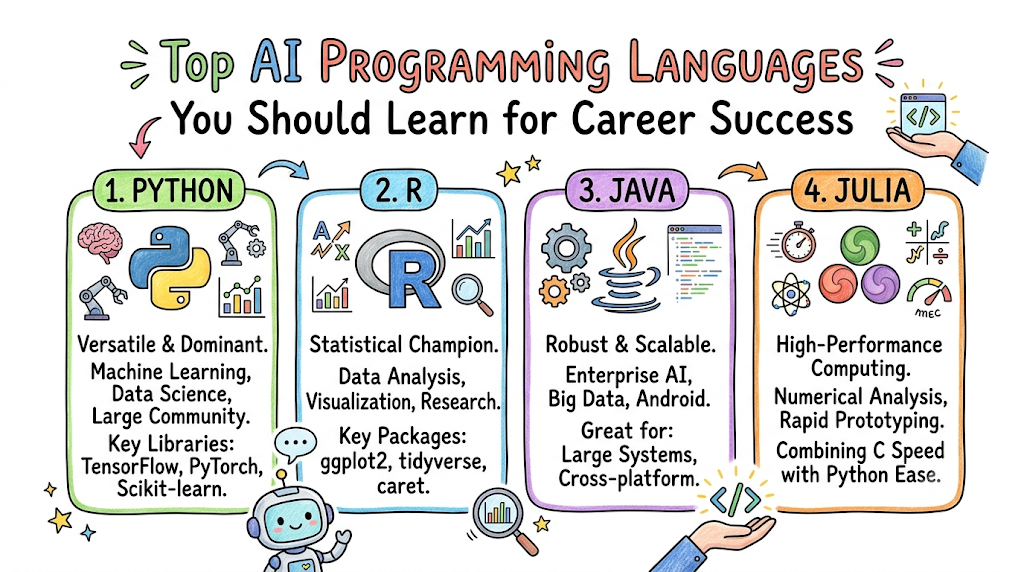
Python
In Simple Terms
Python is a readable, clean programming language that reads like standard English sentences, making it accessible to developers of all skill levels.
Why AI Developers Use It
Python is the primary language for artificial intelligence. Its simple syntax lets developers focus entirely on solving machine learning problems rather than fighting complex language mechanics. It features an unparalleled ecosystem of open-source libraries backed by major technology companies like Google and Meta.
Real-World Example
Building a sentiment analysis system that scans thousands of customer product reviews and automatically classifies them as positive, negative, or neutral.
Python
# A simple example of text classification using Python
from sklearn.feature_extraction.text import CountVectorizer
from sklearn.naive_bayes import MultinomialNB

# Training data
reviews = ["Great product, loved it", "Bad service and broken item", "Excellent quality", "Terrible experience"]
labels = ["positive", "negative", "positive", "negative"]

# Vectorize text and train model
vectorizer = CountVectorizer()
X = vectorizer.fit_transform(reviews)
model = MultinomialNB().fit(X, labels)

# Test the model
new_review = ["Loved the quality"]
print(model.predict(vectorizer.transform(new_review)))
# Output: ['positive']
Pros
- Highly readable syntax that speeds up development cycles.
- Massive ecosystem of pre-built machine learning and deep learning libraries.
- Strong support from a global developer community.
Cons
- Slower execution speeds compared to compiled languages like C++.
- High memory consumption during heavy runtime processing.
- Unsuitable for low-level embedded hardware systems.
Best For
Deep learning, computer vision, natural language processing, and rapid application prototyping.
Learning Difficulty
Easy. Ideal for absolute beginners and career changers.
Key Takeaways
- Point 1: Python is the essential standard language for modern AI job markets.
- Point 2: Its library support reduces complex algorithmic coding to a few clean lines.
- Point 3: Performance limitations are often managed by running core calculations on underlying C++ infrastructure.
R
In Simple Terms
R is a specialized programming language designed by statisticians, specifically optimized for handling complex numbers, mathematics, and data visualizations.
Why AI Developers Use It
R is popular among data analysts and research teams who need to perform deep statistical modeling, exploratory data analysis, and predictive reporting without building massive production software infrastructure.
Real-World Example
Analyzing patient clinical trial data over multiple years to find hidden correlations between medication dosages and patient recovery times.
Pros
- Outstanding built-in tools for advanced statistical analysis.
- High-quality data visualization libraries for professional reporting.
- Strong academic and research community support.
Cons
- Difficult to integrate into standard enterprise software pipelines.
- Slow execution speed when handling non-statistical programming tasks.
- Steep learning curve for developers coming from traditional software backgrounds.
Best For
Statistical modeling, bioinformatics, academic AI research, and exploratory data analysis.
Learning Difficulty
Moderate to Hard. Requires a solid foundation in mathematics and statistics.
Key Takeaways
- Point 1: R is a highly effective tool for data exploration and statistical validation.
- Point 2: It excels at prototyping data insights but is rarely used to run live, customer-facing AI applications.
- Point 3: It works best for research-focused career paths.
Java
In Simple Terms
Java is a dependable corporate language used to build large-scale applications that run across millions of business servers worldwide.
Why AI Developers Use It
Enterprise development teams use Java to embed machine learning models directly into large, existing corporate codebases. It provides excellent concurrency, making it easy to run multiple operations simultaneously across large server networks.
Real-World Example
An automated fraud detection system running inside a major bank’s network, analyzing millions of global credit card transactions in real time.
Pros
- Cross-platform portability via the Java Virtual Machine (JVM).
- Excellent multi-threading capability for heavy enterprise workloads.
- Strong security features and long-term stability for corporate environments.
Cons
- Verbose syntax that requires writing extensive boiler-plate code.
- Slower development speed compared to Python.
- Less access to cutting-edge deep learning frameworks.
Best For
Enterprise AI infrastructure, large-scale backend systems, and android-based AI features.
Learning Difficulty
Moderate. Requires an understanding of object-oriented programming structures.
Key Takeaways
- Point 1: Java is highly valuable for maintaining production systems in major corporations.
- Point 2: It bridges the gap between raw data models and stable, scalable enterprise software.
- Point 3: It is a strong choice for backend software developers moving into enterprise AI engineering.
C++
In Simple Terms
C++ is a high-performance language that gives developers direct control over a computer’s physical hardware resources, offering maximum execution speed.
Why AI Developers Use It
When an AI application requires absolute minimal latency, C++ is essential. It allows developers to optimize memory allocation and write code that interacts directly with hardware processors and graphics units.
Real-World Example
Developing the on-board collision avoidance system for an autonomous drone that must process streaming camera feeds and adjust flight paths within milliseconds.
Pros
- Exceptionally fast execution speeds and low processing latency.
- Precise control over memory allocation and system resource usage.
- It serves as the foundation for major machine learning frameworks like TensorFlow and PyTorch.
Cons
- Complex syntax that is difficult to learn, write, and debug safely.
- Manual memory management can lead to bugs and security vulnerabilities if handled incorrectly.
- Slow development speeds compared to high-level scripting languages.
Best For
Robotics, self-driving vehicle systems, real-time edge devices, and embedded AI applications.
Learning Difficulty
Hard. Requires a clear understanding of computer architecture and memory management.
Key Takeaways
- Point 1: C++ powers the hidden execution engines of modern high-performance AI frameworks.
- Point 2: It is critical for engineering roles where processing delays can cause system failure.
- Point 3: Mastery of C++ commands premium salaries in specialized robotics and autonomous vehicle sectors.
Julia
In Simple Terms
Julia is a modern language built to offer the fast development speed of Python alongside the raw execution performance of C++.
Why AI Developers Use It
Julia was designed from the ground up for numerical and scientific computing. It allows AI researchers to write clean mathematical formulas that execute at native hardware speeds without requiring manual optimization.
Real-World Example
Simulating global climate patterns and training deep learning models to predict extreme weather events using massive planetary data streams.
Pros
- Native execution speeds rivaling C++ and Fortran.
- Clean syntax tailored specifically for mathematical and scientific equations.
- Built-in support for parallel and distributed high-performance computing.
Cons
- Smaller developer community and ecosystem compared to Python.
- Longer initial startup times due to its just-in-time (JIT) compilation design.
- Limited integration options with older legacy enterprise software.
Best For
Scientific AI research, high-dimensional data processing, and advanced financial risk modeling.
Learning Difficulty
Moderate. Accessible to Python developers but requires strong mathematical literacy.
Key Takeaways
- Point 1: Julia addresses the “two-language problem” by eliminating the need to prototype in Python and rewrite in C++.
- Point 2: Its adoption is growing in advanced research facilities, aerospace, and quantitative finance.
- Point 3: It serves as an excellent long-term career differentiator.
JavaScript
In Simple Terms
JavaScript is the foundational language of the world wide web, powering the interactive features of nearly every modern website.
Why AI Developers Use It
JavaScript enables developers to run machine learning models directly inside a user’s web browser or mobile client device. This eliminates the need to send private user data back and forth to an external cloud server.
Real-World Example
Building a web-based camera application that automatically blurs the background behind a user’s face in real time during a video call.
Pros
- Allows AI deployment straight to standard web browsers without extra plugins.
- Reduces cloud server hosting costs by shifting computations to the user’s local device.
- Enables responsive user interfaces by running AI models entirely on the client side.
Cons
- Limited capabilities for training massive, modern deep learning models.
- Execution performance depends heavily on the user’s local computer hardware.
- A smaller collection of dedicated machine learning libraries than Python.
Best For
Browser-based AI models, web development integrations, and edge-device applications.
Learning Difficulty
Easy to Moderate. Highly accessible for web developers.
Key Takeaways
- Point 1: JavaScript brings machine learning models directly to the web user interface.
- Point 2: It allows web developers to integrate practical AI features into applications without relearning an entire backend stack.
- Point 3: It is a vital tool for front-end engineers specializing in user-facing AI tools.
Scala
In Simple Terms
Scala combines object-oriented design with functional programming, engineered to process massive data streams across distributed computer networks.
Why AI Developers Use It
Scala runs on the Java Virtual Machine and serves as the native language for Apache Spark, a premier big data processing platform. It allows engineers to clean, transform, and evaluate terabytes of data before feeding it into machine learning systems.
Real-World Example
Processing daily log files from millions of mobile phones to train user recommendation models for an entertainment streaming platform.
Pros
- Seamless integration with major cloud-based big data infrastructure tools.
- Strong type system that helps catch programming errors before the code runs in production.
- Highly efficient handling of concurrent data processing pipelines.
Cons
- Steep learning curve due to its advanced functional programming concepts.
- Complex syntax that can be difficult for teams to read and maintain uniformly.
- A smaller standalone AI community outside of big data engineering circles.
Best For
Big data engineering, distributed machine learning pipelines, and large-scale streaming data.
Learning Difficulty
Hard. Requires experience with advanced programming paradigms.
Key Takeaways
- Point 1: Scala is an invaluable asset for data engineers managing enterprise data pipelines.
- Point 2: It is highly valued in industries that process vast volumes of transactional or log data.
- Point 3: It pairs well with an enterprise Python environment.
Lisp
In Simple Terms
Lisp is one of the oldest programming languages in existence, famous for its unique structure where code and data are treated identically.
Why AI Developers Use It
Lisp was the foundational language of early artificial intelligence research. It excels at symbolic AI and rapid prototyping of logical rule systems, though its modern usage is limited compared to deep learning technologies.
Real-World Example
Academic research environments exploring symbolic reasoning architectures or historical expert system designs.
Pros
- Highly flexible macro system that allows developers to create custom domain languages.
- Fast prototyping capabilities for complex, symbolic logic structures.
- Deep historical relevance in algorithmic design and computer science theory.
Cons
- Very rare adoption in modern commercial AI production environments.
- Unusual syntax heavily reliant on parentheses, which can be difficult to read.
- Lacks modern libraries for deep learning, computer vision, and neural networks.
Best For
Symbolic AI research, cognitive architecture modeling, and computer science history studies.
Learning Difficulty
Hard. Requires a shift in how you think about code structure.
Key Takeaways
- Point 1: Lisp is highly respected for its historic influence on AI development.
- Point 2: It provides deep computer science insights but offers limited direct job opportunities in modern corporate AI.
- Point 3: Useful for specialized academic research or conceptual programming studies.
Prolog
In Simple Terms
Prolog is a logic programming language where you define a set of facts and relationships, and the language automatically determines answers to complex queries.
Why AI Developers Use It
Unlike imperative languages where you detail how to solve a problem, Prolog requires you to define the problem state itself. The internal engine then navigates the database of rules to solve reasoning problems.
Real-World Example
An automated diagnostics system that matches an array of medical symptoms against a complex rulebook of rare clinical conditions to suggest diagnoses.
Pros
- Outstanding efficiency at solving declarative logic and pattern-matching problems.
- Simple setup for database relationships and semantic network rules.
- Highly structured approach to building deterministic expert systems.
Cons
- Unsuitable for data-heavy statistical machine learning or deep learning workflows.
- Difficult to scale into general-purpose web or enterprise business applications.
- Limited modern library ecosystem and a small community of active developers.
Best For
Expert decision systems, semantic web applications, automated theorem proving, and logic puzzles.
Learning Difficulty
Hard. Demands a strong shift away from traditional procedural programming methods.
Key Takeaways
- Point 1: Prolog remains an effective tool for pure logic and rule-based expert systems.
- Point 2: It does not compete with data-driven deep learning but excels at structured relationship mapping.
- Point 3: Best learned as a complementary tool for understanding symbolic reasoning systems.
Rust
In Simple Terms
Rust is a modern system language built to deliver the ultra-fast performance of C++ while guaranteeing memory safety without slowing down execution.
Why AI Developers Use It
AI engineers adopt Rust to build high-performance data processing pipelines and deploy models to resource-constrained edge devices. It helps prevent critical system crashes and memory leaks without requiring a resource-heavy garbage collector.
Real-World Example
Building a secure embedded gateway for smart home automation networks that runs facial recognition algorithms locally on low-power hardware.
Pros
- Native execution speeds equal to C++ with reliable memory safety protection.
- Excellent compiler design that catches potential thread and memory errors before code compiles.
- Growing ecosystem of modern, highly optimized machine learning libraries.
Cons
- Strict compiler rules that create a steep learning curve for new developers.
- Writing initial prototypes takes longer due to explicit type and safety requirements.
- The ecosystem is newer and less mature than Python’s decades-old library base.
Best For
Edge computing AI, high-performance runtime deployment, and memory-safe system infrastructure.
Learning Difficulty
Hard. Requires deep understanding of memory ownership and reference mechanics.
Key Takeaways
- Point 1: Rust is quickly gaining adoption as a production-grade alternative to C++.
- Point 2: It guarantees secure, high-performance execution for mission-critical AI workloads.
- Point 3: It is a strong skill for developers looking to build modern, stable AI tools.
AI Programming Languages Comparison Table
| Language | Difficulty | AI Popularity | Performance | Best Use Case | Career Demand |
| Python | Easy | Dominant | Moderate | Deep Learning, NLP, General AI | Very High |
| R | Moderate | High (Data Science) | Low to Moderate | Statistical Modeling, Analytics | Moderate |
| Java | Moderate | High (Enterprise) | High | Corporate Infrastructure, Scale | High |
| C++ | Hard | High (Robotics) | Extremely High | Robotics, Low-Latency Edge AI | High |
| Julia | Moderate | Emerging | Extremely High | Scientific Computing, Math Modeling | Growing |
| JavaScript | Easy | Moderate | Moderate | Browser-based AI, Web Apps | Moderate |
| Scala | Hard | Moderate | High | Big Data Pipelines, Apache Spark | High |
| Lisp | Hard | Low (Historical) | Moderate | Symbolic Logic, Academic Research | Very Low |
| Prolog | Hard | Low (Specialized) | Moderate | Automated Reasoning, Expert Systems | Very Low |
| Rust | Hard | Emerging | Extremely High | Secure Systems, High-Speed Inference | Growing |
Most Popular AI Libraries and Frameworks
Understanding a language is only half the battle; you must also master the tools and libraries that power real-world development.
Python Ecosystem
- TensorFlow: Developed by Google, this open-source framework handles large-scale deep learning workloads, neural network architectures, and production-grade model deployments.
- PyTorch: Created by Meta’s AI research group, PyTorch has become the favorite tool for AI researchers and engineers alike due to its dynamic computational graph generation and clean debugging process.
- Scikit-learn: This essential library focuses on classic machine learning algorithms, providing clear tools for data mining, linear regression, clustering, and predictive modeling.
- Keras: A clean, high-level API wrapper that sits on top of TensorFlow, allowing developers to prototype and build deep learning models rapidly with minimal code.
Java Ecosystem
- Deeplearning4j: A commercial-grade, open-source deep learning framework written specifically for the JVM to bring neural network capabilities to enterprise applications.
- Weka: A collection of machine learning algorithms for data mining tasks, featuring an easy-to-use graphical interface for testing workflows.
R Ecosystem
- Caret: A comprehensive framework that unifies data preparation, model training, and parameter tuning for hundreds of statistical machine learning models.
- ggplot2: The standard data visualization library in R, allowing research teams to create detailed, publishable statistical plots of complex data patterns.
JavaScript Ecosystem
- TensorFlow.js: A powerful library that allows developers to train and run machine learning models entirely inside web browsers or backend Node.js applications.
- Brain.js: A simple, fast neural network library for JavaScript that lets web developers integrate basic pattern recognition into client-side codebases easily.
AI Domains and Best Programming Languages
Different sub-fields of artificial intelligence place unique demands on hardware and software architectures. This mapping details the best primary and secondary languages for each specific AI domain:
| AI Domain | Primary Language | Secondary Options | Reason for Choice |
| Machine Learning | Python | R, Java | Balanced prototyping speed with robust library ecosystems. |
| Deep Learning | Python | C++, Julia | Requires heavy GPU utilization, managed via high-level wrappers. |
| Natural Language Processing | Python | Java | Heavy reliance on text vectorization and deep Transformer networks. |
| Computer Vision | Python | C++, Rust | Requires high-speed matrix processing from video and image feeds. |
| Robotics | C++ | Rust, Python | Demands direct hardware manipulation and ultra-low latency. |
| Data Science | Python | R, Scala | Combines exploratory data analysis with large-scale cloud pipelines. |
| Generative AI | Python | C++, JavaScript | Relies on deep model fine-tuning and API integration interfaces. |
Real-World Industry Examples
AI in Healthcare
Modern diagnostic systems use Python to process medical imaging data (like MRI scans) using deep convolutional neural networks to identify anomalies early. However, when these AI models are deployed into patient monitoring systems or cardiac pacemakers, developers rewrite the runtime code in C++ or Rust to prevent processing latency and system crashes.
AI in Finance
Quantitative hedge funds use R and Julia to evaluate algorithmic trading strategies and calculate financial risk models across historical stock market data. Once verified, the live execution engines that trade millions of shares per second are built using C++ or Java to minimize network transaction latency.
AI in E-Commerce
Global shopping platforms use Scala and Java to clean and process massive streaming data feeds of user clicks and purchases. This data feeds into a Python-based deep learning model that updates user recommendation panels in real time.
AI in Manufacturing
Industrial assembly line robots utilize computer vision systems written in C++ to spot product defects in fractions of a second as items move along factory belts. The historical analytics and maintenance forecasting models are managed in Python.
AI in Cybersecurity
Network defense software utilizes Java and Rust to inspect incoming packet streams across enterprise data centers. These systems run classification algorithms that detect and block anomaly patterns linked to hacking attempts in real time.
AI in Autonomous Systems
Self-driving vehicles run localized software networks built entirely in C++. The vehicle must process radar, LiDAR, and camera feeds simultaneously, using deep reinforcement learning models to make safe driving decisions within milliseconds.
Python vs Other AI Programming Languages
| Comparison Area | Python | Alternative Languages |
| Ease of Learning | Exceptional. Simple, clean, and intuitive syntax. | C++ and Scala are significantly harder; JavaScript is comparable. |
| Community Support | Unrivaled worldwide. Millions of active AI developers. | Java and JavaScript have large communities, but fewer AI specialists. |
| Library Ecosystem | Expansive. Thousands of dedicated AI frameworks. | R has excellent statistics tools; others have fewer native AI options. |
| Execution Performance | Moderate to low. Relies on underlying C/C++ speed. | C++, Rust, and Julia provide vastly superior execution performance. |
| Enterprise Adoption | High for analytics; moderate for legacy backends. | Java and Scala dominate heavy corporate backend infrastructure. |
| Career Opportunities | Exceptional. Present in almost every AI job posting. | Java and C++ offer high salaries for specialized development roles. |
Benefits of Learning AI Programming Languages
Investing time in mastering these languages unlocks substantial professional and economic value:
- Career Growth: Organizations are prioritizing AI integration. Proficiency in AI programming positions you for high-impact roles, protecting your career against shifts in traditional IT markets.
- Higher Earning Potential: Because building stable AI systems requires specialized architectural skills, AI development positions offer some of the highest technical compensation packages in the industry.
- Innovation Opportunities: Mastering these tools allows you to build systems that automate tedious tasks, diagnose conditions, or analyze complex data to solve real-world problems.
- Industry Relevance: Knowing how to write production-grade AI code ensures you remain highly competitive across modern software engineering landscapes.
- Freelancing and Consulting Opportunities: Startups and mid-sized enterprises often lack internal AI talent, creating a strong market for independent developers to build custom models and automated systems.
Common Beginner Mistakes
- Learning Too Many Languages at Once: Beginners often try to learn Python, R, and C++ simultaneously. This leads to syntax confusion and slow progress. The Solution: Focus on Python first until you can comfortably build models, then expand as your projects demand.
- Ignoring Engineering Fundamentals: Many new developers learn to train models but struggle to write clean, modular, or well-documented code. The Solution: Practice clean software principles, version control, and modular coding alongside your data studies.
- Focusing Only on Syntax: Memorizing code syntax without understanding underlying machine learning concepts leaves you unable to debug model accuracy issues. The Solution: Focus on learning why an algorithm works, not just how to type the function call.
- Not Building Projects: Reading text tutorials without writing original code creates an illusion of competence. The Solution: Build custom projects from scratch using raw data to encounter and solve real debugging problems.
- Skipping Mathematics: Treating machine learning libraries as simple black boxes will stall your career progress when models require fine-tuning. The Solution: Dedicate consistent time to learning basic linear algebra, calculus, and probability theory.
AI Developer Learning Roadmap
Follow this step-by-step framework to transition from a beginner to a capable AI engineer:
Phase 1: Programming Fundamentals
Master variable assignments, conditional statements, loops, functions, and object-oriented programming concepts using Python.
Phase 2: Core Data Structures
Learn to manipulate and process data efficiently using fundamental libraries like NumPy (for multi-dimensional arrays) and Pandas (for data tables).
Phase 3: Applied Statistics
Study descriptive statistics, probability distributions, hypothesis testing, and linear algebra concepts to understand how models process information.
Phase 4: Classical Machine Learning
Master core algorithmic models using Scikit-learn, practicing linear regression, decision trees, random forests, and support vector machines.
Phase 5: Deep Learning Fundamentals
Transition into neural network design, learning to build, train, and optimize deep models using PyTorch or TensorFlow.
Phase 6: Real-World Portfolio Projects
Build three standalone production projects: a text classifier, a computer vision tool, and a deployment pipeline that hosts a model via an API endpoint.
Phase 7: Advanced AI Architecture
Explore specialized domains like Large Language Model (LLM) fine-tuning, retrieval-augmented generation (RAG), high-performance computing, or robotics edge deployments.
Certifications and Learning Resources
Professional certifications provide structure to your studies and validate your technical skills to potential employers:
- Beginner Certifications: Look for fundamental credentials like the Python Institute PCEP (Certified Associate in Python Programming) or introductory data science certificates from established educational platforms.
- Intermediate Certifications: Aim for practical credentials that validate core engineering skills, such as the TensorFlow Developer Certificate or cloud-based data engineering tracks.
- Advanced AI Certifications: Target specialized professional credentials like the Google Cloud Professional Machine Learning Engineer or AWS Certified Machine Learning – Specialty to demonstrate production deployment expertise.
To support your growth along this path, platforms like AIUniverse offer structural learning paths, comprehensive guides, and community discussions designed to help developers build practical engineering skills.
Future of AI Programming Languages
The artificial intelligence landscape is changing rapidly, altering how developers write code and deploy systems:
- Generative AI Growth: The rise of large foundation models means developers spend less time building simple architectures from scratch and more time writing orchestration code to connect, fine-tune, and deploy models.
- AI-Assisted Coding Tools: Natural language interfaces and code generation tools are changing the role of developers. Writing syntax is becoming automated, shifting the human engineer’s value toward architectural design, code verification, and system security.
- Low-Code and No-Code Platforms: While simple business automations are moving toward visual drag-and-drop tools, complex, high-performance, and proprietary corporate systems still require custom engineering in languages like Python, C++, and Rust.
- High-Performance Infrastructure: As model training costs grow, languages like Julia and Rust will see increased adoption to optimize data pipelines and maximize hardware efficiency.
Case Study Section
Case Study 1: Student Becoming an AI Engineer
Background
Sarah was a university computer science student with a solid academic foundation but zero real-world machine learning experience. She wanted to stand out in a competitive entry-level job market.
Language Selection
Sarah chose Python to build a strong foundational portfolio in deep learning, later adding JavaScript to deploy her models as interactive web tools.
Learning Process
She spent six months working through structured python courses, focusing heavily on data manipulation. Instead of relying on clean tutorial datasets, she scraped real-world real estate web pages to build a custom property valuation model.
Outcomes
Sarah built an interactive web app where users could input home features to receive real-time price predictions. She showcased this project on GitHub, which helped her secure a role as a Junior AI Engineer at a regional tech startup.
Lessons Learned
Building custom, messy projects end-to-end teaches you more than completing ten clean, pre-packaged tutorial exercises.
Case Study 2: Software Developer Transitioning into AI
Background
David was a senior backend Java engineer with a decade of corporate experience. He noticed his enterprise employer was starting to contract out machine learning projects and wanted to lead those initiatives internally.
Language Selection
David retained Java for system integrations but thoroughly learned Python to develop and train machine learning models.
Learning Process
Because David already understood software architecture, he bypassed basic programming tutorials. He focused on learning statistical theory, linear algebra, and the inner mechanics of Scikit-learn and PyTorch.
Outcomes
He successfully bridged the gap within his enterprise team, taking machine learning models built by data scientists in Python and rewriting the data pipelines in Java to integrate smoothly with the company’s core server networks. This saved the company substantial consulting fees and earned him a promotion to Lead AI Infrastructure Architect.
Lessons Learned
Your existing software engineering skills are highly valuable. You do not need to discard your current tech stack; instead, use Python to complement it.
Case Study 3: Enterprise Team Building AI Solutions
Background
A logistics firm managed a massive fleet of delivery trucks. Their software engineering team needed to build a real-time routing engine that processed thousands of traffic updates per second to optimize delivery schedules.
Language Selection
The team selected a hybrid approach: Python for rapid algorithm prototyping and historical data analysis, and Scala paired with C++ for the live production engine.
Learning Process
The data scientists spent two months building predictive routing models in Python. Once the core logic was validated, the engineering team spent another three months translating those algorithms into Scala and C++ to handle live production traffic streams.
Outcomes
The final production system successfully reduced fleet fuel consumption by 15% and cut route planning latency down to sub-millisecond windows.
Lessons Learned
Enterprise AI systems often require combining multiple programming languages to balance development speed with production performance.
FAQ Section
- Which programming language is best for AI?
Python is the best all-around programming language for artificial intelligence. Its vast ecosystem of specialized libraries, massive community support, and simple syntax make it the default standard for companies and research labs globally.
- Is Python enough for AI?
For the vast majority of data science, machine learning, and generative AI roles, Python is entirely sufficient. However, if you plan to specialize in low-level robotics, embedded hardware systems, or massive enterprise big data pipelines, learning a complementary language like C++ or Scala is highly beneficial.
- Can beginners learn AI programming?
Yes, beginners can absolutely learn AI programming. By starting with a readable language like Python and focusing on basic data handling before moving to complex neural networks, newcomers can build practical AI tools without needing an advanced degree.
- Is C++ used in AI?
Yes, C++ is heavily used in AI, particularly where execution speed and low-level hardware control are critical. It powers the underlying execution engines of frameworks like PyTorch and TensorFlow, and serves as the primary language for robotics, autonomous vehicles, and edge devices.
- What language does ChatGPT use?
The core deep learning models behind ChatGPT are developed and trained using Python. However, the underlying high-performance infrastructure, server management tools, and web delivery services use languages like C++, Go, and JavaScript to handle millions of simultaneous user interactions.
- Do AI engineers need multiple languages?
Most AI engineers use Python as their main language for daily model development. However, knowing a secondary system language like Java, C++, or Rust makes you much more versatile and valuable when deploying models into production networks.
- Is Java good for AI?
Java is an excellent language for enterprise AI systems. It provides great performance, reliable multi-threading capabilities, and integrates smoothly into existing corporate network architectures and big data systems.
- Which language is easiest to learn?
Python is widely considered the easiest language to learn due to its clear, readable syntax that closely resembles written English. This allows new developers to focus on learning machine learning concepts rather than managing complex syntax rules.
- How long does it take to learn AI programming?
For an absolute beginner, it typically takes six to twelve months of consistent study to become proficient in AI programming fundamentals. Developers with an existing software background can often transition within three to six months by focusing directly on data libraries and mathematical modeling.
- What should I learn after Python?
After mastering Python, your next steps depend on your career goals. If you want to build high-performance robotics, learn C++ or Rust. If you prefer big data engineering, learn Scala and SQL. For web-based AI tools, focus on JavaScript.
Final Summary
Succeeding in artificial intelligence development requires selecting the right technical tools for your career goals. Python remains the definitive standard for machine learning, deep learning, and natural language processing due to its accessible syntax and extensive library ecosystem. However, specialized domains demand alternative toolsets. C++ and Rust provide the low-latency performance required for robotics, while Java and Scala deliver the scale necessary for enterprise data pipelines.
As a mentor, my advice is straightforward: do not try to learn every language at once. Focus on building a deep, practical understanding of Python and core machine learning principles first. Build real applications, solve debugging issues, and learn the mathematical logic that drives your algorithms. Once you possess a solid foundation, you can easily pick up secondary languages based on the requirements of your production environments.
