Introduction
Revenue Operations Platforms are solutions that unify sales, marketing, and customer success processes to optimize how revenue is generated, measured, and forecasted. Instead of siloed tools for CRM, analytics, engagement, and forecasting, a revenue operations platform provides a central system for tracking the entire customer lifecycle — from lead acquisition to retention and expansion. As businesses scale and adopt more sophisticated go‑to‑market models in , fragmented systems lead to data inconsistency, slow decision‑making, and misalignment between revenue teams.
In plain English, a revenue operations platform empowers organizations to align processes, data, and automation across revenue functions so that strategy and execution can happen with shared visibility and coordinated execution.
Real‑world use cases include:
- Unified forecasting: Single source of truth for pipeline and revenue projections across sales and customer success.
- Lead and opportunity routing: Automated assignment of inbound leads, prioritizing high‑value prospects.
- Revenue analytics: Real‑time dashboards combining data from CRM, marketing automation, and billing.
- Quota and compensation tracking: Align sales incentives to company goals with transparent metrics.
- Customer expansion tracking: Monitor usage, churn risk, and upsell opportunities in one view.
What buyers should evaluate:
- Data unification and integration with CRM, billing, and engagement tools
- Analytics and reporting depth across revenue levers
- Workflow and automation capabilities for routing and approvals
- Forecasting accuracy models
- User experience and ease of adoption
- Security and compliance features
- Scalability for global revenue teams
- Customizability for industry use cases
- Support, training, and community resources
- Mobile and multi‑device accessibility
Best for: Revenue operations teams, sales enablement, marketing operations, finance, and executive leadership across mid‑market and enterprise organizations focused on data‑driven growth.
Not ideal for: Very small businesses that rely on simple CRM and manual reporting where unified revenue operations may not yet be justified.
Key Trends in Revenue Operations Platforms
- AI‑assisted revenue forecasting to improve prediction accuracy.
- Automated lead scoring and prioritization leveraging behavioral and historical data.
- Cross‑functional workflow orchestration aligning sales, marketing, and customer success.
- Real‑time revenue intelligence dashboards accessible to executives and practitioners.
- Native integrations with CRM, ERP, billing, engagement, and analytics systems.
- Usage‑based and expansion revenue tracking built into workflows.
- Dynamic quota and compensation modeling tied to pipeline data.
- Data governance and compliance frameworks for multi‑region operations.
- Self‑service reporting builders for non‑technical stakeholders.
- Mobile and remote‑ready applications for distributed teams.
How We Selected These Tools (Methodology)
- Evaluated market adoption and mindshare among practitioners and revenue operations leaders.
- Assessed feature breadth and depth, including forecasting, analytics, and automation.
- Examined integration flexibility with CRM, ERP, billing, engagement, and data warehouses.
- Reviewed security posture signals such as encryption, role‑based access, and audit logs.
- Considered fit across business sizes, from mid‑market to enterprise.
- Assessed ease of deployment and learning curve for cross‑functional teams.
- Evaluated scalability and performance for high volumes of revenue data.
- Checked support quality and documentation for implementation success.
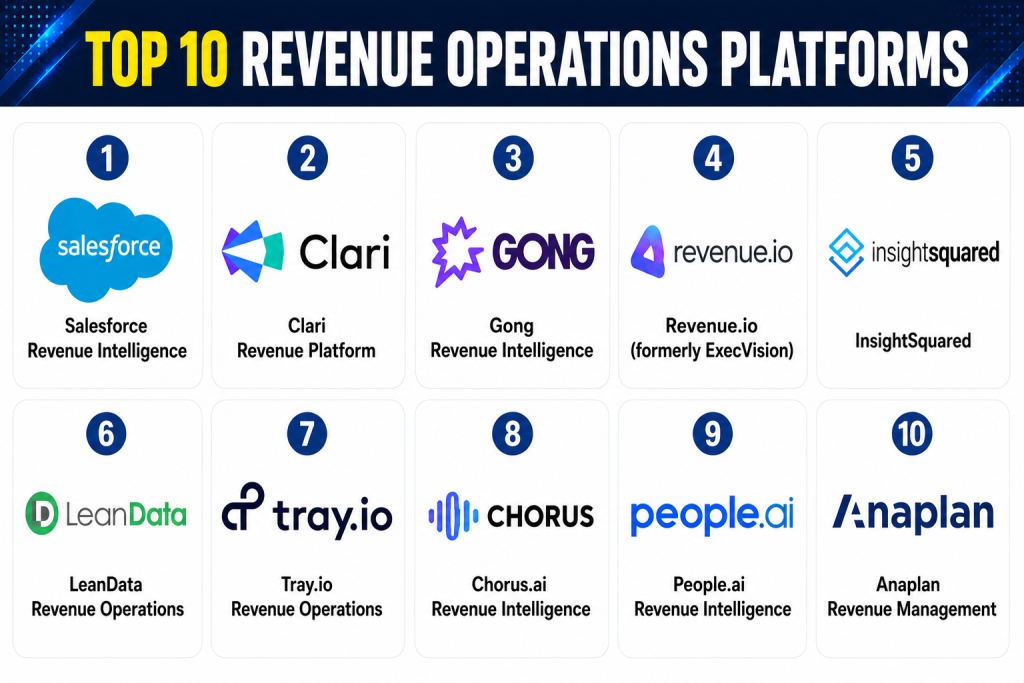
Top 10 Revenue Operations Platforms
1 — Salesforce Revenue Intelligence
Short description: Salesforce Revenue Intelligence unifies pipeline data, forecasting, and revenue analytics within the Salesforce ecosystem. It helps companies eliminate data silos and align revenue teams with shared insights and automation.
Key Features
- AI‑assisted revenue forecasting
- Pipeline diagnostics and health scoring
- Customizable dashboards
- Real‑time KPIs across sales, marketing, and customer success
- Alerts and anomaly detection
- CRM‑native workflow automation
- Mobile access
Pros
- Deep integration with Salesforce CRM
- Real‑time visibility and shared forecasts
- Scales for global revenue teams
Cons
- Best value for Salesforce clients
- Pricing may be high for smaller teams
- Advanced features require configuration
Platforms / Deployment
- Web / iOS / Android
- Cloud
Security & Compliance
- SSO/SAML, MFA, encryption, audit logs
- SOC 2, GDPR
Integrations & Ecosystem
Native with Salesforce CRM and extends to:
- Billing systems
- Marketing automation
- Customer success tools
- Analytics platforms
Support & Community
Enterprise support tiers, documentation, and a large global community.
2 — Clari Revenue Platform
Short description: Clari offers a unified revenue operations platform designed to give sales, marketing, and finance teams real‑time pipeline visibility, forecasting accuracy, and execution insights.
Key Features
- AI‑powered forecasting
- Pipeline and deal tracking
- Win/loss analytics
- Automated activity capture
- Cross‑team dashboards
- Custom metrics and tagging
- Integration with CRM and communication systems
Pros
- Natural language insights
- Strong forecasting accuracy
- Pipeline visibility across teams
Cons
- Can be expensive for mid‑market alone
- Learning curve for advanced modules
- Customization requires planning
Platforms / Deployment
- Web / Mobile
- Cloud
Security & Compliance
- Role‑based access
- Encryption at rest/in transit
- Audit logs
- Not publicly stated specific certifications
Integrations & Ecosystem
- CRM systems (Salesforce, Microsoft)
- Email/scheduling tools
- Communication platforms
- Analytics and BI tools
Support & Community
Documentation, onboarding support, and enterprise success management.
3 — Gong Revenue Intelligence
Short description: Gong captures customer interactions and leverages AI to provide revenue insights, deal risk scoring, and pipeline health diagnostics, helping revenue teams optimize execution.
Key Features
- Conversation capture and analytics
- Deal and opportunity scoring
- Pipeline risk indicators
- Forecasting insights
- Custom dashboards
- Automated alerts
Pros
- Deep conversation and behavior insights
- Helps identify execution risk early
- AI‑driven recommendations
Cons
- Strong focus on sales conversations
- Not a full financial forecasting suite
- Best with CRM integration
Platforms / Deployment
- Web / Mobile
- Cloud
Security & Compliance
- Encryption, access controls
- Not publicly stated specific certifications
Integrations & Ecosystem
- CRM systems
- Email and communications
- Analytics platforms
Support & Community
Robust documentation and support teams.
4 — Revenue.io (formerly ExecVision)
Short description: Revenue.io combines conversation intelligence with revenue insights and operational workflows to help sales and revenue operations teams drive higher execution quality and ROI.
Key Features
- Call recording and analytics
- Deal and pipeline scoring
- Activity capture and coaching workflows
- Revenue performance reporting
- Forecast validation
Pros
- Actionable calling insights
- Coaching and execution tools
- Tied to revenue outcomes
Cons
- Primarily focused on sales performance
- Limited billing or finance features
- Best paired with dedicated analytics
Platforms / Deployment
- Web / Mobile
- Cloud
Security & Compliance
- Encryption and access controls
- Not publicly stated specific certifications
Integrations & Ecosystem
- CRM systems
- Communication tools
- Analytics platforms
Support & Community
Documentation and support tiers included.
5 — InsightSquared
Short description: InsightSquared provides revenue intelligence and analytics with a focus on pipeline, forecast, and executive dashboards to help revenue operations teams drive data‑led decisions.
Key Features
- Forecast reporting and analytics
- Sales and marketing dashboards
- Pipeline health indicators
- Custom reporting builder
- Attribution analytics
Pros
- Strong visual analytics
- Flexible reporting for exec stakeholders
- Works across CRM ecosystems
Cons
- May require BI expertise
- Less native automation than some competitors
- Setup complexity for custom metrics
Platforms / Deployment
- Web / Mobile
- Cloud
Security & Compliance
- Encryption, access controls
- Not publicly stated specific certifications
Integrations & Ecosystem
- CRM integration
- Data warehouse connections
- Analytics tools
Support & Community
Support tiers and training resources.
6 — LeanData Revenue Operations
Short description: LeanData focuses on lead and account routing, attribution, and matching to improve pipeline health and alignment across revenue functions.
Key Features
- Lead-to-account matching
- Rule‑based routing
- Attribution analytics
- Pipeline reports
- Forecast alignment dashboards
Pros
- Improves data quality and GTM alignment
- Strong routing automation
- Useful for complex sales orgs
Cons
- Not full revenue forecasting suite
- Requires CRM expertise
- Mid‑market focus
Platforms / Deployment
- Web / Cloud
Security & Compliance
- Encryption and access controls
- Not publicly stated specific certifications
Integrations & Ecosystem
- CRM platforms
- Data and analytics tools
- APIs
Support & Community
Online documentation and support.
7 — Tray.io Revenue Operations
Short description: Tray.io is an automation and integration platform that supports revenue operations workflows, enabling finance, sales, and marketing teams to connect data and automate processes.
Key Features
- Workflow automation builder
- Data integration across systems
- Real‑time triggers and actions
- Custom workflow logic
- Analytics and reporting pipelines
Pros
- Flexible, no‑code automation
- Connects disparate systems
- Scales with enterprise complexity
Cons
- Not a purpose‑built revenue intelligence system
- Requires workflow design expertise
- Users must build outputs
Platforms / Deployment
- Web
- Cloud
Security & Compliance
- Encryption, access controls
- Not publicly stated compliance
Integrations & Ecosystem
- CRM, ERP, billing, marketing systems
- APIs and connectors
Support & Community
Documentation, community forums.
8 — Chorus.ai Revenue Intelligence
Short description: Chorus.ai provides call and interaction analysis to help revenue teams uncover patterns, risks, and opportunities impacting pipeline and bookings.
Key Features
- Conversation analytics
- Deal risk scoring
- Play insights
- Forecast analytics
- Custom dashboards
Pros
- Improves deal execution insights
- Voice and message capture
- Helps align pipeline behavior
Cons
- Focused on interaction intelligence
- Limited finance or billing features
- Works best coupled with CRM
Platforms / Deployment
- Web / Cloud
Security & Compliance
- Encryption and access controls
- Not publicly stated certifications
Integrations & Ecosystem
- CRM and communications
- Analytics
Support & Community
Documentation and support.
9 — People.ai Revenue Intelligence
Short description: People.ai uses AI to capture and correlate revenue activities — calls, emails, meetings — to connect execution behaviors with revenue results.
Key Features
- Automatic activity capture
- Deal scoring and insights
- Revenue correlation analytics
- Forecast indicators
- Executive dashboards
Pros
- Strong activity‑to‑revenue mapping
- AI‑driven insights
- Helps identify execution gaps
Cons
- Requires CRM presence
- Focused on activity data
- Not end‑to‑end finance system
Platforms / Deployment
- Web / Cloud
Security & Compliance
- Encryption and access controls
- Not publicly stated certifications
Integrations & Ecosystem
- CRM systems
- Communications tools
- Analytics platforms
Support & Community
Support and documentation.
10 — Anaplan Revenue Management
Short description: Anaplan provides enterprise planning that includes revenue operations planning, scenario forecasting, and multi‑dimension modeling.
Key Features
- Scenario revenue forecasting
- Driver‑based modeling
- Cross‑functional planning
- Executive dashboards
- Custom planning apps
Pros
- Excellent for complex forecast planning
- Enterprise‑grade modeling
- Flexible modeling language
Cons
- Requires planning expertise
- Implementation time can be long
- More planning than automated execution
Platforms / Deployment
- Web / Cloud
Security & Compliance
- Encryption, access controls
- Not publicly stated specific certifications
Integrations & Ecosystem
- CRM, ERP, data warehouses
- Analytics and BI platforms
Support & Community
Enterprise support and services.
Comparison Table (Top 10)
| Tool Name | Best For | Platform(s) Supported | Deployment | Standout Feature | Public Rating |
|---|---|---|---|---|---|
| Salesforce Revenue Intelligence | Salesforce customers | Web / iOS / Android | Cloud | Forecasting + CRM alignment | N/A |
| Clari Revenue Platform | Enterprise/global | Web / Mobile | Cloud | Multi‑team forecasting | N/A |
| Gong Revenue Intelligence | Sales execution insights | Web / Mobile | Cloud | Interaction analytics | N/A |
| Revenue.io | Sales performance | Web / Mobile | Cloud | Communication insights | N/A |
| InsightSquared | Revenue analytics | Web / Mobile | Cloud | Analytics & dashboards | N/A |
| LeanData | Routing & attribution | Web | Cloud | Lead routing + attribution | N/A |
| Tray.io | Integrations/automation | Web | Cloud | Workflow automation | N/A |
| Chorus.ai | Interaction analysis | Web | Cloud | Call analytics | N/A |
| People.ai | Revenue activity tracking | Web | Cloud | AI‑driven activity insights | N/A |
| Anaplan Revenue Management | Strategic planning | Web | Cloud | Scenario forecasting | N/A |
Evaluation & Scoring
| Tool Name | Core (25%) | Ease (15%) | Integrations (15%) | Security (10%) | Performance (10%) | Support (10%) | Value (15%) | Weighted Total |
|---|---|---|---|---|---|---|---|---|
| Salesforce Revenue Intelligence | 9 | 8 | 9 | 9 | 9 | 8 | 8 | 8.8 |
| Clari Revenue Platform | 9 | 8 | 8 | 8 | 9 | 7 | 7 | 8.1 |
| Gong Revenue Intelligence | 8 | 8 | 8 | 8 | 8 | 8 | 7 | 7.9 |
| Revenue.io | 8 | 8 | 7 | 8 | 8 | 7 | 7 | 7.8 |
| InsightSquared | 7 | 7 | 8 | 8 | 7 | 7 | 7 | 7.4 |
| LeanData | 7 | 8 | 7 | 8 | 7 | 7 | 8 | 7.6 |
| Tray.io | 7 | 7 | 8 | 8 | 7 | 7 | 8 | 7.6 |
| Chorus.ai | 8 | 8 | 7 | 7 | 8 | 7 | 7 | 7.7 |
| People.ai | 7 | 7 | 8 | 8 | 7 | 7 | 7 | 7.2 |
| Anaplan Revenue Management | 8 | 6 | 8 | 8 | 7 | 7 | 7 | 7.4 |
Interpretation: Scores compare platforms based on core revenue operations capabilities, ecosystem integration, ease of use, security, performance, support, and value. Higher scores indicate stronger overall offerings relative to the category.
Which Revenue Operations Tool Is Right for You?
Solo / Startup
- InsightSquared or LeanData: Strong analytics and routing for early‑stage ops.
Mid‑Market
- Gong, Revenue.io, LeanData: Deliver execution insights and workflow automation with manageable complexity.
Enterprise
- Salesforce Revenue Intelligence or Clari: Scalable, cross‑functional forecasting and revenue visibility.
Budget vs Premium
- Budget: InsightSquared, LeanData
- Premium: Salesforce, Clari
Feature Depth vs Ease of Use
- Depth: Salesforce Revenue Intelligence, Clari, Anaplan
- Ease: Gong, Revenue.io, LeanData
Integrations & Scalability
- Best for large suites: Salesforce, Clari, Tray.io
- Simpler integration: Gong, InsightSquared
Security & Compliance Needs
- Enterprise compliance readiness: Salesforce, Clari, Anaplan
- Mid‑market security: Gong, Revenue.io
Frequently Asked Questions (FAQs)
1 — What pricing models do revenue operations platforms use?
Most use subscription‑based licenses per seat or enterprise tier. Some charge for advanced analytics modules.
2 — How long does implementation take?
Months for enterprise configurations; weeks for mid‑market setup.
3 — Do these tools replace CRM?
No. They augment CRM by unifying data and enabling analytics and cross‑team workflows.
4 — Can revenue operations platforms handle forecasting?
Yes — platforms like Salesforce Revenue Intelligence and Clari specialize in forecasting models.
5 — What integrations are critical?
CRM, billing, customer success, accounting, engagement, and analytics systems.
6 — Are they suitable for SMBs?
Yes — lighter platforms or modules can fit SMB needs without full enterprise cost.
7 — Do they provide mobile access?
Most offer web and mobile‑optimized dashboards.
8 — How do they improve cross‑team alignment?
By unifying data and workflows across sales, marketing, finance, and customer success.
9 — What are common implementation challenges?
Data cleansing, integration setup, and change management across teams.
10 — What alternatives exist?
Custom BI dashboards or CRM‑only reporting can suffice for smaller teams.
Conclusion
Selecting the right Revenue Operations Platform depends on organizational complexity, existing tech stack, and strategic goals. Mid‑market teams can benefit from tools like Gong or InsightSquared to derive execution insights. Enterprise organizations should evaluate Salesforce Revenue Intelligence or Clari for comprehensive forecasting and cross‑functional alignment. Workflow and automation use cases may favor LeanData or Tray.io where integration flexibility matters most.
