Introduction
OTA Firmware Update Platforms are software solutions that allow organizations to deploy, monitor, and manage firmware updates over-the-air for connected devices. In simple terms, these platforms streamline updating embedded systems, IoT devices, and edge hardware remotely without requiring physical access.
OTA platforms are crucial for industries relying on connected devices, from automotive and industrial equipment to consumer electronics. They ensure devices are secure, compliant, and running the latest features, reducing operational disruptions and supporting scalability.
Real-world use cases include:
- Updating firmware on IoT devices in smart homes or factories
- Remote patching for automotive or transportation fleets
- Managing updates for medical devices or healthcare systems
- Deploying feature enhancements to edge devices in distributed networks
- Ensuring security compliance and vulnerability mitigation
Evaluation criteria for buyers include:
- Device provisioning and registration
- Remote firmware deployment and rollback
- Update scheduling and automation
- Security and encryption features
- Scalability for large fleets
- Device health monitoring and telemetry
- Integration with cloud and analytics platforms
- Logging, reporting, and compliance auditing
- Multi-vendor and multi-protocol support
- Cost-effectiveness and deployment flexibility
Best for: IoT product teams, automotive manufacturers, industrial operations, and enterprises with connected device fleets.
Not ideal for: Small-scale or single-device deployments where manual updates may suffice.
Key Trends in OTA Firmware Update Platforms
- AI-driven predictive update scheduling
- Integration with IoT and edge computing platforms
- Automated rollback and staged deployments
- Enhanced encryption and security for update channels
- Real-time device telemetry and monitoring
- Multi-vendor and multi-protocol support
- Cloud-native and hybrid deployment options
- Low-latency updates for edge and remote devices
- Subscription-based flexible pricing models
- Analytics for update success, failures, and device performance
How We Selected These Tools
- Evaluated market adoption and customer recognition
- Assessed completeness of features including OTA deployment, monitoring, and rollback
- Reviewed reliability and performance signals across device fleets
- Analyzed security posture and compliance capabilities
- Examined integration capabilities with cloud, IoT, and analytics platforms
- Evaluated suitability across SMB, mid-market, and enterprise organizations
- Assessed scalability, multi-protocol, and multi-vendor support
- Reviewed vendor support, documentation, and community engagement
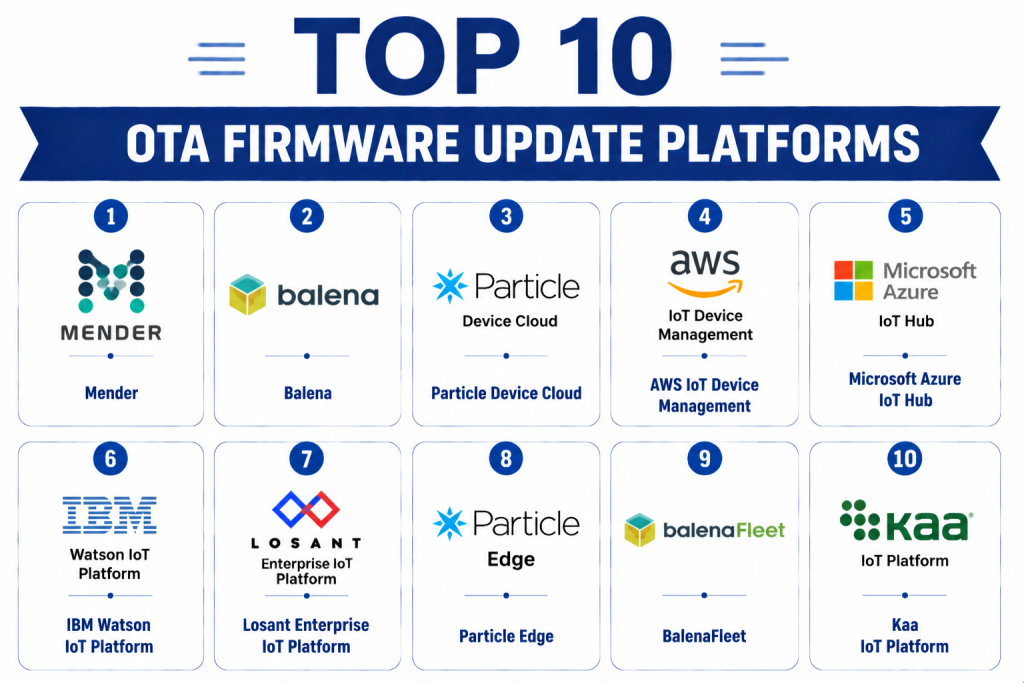
Top 10 OTA Firmware Update Platforms
1- Mender
Short description: Open-source OTA platform for deploying, managing, and monitoring firmware updates for embedded Linux devices, suitable for industrial and IoT applications.
Key Features
- Secure over-the-air updates
- Rollback capabilities
- Device grouping and phased deployments
- Analytics and reporting dashboards
- Multi-vendor support
Pros
- Open-source flexibility
- Strong update reliability
Cons
- Requires technical expertise
- Community support may vary
Platforms / Deployment
- Linux / Windows
- Cloud / On-premises
Security & Compliance
- Encryption and authentication
- Not publicly stated
Integrations & Ecosystem
- APIs for device integration
- CI/CD tools
- IoT platforms
Support & Community
- Documentation and forums
- Vendor support for enterprise plan
2- Balena
Short description: Cloud-based OTA platform for managing updates and deployments to connected IoT devices and edge systems with real-time monitoring.
Key Features
- Device provisioning and registration
- Over-the-air updates and rollback
- Remote monitoring dashboards
- Multi-device fleet management
- API and CLI tools
Pros
- Easy deployment for product teams
- Real-time device monitoring
Cons
- Limited industrial IoT features
- Premium plan required for advanced analytics
Platforms / Deployment
- Linux / Windows / macOS / iOS / Android
- Cloud
Security & Compliance
- Encryption and access control
- Not publicly stated
Integrations & Ecosystem
- APIs and SDKs
- Cloud analytics integration
- Webhooks for automation
Support & Community
- Vendor support
- Community forums
3- Particle Device Cloud
Short description: OTA platform for connected devices providing firmware updates, device monitoring, and lifecycle management for IoT fleets.
Key Features
- OTA firmware updates
- Device provisioning and registration
- Event-driven automation
- Real-time telemetry
- Analytics dashboards
Pros
- Easy setup for IoT products
- Reliable OTA updates
Cons
- Limited for industrial-scale deployments
- Less configurable for large fleets
Platforms / Deployment
- Linux / Windows / macOS / iOS / Android
- Cloud
Security & Compliance
- Encryption and access control
- Not publicly stated
Integrations & Ecosystem
- Cloud analytics
- APIs and webhooks
- SDKs for device management
Support & Community
- Vendor support
- Developer community
4- AWS IoT Device Management
Short description: Cloud-native OTA platform to securely manage and update firmware for IoT devices at scale with integration to AWS analytics.
Key Features
- Secure device provisioning
- OTA updates with rollback
- Fleet monitoring and health checks
- Integration with AWS ML and analytics
- Policy-based update management
Pros
- Highly scalable
- Tight integration with AWS ecosystem
Cons
- AWS expertise required
- Cost may scale with device numbers
Platforms / Deployment
- Linux / Windows / macOS / iOS / Android
- Cloud
Security & Compliance
- Encryption, IAM, audit logs
- SOC 2, ISO 27001, GDPR
Integrations & Ecosystem
- AWS cloud services
- Machine learning and analytics
- APIs
Support & Community
- AWS enterprise support
- Developer forums
5- Microsoft Azure IoT Hub
Short description: OTA platform that allows enterprises to manage firmware updates, device provisioning, and telemetry for connected devices.
Key Features
- Device registration and authentication
- OTA firmware updates
- Telemetry collection and monitoring
- Integration with Azure cloud services
- Policy-driven update management
Pros
- Scalable enterprise solution
- Analytics and AI integration
Cons
- Azure-focused ecosystem
- Premium plan required for advanced features
Platforms / Deployment
- Linux / Windows
- Cloud
Security & Compliance
- SSO, RBAC, encryption
- ISO 27001, SOC 2
Integrations & Ecosystem
- Azure analytics and IoT Edge
- APIs and SDKs
- CI/CD integration
Support & Community
- Microsoft support tiers
- Developer community
6- IBM Watson IoT Platform
Short description: Enterprise OTA platform for deploying firmware updates, monitoring device health, and managing distributed IoT fleets.
Key Features
- Secure OTA updates
- Device provisioning
- Telemetry monitoring
- AI-driven insights
- Fleet and device analytics
Pros
- AI-assisted management
- Industrial IoT ready
Cons
- Enterprise pricing
- Complex setup
Platforms / Deployment
- Linux / Windows / macOS / iOS / Android
- Cloud / Hybrid
Security & Compliance
- Encryption, RBAC
- Not publicly stated
Integrations & Ecosystem
- Cloud analytics
- IoT and industrial systems
- APIs
Support & Community
- Enterprise support tiers
- Developer forums
7- Losant Enterprise IoT Platform
Short description: Provides OTA updates, workflow automation, and device monitoring for distributed IoT deployments.
Key Features
- OTA firmware updates
- Edge and cloud device monitoring
- Automation workflows
- Analytics dashboards
- Device provisioning
Pros
- Low-code workflow automation
- Flexible deployment options
Cons
- Smaller ecosystem
- Enterprise features require subscription
Platforms / Deployment
- Linux / Windows / macOS / iOS / Android
- Cloud / Hybrid
Security & Compliance
- Encryption, RBAC
- Not publicly stated
Integrations & Ecosystem
- APIs for device integration
- Webhooks
- Cloud analytics
Support & Community
- Vendor support
- Developer community
8- Particle Edge
Short description: Edge OTA platform for updating firmware, monitoring devices, and managing distributed IoT endpoints.
Key Features
- OTA firmware updates
- Device telemetry and monitoring
- Edge workflow management
- Security and authentication
- Fleet dashboards
Pros
- Real-time monitoring at edge
- Simple for IoT devices
Cons
- Limited for industrial scale
- Smaller integration ecosystem
Platforms / Deployment
- Linux / Windows / macOS / iOS / Android
- Cloud / Edge
Security & Compliance
- Encryption, access control
- Not publicly stated
Integrations & Ecosystem
- Cloud analytics
- APIs and SDKs
- IoT edge connectors
Support & Community
- Documentation and forums
- Vendor support
9- BalenaFleet
Short description: Provides cloud-managed OTA updates and monitoring for fleets of connected devices with rollback and scheduling.
Key Features
- OTA firmware updates with rollback
- Fleet monitoring dashboards
- Device provisioning and registration
- Update scheduling
- Analytics and reporting
Pros
- Simplifies fleet management
- Affordable for mid-size deployments
Cons
- Limited industrial IoT features
- Smaller enterprise ecosystem
Platforms / Deployment
- Linux / Windows / macOS / iOS / Android
- Cloud
Security & Compliance
- Encryption
- Not publicly stated
Integrations & Ecosystem
- APIs
- Cloud analytics
- Webhooks
Support & Community
- Documentation
- Community support
10- Kaa IoT Platform
Short description: Open-source OTA platform for firmware updates, device management, and real-time monitoring across heterogeneous IoT fleets.
Key Features
- Device provisioning and onboarding
- OTA firmware updates
- Monitoring and analytics dashboards
- Multi-protocol support
- Event-driven automation
Pros
- Open-source flexibility
- Supports multiple device types
Cons
- Requires technical expertise
- Community-based support
Platforms / Deployment
- Linux / Windows / macOS
- Cloud / On-premises
Security & Compliance
- Not publicly stated
Integrations & Ecosystem
- APIs for device and cloud integration
- SDKs for custom applications
Support & Community
- Community forums
- Documentation
Comparison Table (Top 10 OTA Firmware Update Platforms)
| Tool Name | Best For | Platform(s) Supported | Deployment | Standout Feature | Public Rating |
|---|---|---|---|---|---|
| Mender | Industrial & IoT fleets | Linux / Windows | Cloud / On-prem | Open-source OTA management | N/A |
| Balena | Product IoT deployments | Linux / Windows / macOS / iOS / Android | Cloud | Real-time fleet monitoring | N/A |
| Particle Device Cloud | IoT products | Linux / Windows / macOS / iOS / Android | Cloud | OTA updates for connected devices | N/A |
| AWS IoT Device Management | Enterprise IoT | Linux / Windows / macOS / iOS / Android | Cloud | Scalable AWS integration | N/A |
| Microsoft Azure IoT Hub | Enterprise IoT | Linux / Windows | Cloud | AI & analytics integration | N/A |
| IBM Watson IoT Platform | Industrial & enterprise | Linux / Windows / macOS / iOS / Android | Cloud / Hybrid | AI-driven edge management | N/A |
| Losant Enterprise IoT Platform | Mid-market & Enterprise | Linux / Windows / macOS / iOS / Android | Cloud / Hybrid | Workflow automation & monitoring | N/A |
| Particle Edge | Edge IoT deployments | Linux / Windows / macOS / iOS / Android | Cloud / Edge | Edge OTA updates | N/A |
| BalenaFleet | Mid-size IoT fleets | Linux / Windows / macOS / iOS / Android | Cloud | Fleet OTA scheduling & rollback | N/A |
| Kaa IoT Platform | Open-source IoT fleets | Linux / Windows / macOS | Cloud / On-prem | Open-source flexibility | N/A |
Evaluation & Scoring of OTA Firmware Update Platforms
| Tool Name | Core (25%) | Ease (15%) | Integrations (15%) | Security (10%) | Performance (10%) | Support (10%) | Value (15%) | Weighted Total (0–10) |
|---|---|---|---|---|---|---|---|---|
| Mender | 9 | 7 | 8 | 7 | 8 | 7 | 8 | 7.9 |
| Balena | 8 | 8 | 7 | 7 | 8 | 7 | 7 | 7.6 |
| Particle Device Cloud | 7 | 8 | 6 | 7 | 7 | 7 | 7 | 7.0 |
| AWS IoT Device Management | 9 | 7 | 9 | 9 | 9 | 8 | 7 | 8.6 |
| Microsoft Azure IoT Hub | 8 | 7 | 8 | 8 | 8 | 8 | 7 | 7.8 |
| IBM Watson IoT Platform | 8 | 7 | 8 | 7 | 8 | 7 | 7 | 7.6 |
| Losant Enterprise IoT Platform | 7 | 8 | 7 | 7 | 7 | 7 | 7 | 7.2 |
| Particle Edge | 7 | 7 | 6 | 7 | 7 | 7 | 7 | 6.8 |
| BalenaFleet | 6 | 8 | 6 | 6 | 7 | 7 | 7 | 6.8 |
| Kaa IoT Platform | 6 | 7 | 6 | 6 | 7 | 7 | 8 | 6.8 |
Interpretation: Weighted totals provide a comparative view of OTA update capabilities, ease of use, integration potential, and overall value for organizations managing device fleets.
Which OTA Firmware Update Tool Is Right for You?
Solo / Freelancer
Particle Device Cloud or Kaa IoT for small or prototype device deployments.
SMB
Losant Enterprise IoT Platform or BalenaFleet for cost-effective OTA updates and monitoring.
Mid-Market
Particle Edge or Balena for scalable updates and fleet automation.
Enterprise
AWS IoT Device Management, Microsoft Azure IoT Hub, or IBM Watson IoT Platform for secure, scalable, and AI-driven OTA management.
Budget vs Premium
Open-source Kaa IoT and Particle Cloud for budget-conscious teams. Premium enterprises benefit from AWS, Azure, or IBM platforms.
Feature Depth vs Ease of Use
Complex fleets require AWS, Azure, or IBM. Smaller fleets are best managed with Losant or Particle platforms.
Integrations & Scalability
AWS, Azure, and IBM provide extensive integrations and can scale globally.
Security & Compliance Needs
Enterprises needing secure OTA, encryption, audit logs, and compliance certifications should focus on AWS, Azure, or IBM platforms.
Frequently Asked Questions (FAQs)
1- What is an OTA Firmware Update Platform?
It is software that enables remote deployment and management of firmware updates to connected devices across fleets.
2- Can these platforms handle large fleets?
Yes, enterprise platforms like AWS IoT Device Management and Azure IoT Hub scale to tens of thousands of devices.
3- Do these tools support rollback?
Most platforms include rollback capabilities to restore devices to previous firmware versions if updates fail.
4- Are these platforms suitable for industrial IoT?
Yes, platforms like IBM Watson IoT, PTC ThingWorx, and AWS IoT support industrial and enterprise environments.
5- Can they integrate with cloud analytics?
Yes, these platforms integrate with cloud-based analytics, AI, and operational dashboards.
6- How secure are OTA update platforms?
Enterprise solutions offer encryption, authentication, RBAC, and audit logging, with some supporting SOC 2, ISO, or GDPR compliance.
7- Are open-source options available?
Yes, Mender and Kaa IoT provide open-source flexibility for custom OTA workflows.
8- Can these platforms monitor device health?
Yes, all platforms provide real-time monitoring, telemetry dashboards, and alerts.
9- Are they suitable for small-scale deployments?
Yes, Particle Cloud, Balena, and Kaa IoT are suitable for smaller fleets or prototype devices.
10- What are common adoption challenges?
Integration complexity, device heterogeneity, network reliability, and secure deployment are common challenges.
Conclusion
OTA Firmware Update Platforms help organizations efficiently manage device firmware across distributed fleets, ensuring security, reliability, and compliance. Smaller teams may use lightweight or open-source solutions, while enterprises benefit from scalable, AI-enabled, and fully integrated platforms. Shortlist , run pilot deployments, and validate security and integration before full-scale rollout.
