Introduction
Product reviews and UGC (User‑Generated Content) platforms are software tools that help brands collect, manage, display, and analyze customer reviews, ratings, photos, videos, and other content created by real users. These platforms make it easier to build trust, improve conversion rates, increase SEO visibility, and tap into real customer sentiment. In , with consumers relying on peer opinions more than ever, integrating reviews and user content into buying journeys is a competitive necessity.
Real‑world use cases include:
- Displaying verified customer reviews on product pages to boost conversion.
- Aggregating user‑submitted photos and videos for social proof in ecommerce.
- Collecting feedback via surveys, Q&A modules, and rating widgets.
- Syndicating reviews across search engines and marketplaces.
- Hosting community discussion and product feedback loops.
Buyers evaluating product review and UGC platforms should consider:
- Ease of collecting reviews (email invites, onsite widgets, QR codes).
- Moderation and spam control tools.
- Types of UGC supported (ratings, text, photos, videos).
- Integration with ecommerce platforms and CMS.
- SEO and structured data support for visibility in search.
- Analytics on sentiment, trends, and conversion impact.
- Customization and UI integration with sites and apps.
- Compliance with privacy laws and terms of service.
- Scalability and automation features.
- Pricing models and support resources.
Best for: Ecommerce brands, SaaS companies showing customer satisfaction, marketplaces seeking rich content layers, and marketers focused on engagement and conversion.
Not ideal for: Small brochure sites without product listings or organizations with minimal user interaction where UGC adds little value.
Key Trends in Product Reviews & UGC Platforms
- AI moderation and fraud detection to filter spam and fake reviews.
- Rich media UGC (photos, videos, livestream highlights) embedded directly on product pages.
- Omnichannel syndication of reviews to search engines, marketplaces, and ad platforms.
- Sentiment and trend analytics tied to natural language processing.
- Real‑time review capture flows via mobile push, SMS, and QR codes.
- Integration with personalization engines to show adaptive UGC content.
- Gamification and loyalty integration to incentivize reviews.
- Structured data markup to enhance SEO and rich snippets.
- Multi‑language support for global audiences.
- Privacy and compliance automation for GDPR/CCPA review capture and display.
How We Selected These Tools (Methodology)
- Evaluated market adoption and mindshare for product review and UGC platforms.
- Assessed feature completeness including collection, moderation, display, and analytics.
- Reviewed integration capabilities with ecommerce systems, CMS, and marketplaces.
- Verified security posture and compliance with data privacy requirements.
- Considered scalability for large catalogs and high‑traffic sites.
- Assessed automation, AI features, and moderation tools.
- Analyzed analytics capabilities tied to conversion and sentiment.
- Prioritized solutions with strong developer ecosystems and extensibility.
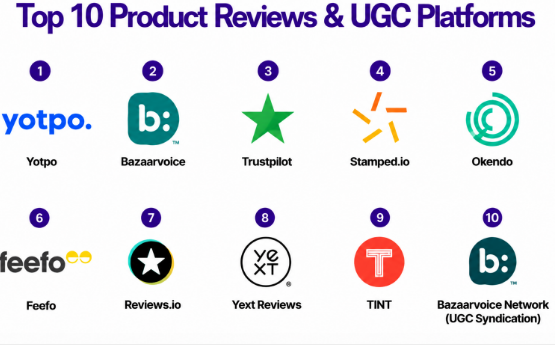
Top 10 Product Reviews & UGC Platforms
1 — Yotpo
Short description: Yotpo is an integrated reviews and UGC platform enabling brands to collect and display reviews, photos, Q&A, and ratings across websites, social channels, and marketplaces.
Key Features
- Review and rating collection via email and onsite prompts.
- Photo and video UGC collection.
- Q&A modules on product pages.
- SEO‑optimized widgets and schema markup.
- Integration with ecommerce platforms and ads.
Pros
- Robust UGC ecosystem tied to customer lifecycles.
- Strong SEO and syndication features.
Cons
- Pricing can be costly for small businesses.
- Feature set may be complex for basic review needs.
Platforms / Deployment
- Web / Cloud
Security & Compliance
- Encryption, role access
- Not publicly stated
Integrations & Ecosystem
Connects with ecommerce platforms, marketing tools, social channels.
Support & Community
Documentation, online support, customer success teams
2 — Bazaarvoice
Short description: Bazaarvoice provides enterprise‑grade review, Q&A, and UGC solutions that capture and distribute content across product pages, search partners, and marketplaces.
Key Features
- Global review syndication network.
- Intelligent moderation and spam filtering.
- Visual UGC (photos, videos).
- Analytics and sentiment scoring.
- Q&A and curated UGC displays.
Pros
- Large syndication footprint and enterprise integrations.
- Strong content governance and moderation.
Cons
- Enterprise focus means higher cost.
- Setup requires configuration effort.
Platforms / Deployment
- Web / Cloud
Security & Compliance
- Encryption, access roles
- Not publicly stated
Integrations & Ecosystem
CRM, ecommerce, analytics, marketplace partners
Support & Community
Enterprise support and documentation
3 — Trustpilot
Short description: Trustpilot is a consumer‑review platform where customers leave public reviews about brands and services, which companies can embed and leverage for social proof.
Key Features
- Public review collection and rating displays.
- Moderation and review management.
- SEO‑optimized review pages.
- Analytics on sentiment and performance.
- Integration options for brand sites.
Pros
- Strong brand trust signals with public reviews.
- Easy collection flows for consumers.
Cons
- Public platform means less control over content.
- Smaller UGC types (limited media).
Platforms / Deployment
- Web / Cloud
Security & Compliance
- Encryption
- Not publicly stated
Integrations & Ecosystem
Web embeds, commerce systems, analytics
Support & Community
Help docs and brand support
4 — Stamped.io
Short description: Stamped.io provides review, rating, Q&A, and photo/video UGC tools focused heavily on ecommerce brands and direct conversions.
Key Features
- Review requests via email and SMS.
- Photo and video review capture.
- Q&A and UGC galleries.
- Customizable widgets and layouts.
- Loyalty and referral integrations.
Pros
- Good balance of features and pricing.
- Strong media UGC options.
Cons
- Smaller integration ecosystem than some enterprise tools.
- Learning curve for advanced templating.
Platforms / Deployment
- Web / Cloud
Security & Compliance
- Encryption
- Not publicly stated
Integrations & Ecosystem
Ecommerce platforms, marketing tools
Support & Community
Documentation, email support
5 — Okendo
Short description: Okendo is a reviews and UGC platform built for ecommerce brands, with a focus on rich media, customer segmentation, and conversion analytics.
Key Features
- Photo and video reviews.
- Customer segmentation for targeted review campaigns.
- Analytics dashboard for performance.
- Loyalty and rewards support tied to UGC.
- Customizable display widgets.
Pros
- Strong analytics and segmentation tools.
- Designed for conversion optimization.
Cons
- Pricing may escalate with feature add‑ons.
- Less suitable for non‑commerce use cases.
Platforms / Deployment
- Web / Cloud
Security & Compliance
- Encryption, access roles
- Not publicly stated
Integrations & Ecosystem
Ecommerce and analytics integrations
Support & Community
Guides, email support
6 — Feefo
Short description: Feefo is a review and ratings platform emphasizing verified customer reviews with built‑in compliance and moderation tools.
Key Features
- Verified review invitations.
- Fraud and fake review detection.
- Display widgets and badges.
- Analytics and reporting dashboards.
- Guides and response tools.
Pros
- Verified review emphasis increases trust.
- Solid moderation tools.
Cons
- Limited rich media support.
- Smaller ecosystem than enterprise platforms.
Platforms / Deployment
- Web / Cloud
Security & Compliance
- Encryption
- Not publicly stated
Integrations & Ecosystem
Ecommerce and CRM systems
Support & Community
Documentation, support teams
7 — Reviews.io
Short description: Reviews.io enables businesses to collect, manage, and publish customer reviews and ratings including photos and videos.
Key Features
- Automated review requests.
- Photo/video review capture.
- Custom review displays.
- SEO‑optimized structured data.
- Analytics dashboards.
Pros
- Good media support and SEO focus.
- Flexible display templates.
Cons
- Reporting could be more advanced.
- Enterprise features are limited.
Platforms / Deployment
- Web / Cloud
Security & Compliance
- Secure payments & encryption
- Not publicly stated
Integrations & Ecosystem
Ecommerce platforms, analytics
Support & Community
Documentation, email support
8 — Yext Reviews
Short description: Yext Reviews focuses on capturing, aggregating, and displaying reviews across search engines, maps, and listings, improving discoverability and reputation.
Key Features
- Review collection and response tools.
- Syndication to search engines and directories.
- Analytics on sentiment and review trends.
- Notification and moderation tools.
- Unified dashboard for local listings.
Pros
- Strong focus on discoverability and local search.
- Aggregates review signals across many platforms.
Cons
- Less tailored for product pages.
- Limited UGC media support.
Platforms / Deployment
- Web / Cloud
Security & Compliance
- Encryption, access roles
- Not publicly stated
Integrations & Ecosystem
Listings, CRM, analytics
Support & Community
Online documentation, support
9 — TINT
Short description: TINT aggregates UGC across social platforms and brand touchpoints, enabling curated displays of photos, videos, and social stories for commerce and marketing.
Key Features
- Social media UGC aggregation.
- Customizable UGC walls and galleries.
- Moderation and filtering workflows.
- Analytics on engagement.
- API and embed tools.
Pros
- Strong social media UGC integration.
- Highly visual UGC displays.
Cons
- Not focused on traditional reviews.
- Requires moderation workflows.
Platforms / Deployment
- Web / Cloud
Security & Compliance
- Encryption
- Not publicly stated
Integrations & Ecosystem
Social platforms, websites
Support & Community
Documentation, support
10 — Bazaarvoice Network (UGC Syndication)
Short description: Bazaarvoice Network enables brands to syndicate product reviews to retail and marketplace partners, expanding reach and building social proof across channels.
Key Features
- Review syndication across partners.
- Amazon and retail integrations.
- Global moderation and consistency tools.
- Rich analytics on syndicated content.
- Multi‑locale support.
Pros
- Broad syndication footprint.
- Enterprise focus on multi‑channel UGC.
Cons
- Enterprise pricing.
- Setup and partner agreements add complexity.
Platforms / Deployment
- Web / Cloud
Security & Compliance
- Encryption, access controls
- Not publicly stated
Integrations & Ecosystem
Retail partners, ecommerce, CRM
Support & Community
Dedicated support
Comparison Table (Top 10)
| Tool Name | Best For | Platform(s) Supported | Deployment | Standout Feature | Public Rating |
|---|---|---|---|---|---|
| Yotpo | Ecommerce UGC platform | Web | Cloud | Integrated reviews + media | N/A |
| Bazaarvoice | Enterprise UGC & syndication | Web | Cloud | Syndication & partner UGC | N/A |
| Trustpilot | Public brand reviews | Web | Cloud | Public consumer trust reviews | N/A |
| Stamped.io | Ecommerce reviews & media | Web | Cloud | Photo/video reviews | N/A |
| Okendo | Reviews + analytics | Web | Cloud | Segmentation + conversion | N/A |
| Feefo | Verified reviews | Web | Cloud | Verified customer reviews | N/A |
| Reviews.io | Flexible review capture | Web | Cloud | SEO‑focused structured reviews | N/A |
| Yext Reviews | Search engine review syndication | Web | Cloud | Local & search reviews | N/A |
| TINT | Social UGC aggregation | Web | Cloud | Social media UGC walls | N/A |
| Bazaarvoice Network | Syndicated reviews | Web | Cloud | UGC distribution across partners | N/A |
Evaluation & Scoring of Product Reviews & UGC Platforms
| Tool Name | Core | Ease | Integrations | Security | Performance | Support | Value | Weighted Total |
|---|---|---|---|---|---|---|---|---|
| Yotpo | 9 | 8 | 9 | 8 | 9 | 8 | 7 | 8.5 |
| Bazaarvoice | 9 | 7 | 9 | 8 | 9 | 8 | 7 | 8.4 |
| Trustpilot | 8 | 9 | 7 | 8 | 8 | 8 | 8 | 8.1 |
| Stamped.io | 8 | 8 | 8 | 7 | 8 | 7 | 8 | 7.9 |
| Okendo | 8 | 8 | 8 | 7 | 8 | 8 | 7 | 7.9 |
| Feefo | 7 | 8 | 7 | 8 | 7 | 7 | 8 | 7.6 |
| Reviews.io | 8 | 8 | 7 | 7 | 8 | 7 | 8 | 7.8 |
| Yext Reviews | 7 | 8 | 8 | 8 | 7 | 7 | 8 | 7.7 |
| TINT | 7 | 7 | 7 | 7 | 7 | 6 | 8 | 7.3 |
| Bazaarvoice Network | 9 | 7 | 9 | 8 | 9 | 8 | 7 | 8.4 |
Interpretation: Weighted totals reflect overall balance across core UGC features, ease of use, integrations, security, performance, support, and value. Higher scores indicate stronger suitability for broad UGC and review use cases.
Which Product Reviews & UGC Platform Is Right for You?
Solo / Small Ecommerce Sellers
- Stamped.io, Reviews.io: Flexible review collection and media support with affordable pricing.
SMB Ecommerce Brands
- Yotpo, Okendo: Strong review + UGC integrations with segmentation, automation, and analytics.
Enterprise
- Bazaarvoice, Bazaarvoice Network: Syndication and multi‑channel UGC distribution for global brands.
SEO & Public Trust Focus
- Trustpilot, Yext Reviews: Large public review footprints and search syndication.
Social UGC & Visual Displays
- TINT: Aggregates social content for visual commerce and community engagement.
Feature Depth vs Ease of Use
- Platforms like Yotpo and Bazaarvoice offer deep functionality but may require setup; Stamped.io and Reviews.io are easier for quick adoption.
Integrations & Scalability
- Enterprise platforms integrate with major commerce stacks, marketplaces, and analytics tools for high‑volume catalogs.
Security & Compliance Needs
- Enterprise offerings include role‑based access, encryption, and moderation controls; ensure privacy compliance for review capture.
Frequently Asked Questions (FAQs)
1. What types of UGC do these platforms support?
Most support ratings, text reviews, photos, videos, Q&A, and social media content depending on platform focus.
2. How do platforms prevent fake reviews?
Many use AI moderation, verified purchase flags, and spam filtering to reduce fake content.
3. Can reviews improve SEO?
Yes—structured review data and schema markup help rich snippets and search visibility.
4. Do these tools integrate with ecommerce platforms?
Yes—popular integrations include Shopify, BigCommerce, Magento, Salesforce Commerce, and custom APIs.
5. Are review syndication options available?
Some platforms offer syndication to partners, retailers, and search engines.
6. Can users submit photo and video reviews?
Many platforms support rich media UGC to boost visual social proof.
7. How do analytics help?
Analytics reveal sentiment trends, conversion impact, and UGC performance across pages and channels.
8. Is community Q&A included?
Yes—several tools include user Q&A modules to drive engagement and reduce support costs.
9. Are these platforms mobile‑friendly?
Most provide responsive widgets and mobile capture tools to collect on‑the‑go reviews.
10. What compliance tools exist?
Platforms often include moderation rules, consent tracking, and privacy settings to meet GDPR/CCPA needs.
Conclusion
Product reviews and UGC platforms are indispensable in for building trust, improving conversion, enhancing SEO, and generating rich user content across ecommerce and digital experiences. Small sellers benefit from platforms like Stamped.io and Reviews.io, mid‑market brands gain value from Yotpo and Okendo, while enterprises should consider Bazaarvoice or Bazaarvoice Network for global reach and syndication. To select the right tool, shortlist based on catalog size, integration needs, budget, and expected UGC volume; pilot with test pages; and validate how analytics and moderation features align with your growth strategy.
