Last updated: 29 November 2026
AI is at the heart of our innovation economy because it now attracts most venture capital by value, helps drive record corporate research spending, and is spreading into everyday work. It is a general-purpose technology: one capability can be applied to software, science, services and manufacturing.
That does not mean the payoff is settled. The evidence for investment is very strong. The evidence for economy-wide productivity is still developing. This article separates the two, using figures available in late November 2026.
Why AI is at the heart of the innovation economy
An innovation economy grows by turning new knowledge into better products, processes and firms. AI currently touches each stage of that chain.
Capital has shifted toward AI
The World Intellectual Property Organization (WIPO) reports in its Global Innovation Index 2026 that global venture capital deal value rose 27.9% to $510 billion in 2025. AI took 53% of that value, up from about 27% around late 2022.
In the first half of 2026, AI’s share reached 77% of value but only 36% of deals. Large sums are going into a comparatively small set of transactions. Total deal counts also slipped 1.4% in 2025, so a booming headline figure does not mean funding became easier for every founder.
Stanford’s AI Index 2026 uses a broader measure. It puts global corporate AI investment at $581.7 billion in 2025, more than double the year before. Private investment made up $344.7 billion. The United States accounted for $285.9 billion of private AI investment, against $12.4 billion for China. Private figures do not capture all public spending, so read country gaps with care.
Research budgets are rising
WIPO found that research and development by the world’s largest corporate investors reached a record $1.5 trillion in 2025, up 5.8% in real terms. Software and AI companies, along with defence-related work, drove that growth.
AI sits within a wider science boom. WIPO values deep-science startups, in fields such as semiconductors, robotics, life sciences and quantum computing, at $7.6 trillion combined. That figure covers far more than AI companies.
WIPO also adds a useful caution: technological progress in 2025 came mainly through refinement and diffusion, not sudden breakthroughs.
Use is spreading, but unevenly
The AI Index reports that 88% of surveyed organisations used AI in 2025, and 70% used generative AI in at least one business function. Deployment of AI agents remained in single digits across nearly all functions.
Official statistics show a more restrained picture. The OECD reports that about 20% of enterprises with at least 10 employees used AI in 2025, up from 8.7% in 2023. Among firms with 250 or more employees, the figure was 52%.
The 88% and 20% results come from different samples and definitions, so they should not be compared directly. Always ask who was surveyed and what counted as “using AI”.
Individuals show a gap too. In the OECD data, 37% used generative AI in 2025: 68% of people aged 16 to 24, but only 14% of those aged 55 to 74.
How AI turns into economic value
Investment and model releases are inputs. Value appears only when people and organisations change what they can produce.
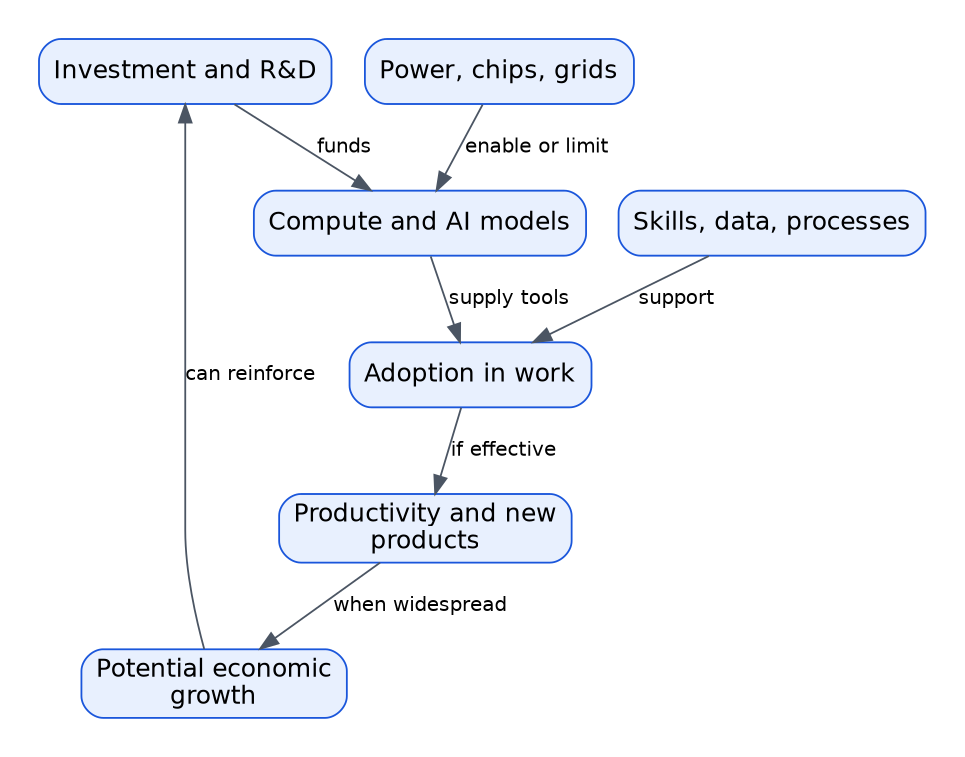
- Doing existing tasks faster: drafting, coding, summarising and answering customer queries.
- Improving quality: catching defects, searching large document sets or supporting less experienced staff.
- Speeding up discovery: helping researchers screen options, analyse data and write research software. Promising candidates still need real-world validation.
- Creating new products: services that were previously too slow or costly to offer.
Each route depends on complements: usable data, suitable software, trained people and redesigned processes. Buying a model licence supplies none of these automatically.
What the productivity evidence shows
Results depend heavily on what is measured. A gain on one task is not the same as a gain for a firm or a country.
| Evidence | Finding | What it does not show |
|---|---|---|
| Task studies summarised by the AI Index 2026 | Gains of 14–15% in customer support, 26% in software development and 50% in marketing output | That whole firms or economies improve by the same amounts |
| BIS Working Paper 1325 (January 2026), over 12,000 EU and US firms | AI adoption raised labour productivity by about 4%, with no adverse short-run effect on firm employment found | A 4% gain every year, or long-run job effects |
| OECD projection for G7 economies (2025) | In countries with high AI exposure and wider adoption, such as the US and UK, AI could add 0.4–1.3 percentage points to annual labour productivity growth over ten years, depending on the scenario. Gains in several other G7 economies could be up to 50% smaller | An observed result, or one range that applies to every G7 member; it is a model-based forecast |
| METR randomised trial (2025), 16 experienced open-source developers | Tasks took 19% longer when AI tools were allowed | How current tools perform, or how other developers fare |
The METR result is now historical. In February 2026, the organisation said its follow-up data gave an unreliable signal, partly because of who chose to take part and which tasks they were willing to do without AI. The lasting lesson is to measure outcomes instead of relying on how fast a tool feels.
BIS Working Paper 1325, whose authors include European Investment Bank staff, also found that benefits were concentrated in medium and large firms. Investment in software, data and workforce training strengthened the gains.
What could limit the AI innovation economy
Power, chips and grids
The International Energy Agency (IEA) estimates that data centres used 485 TWh of electricity in 2025. It projects about 950 TWh in 2030, roughly 3% of global demand. These totals cover all data centres, not only AI.
Demand at AI-focused facilities grew 50% in 2025. The IEA identifies slow grid connections, supply-chain constraints, planning pressure and community concerns as bottlenecks. Falling energy use per task helps, but rising usage can outweigh it.
Concentration and access
Money, computing capacity and adoption are clustered in particular countries and larger organisations. Smaller firms face barriers the OECD highlights, including limited finance, skills shortages, weak digital infrastructure, integration difficulty and legal uncertainty.
Jobs and skills
In the United States, employment for software developers aged 22 to 25 has fallen nearly 20% from 2024, according to the AI Index, even as headcount for older developers continued to grow.
One figure for one group cannot establish the effect of AI on all jobs, or isolate every cause. It is still a reason to plan how junior staff will gain experience.
Trust and regulation
Recorded AI incidents rose from 233 in 2024 to 362 in 2025, according to the AI Index. Rules are also changing. In the European Union, an amending law, Regulation (EU) 2026/1744, was published in July 2026. It moved obligations for stand-alone high-risk systems listed in Annex III to 2 December 2027, and for those covered by Annex I product rules to 2 August 2028.
This was not a pause on the whole AI Act. Some obligations already apply, so check which ones cover your system.
Best practices for turning AI into innovation
- Start with a problem. Choose a workflow with a clear cost, delay or quality issue.
- Record a baseline. Measure time, error rate and cost before introducing AI.
- Use a comparison group. Randomly assign similar tasks to AI-assisted and usual methods where practical.
- Count the full cost. Include review, rework, integration, training and usage fees.
- Protect data. Decide what may be sent to a tool before the pilot starts.
- Name an owner. Someone must be accountable for outputs and for stopping the system.
- Set a decision rule. Agree in advance what result means expand, revise or stop.
Hands-on exercise: test one AI workflow
Pick one repeatable task, such as drafting support replies. Collect at least 20 comparable cases for each method as a first look; more may be needed for a reliable decision. Record total minutes, including checking and corrections, and whether each result passed review.
The Python example below uses invented numbers to show the calculation. It has not been tested here.
from statistics import median

# Hypothetical data: (total_minutes, passed_review)
usual = [(30, True), (28, True), (35, False), (32, True), (29, True)]
assisted = [(22, True), (25, False), (20, True), (31, True), (21, False)]

def summarise(rows):
    minutes = sum(m for m, _ in rows)
    passed = sum(ok for _, ok in rows)
    return {
        "median_minutes": median(m for m, _ in rows),
        "pass_rate": passed / len(rows),
        "minutes_per_pass": minutes / passed if passed else None,
    }

for name, rows in (("usual", usual), ("assisted", assisted)):
    print(name, summarise(rows))
In this made-up sample, the assisted method has a lower median time but also a lower pass rate. Minutes per accepted result is slightly better for the usual method (38.5 against about 39.7). Speed alone would give the wrong impression.
Replace the sample data with your own. Then write down your decision rule, for example: expand only if minutes per accepted result fall and the pass rate does not decline. A fuller test should also price rework on failed cases.
Common mistakes and how to fix them
| Mistake | Better approach |
|---|---|
| Treating funding as proof of value | Track customer, quality and cost outcomes |
| Counting licences or logins as adoption success | Measure completed work in a defined process |
| Timing only the first draft | Include verification and rework |
| Applying a published percentage to your business case | Run a local comparison |
| Training only technical staff | Train users, reviewers and process owners |
| Depending on one supplier without a fallback | Keep portable data, test sets and an exit plan |
Frequently asked questions
What is an innovation economy?
It is an economy in which growth depends substantially on creating and applying new knowledge, through research, skills, new firms and improved processes.
Has AI already raised national productivity?
Some firm and task studies show gains. Attributing national productivity changes to AI is much harder, and long-range figures such as the OECD’s are projections. Its 0.4–1.3 point annual range applies to high-exposure countries such as the US and UK; several other G7 economies may see considerably less.
Is AI investment a bubble?
The figures here cannot answer that. They show heavy concentration, which raises exposure if expected returns do not arrive. The IEA also notes that data-centre growth depends on capital markets and investor sentiment.
Can small businesses benefit?
Yes, potentially, but adoption is lower among them and benefits are not automatic. A narrow pilot, staff training and good data are sensible starting points.
What should policymakers focus on?
The evidence points to diffusion as well as invention: skills, connectivity, finance for smaller firms, reliable power, clear rules and better measurement.
The bottom line
AI is central to today’s innovation economy because capital, research and adoption are converging on it. Whether that becomes broad prosperity depends on what happens after investment: useful applications, capable people, accessible infrastructure and honest measurement.