Introduction
Artificial intelligence (AI) has moved from the pages of science fiction into the fabric of our daily lives, operating behind the scenes to shape how we work, communicate, and interact with technology. Whether it is a smartphone recognizing your face, a streaming service suggesting your next favorite movie, or a virtual assistant answering your questions, AI is the silent force powering these experiences. At its core, AI refers to computer systems engineered to perform tasks that typically require human intellect, such as learning from experience, recognizing complex patterns, and making autonomous decisions. Rather than relying on simple, pre-programmed instructions, modern AI systems use data to perceive, reason, and adapt. If you are eager to demystify these technologies—from machine learning basics to the ethical considerations that guide their responsible development—AIUniverse is your gateway to mastering these concepts. By visiting aiuniverse.xyz, you can access the foundational knowledge and practical insights needed to navigate and succeed in an increasingly AI-driven world.
The Origin of Artificial Intelligence
Early Dreams of Intelligent Machines
For decades, thinkers imagined machines that could think and act like people. Early scientists dreamed of mechanical brains capable of performing logical tasks or playing chess. While those early machines were very limited, they planted the seeds for the technology we use today.
The Evolution from Rule-Based Systems to Learning Models
Traditional programs followed strict rules: “If this happens, do that.” However, the world is too complex for hard-coded rules. Modern AI evolved by allowing machines to learn from examples instead. This shift transformed computers from simple calculators into systems that learn patterns from vast amounts of information.
The Rise of AI Across Global Industries
Artificial intelligence now influences almost every major sector. In hospitals, it assists doctors with image diagnosis. In banking, it prevents fraud by spotting unusual spending patterns. From education to e-commerce, these systems help professionals manage complexity at a scale that was previously impossible.
Defining Modern Artificial Intelligence
The Core Foundation of AI Systems
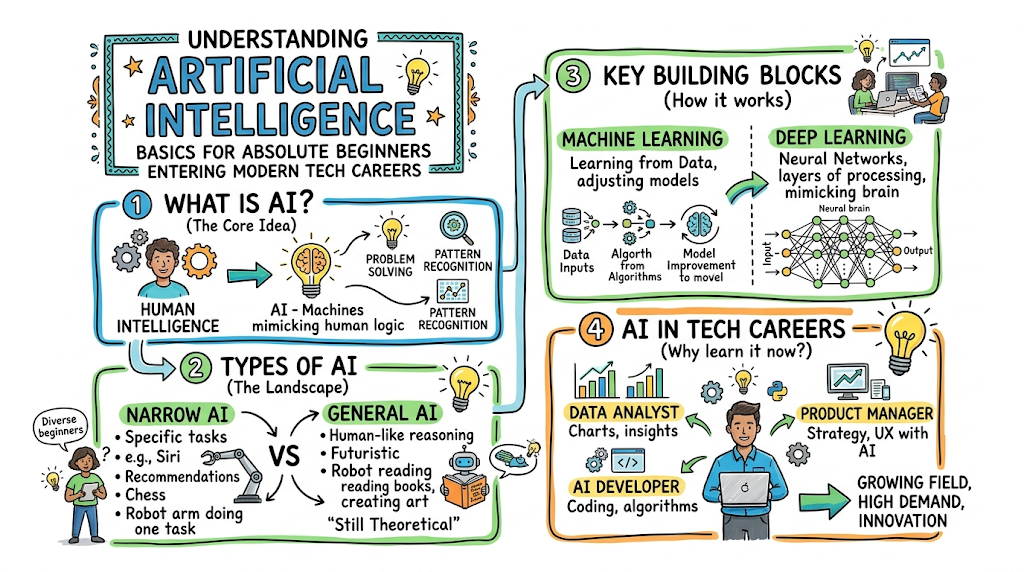
Modern AI rests on three main pillars: data, algorithms, and computing power. Algorithms act as the set of instructions, while data acts as the textbook from which the system learns. By processing this data, the model creates a way to predict outcomes or perform tasks.
Daily Examples of AI Around Us
- Virtual Assistants: Answering your questions and managing your schedule.
- Recommendation Engines: Suggesting products or content based on your history.
- Navigation Maps: Calculating the fastest route by analyzing live traffic data.
- Chatbots: Providing instant responses to common customer service queries.
Narrow AI vs. General AI
Most AI today is “Narrow AI,” meaning it excels at one specific task like translating text or playing a game. “General AI” is a theoretical concept where a machine would possess human-level intelligence across all domains. We currently do not have systems that truly think like humans.
The Intelligent Automation Mindset
Instead of replacing humans, the best AI systems act as force multipliers. They take over repetitive, boring tasks—like sorting emails or checking data for errors—so that humans can focus on creative, high-level thinking.
The 7 Core Principles of Introduction to Artificial Intelligence for Beginners
1. Data as the Foundation of AI
AI is only as good as the information it studies. If you provide a system with accurate, diverse, and clean data, it will make smart decisions. If you provide poor data, the results will be unreliable.
2. Machine Learning and Pattern Recognition
Machine learning allows a computer to find patterns on its own. For example, by looking at thousands of pictures of cats, the system eventually learns to identify a cat without being told exactly what one looks like.
3. Natural Language Processing
This field allows machines to “read,” “write,” and “speak.” It helps computers understand the structure of human sentences, grasp context, and even translate languages in real-time during conversations.
4. Computer Vision
Computer vision gives machines the ability to see. It identifies objects, people, and actions in digital images or videos. This is why your phone can recognize your face to unlock or why self-driving cars can see stop signs.
5. Automation and Decision-Making
Intelligent automation systems can weigh different options to make a choice. In business, this might mean automatically approving a loan request if it meets certain risk criteria, speeding up the process for everyone involved.
6. Continuous Learning and Improvement
AI models do not stay the same. As they encounter more information, they refine their internal logic. This constant feedback loop means that the longer an AI system runs, the better it often gets at its specific job.
7. Ethical and Responsible AI
Building AI requires a moral compass. We must ensure that systems are fair, respect user privacy, and do not repeat human biases. Transparency in how an AI makes a decision is vital for building public trust.
Key AI Concepts Every Beginner Must Know
AI vs. Machine Learning vs. Deep Learning — Explained Simply
- AI: The umbrella term for any computer-based intelligence.
- Machine Learning: A specific method where computers learn from data.
- Deep Learning: A complex type of machine learning inspired by the human brain.
Neural Networks — The Brain-Inspired AI Concept
Think of a neural network as a series of connected filters. Data goes into one end, passes through several layers of mathematical connections, and an answer comes out the other end. It mimics how neurons in your brain pass information to each other.
Generative AI — The Technology Behind AI Content Creation
Generative AI creates new content rather than just analyzing old data. These systems can draft emails, write code, paint digital art, or compose music by predicting what sequence of words or pixels should come next.
AI Bias and Ethical Challenges
If an AI is trained on biased data, it will produce biased results. If we only show an AI pictures of one type of person, it might struggle to recognize others. Solving this requires developers to be mindful of the data they use during training.
AI Automation in Daily Business Operations
Businesses use AI to provide 24/7 customer support via chatbots, personalize marketing emails for millions of users at once, and detect anomalies in accounting records to prevent loss.
The Four Major Branches of Artificial Intelligence
- Natural Language Processing (NLP): Understanding human speech and text.
- Robotics: Designing physical machines that can perform tasks.
- Machine Learning: Using data to improve performance.
- Computer Vision: Interpreting visual data from the world.
Traditional Programming vs. Artificial Intelligence — What’s the Difference?
The Philosophy Difference
In traditional programming, the developer writes a list of explicit instructions for the computer to follow. In AI, the developer provides the computer with a goal and enough data, and the system figures out the logic itself.
Roles & Responsibilities Compared
- Developers: Write and maintain the code that powers applications.
- Data Scientists: Focus on cleaning, analyzing, and interpreting the data.
- AI Engineers: Build and tune the complex models that use that data.
Can Traditional Software and AI Work Together?
They work together constantly. A typical app might have a traditional interface for the user, while the backend uses an AI model to suggest search results or organize data.
Which Technology Path Should Beginners Learn First?
Start with the basics of programming and statistics. If you find you enjoy making things work, lean toward software engineering. If you find you enjoy finding hidden patterns in messy data, lean toward data science.
Real-World Use Cases of Artificial Intelligence
AI in Healthcare
AI systems help analyze X-rays and scans to find health issues early. They also help researchers predict how different molecules might react, which speeds up the development of new treatments.
AI in Finance and Banking
Banks use AI to monitor transactions. If your card is used in a city you aren’t currently visiting, the system might flag it for security. It also helps calculate credit scores more accurately for people who have limited financial history.
AI in E-Commerce and Marketing
When you see a “Recommended for You” section on a website, that is AI. It analyzes what you have bought, what you have clicked on, and what similar users have liked, to provide a custom shopping experience.
AI in Education
Intelligent tutors provide extra practice on topics where a student is struggling. These tools adapt in real-time, giving harder challenges to students who are excelling and extra help to those who need it.
AI Tools Used by Everyday Users
- Chatbots: For quick research or drafting text.
- Writing Assistants: To check grammar and style.
- Image Generators: To visualize ideas for creative projects.
- Virtual Assistants: To set reminders and control smart home devices.
Common Mistakes Beginners Make While Learning AI
Mistake 1 — Thinking AI Means Human-Like Robots
AI is software, not a conscious being. It does not “think” or “feel” like you do. It processes numbers and probabilities to generate an output. Understanding this helps you manage your expectations.
Mistake 2 — Ignoring Basic Programming Fundamentals
You cannot run before you can walk. Spend time learning a language like Python. You need to understand how computers think and how data flows through a program before you can build complex AI models.
Mistake 3 — Trying Advanced AI Too Early
Don’t jump into building a deep-learning neural network on day one. Learn the basics of logic, data structures, and simple algorithms. Foundations make the complex stuff much easier later on.
Mistake 4 — Focusing Only on Tools Instead of Concepts
Tools change every few months, but mathematical and logical concepts stay the same for decades. Focus on understanding why an algorithm works, not just which button to click in a software interface.
Mistake 5 — Ignoring Ethical and Responsible AI Practices
Technical skill without ethics is dangerous. Always ask yourself: Who is my data coming from? Is this system fair to everyone? How can I protect the privacy of the people in my dataset?
Mistake 6 — Expecting Instant Career Success
Building expertise takes time. Focus on completing small projects and learning through practice rather than looking for a shortcut to a high-paying job. Mastery comes from consistent effort.
Essential AI Tools & Technologies
AI Development Frameworks
Tools like TensorFlow and PyTorch are the standard libraries used to build neural networks. They handle the heavy mathematical lifting so you can focus on building your model.
Generative AI Platforms
These are the interfaces like ChatGPT or Midjourney that allow you to interact with large AI models to generate text, code, or images instantly.
AI Data Processing Tools
Before AI can learn, data must be cleaned. Tools like Pandas or SQL help organize raw, messy information into clean tables that machines can actually understand.
Cloud AI Platforms
Services from companies like Google, AWS, and Azure allow you to rent high-powered computers to train your models, so you don’t need to buy expensive hardware.
AI Automation & Productivity Tools
Platforms that integrate AI into your workflow, such as automated meeting transcribers or intelligent email organizers, are becoming standard in modern offices.
Becoming an AI Professional — Career Roadmap
Essential Skills Every AI Beginner Should Learn
- Programming: Python is the industry standard for AI.
- Mathematics: Basic statistics and algebra are critical for understanding how models work.
- Data Handling: Knowing how to clean and organize information.
- Critical Thinking: Being able to break down a big problem into smaller pieces.
Step-by-Step AI Learning Path
- Learn the basics of Python programming.
- Study basic statistics and data analysis.
- Experiment with simple machine learning algorithms.
- Work on small projects using real-world data.
- Deepen your knowledge of specialized fields like NLP or vision.
Certifications Worth Exploring
Look for foundational certifications from recognized universities or major technology providers. These help validate your skills and keep you focused on industry standards.
Educational Resources with [PROVIDER_NAME]
To start your path with a structured approach, check out the beginner modules and learning tracks curated by AIUniverse.
The Future of Artificial Intelligence
AI-Powered Automation Across Industries
We are entering a phase where AI will handle the “plumbing” of business. This means the boring, repetitive parts of your job will be automated, letting you spend more time on strategy and problem-solving.
Generative AI and Creative Technologies
The barrier to entry for creativity is lowering. AI tools help people write, draw, and code ideas that they previously couldn’t execute, which will lead to an explosion of new digital content and innovations.
AI in Robotics and Autonomous Systems
Beyond screens, AI is moving into the physical world. Expect to see more intelligent robots in warehouses, improved logistics for shipping, and safer systems in transportation.
Skills That Will Matter Most in Future AI Careers
The most valuable skill will be “AI Literacy”—the ability to use these tools effectively, understand their limits, and guide their use toward ethical and productive outcomes.
FAQ Section
- Do I need a PhD to start a career in Artificial Intelligence?
No, you do not. While advanced research roles may require a PhD, many practical, high-impact roles in AI development, data analysis, and automation engineering are filled by people who are self-taught or hold bachelor’s degrees and relevant certifications. - Is it too late for a beginner to start learning AI now?
It is the perfect time to start. Because AI is moving into every industry, the demand for people who understand how to use these tools is higher than ever. You do not need to be a pioneer; you just need to be a learner. - What is the most important programming language for AI?
Python is the undisputed leader. Its simple syntax makes it easy for beginners, and it has a massive ecosystem of libraries specifically designed for machine learning and data science. - How can I ensure the AI models I build are ethical?
Start by auditing your data for bias, involve diverse groups in the testing phase, and always maintain human oversight. Transparency is key; you should be able to explain why your system made a certain decision. - Which certifications are actually worth my time?
Focus on certifications offered by major cloud providers or accredited institutions that emphasize hands-on projects. A certification is most valuable when it proves you can actually build something, not just answer multiple-choice questions. - Will AI replace human jobs in the near future?
AI will change jobs, not necessarily eliminate them. The professionals who use AI to become more productive will have a significant advantage over those who do not. The goal is to collaborate with technology, not compete against it.
Conclusion
Artificial Intelligence is a powerful toolkit that is transforming how we work, learn, and create. By understanding the basics—data, learning patterns, and responsible use—you position yourself to participate in one of the most significant technological shifts in history. The barrier to entry has never been lower, and the resources to help you succeed are widely available. Start small, build your foundation, and explore the possibilities by visiting AIUniverse to continue your journey today.
