Introduction
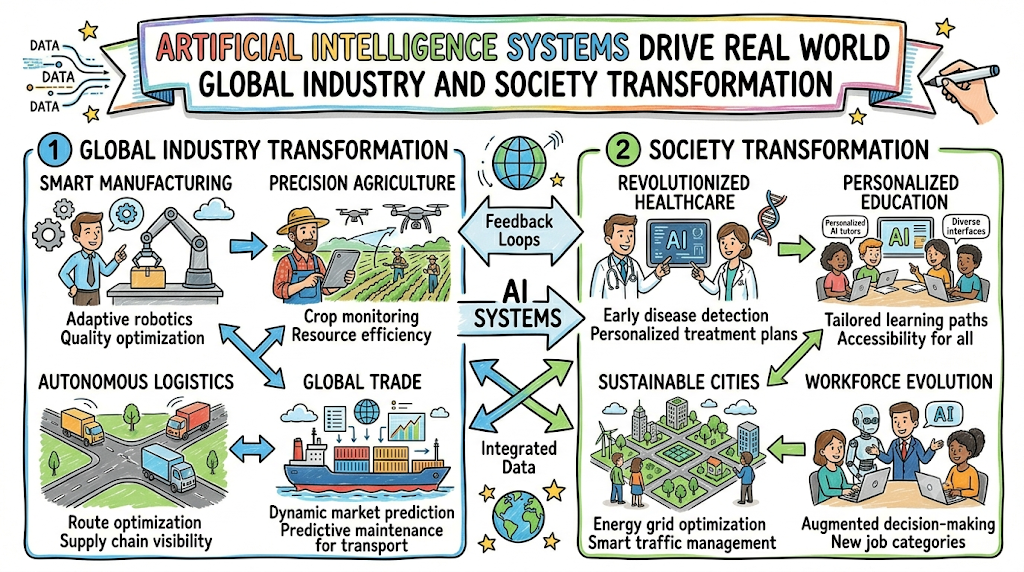
At its core, artificial intelligence is a branch of computer science focused on building software that can learn, reason, and solve problems. Think of it as a system designed to look for patterns in massive amounts of data and make logical decisions based on what it finds. It is not about creating conscious machines, but rather about developing highly capable tools that can process complex information faster than ever before. This incredible ability to process information is driving a massive AI transformation across multiple sectors. Industries like healthcare, finance, and logistics rely heavily on identifying patterns to function. Because modern software handles large datasets effortlessly, it can optimize complex workflows, reduce human error, and uncover insights that might otherwise remain hidden. In this comprehensive guide, you will explore how these systems operate across different industries. We will break down the core benefits, look at the very real challenges like data privacy, and separate common myths from reality. Understanding this technology is no longer optional; it is essential for navigating the modern professional landscape. To stay ahead of these trends and deepen your understanding of modern technology, explore the latest insights and learning paths available at AIUniverse. Let us dive into the evolution of these intelligent platforms.
Evolution of Artificial Intelligence
Early Concepts of Intelligent Machines
The desire to build machines that can mimic human logic spans many decades. Early computer scientists focused on creating systems that followed strict, pre-programmed rules. If a specific condition was met, the computer executed a specific response. While these early machines excelled at calculation, they lacked the flexibility to adapt to unexpected situations or unorganized data.
Rise of Machine Learning and Data-Driven AI
The true breakthrough occurred when researchers shifted from writing rigid rules to developing machine learning. Instead of telling a computer exactly what to do, engineers began feeding it vast amounts of historical data. The software was given an objective and left to discover the underlying patterns on its own. This shift made systems significantly more adaptable and capable of handling complex variations.
Modern AI Systems and Real-World Adoption
Today, we live in an era of widespread digital transformation. High-speed internet, cloud computing, and massive data storage have allowed these intelligent models to scale rapidly. Modern businesses regularly deploy these platforms to manage everything from customer interactions to global supply chains. The technology has evolved from academic experiments into the primary engine of corporate efficiency.
Core Areas Where AI Is Transforming the World
AI in Healthcare
The integration of AI in healthcare is saving lives by speeding up data analysis. Imaging software scans medical scans, such as X-rays and MRIs, to flag potential anomalies for radiologists to review.
- Diagnostic support: Analyzing patient records to catch early indicators of chronic illnesses.
- Administrative relief: Automating medical transcription so doctors can focus directly on patient care.
- Research acceleration: Sorting through biochemical data to identify promising compounds for new medications.
AI in Education
The primary strength of AI in education is its ability to support customized learning paths. Standard classrooms often require a one-size-fits-all approach, but software can adapt to an individual student’s pace.
- Adaptive learning: Adjusting the difficulty of exercises based on a student’s real-time performance.
- Instant feedback: Providing immediate explanations to students when they make mistakes in practice problems.
- Administrative support: Grading repetitive assignments automatically, freeing up time for teachers to provide mentorship.
AI in Business and Finance
The deployment of AI in business has rewritten the rules of operational efficiency and financial security. Financial institutions handle billions of transactions daily, making manual monitoring entirely impossible.
- Risk assessment: Evaluating loan applications instantly by analyzing historical financial behavior.
- Market analysis: Scanning global economic indicators to assist portfolio managers in making informed decisions.
- Inventory optimization: Predicting product demand patterns so retail companies can manage warehouse stock efficiently.
AI in Transportation
Modern transportation rely on advanced algorithms to make transit safer and more predictable. Navigational software uses real-time traffic data to calculate the most efficient routes for delivery fleets and commuters. Public transit systems use predictive models to schedule maintenance before trains or buses experience mechanical failures. Logistics hubs deploy these systems to coordinate shipping containers, minimizing delays across global trade routes.
AI in Communication and Social Media
Digital communication networks utilize sophisticated tools to manage the massive flow of daily information. Social platforms analyze engagement metrics to curate user feeds, showing content most relevant to individual interests. Email providers rely on text classification models to filter out malicious spam and phishing attempts. Language translation software breaks down global communication barriers by translating text instantly across hundreds of languages.
AI in Daily Life Applications
We interact with AI in daily life through simple, convenient tools that save time and effort. Smart thermostats learn household routines to optimize energy consumption throughout the day. Streaming platforms analyze viewing history to recommend movies and television shows tailored to your tastes. Mobile keyboards use predictive text algorithms to anticipate the next word you want to type, speeding up text messaging.
Key Benefits of Artificial Intelligence
Automation of Repetitive Tasks
One of the most obvious advantages of automation is its capacity to handle repetitive, time-consuming tasks. Data entry, invoice processing, and basic sorting can be entirely managed by software. This allows human workers to step away from mundane work and focus on strategic, creative endeavors.
Improved Decision Making
Human decision-making can be influenced by fatigue or emotional bias. Automated systems, however, process variables objectively based on historical facts and statistical probabilities. By presenting clear, data-backed options, these platforms help managers make smarter, more reliable choices under pressure.
Enhanced Productivity
When software works alongside human professionals, overall operational output increases significantly. Systems can run continuously without needing breaks, processing data or answering basic customer inquiries around the clock. This constant operational baseline ensures that business workflows never grind to a complete halt.
Better User Experiences
Modern consumers expect instant service tailored directly to their needs. Digital platforms achieve this by remembering user preferences and providing immediate responses to inquiries. Whether it is a shopping website showing relevant items or a support system resolving an issue instantly, personalization enhances satisfaction.
Data-Driven Insights
Hidden within corporate databases are valuable trends that can drive growth. Advanced analytics platforms can comb through these massive repositories to find correlations that humans might overlook. These insights allow organizations to spot shifting market demands early and adjust their strategies accordingly.
Challenges and Limitations of AI
Data Privacy Concerns
Because modern algorithms require massive amounts of data to function correctly, data privacy has become a major concern. Collecting, storing, and analyzing user information raises serious questions about consent and digital security. Organizations must build highly secure infrastructure to ensure personal user details are never leaked or misused.
Bias in AI Systems
Software is entirely dependent on the data used to build it. If the historical data contains human biases or imbalances, the system will learn and repeat those exact same prejudices. Preventing algorithmic bias requires engineering teams to carefully audit their data sources to ensure fairness and accurate representation.
Job Transformation Concerns
The rise of automated tools naturally alters the employment landscape. Tasks that once required manual labor or repetitive data management are increasingly handled by software. While this shift creates new technical positions, it also requires professionals to learn new skills to remain competitive in their industries.
Dependence on Technology
Over-reliance on automated systems can lead to a decline in critical human skills. If professionals delegate every calculation and analytical task to software, their own problem-solving abilities can weaken. It is vital to maintain a balance where technology acts as an assistant rather than a total replacement for thought.
Ethical Considerations
The widespread deployment of automated decision-making brings complex ethical dilemmas to the forefront. Determining accountability when an algorithmic system makes an error is a difficult legal and ethical challenge. Developers and policy makers must establish clear boundaries regarding how these tools are used in sensitive situations.
AI vs Traditional Systems
Rule-Based Systems vs AI Systems
Traditional software runs on rigid, explicit logic designed by human programmers. If a user inputs data, the system follows a fixed, unchanging path to deliver an outcome. AI systems, conversely, use pattern recognition to adapt their behavior based on new information, allowing them to solve problems without explicit instructions.
Manual Workflows vs Automated Intelligence
Manual workflows require human staff to review documents, input figures, and move processes forward step by step. Automated intelligence uses software to handle these operational steps automatically. The system reviews the information, processes the necessary actions, and flags only the complex exceptions for human review.
Static Systems vs Adaptive Systems
A static system remains identical from the day it is installed until an engineer manually updates the code. Adaptive systems use machine learning to continuously refine their performance as they encounter new data over time. This continuous self-improvement allows the software to become more accurate the longer it operates.
Real-World Use Cases of AI
Virtual Assistants and Chatbots
Many consumer-facing businesses use virtual assistants to handle high volumes of customer service inquiries. These tools use natural language processing to understand customer questions and provide instant answers regarding order tracking or store policies. By resolving simple issues immediately, they reduce waiting times for customers worldwide.
Recommendation Systems
E-commerce websites and entertainment networks rely heavily on sophisticated recommendation systems. These algorithms analyze your browsing history, past purchases, and the behavior of similar users to predict what you might like next. This highly effective personalization keeps users engaged and introduces them to products they enjoy.
Fraud Detection Systems
Banking institutions use advanced security algorithms to monitor transaction networks around the world. These systems establish a baseline of your typical spending habits, including geographical location and average transaction amounts. If a purchase occurs that deviates completely from this pattern, the system blocks the transaction instantly.
Medical Diagnosis Support Systems
In the medical field, digital tools serve as an extra pair of eyes for healthcare practitioners. Specialized software can analyze thousands of laboratory results or pathology slides in seconds, highlighting areas that match known patterns of illness. This helps physicians verify their findings and speeds up the diagnostic process.
Smart City Technologies
Municipalities use urban management systems to optimize city resources and improve public infrastructure. Smart traffic grids analyze real-time vehicle flow to adjust traffic light timing dynamically, reducing congestion in busy downtown areas. Waste management systems use sensors to alert collection trucks only when public bins are full, reducing fuel consumption.
Common Misconceptions About AI
AI is not human intelligence
A common misconception is that modern software possesses general human intelligence or awareness. In reality, these platforms are highly specialized calculators designed for specific mathematical tasks. They do not experience consciousness, emotions, or independent thoughts; they simply follow mathematical equations to process data.
AI does not think like humans
Human beings use intuition, life experience, and emotional context to understand the world around them. Machine learning models, by contrast, rely entirely on statistical probabilities calculated from historical training data. A system does not understand what a word or image actually means; it only recognizes the mathematical patterns behind them.
AI cannot replace all jobs
While automation is transforming the workplace, it cannot replace occupations that require deep empathy, creativity, or complex physical dexterity. Jobs centered around human relationship management, strategic leadership, and nuanced ethical reasoning remain securely in human hands. The technology is built to assist humans, not eliminate them.
AI requires data to function
An automated system cannot solve problems in a vacuum or figure out an unfamiliar scenario without information. If you present an algorithm with a completely novel problem with zero historical data, it cannot function. The performance of any intelligent model is strictly limited by the quality and volume of data provided.
AI is still evolving technology
Despite its rapid adoption across major industries, this technology is still in its early developmental stages. Current software still struggles with abstract reasoning, common sense context, and data efficiency. Recognizing that these platforms are imperfect tools helps organizations deploy them safely and set realistic operational goals.
Essential AI Technologies (Conceptual Overview)
To truly understand how this technological shift works, it helps to be familiar with the core terms used by experts. Machine learning serves as the foundational framework, allowing software to learn from historical data without being explicitly programmed. Deep learning takes this a step further by utilizing neural networks, which are layered mathematical structures inspired by the interconnected paths found in nature.
When it comes to specialized tasks, natural language processing enables software to analyze, interpret, and generate human text. Computer vision gives applications the power to identify and process visual information from digital images or video feeds. All of these components are brought together within data analytics platforms, which collect and organize information so algorithms can run efficiently.
Career Path in Artificial Intelligence
Skills Required
Entering this growing field requires a balanced combination of technical understanding and analytical problem-solving skills.
- Programming basics: Understanding how to write clear, structured code to manipulate data.
- Data analysis fundamentals: Knowing how to clean, organize, and interpret large datasets.
- Machine learning concepts: Familiarity with how algorithms learn patterns from training data.
- Logical thinking: The ability to break complex operational problems down into step-by-step solutions.
- Mathematics basics: Comfort with foundational statistics and probability concepts.
Learning Roadmap
The journey begins with building a strong foundation in data literacy and basic computer science principles. Once you are comfortable managing data, you can progress to studying specific machine learning algorithms and statistical models. The final stage involves learning how to deploy these models into real-world business applications where they can solve practical problems.
Certifications & Learning Paths
Professionals can choose from a variety of educational options depending on their current experience level. Structured online courses, university certificates, and specialized bootcamps offer practical, hands-on training. Focusing on building an educational portfolio filled with real-world projects is the most effective way to demonstrate your capabilities to hiring managers.
Career Opportunities
The demand for qualified technical professionals spans across almost every major industry today. Organizations actively hire data analysts to interpret market trends and machine learning specialists to design predictive models. Businesses also require tech-savvy project managers who can bridge the communication gap between engineering teams and corporate executives.
Learning Resources from AIUniverse
Building a successful career in this rapidly changing field requires access to high-quality, up-to-date educational materials. Aspiring professionals need clear guidance to avoid getting overwhelmed by technical jargon. AIUniverse provides structured tutorials, conceptual guides, and learning paths designed specifically to help beginners build practical skills from scratch.
Future of Artificial Intelligence
AI in Everyday Systems
In the coming years, automated technology will become an invisible standard built into almost every software platform. Rather than logging into separate specialized applications, users will find intelligent features seamlessly integrated into standard office tools. This widespread availability will turn advanced data analysis into a standard skill for everyday workplace productivity.
Human-AI Collaboration
The future of work is centered around close collaboration between human professionals and intelligent software assistants. Humans will continue to provide critical oversight, ethical judgment, and creative direction for projects. Meanwhile, software will handle the heavy lifting of data processing, mathematical modeling, and repetitive administrative organization.
Smarter Automation Systems
As algorithms become more refined, automation platforms will handle increasingly complex operational workflows. Future systems will move beyond simply flagging simple errors to suggesting comprehensive optimizations for supply chains and energy grids. These advancements will help cities and businesses cut down on waste and operate much more sustainably.
Ethical AI Development
The technology sector is placing a massive emphasis on building fair, transparent, and accountable software systems. Future engineering frameworks will prioritize algorithmic explainability, making it easy for users to understand exactly how a system reached a conclusion. This focus on responsibility ensures that technology serves society equitably.
Future Skills in AI
As automated tools take over basic data entry and rote programming, human skill requirements will naturally evolve. Professionals will need to focus on developing strong data curation, algorithmic evaluation, and strategic problem-solving abilities. Learning how to direct and audit intelligent systems will become a core requirement for leadership roles across all industries.
FAQs
- What is artificial intelligence in simple terms?
Artificial intelligence is a branch of computer science focused on building software systems that can analyze data, recognize complex patterns, and solve specific problems without needing human intervention for every individual step. - How does machine learning differ from traditional computer programming?
Traditional programming requires a human to write explicit, unchanging rules for the computer to follow. Machine learning allows software to analyze large amounts of data and discover the rules and patterns on its own. - Can artificial intelligence think or feel like a human being?
No, it cannot. Automated systems do not have feelings, consciousness, or self-awareness. They are advanced mathematical calculators that process digital information based on statistical probabilities, not independent thoughts. - What are some common examples of AI applications in daily life?
Everyday examples include predictive text on your smartphone, personalized movie recommendations on streaming apps, spam filters in your email inbox, and navigation apps that route you around real-time traffic congestion. - Is AI in healthcare safe for making medical decisions?
These systems are designed to act as diagnostic support tools, not independent doctors. They help medical professionals locate anomalies in scans and analyze patient data quickly, but final treatment decisions are always made by human physicians. - Will automation eliminate the need for human workers in the future?
Automation transforms jobs by taking over repetitive, manual tasks, but it does not eliminate the need for people. It shifts human employment toward roles that demand emotional intelligence, strategic leadership, and creative problem-solving. - Why is data privacy a major concern in modern AI development?
Modern algorithms require massive datasets to learn and function accurately. This reliance on data means companies must collect and store vast amounts of information, raising important questions about user consent and data protection. - What is algorithmic bias and how does it happen?
Bias occurs when the historical data used to build a system contains human prejudices or imbalances. Because the software learns strictly from that past data, it unintentionally mirrors and repeats those same unfair biases in its outcomes. - What basic skills do I need to start a career in artificial intelligence?
Beginners should focus on learning foundational computer programming, basic data organization, introductory statistics, and logical problem-solving. You do not need an advanced engineering degree to understand the fundamentals. - What role will human-AI collaboration play in the future workplace?
Technology will serve as a powerful assistant rather than a total replacement. Humans will provide the creative vision, empathy, and ethical boundaries, while digital tools handle the heavy processing and administrative organization.
Conclusion
Artificial intelligence is driving a profound AI transformation that is permanently changing how we live, work, and communicate. From automating mundane data management to providing vital diagnostic support in medical facilities, its real-world applications are practical and widespread. Rather than replacing human capability, these advanced systems serve as tools that enhance our productivity and help us make sense of an increasingly data-rich world.
As these adaptive systems continue to mature, understanding their capabilities and limitations becomes essential for students, professionals, and business leaders alike. Staying informed allows us to deploy these tools responsibly while navigating the ethical challenges around data privacy and algorithmic fairness. The future belongs to those who learn to collaborate effectively with intelligent technology.
