Introduction
Technology changes how the world operates. In the past, automated machines followed fixed instructions to complete repetitive tasks. Today, the integration of artificial intelligence into physical machinery has completely redefined production capabilities. Understanding the relationship between artificial intelligence and machine learning is no longer just for research labs. It has become a core business strategy across manufacturing, logistics, healthcare, and retail.
For anyone entering the technology sector, learning about intelligent systems offers clear career potential. Companies around the world are looking for professionals who understand how to connect virtual software code to physical mechanical hardware. Developing a strong foundation in these integrated systems prepares you to design, build, and maintain the infrastructure running tomorrow’s factories. To stay ahead of these shifting technologies and master the core frameworks driving automated systems, you can explore the curated educational resources and expert insights available at AIUniverse.
What Is AI in Robotics?
To understand this field, we must separate the physical machine from its cognitive software. A traditional robot consists of mechanical joints, motors, actuators, and structural links. Without artificial intelligence, this machine is essentially blind and deaf; it relies on hardcoded coordinates to move from point A to point B.
When you introduce artificial intelligence, you give that mechanical structure a digital brain. AI in robotics represents the intersection of computer science and mechanical engineering, where machine learning algorithms, sensor networks, and data processing pipelines combine to help a machine interact dynamically with an unpredictable environment.
The Evolution of Robotics
The journey of automation developed over several distinct phases:
- First Generation (Fixed Automation): Simple mechanical arms used in early automotive assembly lines. They moved along rigid, unchanging spatial tracks and stopped completely if an object was misplaced by even a few millimeters.
- Second Generation (Sensor-Assisted Automation): Systems integrated basic physical limit switches, proximity sensors, or simple cameras. They could detect if an object was present but could not figure out how to handle unexpected changes.
- Third Generation (AI-Powered Autonomy): Modern systems that combine multi-sensor arrays, edge computing, and real-time deep learning models. These machines navigate unmapped spaces, identify distinct objects, and correct their own errors without human intervention.
Traditional vs. AI-Powered Robots
The operational differences become clear when you look at how each system handles real-world factory scenarios:
| Characteristic | Traditional Robots | AI-Powered Robots |
| Environmental Adaptation | Fails if the environment changes slightly. | Automatically adjusts to new layouts or item positions. |
| Programming Requirement | Requires manual, line-by-line coordinate coding. | Learns tasks via data training, simulations, or demonstrations. |
| Error Management | Halts operation and triggers an emergency alarm. | Identifies the fault and attempts a corrective path. |
| Data Utilization | Ignores operational data once a movement completes. | Analyzes sensor logs to improve speed and precision over time. |
Why AI in Robotics Matters in Modern Industries
Enterprise operations use intelligent automation because it directly improves bottom-line metrics, quality control, and workplace safety.
Automation Efficiency & Smart Decision-Making
Traditional automation slows down when processing mixed product types. An AI-powered system can scan an incoming conveyor belt holding varied parts, instantly identify each item, and sort them into different bins. The machine makes these choices in milliseconds, eliminating the need for separate, dedicated sorting lines.
Reducing Human Error & Boosting Productivity
Repetitive human tasks often suffer from fatigue-related drops in quality over long shifts. Intelligent machines maintain uniform precision throughout continuous 24/7 operations. In high-tolerance environments like electronics assembly, vision-guided arms inspect and place microscopic components with minimal error rates, preventing costly product recalls.
Predictive Maintenance & Cost Optimization
By tracking internal motor temperatures, electrical current draws, and vibration signatures, an intelligent robot can predict its own component failures. The system flags when a specific joint bearing is wearing down, allowing maintenance teams to replace it during scheduled weekend breaks instead of dealing with sudden, expensive breakdowns during a live production run.
Core Concepts of AI-Powered Robotics
Building an autonomous machine requires combining several distinct areas of computer science and hardware engineering.
Machine Learning in Robotics
Machine learning allows hardware to optimize its movements through data trial and error. Instead of manual mathematical programming for every joint angle, engineers use reinforcement learning models. The system runs thousands of virtual simulations, tries different approach angles, receives positive scores for successful attempts, and eventually establishes the most stable path for lifting and moving target objects.
Computer Vision
Computer vision provides the visual processing needed to understand physical surroundings. Using input from digital cameras, depth sensors, and laser scanners, deep learning models perform real-time object detection and semantic segmentation. This processing allows a sorting arm to distinguish a cardboard box from a plastic bottle, even when items are piled together on a moving belt.
Autonomous Navigation
Autonomous navigation lets mobile units move through unmapped warehouses without hitting structural walls or human workers. This relies on Simultaneous Localization and Mapping (SLAM). The machine constructs a real-time internal map of its surroundings while simultaneously tracking its own position within that space, recalculating its travel path instantly if someone steps in front of it.
Sensor Systems
Modern units use complex sensor networks to gather environmental data. Inertial Measurement Units (IMUs) track orientation and balance, LiDAR sensors measure distances using laser pulses, and tactile force sensors monitor grip pressure. This sensory input prevents a robotic gripper from crushing fragile items like glassware or agricultural produce while maintaining enough force to secure a solid hold.
Robotics Automation & Natural Language Processing
Robotic Process Automation (RPA) manages digital workflows, but when combined with physical automation and Natural Language Processing (NLP), warehouse operators can issue direct commands using everyday speech. An operator can say, “Move pallet four to loading dock B,” and the system translates that verbal request into localized spatial coordinates for autonomous transport vehicles.
Predictive Analytics & Decision-Making
Onboard processing units run predictive analytics models to choose the best actions. If a delivery robot detects an upcoming bottleneck in a factory aisle, its decision-making engine calculates alternative routes, weighs the travel time delays of each option, and selects the fastest clear path before it ever reaches the crowded area.
Human-Robot Collaboration (Cobots)
Collaborative robots, or cobots, are built to work directly alongside human operators without protective safety cages. They use low-inertia motors and high-density force feedback sensors. If a cobot makes light physical contact with a human hand, it stops its motion in milliseconds to prevent injury, allowing humans and machines to share assembly tasks safely.
Edge AI in Robotics
Sending massive amounts of sensor data to distant cloud servers creates communication lag that can cause accidents. Edge AI addresses this by running machine learning models directly on internal microprocessors. Processing data locally allows a drone or mobile platform to make critical navigation decisions in microseconds, ensuring reliable operation even if local wireless networks drop out.
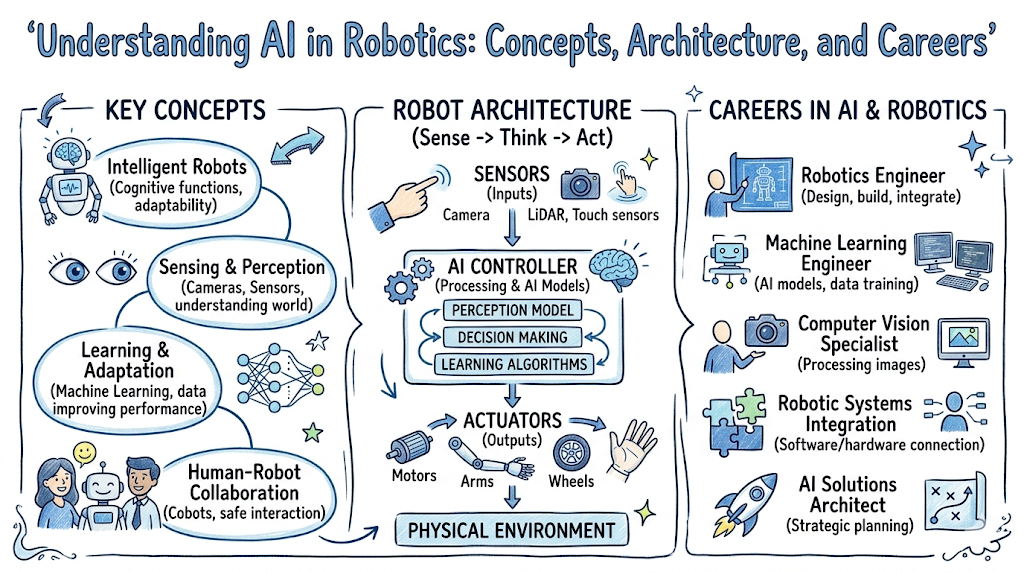
Robotics Architecture & Workflow
An intelligent robotic system relies on an integrated, multi-layered data pipeline to transform raw physical inputs into precise mechanical movements.
1. Sensor Integration & Data Collection
The workflow begins at the sensor layer. Cameras, LiDAR scanners, and encoder wheels gather continuous environmental data. This raw structural information is collected by onboard microcontrollers via internal data networks like CAN buses or Ethernet links.
2. The Perception Layer
The perception layer converts raw sensor data into structured formats. This stage uses data fusion techniques, combining camera imagery with distance measurements from LiDAR to build a unified 3D point cloud map. This ensures the system does not rely on a single sensor that might fail in dusty or poorly lit factory conditions.
3. The Decision-Making Engine
The unified environment map is sent directly to the decision-making engine. This software layer runs path-planning algorithms and behavior state machines to choose the best next action. If the system detects an obstacle, it calculates a safe detour around it while keeping the target destination in mind.
4. Control Layer & Action Execution
Once a path is determined, the decision layer sends target coordinates to the control system. The controller translates these abstract vector paths into electrical pulse-width modulation (PWM) signals. These signals drive the physical motors, joints, and actuators, translating software decisions into real-world mechanical work.
5. Cloud & Edge Infrastructure
While edge processors handle real-time navigation and safety decisions locally, non-urgent telemetry data is sent up to central cloud servers. This cloud connection allows operations managers to monitor fleet health, run large-scale optimization models, and push over-the-air firmware updates to keep systems updated.
AI Robotics Lifecycle
Managing an enterprise robotics deployment requires a structured approach across several key operational stages:
| Stage | Purpose | Technologies Used | Real-World Outcome |
| Data Collection | Gathers raw physical and environmental measurements. | LiDAR, HD Cameras, Ultrasonic Sensors, IMUs. | Stores high-resolution sensory logs for analysis. |
| Sensor Processing | Filters out noise and combines different data streams. | Kalman Filters, Point Cloud Libraries (PCL). | Creates a clean, structured map of the environment. |
| AI Model Training | Teaches the software to recognize objects and plan paths. | PyTorch, TensorFlow, Reinforcement Learning. | Produces a deployable neural network file. |
| Decision Making | Selects the best action based on current inputs. | Finite State Machines, Behavior Trees, A* Search. | Identifies a clear, collision-free task path. |
| Motion Planning | Calculates precise angles for physical joints. | Inverse Kinematics, MoveIt Framework. | Generates smooth, safe movement trajectories. |
| Automation Execution | Drives the physical motors and mechanical joints. | Motor Drivers, PID Control Loops, Actuators. | Completes physical tasks like lifting or welding. |
| Monitoring | Tracks hardware health and performance live. | Prometheus, Grafana, Onboard Telemetry Logs. | Flags unexpected drops in mechanical speed. |
| Continuous Optimization | Improves system performance over long-term use. | MLOps Pipelines, Automated Retraining Loops. | Lowers cycle times across factory floors. |
Popular AI Robotics Tools & Platforms
Engineers use a specialized ecosystem of frameworks, simulators, and analysis tools to design and deploy intelligent machines.
Robotics & AI Frameworks
The Robot Operating System (ROS and ROS 2) serves as the primary middleware for modern robotics development. It provides standard messaging protocols, hardware abstraction layers, and pre-built packages for navigation and control. For machine learning, developers build and train neural networks using PyTorch or TensorFlow, then optimize them for hardware deployment using tools like NVIDIA TensorRT.
Simulation Environments
Testing untamed AI algorithms on physical multi-ton industrial machines can cause expensive hardware damage. Developers use simulators like Gazebo, Webots, or NVIDIA Isaac Sim to build accurate virtual copies of factory floors. This lets teams test navigation and picking logic safely in simulation before deploying the code onto real physical hardware.
Tool Comparison Matrix
| Tool / Platform | Main Purpose | Difficulty Level | Enterprise Usage |
| ROS 2 | Robotics communication and middleware. | Advanced | Industry standard for fleet control and sensor routing. |
| NVIDIA Isaac Sim | Photorealistic physics simulation and testing. | Advanced | Used for training vision models and testing factory workflows. |
| Gazebo | Open-source multi-robot physics simulation. | Intermediate | Used for verifying navigation logic and sensor setups. |
| PyTorch | Building and training machine learning models. | Advanced | Used for developing vision, grasping, and sorting models. |
| OpenCV | Real-time image processing and computer vision. | Intermediate | Used for basic camera calibration, sorting, and edge tracking. |
| MoveIt | Mobile manipulation and kinematic path planning. | Advanced | Used for calculating smooth paths for multi-axis arms. |
Real-World Use Cases of AI in Robotics
Intelligent automation delivers practical value across many different global sectors.
Manufacturing and Automotive Lines
Modern automotive factories use vision-guided robotic arms to weld complex car chassis, apply uniform paint coats, and install delicate windshields. These machines adjust their positioning dynamically to handle minor alignment differences on the assembly line, ensuring consistent build quality without manual resetting.
Warehousing, Logistics, and Smart Factories
Distribution centers deploy fleets of Autonomous Mobile Robots (AMRs) to move pallets across large facilities. These mobile units navigate changing warehouse layouts, avoid human workers, and coordinate with each other to prevent traffic jams, keeping fulfillment operations moving smoothly around the clock.
Healthcare and Medical Assistance
In hospital environments, AI-assisted surgical platforms help doctors perform complex, minimally invasive procedures with extreme stability. These systems filter out natural human hand tremors, allowing for highly precise incisions that can shorten patient recovery times.
Agriculture and Field Robotics
Autonomous tractors and weeding machines drive through fields using GPS and computer vision. They scan crops individually, identify and target invasive weeds with micro-doses of herbicide, and check crop ripeness without damaging the plants, reducing chemical usage and optimizing seasonal harvests.
Benefits of AI in Robotics
- Higher Production Output: Intelligent systems run continuous production cycles at peak operational speeds without dropping in accuracy.
- Reduced Operational Downtime: Built-in predictive diagnostics spot mechanical wear early, preventing sudden line stoppages.
- Safer Work Environments: Moving heavy parts or working around hazardous materials is shifted to machines, keeping human workers out of harm’s way.
- Improved Resource Efficiency: Vision-guided systems cut down on manufacturing waste by using raw materials with consistent precision.
- Operational Scalability: Fleet management software makes it simple to add more mobile robots to a warehouse as shipping demands grow.
Challenges & Limitations
While the advantages are clear, production deployments require addressing several technical and financial hurdles:
- High Initial Investments: Buying advanced robotic hardware, depth sensors, and specialized edge processors requires significant upfront capital.
- Complex Implementation Paths: Integrating modern ROS-based middleware with older legacy enterprise software takes careful engineering.
- Data Dependency Issues: Machine learning models need thousands of clean training examples to handle unique, real-world sorting errors reliably.
- Evolving Cyber Security Risks: Connecting factory hardware to local networks means teams must use strict encryption to prevent unauthorized access.
Practical Engineering Solutions
To manage high upfront costs, companies can start with small pilot projects, automating a single conveyor line before scaling across the entire facility. Using accurate physics simulators also lowers development costs by letting engineers find and fix bugs virtually before buying physical hardware.
Robotics & AI Career Opportunities
The growth of industrial automation continues to drive strong demand for skilled professionals who understand both hardware and software.
Core Professional Roles
- Robotics Software Engineer: Focuses on writing reliable C++ and Python code for ROS 2 networks, path planning, and sensor integration.
- Computer Vision Specialist: Designs and deploys deep learning models that process camera data for real-time object tracking.
- Automation Engineer: Designs the physical electrical cabinets, programmable logic controller (PLC) systems, and factory layouts.
- Embedded Systems Developer: Writes low-level firmware for microcontrollers to manage real-time motor signals with minimal latency.
Required Skills & Compensation Trends
Succeeding in this field requires balancing software skills like C++, Python, and Linux with a solid grasp of physical concepts like kinematics and sensor networks. Because these roles require specialized technical knowledge, compensation trends remain strong globally and across India’s growing manufacturing hubs, making automation a rewarding long-term career path.
Beginner Roadmap for Learning AI in Robotics
Breaking into this field requires building your skills step-by-step, starting with basic programming before moving on to complex physical hardware.
Step 1: Learn Core Programming Fundamentals
Focus on mastering Python and Linux command-line operations. Python is the primary language used to build machine learning models, while Linux serves as the baseline operating system for industrial ROS 2 environments.
Step 2: Understand Electronics and Microcontrollers
Work on basic projects with open-source microcontrollers like Arduinos or Raspberry Pis. Learn how to read input values from simple ultrasonic distance sensors and control physical components like DC motors or small servos.
Step 3: Study the Robot Operating System (ROS 2)
Learn how ROS 2 manages communication between different parts of a robot using nodes, topics, and services. Practice running virtual robot simulations in Gazebo to understand navigation logic without needing physical hardware.
Step 4: Explore Machine Learning & Computer Vision
Learn the basics of image processing using OpenCV, then move on to training simple object detection networks with PyTorch. Connect these models to your robot simulation so the virtual machine can identify and navigate toward target objects.
Certifications & Training
Industry certifications help validate your technical skills and practical knowledge to potential employers.
| Certification Name | Target Professional Level | Primary Skills Covered | Best For |
| ROS 2 Fundamentals Developer Certification | Beginner to Intermediate | Node communication, custom interfaces, simulation. | Robotics software engineers. |
| NVIDIA Isaac Sim Edge Automation Specialization | Intermediate to Advanced | Digital twins, synthetic data generation, 3D simulation. | Simulation engineers. |
| AWS Certified Cloud Robotics Practitioner | Intermediate | RoboMaker deployment, fleet telemetry, cloud analytics. | Cloud infrastructure teams. |
| Certified Professional Automation Specialist | Enterprise Industrial | PLC programming, safety architectures, SCADA. | Manufacturing engineers. |
Common Beginner Mistakes
- Skipping the Linux Command Line: Many beginners try to develop robotics software on standard consumer operating systems, which often leads to tool compatibility issues. Save time by learning Linux early.
- Ignoring Physical Hardware Limitations: Software-only developers sometimes forget that real motors have torque limits, physical friction, and battery constraints. Always test your code with physical realities in mind.
- Focusing Only on Theory: Spending months reading textbooks without writing code or building simulations can slow down your progress. Aim to build small, practical projects alongside your reading.
Best Practices for AI Robotics Systems
- Design for Safety First: Always include independent, hardwired physical E-stop switches that cut power to motors instantly if software fails.
- Keep Code Modular: Build your software using isolated ROS 2 nodes so you can update vision models without breaking the underlying motor control code.
- Set Up Real-Time Telemetry: Log motor temperatures, error rates, and communication latency to spot hardware wear before it causes a failure.
- Write Clear Technical Docs: Document your sensor positions, wiring layouts, and API endpoints so maintenance teams can troubleshoot systems easily.
Future of AI in Robotics
The next phase of automation will focus on building more adaptable, self-learning systems. We are moving away from single-purpose industrial arms toward general-purpose humanoid platforms capable of navigating human spaces and using standard tools.
Generative AI is also changing how we program hardware. Future systems will translate high-level commands like “clean up the breakroom counter” into precise physical actions on their own, removing the need for manual path programming. As edge processing chips become more powerful and efficient, these machines will process complex data locally, making them fully autonomous, safe, and ready to work alongside human teams across global industries.
FAQs
1. What is AI in robotics?
AI in robotics is the integration of artificial intelligence algorithms with physical machines. This combination allows robots to interpret sensor data, make autonomous navigation choices, identify unique objects, and adapt to changing environments without relying on fixed, pre-programmed paths.
2. How does AI improve industrial robots?
Artificial intelligence gives traditional robots situational awareness. Instead of stopping when an assembly part is slightly misaligned, an AI-powered machine uses vision sensors to locate the item, adjust its grip path, and continue working without human help.
3. Is robotics difficult for beginners?
It can feel challenging initially because it combines several disciplines: software programming, electronics, and mechanical engineering. Breaking your learning down into clear steps—starting with basic software before moving to physical components—makes the process manageable.
4. Does robotics require coding?
Yes, writing code is essential for building modern robotics applications. Developers use languages like C++ and Python to handle sensor data, run path-planning logic, control motor movements, and deploy machine learning models.
5. Which programming language is best for robotics?
Python and C++ are the industry standards. Python is widely used for machine learning, data analysis, and fast prototyping, while C++ is preferred for production microcontrollers and real-time control loops where speed is critical.
6. What industries use AI robotics?
Intelligent robots are used across manufacturing, automotive assembly, e-commerce warehouses, agricultural monitoring, surgical healthcare, and automated retail delivery networks.
7. Is machine learning necessary for robotics?
While simple automation can run on standard geometric code, machine learning is necessary for advanced tasks. It allows robots to navigate unmapped spaces, sort varied objects, and learn new movements through trial and error.
8. How long does it take to learn robotics?
Acquiring the baseline skills needed to build simple autonomous mobile projects typically takes six to twelve months of consistent, hands-on practice with programming, electronics, and simulation tools.
9. What is ROS 2?
The Robot Operating System 2 (ROS 2) is an open-source middleware framework. It provides a standard set of software tools, device drivers, and communication protocols that simplify building complex robotic applications.
10. Can I learn robotics without buying expensive hardware?
Yes. Modern simulators like Gazebo and NVIDIA Isaac Sim allow you to design, program, and test complex virtual robots in realistic 3D environments using only your computer.
11. What is an AMR?
An Autonomous Mobile Robot (AMR) is a mobile platform that uses onboard sensors and computer vision to navigate through spaces like warehouses independently, without needing fixed floor tracks or external guidance markers.
12. What is a Cobot?
A cobot, or collaborative robot, is a machine built with specialized force sensors and smooth edges designed to work safely alongside human operators without requiring protective physical safety cages.
13. How do robots see their surroundings?
Robots perceive their environment using a combination of hardware sensors, including digital cameras, ultrasonic rangers, and infrared sensors, along with LiDAR scanners that map distances using laser pulses.
14. What is Edge AI in robotics?
Edge AI refers to running machine learning algorithms directly on the robot’s local microprocessors. This local processing removes network communication lag, allowing the machine to make safe navigation decisions in real time.
15. How do I get an entry-level job in this industry?
Focus on building a solid portfolio of practical projects. Show your skills by sharing clean code on GitHub, participating in simulation challenges, and mastering core tools like Linux, Python, and ROS 2.
Final Thoughts
Stepping into the field of intelligent automation is a journey into the future of industrial production. Success as an engineer or developer comes down to hands-on experimentation. The strongest professional portfolios are built by taking code out of the textbook and testing it in real-world environments or detailed simulators. Focus on mastering core programming concepts, learning to interpret sensor data, and understanding how physical hardware responds to digital commands. As automation continues to scale globally, developing a deep understanding of these integrated systems will open up rewarding long-term career opportunities across the technology sector.
