Introduction
Telemedicine platforms are digital health systems that enable remote clinical consultations, virtual visits, patient communication, and care delivery using video, audio, and messaging technologies.
They allow clinicians and patients to interact without physical proximity, improving access to care, reducing travel burden, and supporting continuity of services.
Modern telemedicine platforms also integrate scheduling, EHR/EMR access, secure messaging, billing, and clinical documentation to streamline workflows.
Choosing the right telemedicine solution enhances patient satisfaction, clinician efficiency, and quality of care while supporting regulatory compliance and reimbursement.
Real‑world use cases:
- Virtual primary care appointments and follow‑ups
- Chronic disease check‑ins and remote assessments
- Behavioral health and counseling sessions
- Post‑acute care follow‑up and medication reviews
- Specialist teleconsultations across locations
Key buyer evaluation criteria:
- Quality and reliability of video/audio connections
- Security and HIPAA compliance
- Integration with EHR/EMR and scheduling systems
- Patient usability and mobile access
- Documentation and clinical charting tools
- Billing, coding, and reimbursement support
- Multi‑specialty support and workflows
- Analytics and reporting
- Scalability and deployment flexibility
Best for: Hospitals, specialty practices, primary care groups, urgent care networks, and telehealth providers.
Not ideal for: Practices with minimal need for remote visits or internal messaging only.
Key Trends in Telemedicine Platforms
- Cloud‑native execution with high‑availability and minimal latency
- Integration with EHR/EMR systems via FHIR/HL7 for secure data flow
- Mobile‑first patient experiences with native iOS/Android apps
- AI‑assisted visit summaries, auto‑transcription, and decision support
- Automated encounter documentation and billing
- Multi‑party video for family or specialist inclusion
- Secure messaging and asynchronous care options
- Remote patient monitoring (RPM) and wearable integrations
- Outcome analytics and quality reporting
- Flexible pricing models and telehealth reimbursement support
How We Selected These Tools (Methodology)
- Adoption in healthcare organizations of varying sizes
- Quality and stability of telehealth video/audio
- Security, compliance, and HIPAA safeguards
- EHR/EMR integration and workflow support
- Ease of use for clinicians and patients
- Scheduling, documentation, and billing capabilities
- Mobile and web access for patients and providers
- Analytics and reporting tools
- Support, training, and onboarding quality
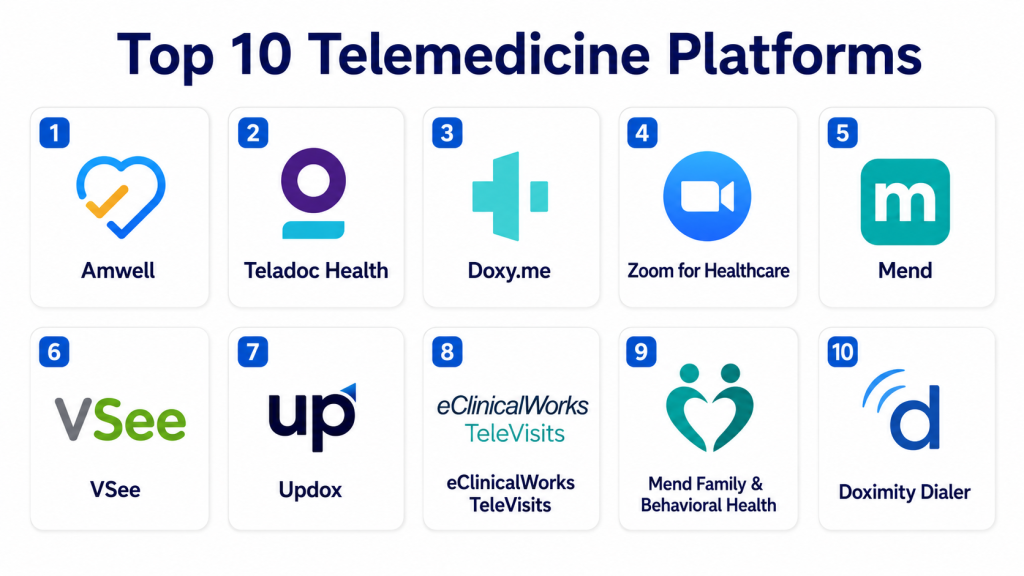
Top 10 Telemedicine Platforms
#1 — Amwell
Short description:
Amwell is a comprehensive telemedicine platform supporting clinical video visits, e‑consults, and urgent care.
Provides EHR integrations, provider workflows, and enterprise scalability.
Supports multi‑specialty engagements and clinical documentation.
Ideal for health systems and large provider groups.
Key Features
- High‑quality video/audio visits
- EHR/EMR integration
- Scheduling and triage workflows
- Documentation and billing support
Pros
- Enterprise focus with scalability
- Strong EHR integrations
- Broad specialty support
Cons
- Higher pricing tier
- Implementation requires planning
Platforms / Deployment
- Web / iOS / Android
- Cloud
Security & Compliance
- Encryption, audit logs, RBAC
- HIPAA compliant
Integrations & Ecosystem
- HL7/FHIR connectors
- Scheduling and claim systems
- Device/RPM integrations
Support & Community
- Vendor support programs
- Training resources
#2 — Teladoc Health
Short description:
Teladoc Health is a widely deployed telemedicine platform for primary care, chronic care, and specialty services.
Includes video visits, messaging, and care navigation features.
Integrated analytics and population health tools.
Ideal for large health plans and provider networks.
Key Features
- Video and audio visits
- Asynchronous messaging
- Care navigation tools
- Analytics and reporting
Pros
- Strong scalability
- Enterprise health plan support
- Large user base
Cons
- Costs scale with usage
- Customization complexity
Platforms / Deployment
- Web / iOS / Android
- Cloud
Security & Compliance
- Encryption, access control
- HIPAA compliant
Integrations & Ecosystem
- APIs for EHR data exchange
- Billing/coding support
Support & Community
- Vendor support
- Documentation
#3 — Doxy.me
Short description:
Doxy.me is a simple, browser‑based telemedicine platform requiring no downloads.
Supports video visits, waiting rooms, and clinician tools.
Free tier available for smaller practices.
Ideal for independent clinicians and small clinics.
Key Features
- Browser‑based video visits
- Virtual waiting rooms
- Screen sharing
- Clinic branding
Pros
- Easy to adopt
- No downloads required
- Free tier availability
Cons
- Limited advanced workflows
- Billing integrations require add‑ons
Platforms / Deployment
- Web
- Cloud
Security & Compliance
- Encryption
- HIPAA compliant
Integrations & Ecosystem
- Optional integrations via API
- EHR connectors possible
Support & Community
- FAQs and tutorials
- Vendor support tiers
#4 — Zoom for Healthcare
Short description:
Zoom for Healthcare provides telemedicine video conferencing with clinical features.
Includes waiting rooms, chat, and EHR integrations.
Secure and scalable for multi‑site use.
Ideal for practices needing flexible video tools.
Key Features
- High‑definition video & audio
- Breakout rooms & waiting rooms
- Chat and screen share
- APIs for EHR integration
Pros
- Familiar UI for users
- Easy scheduling and links
- Scalable video quality
Cons
- Not telemedicine‑specific by default
- Requires configuration for clinical workflows
Platforms / Deployment
- Web / iOS / Android / Windows / macOS
- Cloud
Security & Compliance
- Encryption
- HIPAA compliant configurations
Integrations & Ecosystem
- EHR/EMR connectors via API
- Scheduling systems
Support & Community
- Extensive documentation
- Support plans
#5 — Mend
Short description:
Mend provides video visits, secure messaging, and patient scheduling in one platform.
Supports payments, reminders, automated reminders, and intake forms.
User‑friendly for both patients and clinicians.
Ideal for small to mid‑sized practices.
Key Features
- Video visits
- Secure text/portal messaging
- Scheduling & reminders
- Billing and payments
Pros
- Strong user experience
- Built‑in payments
- Easy intake workflows
Cons
- Enterprise features limited
- Advanced analytics require upgrades
Platforms / Deployment
- Web / iOS / Android
- Cloud
Security & Compliance
- Encryption, role access
- HIPAA compliant
Integrations & Ecosystem
- EHR/EMR connectors
- API access
Support & Community
- Vendor support
- Tutorials
#6 — VSee
Short description:
VSee is a secure telemedicine and virtual care platform with video, messaging, and collaboration features.
Includes screen sharing, virtual waiting rooms, and clinical workflows.
Supports device data integration.
Ideal for specialty care and remote monitoring ties.
Key Features
- Video & audio
- Screening/triage workflows
- Secure messaging
- Device data support
Pros
- Veteran‑friendly and secure
- Flexible deployments
- Device/RPM integrations
Cons
- UI feels dated
- Billing workflows require add‑ons
Platforms / Deployment
- Web / iOS / Android
- Cloud
Security & Compliance
- Encryption, MFA
- HIPAA compliant
Integrations & Ecosystem
- APIs for EHR
- RPM and device links
Support & Community
- Vendor support
- Documentation
#7 — Updox
Short description:
Updox combines telemedicine with secure messaging, faxing, and patient engagement tools.
Offers video visits, SMS/portal messaging, and document exchange.
Ideal for practices seeking combined communication solutions.
Key Features
- Telemedicine video
- Secure SMS and messaging
- Document exchange
- Patient reminders
Pros
- Unified communication hub
- Integrates fax and messaging
- Affordable
Cons
- Analytics limited
- Platform can feel busier
Platforms / Deployment
- Web / iOS / Android
- Cloud
Security & Compliance
- Encryption
- HIPAA compliant
Integrations & Ecosystem
- EHR/EMR APIs
- Scheduling systems
Support & Community
- Tutorials
- Vendor support
#8 — eClinicalWorks TeleVisits
Short description:
TeleVisits is eClinicalWorks’ integrated telemedicine module.
Works inside the EMR for clinical documentation and scheduling.
Supports video, messaging, and charting.
Ideal for organizations already using eClinicalWorks.
Key Features
- EMR‑embedded visits
- Documentation & billing
- Patient notifications
- Secure video/audio
Pros
- Seamless EMR workflow
- Familiar UI
- Billing capture
Cons
- Only for eCW clients
- Less standalone flexibility
Platforms / Deployment
- Web / iOS / Android
- Cloud
Security & Compliance
- Encryption
- HIPAA compliant
Integrations & Ecosystem
- Native EMR integration
- Internal scheduling
Support & Community
- Vendor support
- Documentation
#9 — Mend Family & Behavioral Health
Short description:
Mend’s specialized offering focuses on mental health and family care telemedicine.
Includes group sessions, appointment coordination, and secure messaging.
Tailored workflows for therapy and counseling.
Ideal for behavioral health clinics.
Key Features
- Group video sessions
- Secure messaging
- Patient scheduling
- Billing integration
Pros
- Built for behavioral workflows
- Group functionality
- Patient experience
Cons
- Narrow niche focus
- Analytics advanced features extra
Platforms / Deployment
- Web / iOS / Android
- Cloud
Security & Compliance
- Encryption
- HIPAA compliant
Integrations & Ecosystem
- API access
- EHR links
Support & Community
- Vendor support
#10 — Doximity Dialer
Short description:
Doximity Dialer enables secure clinician‑patient video visits through mobile and web.
Supports dialing without downloads, clinician contact privacy, and scheduling.
Ideal for clinicians on the go.
Key Features
- Click‑to‑connect video
- Contact protection
- Mobile‑friendly
- Scheduling overlays
Pros
- Extremely easy access
- Clinician‑centric tools
- No download needed
Cons
- Focused on simple video
- Limited full telehealth workflows
Platforms / Deployment
- Web / iOS / Android
- Cloud
Security & Compliance
- Encryption
- HIPAA compliant
Integrations & Ecosystem
- API availability
- Scheduling sync
Support & Community
- Help guides
- Support
Comparison Table (Top 10)
| Tool Name | Best For | Platform(s) | Deployment | Standout Feature | Public Rating |
|---|---|---|---|---|---|
| Amwell | Enterprise health systems | Web/iOS/Android | Cloud | Scalable clinical workflows | N/A |
| Teladoc Health | Health networks & payers | Web/iOS/Android | Cloud | Care navigation & population tools | N/A |
| Doxy.me | Small clinics & independent clinicians | Web | Cloud | Browser‑based ease | N/A |
| Zoom for Healthcare | Flexible video | Web/Mobile/Desktop | Cloud | High‑def video | N/A |
| Mend | Small/mid practices | Web/iOS/Android | Cloud | Scheduling & payments | N/A |
| VSee | Specialty & RPM link | Web/iOS/Android | Cloud | Device integration | N/A |
| Updox | Unified comms | Web/iOS/Android | Cloud | All‑in‑one messaging | N/A |
| eClinicalWorks TeleVisits | eCW clients | Web/iOS/Android | Cloud | EMR‑embedded telehealth | N/A |
| Mend Family & Behavioral | Behavioral health | Web/iOS/Android | Cloud | Group & niche workflows | N/A |
| Doximity Dialer | On‑the‑go clinicians | Web/iOS/Android | Cloud | Easy connect | N/A |
Evaluation & Scoring
| Tool | Core (25%) | Ease (15%) | Integrations (15%) | Security (10%) | Performance (10%) | Support (10%) | Value (15%) | Weighted Total |
|---|---|---|---|---|---|---|---|---|
| Amwell | 10 | 7 | 9 | 8 | 9 | 8 | 6 | 8.6 |
| Teladoc Health | 10 | 8 | 8 | 8 | 8 | 7 | 6 | 8.1 |
| Doxy.me | 7 | 9 | 6 | 8 | 8 | 7 | 8 | 7.8 |
| Zoom for Healthcare | 8 | 9 | 7 | 8 | 8 | 8 | 7 | 8.0 |
| Mend | 8 | 9 | 7 | 8 | 8 | 8 | 7 | 8.1 |
| VSee | 8 | 8 | 7 | 8 | 8 | 7 | 7 | 7.8 |
| Updox | 7 | 8 | 7 | 8 | 7 | 7 | 7 | 7.6 |
| eClinicalWorks TeleVisits | 8 | 7 | 8 | 8 | 8 | 7 | 6 | 7.6 |
| Mend Behavioral | 7 | 8 | 6 | 8 | 7 | 7 | 7 | 7.3 |
| Doximity Dialer | 6 | 9 | 6 | 8 | 7 | 7 | 8 | 7.5 |
Decision Guide
Enterprise & Health System Telemedicine
Amwell and Teladoc Health provide robust clinical capabilities, analytics, and multi‑specialty workflows.
Small/Mid‑Sized Practices
Mend, Doxy.me, and Zoom for Healthcare offer easy deployment and solid core telemedicine features.
Integrated EMR Workflow
eClinicalWorks TeleVisits is ideal for existing eCW practices seeking embedded telehealth.
Behavioral & Specialized Care
Mend Family & Behavioral adds group session workflows tailored for mental health.
On‑the‑Go Clinicians
Doximity Dialer excels for clinicians needing quick, lightweight visits without complex workflows.
Frequently Asked Questions (FAQs)
1. What devices work with telemedicine platforms?
Most support smartphones, tablets, and desktops with cameras and microphones; some integrate Bluetooth or device data streams.
2. Are telemedicine platforms HIPAA compliant?
Yes, leading telemedicine solutions enforce encryption, access controls, and audit logging to meet HIPAA privacy and security standards.
3. Can these platforms schedule appointments?
Yes — most include integrated scheduling with reminders, calendar sync, and automated alerts.
4. Do these systems work with EHR/EMRs?
Yes — top platforms support FHIR/HL7 or native APIs for EHR integration to streamline documentation and workflows.
5. Can patients use mobile apps?
Yes — many offer mobile apps for iOS and Android alongside web access.
6. Are billing and reimbursement supported?
Leading solutions support billing codes and workflows for telemedicine reimbursement, often with documentation capture.
7. Can telemedicine support group visits?
Some platforms like Mend Behavioral offer group session support for family, therapy, or chronic care education.
8. Is there support for asynchronous messaging?
Yes — platforms like Teladoc Health and Updox support secure asynchronous patient messaging.
9. Do these platforms provide analytics?
Yes — enterprise solutions include dashboards and reporting for quality, utilization, and performance.
10. Are these tools easy for patients to use?
Many prioritize patient usability with browser‑based access, mobile apps, and guided visit flows to minimize barriers.
Conclusion
Selecting the right telemedicine platform depends on clinical workflows, patient demographics, and organizational scale. Enterprise health systems can benefit from fully featured telemedicine like Amwell and Teladoc Health that support multi‑specialty care and analytics. For smaller clinics, Mend and Doxy.me deliver strong usability, scheduling, and core video visits. Platforms like Zoom for Healthcare offer flexible, familiar video tools that integrate into broader clinical workflows, while eClinicalWorks TeleVisits is ideal for existing eCW customers seeking seamless EMR‑embedded visits. Clinicians on the go may choose Doximity Dialer for lightweight session tools. Prioritizing security, ease of use, interoperability, and billing support helps ensure patient satisfaction and operational success in delivering virtual care.
