Introduction
Pathology Laboratory Information Systems (LIS) are specialized healthcare software platforms that manage laboratory workflows, specimen tracking, test result reporting, and regulatory compliance for clinical, anatomical, and molecular pathology laboratories.
They streamline operations from sample accessioning to reporting, integrating instrumentation, quality control, and lab billing to improve efficiency, accuracy, and patient care.
Modern LIS solutions provide robust interfaces with EMR/EHR systems, enable automated reporting, support analytics for lab performance, and facilitate telepathology and remote collaboration.
Real-world use cases:
- Managing clinical chemistry, hematology, microbiology, and molecular test results
- Tracking anatomical pathology specimens and histology slides
- Automating test workflows and QC monitoring
- Generating structured pathology reports for clinicians
- Ensuring regulatory compliance, accreditation, and billing accuracy
Key buyer evaluation criteria:
- Accessioning, tracking, and workflow automation
- Integration with instruments and analyzers
- EMR/EHR interoperability and reporting
- Billing, coding (CPT/ICD), and revenue cycle support
- Quality control and regulatory compliance (CAP, CLIA, HIPAA)
- Multi-lab or enterprise scalability
- Analytics dashboards and performance metrics
- Secure communication and telepathology capabilities
- User interface, mobile access, and usability
Best for: Hospital laboratories, independent pathology labs, academic research labs, and diagnostic networks.
Not ideal for: Small clinics or single-test labs without complex pathology workflows.
Key Trends in Pathology Laboratory Information Systems
- Cloud-based LIS deployment for multi-site access
- Integration with laboratory instrumentation for automated results
- AI and machine learning for image analysis and anomaly detection
- Telepathology and remote collaboration for specialty consultations
- Advanced analytics dashboards for lab performance and utilization
- Standardized reporting templates and synoptic reports
- Mobile and web access for lab technicians and pathologists
- Regulatory compliance tracking and automated quality assurance
- Barcode and RFID tracking for specimen management
- Vendor-neutral archive (VNA) and data interoperability
How We Selected These Tools (Methodology)
- Market adoption and reputation in clinical and anatomical pathology
- Feature completeness for accessioning, reporting, and workflow automation
- Integration with instruments, EMR/EHR, and PACS
- Scalability for single labs to enterprise networks
- Security, compliance, and data protection standards
- Reporting and analytics capabilities
- Vendor support, documentation, and training resources
- Cloud, hybrid, and on-premises deployment options
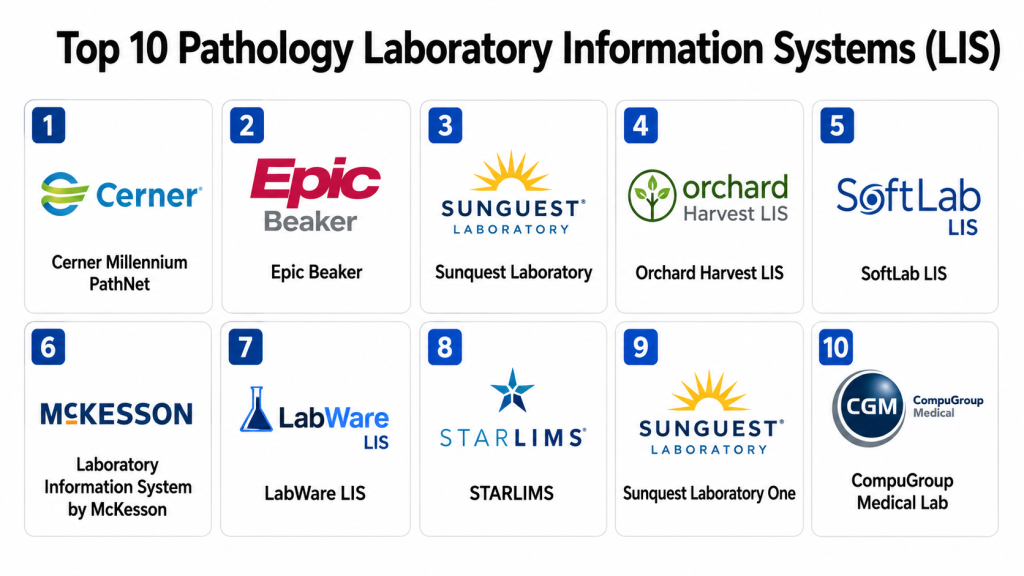
Top 10 Pathology Laboratory Information Systems (LIS)
#1 — Cerner Millennium PathNet
Short description:
Cerner PathNet provides comprehensive LIS functionality for clinical and anatomical labs.
Supports accessioning, workflow automation, and structured reporting.
Integrates seamlessly with Cerner EMR and instrument interfaces.
Ideal for large hospital laboratories and multi-site pathology networks.
Key Features
- Patient accessioning and specimen tracking
- Structured reporting and synoptic templates
- Instrument and analyzer integration
- EMR connectivity and clinician access
Pros
- Scalable for enterprise hospitals
- Comprehensive workflow coverage
- Strong reporting and analytics
Cons
- Best when used with Cerner EMR
- Higher implementation complexity
Platforms / Deployment
- Web / Desktop
- Cloud / On-premises
Security & Compliance
- Encryption, audit logs
- HIPAA, CAP, CLIA compliance
Integrations & Ecosystem
- HL7/FHIR standards
- PACS integration
- API connectivity for instrument and EMR workflows
Support & Community
- Vendor support and training
- Documentation and best practices
#2 — Epic Beaker
Short description:
Epic Beaker offers LIS solutions for anatomic and clinical pathology.
Manages accessioning, testing, and reporting within the Epic EMR ecosystem.
Supports automation, barcode tracking, and lab dashboards.
Ideal for hospitals using Epic EMR for unified workflows.
Key Features
- Specimen tracking and accessioning
- Clinical and anatomical pathology workflows
- Structured report generation
- Dashboard analytics and turnaround tracking
Pros
- Deep Epic EMR integration
- Flexible and comprehensive workflows
- Strong reporting capabilities
Cons
- Best for Epic-centric organizations
- Cost-intensive implementation
Platforms / Deployment
- Web / Desktop
- Cloud / On-premises
Security & Compliance
- Encryption, access controls
- HIPAA, CAP, CLIA compliance
Integrations & Ecosystem
- EMR and PACS interfaces
- Instrument and device connectivity
Support & Community
- Vendor-led training
- Documentation and user forums
#3 — Sunquest Laboratory
Short description:
Sunquest LIS provides robust clinical and anatomical pathology workflow management.
Supports automated lab instruments, structured reporting, and EMR interoperability.
Offers multi-site scalability and analytics dashboards.
Ideal for hospital laboratories and reference labs.
Key Features
- Accessioning and specimen management
- Integration with automated analyzers
- Structured reporting and synoptic templates
- Dashboards for turnaround and quality metrics
Pros
- Scalable and flexible for large labs
- Strong instrument integration
- Advanced analytics
Cons
- Complex setup for smaller labs
- Premium pricing
Platforms / Deployment
- Web / Desktop
- Cloud / On-premises
Security & Compliance
- Encryption, audit logging
- HIPAA, CLIA, CAP compliance
Integrations & Ecosystem
- Instrument interfacing via HL7/DICOM
- EMR and PACS connections
Support & Community
- Vendor support
- Documentation and tutorials
#4 — Orchard Harvest LIS
Short description:
Orchard Harvest LIS supports clinical, anatomic, and molecular pathology workflows.
Includes specimen tracking, reporting, billing, and quality management.
Flexible deployment for hospitals and reference labs.
Key Features
- Accessioning and workflow automation
- Reporting and synoptic templates
- Billing and coding integration
- Quality control monitoring
Pros
- Modular and flexible
- Supports multi-discipline labs
- Strong quality and regulatory tracking
Cons
- Advanced features may require add-ons
- Training required for full utilization
Platforms / Deployment
- Web / Desktop
- Cloud / On-premises
Security & Compliance
- Encryption and access control
- HIPAA, CAP, CLIA
Integrations & Ecosystem
- PACS and EMR connections
- Instrument interfaces
Support & Community
- Vendor support and guides
- Training resources
#5 — SoftLab LIS
Short description:
SoftLab LIS provides clinical lab management with specimen tracking, reporting, and analytics.
Supports automated interfacing with analyzers and EMRs.
Ideal for mid-size hospitals and commercial labs.
Key Features
- Accessioning and worklists
- Structured reporting
- Instrument integration
- Quality and compliance tracking
Pros
- Efficient workflow management
- Scalable for multiple sites
- Strong instrument interfacing
Cons
- User interface can be dated
- Advanced analytics may require modules
Platforms / Deployment
- Web / Desktop
- Cloud / On-premises
Security & Compliance
- Encryption
- HIPAA, CLIA, CAP
Integrations & Ecosystem
- HL7, DICOM, PACS
- EMR interfacing
Support & Community
- Vendor support
- Documentation
#6 — Laboratory Information System by McKesson
Short description:
McKesson LIS delivers clinical lab management with integration to hospital systems.
Supports automated workflow, reporting, and EMR connectivity.
Ideal for hospital labs requiring enterprise-grade solutions.
Key Features
- Workflow management and tracking
- Structured reporting and analytics
- Instrument interfacing
- EMR connectivity
Pros
- Enterprise-grade reliability
- Strong workflow automation
- Multi-site support
Cons
- Implementation complexity
- Licensing cost
Platforms / Deployment
- Web / Desktop
- Cloud / On-premises
Security & Compliance
- Encryption, audit logs
- HIPAA, CAP, CLIA
Integrations & Ecosystem
- EMR and PACS integration
- API support
Support & Community
- Vendor support
- Documentation
#7 — LabWare LIS
Short description:
LabWare LIS is a flexible laboratory management system for clinical, molecular, and anatomical labs.
Supports workflow automation, reporting, and multi-site operations.
Key Features
- Accessioning and specimen management
- Structured reporting
- Instrument and EMR integration
- Quality and compliance monitoring
Pros
- Highly configurable
- Supports multiple lab disciplines
- Scalable for large labs
Cons
- Learning curve for advanced modules
- Cost-intensive for smaller labs
Platforms / Deployment
- Web / Desktop
- Cloud / On-premises
Security & Compliance
- Encryption and access controls
- HIPAA, CLIA, CAP
Integrations & Ecosystem
- HL7, DICOM interfaces
- PACS and EMR connections
Support & Community
- Vendor support
- Documentation
#8 — STARLIMS
Short description:
STARLIMS offers a unified platform for clinical, molecular, and research labs.
Supports specimen tracking, workflow management, reporting, and analytics.
Key Features
- Accessioning and worklists
- Structured reporting
- Quality control dashboards
- Multi-site lab coordination
Pros
- Enterprise scalability
- Multi-discipline support
- Strong analytics
Cons
- Complex deployment
- Premium licensing
Platforms / Deployment
- Web / Desktop
- Cloud / On-premises
Security & Compliance
- Encryption
- HIPAA, CLIA, CAP
Integrations & Ecosystem
- EMR/PACS interfaces
- HL7/DICOM
Support & Community
- Vendor support
- Documentation
#9 — Sunquest Laboratory One
Short description:
Sunquest Laboratory One provides an enterprise LIS for clinical and anatomical pathology.
Supports workflow automation, reporting, and instrument interfacing.
Key Features
- Accessioning and specimen tracking
- Structured and synoptic reporting
- EMR integration
- Workflow dashboards
Pros
- Scalable and flexible
- Strong instrument support
- Analytics capabilities
Cons
- Implementation time
- Training required
Platforms / Deployment
- Web / Desktop
- Cloud / On-premises
Security & Compliance
- Encryption
- HIPAA, CLIA, CAP
Integrations & Ecosystem
- HL7, DICOM
- PACS and EMR
Support & Community
- Vendor support
- Training
#10 — CompuGroup Medical Lab
Short description:
CompuGroup LIS offers pathology and clinical lab management for medium and large labs.
Supports accessioning, reporting, EMR integration, and analytics.
Key Features
- Workflow and specimen management
- Structured reporting
- EMR and PACS integration
- Analytics dashboards
Pros
- Flexible deployment
- Scalable for multiple sites
- Reliable reporting
Cons
- UI complexity
- Advanced features may need add-ons
Platforms / Deployment
- Web / Desktop
- Cloud / On-premises
Security & Compliance
- Encryption
- HIPAA, CLIA, CAP
Integrations & Ecosystem
- HL7/DICOM
- EMR/PACS connectors
Support & Community
- Vendor support
- Documentation
Comparison Table (Top 10)
| Tool Name | Best For | Platform(s) | Deployment | Standout Feature | Public Rating |
|---|---|---|---|---|---|
| Cerner PathNet | Large hospital labs | Web/Desktop | Cloud/On-prem | EMR integration & structured reporting | N/A |
| Epic Beaker | Epic users | Web/Desktop | Cloud/On-prem | Integrated anatomical & clinical workflows | N/A |
| Sunquest Laboratory | Hospitals & reference labs | Web/Desktop | Cloud/On-prem | Multi-discipline support | N/A |
| Orchard Harvest | Hospitals & mid-sized labs | Web/Desktop | Cloud/On-prem | Flexible workflows & QC | N/A |
| SoftLab LIS | Mid-sized labs | Web/Desktop | Cloud/On-prem | Instrument interfacing | N/A |
| McKesson LIS | Enterprise labs | Web/Desktop | Cloud/On-prem | Enterprise workflow automation | N/A |
| LabWare LIS | Multi-site & research labs | Web/Desktop | Cloud/On-prem | Highly configurable | N/A |
| STARLIMS | Clinical, molecular, research labs | Web/Desktop | Cloud/On-prem | Multi-discipline analytics | N/A |
| Sunquest Laboratory One | Enterprise labs | Web/Desktop | Cloud/On-prem | Workflow dashboards | N/A |
| CompuGroup Medical Lab | Medium & large labs | Web/Desktop | Cloud/On-prem | Reporting & EMR integration | N/A |
Weighted Evaluation & Scoring
| Tool | Core (25%) | Ease (15%) | Integrations (15%) | Security (10%) | Performance (10%) | Support (10%) | Value (15%) | Weighted Total |
|---|---|---|---|---|---|---|---|---|
| Cerner PathNet | 10 | 7 | 9 | 8 | 9 | 8 | 6 | 8.5 |
| Epic Beaker | 9 | 7 | 9 | 8 | 8 | 7 | 6 | 7.9 |
| Sunquest Laboratory | 9 | 7 | 8 | 8 | 8 | 7 | 6 | 7.8 |
| Orchard Harvest | 8 | 8 | 8 | 8 | 8 | 7 | 7 | 7.9 |
| SoftLab LIS | 8 | 7 | 8 | 8 | 7 | 7 | 6 | 7.6 |
| McKesson LIS | 8 | 7 | 8 | 8 | 8 | 7 | 6 | 7.7 |
| LabWare LIS | 9 | 7 | 8 | 8 | 8 | 7 | 6 | 7.8 |
| STARLIMS | 9 | 7 | 8 | 8 | 8 | 7 | 6 | 7.8 |
| Sunquest One | 8 | 7 | 8 | 8 | 8 | 7 | 6 | 7.7 |
| CompuGroup Medical Lab | 8 | 7 | 8 | 8 | 8 | 7 | 6 | 7.7 |
Decision Guide
Enterprise Hospitals & Reference Labs
Cerner PathNet, Epic Beaker, and Sunquest LIS provide robust multi-discipline workflows with EMR integration.
Mid-sized Labs & Imaging Centers
Orchard Harvest, SoftLab, and McKesson LIS balance flexibility, instrument integration, and workflow management.
Multi-site & Research Labs
LabWare LIS and STARLIMS support high configurability, analytics, and cross-site coordination.
Reporting-Focused Laboratories
Sunquest Laboratory One and CompuGroup LIS emphasize structured reporting and dashboard analytics.
Frequently Asked Questions (FAQs)
1. What is the primary function of LIS?
To manage laboratory workflows, track specimens, report results, and integrate with clinical systems.
2. Do LIS platforms integrate with PACS?
Yes — anatomical pathology modules often connect with PACS to store and view imaging data.
3. Are LIS platforms HIPAA compliant?
Top solutions implement encryption, access controls, and audit logs to meet HIPAA and CLIA standards.
4. Can LIS support multi-site laboratories?
Yes — enterprise LIS like Cerner PathNet and LabWare support centralized workflows across multiple labs.
5. Are analytics dashboards included?
Many LIS systems provide dashboards for turnaround times, workload, and quality metrics.
6. Do LIS systems integrate with EMR/EHR?
Yes — HL7 and FHIR interfaces allow smooth integration with hospital EMRs.
7. Is training required?
Yes — onboarding and training ensure workflow adoption and full utilization of advanced LIS features.
8. Do LIS platforms support structured reporting?
Yes — templates and synoptic reporting are standard to improve consistency.
9. Can LIS handle billing and coding?
Most LIS provide CPT/ICD billing support and integration with revenue workflows.
10. Are LIS platforms cloud-based?
Many vendors offer cloud, on-premises, or hybrid deployment options depending on lab size.
Conclusion
Pathology Laboratory Information Systems (LIS) streamline lab workflows, reporting, and integration across clinical, anatomical, and molecular pathology disciplines. Enterprise labs benefit from Cerner PathNet, Epic Beaker, and Sunquest LIS for robust workflows and EMR integration. Mid-sized labs can leverage Orchard Harvest, SoftLab, and McKesson LIS for flexible operations and analytics. Multi-site and research labs gain configurability with LabWare LIS and STARLIMS, while Sunquest One and CompuGroup LIS excel in reporting and structured workflows. Evaluating EMR integration, instrument interfacing, analytics, and regulatory compliance ensures efficient pathology operations, improved accuracy, and better patient care.
