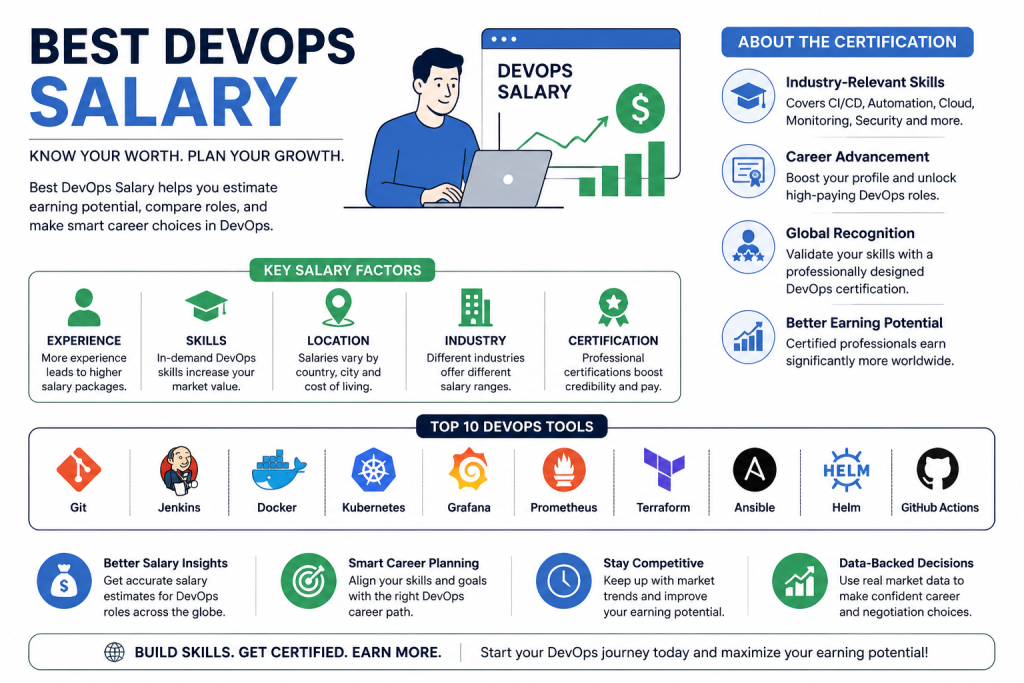
Meta Title: Best DevOps Salary
Meta Description: Master the Best DevOps Salary system. Learn how salary trends work, evaluate your earning potential, and explore strategies to maximize income.
Introduction
Navigating the world of DevOps careers can feel overwhelming. Professionals often struggle to understand compensation benchmarks, regional differences, and the impact of skills, experience, and certifications on earnings. Without clarity, even the most talented engineers may undervalue themselves or miss lucrative opportunities. This blog provides a clear roadmap to understanding the Best DevOps Salary landscape. It connects market data, career pathways, skill sets, and certifications with practical strategies to maximize earning potential and long-term career growth.
What Is Best DevOps Salary?
The Core Purpose of Best DevOps Salary
The term Best DevOps Salary refers to the optimal earning potential for DevOps professionals based on experience, skills, certifications, tools proficiency, industry, and location. Understanding these factors allows candidates and professionals to plan their career strategically, negotiate salaries effectively, and prioritize skill acquisition.
How the Best DevOps Salary System Works
The salary system in DevOps is influenced by multiple factors. Employers evaluate candidates based on experience, technical expertise, cloud knowledge, automation proficiency, CI/CD pipeline implementation, and familiarity with DevOps tools. Companies also consider regional demand, industry budgets, and team requirements. Compensation often includes base salary, performance bonuses, stock options, and benefits, all of which contribute to the total earning potential.
Eligibility Standards vs. Selection Criteria
Eligibility standards refer to the typical experience and skill requirements that employers expect from DevOps professionals. Selection criteria focus on specific qualifications, certifications, and demonstrated proficiency with tools, automation pipelines, cloud infrastructure, and team collaboration. Candidates meeting these standards are likely to command higher salaries.
Best DevOps Salary Components: The Building Blocks
Understanding salary requires analyzing several key components. These components help professionals assess their earning potential accurately.
Age Factors in Best DevOps Salary
While age does not directly determine salary, professional experience often correlates with earning potential. Early-career engineers may earn less initially, but focused skill development and certifications can accelerate growth. Mid-career professionals with hands-on experience and leadership capabilities typically command higher salaries.
Educational Evaluation for Best DevOps Salary
Education is a critical factor. Candidates with relevant degrees in computer science, software engineering, or IT often start with higher salary brackets. However, practical experience, certifications, and demonstrated project success frequently outweigh formal education in determining compensation.
Performance Standards and Benchmarks
Performance benchmarks include measurable skills and deliverables, such as the ability to design and manage CI/CD pipelines, automate deployment processes, configure containerized applications, and monitor production systems. Professionals consistently meeting or exceeding benchmarks are more likely to achieve top-tier salaries.
Professional Experience Verification
Verifiable experience in large-scale projects, cloud deployments, infrastructure automation, and monitoring is essential. Documentation of contributions, completed projects, and certifications validates expertise and increases earning potential.
Primary Frameworks Governing Best DevOps Salary
Salary frameworks rely on industry-wide metrics and market surveys. These frameworks evaluate tools proficiency, certifications, cloud expertise, and leadership roles.
The Detailed Score Breakdown
| Component | Weight | Metric |
|---|---|---|
| DevOps Fundamentals (DCP) | 15% | Knowledge of DevOps culture, workflows, and SDLC |
| CI/CD Pipeline Skills (Jenkins) | 15% | Ability to implement automated build and deployment |
| Version Control (Git) | 10% | Mastery of Git branching, merging, and collaboration |
| Containerization (Docker) | 10% | Building, managing, and deploying container images |
| Orchestration (Kubernetes) | 10% | Managing workloads and services in cluster environments |
| Infrastructure as Code (Terraform) | 10% | Automated infrastructure provisioning and management |
| Configuration Management (Ansible) | 5% | Managing server and application configurations |
| Monitoring (Prometheus) | 5% | Metrics collection and alerting |
| Observability (Grafana) | 5% | Data visualization and dashboard creation |
| Deployment Automation (GitHub Actions) | 5% | Automated workflows for code deployme |
Real-World Application Scenarios
Professionals applying these skills effectively in projects see tangible salary advantages. Companies reward engineers who streamline deployment pipelines, automate cloud infrastructure, and reduce production incidents.
International Pathways for Best DevOps Salary
Key Categories and Classes
Salary levels vary depending on industry, region, and role. Key categories include:
- Entry-Level DevOps: Focused on CI/CD, basic scripting, and tool familiarity
- Mid-Level DevOps Engineer: Handles cloud infrastructure, monitoring, and automation
- Senior DevOps Engineer: Leads projects, architects pipelines, and implements best practices
- Specialist Roles: Security, SRE, cloud-focused, and GitOps expertise
Comparative Results Summary
Global compensation varies based on skill demand, cost of living, and company size. For instance, cloud-intensive regions typically offer higher salaries, while smaller markets provide growth opportunities but lower base pay.
Advanced Regional Requirements for Best DevOps Salary
Regions such as North America, Europe, and Asia-Pacific have different compensation structures. Large enterprises may emphasize experience and certifications, while startups often value speed and tool flexibility. Professional registration and legal compliance in certain countries can also impact compensation.
The Global Landscape of Best DevOps Salary
| Region | Average Range | Key Drivers |
|---|---|---|
| North America | High | Cloud adoption, automation, certifications |
| Europe | Mid-High | Experience, DevSecOps, Kubernetes expertise |
| Asia-Pacific | Mid | Skill availability, project exposure, cloud demand |
| Middle East | Mid | Cloud, DevOps adoption, certifications |
| Latin America | Lower-Mid | Emerging DevOps culture, tool adoption |
Benefits of Utilizing Best DevOps Salary Knowledge
- Cost Efficiency: Guides career planning to maximize return on learning investments
- Instant Reality Checks: Compares skills with market expectations
- Strategic Planning: Helps identify skills for higher-paying roles and certifications
Step-by-Step Guide to Mastering Best DevOps Salary
Gathering Necessary Documents
Compile resumes, portfolios, and certificates to demonstrate skills and experience.
Practicing the Core Assessments
Apply practical skills across CI/CD, automation, containerization, orchestration, and cloud deployment.
Checking Market Demand Lists
Review job postings to identify trending tools, frameworks, and in-demand skills.
Adding Secondary Factors
Incorporate communication, documentation, leadership, and cross-team collaboration abilities.
Calculating the Final Result
Evaluate your readiness and identify gaps to prioritize learning for higher salary potential.
Strategies to Optimize Your Best DevOps Salary Score
The Performance Enhancement Strategy
Regular hands-on practice in pipelines, containerization, cloud, and monitoring improves skills and salary prospects.
Bonus Qualification Advantages
Certifications, specialized tools knowledge, cloud expertise, and SRE principles provide extra leverage.
Specialized Opportunity Pathways
Advanced paths such as DevSecOps, Kubernetes, Terraform, SRE, GitOps, and MLOps unlock higher-paying opportunities.
Common Mistakes in the Best DevOps Salary Process
- Overestimating abilities without practical verification
- Ignoring emerging tools or cloud platforms
- Using outdated documents or certificates
- Memorizing theory without building workflows
Real-Life Case Scenarios Using Best DevOps Salary
The Early Career Scenario
A fresher focuses on gaining CI/CD and tool skills, gradually increasing earning potential as experience accumulates.
The Experienced Professional Scenario
Mid-career engineers leverage automation, cloud expertise, and certifications to negotiate higher salaries.
The Specialized Hero Scenario
Specialists in Kubernetes, SRE, or DevSecOps see maximum compensation due to market demand for niche expertise.
Frequently Asked Questions
- What determines the Best DevOps Salary?
Salary depends on skills, certifications, experience, industry, and location.
- Which DevOps skills are highest paying?
Cloud platforms, CI/CD pipelines, containers, Kubernetes, Terraform, and monitoring tools.
- Does certification affect salary?
Yes, certifications validate skills and significantly influence earning potential.
- Do location and industry matter?
Absolutely. High-demand regions and sectors offer higher compensation.
- Which tools are most valuable for salary growth?
Git, Jenkins, Docker, Kubernetes, Terraform, Ansible, Prometheus, Grafana, Helm, GitHub Actions.
- Is DevSecOps experience more profitable?
Yes, security-focused DevOps roles typically command higher pay.
- Do early career professionals earn competitive salaries?
Entry-level pay is lower but can rise quickly with certifications and hands-on experience.
- Can non-developers transition into DevOps?
Yes, system admins, QA, and cloud professionals can shift with training and practical skills.
- Does cloud expertise increase salary?
Yes, cloud knowledge is a top driver of higher earnings.
- How can I maximize my DevOps salary?
Gain practical experience, pursue certifications, specialize in in-demand tools, and develop leadership skills.
Conclusion
Understanding Best DevOps Salary empowers professionals to plan careers strategically. By evaluating skills, experience, certifications, and market data, learners can focus on growth areas, negotiate better compensation, and unlock higher-paying roles. Practical application, continuous skill development, and specialization in cloud, containers, CI/CD, and automation remain key to long-term financial and professional success.
