Introduction
Domain registration platforms help individuals, businesses, agencies, developers, and enterprises search, register, transfer, renew, and manage domain names. A domain name is the public web address people use to find a brand, website, SaaS product, online store, blog, portfolio, or business service. A good domain registrar does more than sell domains. It helps users manage DNS records, protect domain ownership, enable privacy, configure email routing, renew domains on time, transfer domains safely, and connect domains with websites, apps, hosting platforms, and business tools.
Domain registration matters because a domain is a critical digital asset. If a domain expires, is misconfigured, or is stolen, a business can lose website traffic, email access, customer trust, and brand reputation. Modern buyers now expect domain platforms to provide strong security, simple DNS management, transparent pricing, privacy protection, reliable renewal controls, and support for growing domain portfolios.
Real-world use cases include:
- Business website launch: Register a domain for a company website, SaaS product, landing page, or eCommerce store.
- Brand protection: Register multiple domain extensions, misspellings, regional domains, and campaign domains to reduce misuse.
- Email setup: Configure MX, TXT, SPF, DKIM, and DMARC-related records for professional business email.
- SaaS and app deployment: Manage subdomains, DNS records, SSL routing, app domains, and customer-facing product URLs.
- Agency management: Handle multiple client domains, renewals, DNS changes, transfers, and ownership records.
- Domain investing: Buy, sell, auction, backorder, and manage domain portfolios.
Evaluation Criteria for Buyers:
- Domain search quality: Fast search, smart suggestions, bulk search, and premium domain discovery.
- Pricing transparency: Clear registration, renewal, transfer, privacy, and add-on costs.
- DNS management: Easy control over A, CNAME, MX, TXT, NS, and forwarding records.
- Security controls: Two-factor authentication, domain lock, DNSSEC, alerts, and account protection.
- Privacy protection: WHOIS privacy or domain privacy options where available.
- Transfer experience: Simple inbound and outbound transfer workflows.
- Renewal reliability: Auto-renewal, expiry alerts, grace period clarity, and recovery support.
- Portfolio tools: Bulk updates, folder organization, domain tagging, ownership controls, and reporting.
- Add-on ecosystem: Email, SSL, hosting, website builder, CDN, marketplace, and business tools.
- Support quality: Helpful support for DNS issues, transfers, billing, ownership, and urgent recovery.
Best for: Domain registration platforms are best for startups, SMBs, bloggers, creators, digital marketers, developers, agencies, SaaS companies, eCommerce businesses, domain investors, and enterprises that need secure domain ownership, DNS management, renewal control, and online brand protection.
Not ideal for: Standard domain registrars may not be enough for large enterprises needing advanced brand monitoring, trademark enforcement, anti-phishing response, corporate domain governance, registry lock workflows, or managed global domain portfolios. In those cases, dedicated enterprise domain management or brand protection services may be better.
Key Trends in Domain Registration Platforms
- Security-first domain management is now essential: Buyers increasingly expect two-factor authentication, domain lock, DNSSEC, account alerts, and stronger transfer protection.
- Domain privacy remains a major buyer requirement: Many users want privacy protection to reduce spam, unwanted outreach, and public exposure of personal contact information.
- DNS reliability is more important than ever: A domain connects websites, email, SaaS apps, APIs, landing pages, and customer portals, so DNS downtime can directly affect revenue and trust.
- Transparent renewal pricing is becoming a deciding factor: Buyers are paying closer attention to renewal rates, transfer fees, privacy add-ons, premium pricing, and bundled service costs.
- Domain portfolio management is growing: Agencies, startups, and enterprises often manage many domains across brands, campaigns, regions, and product lines.
- Developer-friendly DNS controls are in demand: Technical buyers want clean DNS editing, fast propagation, API access, subdomain control, and easy integration with hosting platforms.
- AI-assisted domain search is becoming more useful: Some platforms now provide smarter name suggestions, alternative spellings, brandable options, and extension recommendations.
- Defensive registration is more common: Businesses increasingly buy related domains, regional extensions, and brand variants to protect against impersonation and customer confusion.
- Bundled web services remain popular with SMBs: Many small businesses prefer domain platforms that also offer email, SSL, hosting, website builders, and online store tools.
- Transfers are becoming a competitive feature: Buyers want registrars that make domain transfer simple, transparent, and safe without unnecessary friction.
How We Selected These Tools Methodology
The platforms in this list were selected based on their practical usefulness for domain buyers, from solo creators to agencies, developers, SMBs, and enterprise teams. The goal is to include a balanced mix of beginner-friendly, developer-friendly, portfolio-friendly, and business-focused domain registration platforms.
- Market recognition: Platforms with strong awareness and broad usage among domain buyers were prioritized.
- Domain management depth: Search, registration, transfer, renewal, DNS, privacy, and portfolio features were evaluated.
- Ease of use: Dashboard clarity, DNS editing, renewal controls, and beginner workflows were considered.
- Security posture: Two-factor authentication, domain lock, DNSSEC, privacy, and account protection were reviewed.
- Pricing clarity: Registration, renewal, transfer, privacy, and add-on costs were considered from a buyer perspective.
- Integrations and ecosystem: Hosting, email, SSL, CDN, marketplace, website builder, and developer workflows were evaluated.
- Customer fit: The list includes tools for individuals, SMBs, developers, agencies, investors, and enterprise-oriented users.
- Support quality: Documentation, help resources, customer support, and transfer assistance were considered.
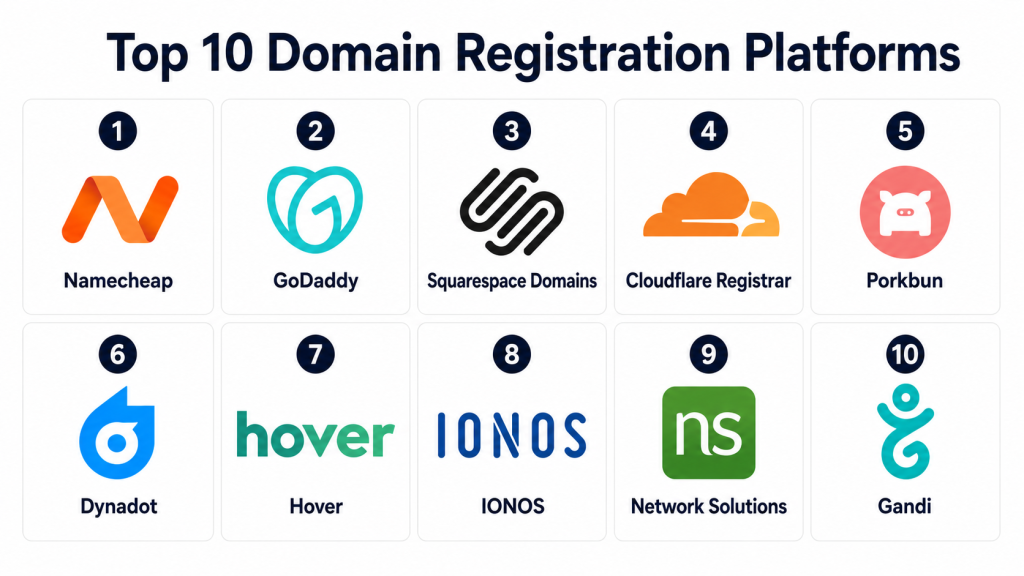
Top 10 Domain Registration Platforms
1- Namecheap
Short description:
Namecheap is a popular domain registration platform used by individuals, startups, bloggers, developers, agencies, and small businesses. It offers domain search, registration, transfers, DNS management, privacy options, SSL, email, hosting, and marketplace services. Namecheap is especially useful for users who want a balance of affordability, simplicity, and practical domain controls. Its dashboard is approachable for beginners while still being useful for people managing multiple domains. The platform is a strong fit for buyers who want domain registration plus optional business services in one account.
Key Features
- Domain search and registration
- Domain transfer support
- DNS and nameserver management
- Domain privacy options
- Domain marketplace tools
- SSL, hosting, and email add-ons
- Auto-renewal and expiry reminders
Pros
- Good value for individuals, startups, and small businesses.
- Simple dashboard for domain and DNS management.
- Useful ecosystem for domains, hosting, email, and SSL.
Cons
- Advanced enterprise portfolio governance may be limited.
- Add-ons can increase total cost if not reviewed carefully.
- Support quality may vary by issue complexity.
Platforms / Deployment
Web / Cloud-based domain management platform
Security & Compliance
Supports account security features, two-factor authentication, domain lock, DNS controls, and privacy options where available. Specific enterprise compliance details are not publicly stated.
Integrations & Ecosystem
Namecheap provides a broad ecosystem for domain buyers who also need hosting, SSL, email, and basic business web services. It works well for users who want one provider for domain registration and supporting services.
- Web hosting
- Business email
- SSL certificates
- DNS management
- Domain marketplace
- Website services
- External hosting connection through DNS
Support & Community
Namecheap offers documentation, support resources, help articles, and customer support for domains, DNS, transfers, hosting, and billing. It has strong awareness among small businesses, developers, bloggers, and budget-focused buyers.
2- GoDaddy
Short description:
GoDaddy is one of the most recognized domain registration platforms and is widely used by small businesses, entrepreneurs, agencies, and first-time website owners. It offers domain registration, domain transfers, auctions, marketplace services, hosting, email, SSL, website building, and online business tools. GoDaddy is especially useful for non-technical users who want to manage domains and business web services from one place. Its broad ecosystem makes it practical for businesses that need more than just domain registration. However, buyers should review renewal pricing, privacy options, and add-ons before purchasing.
Key Features
- Domain search and registration
- Domain transfer support
- Domain auctions and marketplace
- DNS management and forwarding
- Website builder and hosting services
- Business email and SSL options
- Auto-renewal and expiry controls
Pros
- Large ecosystem for domains, websites, email, and business tools.
- Beginner-friendly for small business website setup.
- Useful marketplace and auction features for premium domains.
Cons
- Add-ons and renewal pricing should be reviewed carefully.
- Dashboard may feel busy because of many services.
- Technical users may prefer cleaner DNS-focused platforms.
Platforms / Deployment
Web / Cloud-based domain and business services platform
Security & Compliance
Supports account security options, domain protection features, domain privacy options, and DNS controls depending on selected services and plan. Specific compliance details are not publicly stated.
Integrations & Ecosystem
GoDaddy offers a wide ecosystem for businesses that want domains, websites, email, hosting, security, and online store tools in one provider.
- Website builder
- Web hosting
- Business email
- SSL services
- Domain marketplace
- Online store tools
- Marketing tools
Support & Community
GoDaddy provides support channels, help documentation, onboarding guidance, and customer service resources. It is widely known among small businesses and first-time website owners.
3- Squarespace Domains
Short description:
Squarespace Domains is a domain registration option connected with Squarespace’s website and online presence ecosystem. It became especially relevant after Google Domains customers were migrated into Squarespace. The platform is useful for creators, small businesses, portfolio owners, and website builders who want clean domain management connected with a simple website platform. Squarespace Domains supports domain registration, DNS management, transfers, privacy options where available, and website connection workflows. It is not the deepest option for domain investors or complex enterprise portfolios, but it is practical for users who value ease of use and website integration.
Key Features
- Domain search and registration
- DNS record management
- Domain transfer support
- Website builder ecosystem connection
- Email integration options
- Auto-renewal controls
- Domain privacy options where available
Pros
- Clean experience for website creators and small businesses.
- Convenient for users building websites with Squarespace.
- Good option for former Google Domains users who prefer simplicity.
Cons
- Less suitable for advanced domain investors.
- Enterprise portfolio controls may be limited.
- Ecosystem is more website-focused than developer-focused.
Platforms / Deployment
Web / Cloud-based domain and website platform
Security & Compliance
Supports account security features, DNS management, privacy options where available, and account-level controls. Specific compliance details are not publicly stated.
Integrations & Ecosystem
Squarespace Domains works best for users who want domain registration connected with website creation, online stores, and small business web presence.
- Squarespace websites
- Email integrations
- DNS management
- Website builder tools
- Online store features
- Marketing tools
- External hosting through DNS configuration
Support & Community
Squarespace provides documentation, support resources, and onboarding help for domain and website users. It is especially useful for creators, small businesses, and users already building within Squarespace.
4- Cloudflare Registrar
Short description:
Cloudflare Registrar is a domain registration platform built around Cloudflare’s DNS, security, and internet performance ecosystem. It is especially useful for developers, SaaS companies, security-focused teams, agencies, and businesses already using Cloudflare for DNS, CDN, WAF, edge services, or web protection. Cloudflare Registrar is not a traditional all-in-one website builder registrar. Instead, it focuses on domain registration, DNS reliability, transparent management, and security controls. It is a strong choice for users who care about DNS performance, account protection, domain security, and technical control.
Key Features
- Domain registration and transfer
- Integration with Cloudflare DNS
- Strong DNS performance ecosystem
- DNSSEC support where available
- Domain lock and account protection features
- Security-focused domain controls
- Connection with Cloudflare web security services
Pros
- Excellent fit for users already using Cloudflare.
- Strong DNS, security, and performance ecosystem.
- Good technical experience for developers and businesses.
Cons
- Not ideal for users wanting website builder bundles.
- Domain extension availability may vary.
- Best value comes when using broader Cloudflare services.
Platforms / Deployment
Web / Cloud-based domain and DNS platform
Security & Compliance
Supports Cloudflare account security features, two-factor authentication, DNSSEC where available, domain locking, and security controls connected with the Cloudflare ecosystem. Specific compliance details depend on services and plan.
Integrations & Ecosystem
Cloudflare Registrar integrates directly with Cloudflare’s broader internet security, DNS, performance, and edge platform. It is strong for technical teams that want domain registration and DNS control in one ecosystem.
- Cloudflare DNS
- CDN services
- Web application security
- Zero Trust tools
- Edge computing services
- Analytics and traffic tools
- Domain security controls
Support & Community
Cloudflare provides technical documentation, community support, developer resources, and plan-based support options. It is widely recognized among developers, SaaS teams, security teams, and technical website operators.
5- Porkbun
Short description:
Porkbun is a domain registration platform known for simple pricing, a clean dashboard, and an easy domain management experience. It is popular with individuals, developers, creators, small businesses, and budget-conscious domain buyers. Porkbun offers domain registration, transfers, DNS management, privacy options where available, email forwarding, SSL support, and domain marketplace features. It is especially useful for buyers who want a straightforward registrar without excessive complexity. While it may not offer the deepest enterprise governance features, it is practical for standard domain ownership and small portfolios.
Key Features
- Domain search and registration
- Domain transfer support
- DNS management
- Privacy options where available
- Email forwarding options
- SSL support
- Marketplace and premium domain access
Pros
- Simple and user-friendly experience.
- Strong value for budget-conscious buyers.
- Good fit for individuals, creators, and developers.
Cons
- Enterprise portfolio controls may be limited.
- Support ecosystem is smaller than larger global providers.
- Fewer bundled business services than all-in-one platforms.
Platforms / Deployment
Web / Cloud-based domain management platform
Security & Compliance
Supports account security features, domain lock, DNS controls, and privacy options where available. Specific compliance details are not publicly stated.
Integrations & Ecosystem
Porkbun provides essential domain management features and connection options for external hosting, email, website builders, and application platforms.
- DNS management
- Email forwarding
- SSL options
- External hosting connection
- Marketplace tools
- Domain transfer tools
- Website service connections through DNS
Support & Community
Porkbun offers help resources and customer support for domain management, transfers, billing, and DNS. It has a positive reputation among many technical users and budget-focused buyers.
6- Dynadot
Short description:
Dynadot is a domain registration platform that appeals to domain investors, portfolio owners, small businesses, and users who manage multiple domains. It offers domain search, registrations, transfers, auctions, marketplace tools, backorders, DNS controls, privacy options, and website-related services. Dynadot is useful for buyers who need more than basic registration but do not necessarily require a specialized enterprise domain management provider. Its marketplace and bulk tools make it practical for users who buy, sell, or manage many domains. It works well for portfolio-focused users and growing businesses with multiple domain assets.
Key Features
- Domain registration and transfer
- Bulk domain management
- Domain marketplace and auctions
- Backorder support
- DNS and nameserver controls
- Domain privacy options
- Website and email-related services
Pros
- Good fit for domain investors and portfolio owners.
- Useful auction, marketplace, and backorder features.
- Practical bulk domain management capabilities.
Cons
- Interface may feel more investor-focused than beginner-focused.
- New users may need time to understand aftermarket tools.
- Enterprise governance features may be limited.
Platforms / Deployment
Web / Cloud-based domain management platform
Security & Compliance
Supports account security options, domain lock, privacy features where available, and standard domain management controls. Specific compliance details are not publicly stated.
Integrations & Ecosystem
Dynadot provides domain-focused tools for registration, portfolio control, marketplace activity, and website-related services.
- Domain marketplace
- Auction tools
- Backorder tools
- DNS management
- Website builder options
- Email services
- Bulk domain workflows
Support & Community
Dynadot provides documentation, support resources, and domain-focused assistance. It is known among domain investors, portfolio managers, and users who regularly buy or transfer domains.
7- Hover
Short description:
Hover is a domain registration platform focused on simplicity, clean design, and easy domain ownership management. It is popular with individuals, creative professionals, small businesses, agencies, and users who prefer a registrar without heavy upselling. Hover provides domain search, registration, transfer support, DNS management, email services, privacy options where available, and renewal controls. It is a strong choice for users who want a straightforward domain platform instead of a complex bundle of hosting and marketing tools. Hover may not be ideal for advanced domain investors or enterprises, but it is practical for clean and simple domain management.
Key Features
- Domain search and registration
- Domain transfer support
- DNS management
- Email service options
- Privacy options where available
- Renewal and auto-renewal controls
- Simple account dashboard
Pros
- Clean and easy domain management experience.
- Good fit for creators, professionals, and small businesses.
- Less distracting than many all-in-one platforms.
Cons
- Fewer bundled services than larger providers.
- Advanced investor features may be limited.
- Enterprise portfolio governance may be limited.
Platforms / Deployment
Web / Cloud-based domain management platform
Security & Compliance
Supports account security controls, domain lock features, privacy options where available, and DNS management. Specific compliance details are not publicly stated.
Integrations & Ecosystem
Hover focuses on domain and email services while allowing users to connect domains to external hosting, website builders, and business tools through DNS.
- DNS management
- Email services
- External hosting connection
- Website builder connection
- Domain transfer tools
- Renewal management
- Domain forwarding
Support & Community
Hover provides documentation and support resources for domain management, DNS, email, and transfers. It is often appreciated by users who want a clean registrar experience.
8- IONOS
Short description:
IONOS is a domain registration and web services platform serving individuals, small businesses, startups, and larger organizations. It offers domain registration, DNS management, web hosting, email, SSL, website builder tools, cloud services, and business web solutions. IONOS is useful for buyers who want domain registration connected with hosting and business infrastructure. It is especially relevant for small businesses that prefer one provider for domains, websites, email, and related services. The platform has a broad service catalog, which can help growing companies but may require careful review of plans and renewals.
Key Features
- Domain search and registration
- DNS management
- Web hosting and cloud services
- Business email options
- SSL and security add-ons
- Website builder tools
- Domain transfer and renewal management
Pros
- Broad ecosystem for domains, hosting, email, and business tools.
- Useful for small businesses that want bundled services.
- Offers both beginner-friendly and infrastructure-oriented options.
Cons
- Large service catalog may feel complex.
- Buyers should review renewal and bundle pricing carefully.
- Advanced domain-only users may prefer simpler registrars.
Platforms / Deployment
Web / Cloud-based domain and business services platform
Security & Compliance
Supports account security features, domain controls, SSL options, and hosting-related security tools. Specific compliance details vary by service and are not universally stated.
Integrations & Ecosystem
IONOS provides a wide business web ecosystem for users who need domains, hosting, email, websites, and cloud services.
- Web hosting
- Business email
- SSL services
- Website builder
- Cloud services
- DNS management
- Online business tools
Support & Community
IONOS provides customer support, documentation, onboarding resources, and service guidance. Support experience may vary depending on region, plan, and service type.
9- Network Solutions
Short description:
Network Solutions is a long-established domain registration provider serving businesses, professionals, and organizations that need domain registration, hosting, email, website services, and online presence tools. It offers domain search, registration, transfer support, privacy options, DNS management, website building, SSL, and business email services. Network Solutions can be useful for traditional businesses that want domain and web services from one provider. It may not be the most modern developer-first registrar, but it remains relevant for organizations needing standard domain and web services. Buyers should carefully review pricing, renewals, and add-ons.
Key Features
- Domain registration and transfer
- DNS management
- Domain privacy options
- Website builder and hosting services
- Business email services
- SSL services
- Renewal and account management
Pros
- Established provider with broad domain service history.
- Useful for businesses needing domains plus web services.
- Offers standard tools for websites, email, and SSL.
Cons
- Interface may not appeal to all modern users.
- Developers may prefer more technical DNS-focused platforms.
- Buyers should review renewal costs and add-ons carefully.
Platforms / Deployment
Web / Cloud-based domain and web services platform
Security & Compliance
Supports domain management controls, account security options, privacy services where available, and SSL services. Specific compliance details are not publicly stated.
Integrations & Ecosystem
Network Solutions provides a traditional domain and web services ecosystem for business users that want multiple online presence tools under one provider.
- Web hosting
- Email services
- SSL certificates
- Website builder
- DNS management
- Domain privacy
- Business web tools
Support & Community
Network Solutions provides support resources, account assistance, and service documentation. It is more business-service focused than developer-community focused.
10- Gandi
Short description:
Gandi is a domain registration platform used by individuals, developers, organizations, agencies, and businesses that want flexible domain management. It offers domain registration, transfers, DNS services, SSL options, email services, and hosting-related products. Gandi is useful for users managing multiple domains, international domains, or more technical domain configurations. It may not always be the cheapest option, but it appeals to buyers who value reliability, control, and a domain-focused experience. It is especially practical for users who want strong DNS management and broad domain extension support.
Key Features
- Domain search and registration
- Domain transfer support
- DNS and nameserver management
- Email services
- SSL certificate options
- Broad domain extension support
- Domain portfolio tools
Pros
- Good fit for developers and technical domain users.
- Useful for multi-domain and international domain portfolios.
- Provides flexible domain, DNS, email, and SSL options.
Cons
- Pricing may not be the lowest for all extensions.
- Beginners may prefer a simpler registrar interface.
- Advanced enterprise brand protection may require specialized tools.
Platforms / Deployment
Web / Cloud-based domain management platform
Security & Compliance
Supports account security features, DNS management, domain lock options, and privacy where available. Specific compliance details are not publicly stated.
Integrations & Ecosystem
Gandi provides domain, DNS, email, SSL, and hosting-related services for users who want technical flexibility and multi-domain management.
- DNS management
- Email services
- SSL options
- Hosting-related services
- Domain transfer tools
- Domain portfolio management
- External platform connection through DNS
Support & Community
Gandi provides documentation, support resources, and domain-focused guidance. It is known among technical users, organizations, and international domain buyers.
Comparison Table Top 10
| Tool Name | Best For | Platforms Supported | Deployment | Standout Feature | Public Rating |
|---|---|---|---|---|---|
| Namecheap | SMBs, creators, developers | Web | Cloud | Affordable domain management | N/A |
| GoDaddy | Small businesses and beginners | Web | Cloud | Broad all-in-one business services | N/A |
| Squarespace Domains | Website creators and small businesses | Web | Cloud | Simple website-connected domain experience | N/A |
| Cloudflare Registrar | Developers and security-focused teams | Web | Cloud | DNS and security ecosystem | N/A |
| Porkbun | Budget-conscious domain buyers | Web | Cloud | Simple pricing and clean dashboard | N/A |
| Dynadot | Domain investors and portfolio owners | Web | Cloud | Auctions, marketplace, and bulk tools | N/A |
| Hover | Simple domain ownership management | Web | Cloud | Clean registrar experience | N/A |
| IONOS | SMBs needing domains plus hosting | Web | Cloud | Domain, hosting, email, and cloud services | N/A |
| Network Solutions | Traditional businesses | Web | Cloud | Established domain and web services provider | N/A |
| Gandi | Developers and international users | Web | Cloud | Technical flexibility and broad domain support | N/A |
Evaluation & Scoring of Domain Registration Platforms
The scoring below is comparative and based on common buyer needs such as domain features, ease of use, integrations, security, reliability, support, and value. A higher score does not mean the platform is best for every user. A solo creator may prioritize simplicity, a developer may prioritize DNS control, an agency may prioritize bulk management, and an enterprise may prioritize security governance. Buyers should use this table as a shortlist guide and validate pricing, renewal rules, transfer policies, and security controls before purchasing.
| Tool Name | Core 25% | Ease 15% | Integrations 15% | Security 10% | Performance 10% | Support 10% | Value 15% | Weighted Total 0–10 |
| Namecheap | 9.0 | 8.5 | 8.0 | 8.0 | 8.0 | 8.0 | 9.0 | 8.45 |
| Cloudflare Registrar | 8.5 | 7.5 | 8.5 | 9.0 | 9.0 | 8.0 | 8.5 | 8.35 |
| GoDaddy | 8.5 | 8.0 | 8.5 | 8.0 | 8.0 | 8.0 | 7.5 | 8.10 |
| Porkbun | 8.0 | 8.5 | 7.5 | 7.5 | 8.0 | 7.5 | 9.0 | 8.10 |
| Dynadot | 8.5 | 7.5 | 8.0 | 7.5 | 8.0 | 7.5 | 8.5 | 8.00 |
| Squarespace Domains | 8.0 | 8.5 | 8.0 | 7.5 | 8.0 | 8.0 | 7.5 | 7.95 |
| Hover | 8.0 | 8.5 | 7.0 | 7.5 | 8.0 | 8.0 | 8.0 | 7.90 |
| IONOS | 8.0 | 7.5 | 8.0 | 8.0 | 8.0 | 8.0 | 7.5 | 7.85 |
| Gandi | 8.0 | 7.5 | 7.5 | 8.0 | 8.0 | 7.5 | 7.5 | 7.70 |
| Network Solutions | 7.5 | 7.0 | 7.5 | 7.5 | 7.5 | 7.5 | 7.0 | 7.35 |
How to interpret the scores:
- 8.3 and above: Strong overall platforms with broad value for many buyers.
- 8.0 to 8.2: Good platforms with clear strengths for specific user groups.
- 7.5 to 7.9: Practical choices when the platform matches your domain needs.
- Below 7.5: May still work for certain users, but should be compared carefully.
- Always review registration price, renewal price, privacy cost, DNS features, and transfer rules before choosing.
Which Domain Registration Platform Is Right for You?
Solo / Freelancer
Solo users, creators, bloggers, and freelancers usually need simple pricing, easy domain search, privacy options, DNS basics, and renewal alerts. Namecheap, Porkbun, and Hover are strong choices because they are easy to use and practical for small portfolios. Squarespace Domains is also useful if the user plans to build a website inside the Squarespace ecosystem.
SMB
Small and mid-sized businesses often need domains, email, SSL, website tools, DNS management, and reliable renewal controls. Namecheap, GoDaddy, IONOS, and Squarespace Domains are practical options for SMBs that want domain registration plus business services. If DNS reliability and security are more important than bundled website tools, Cloudflare Registrar is worth considering.
Mid-Market
Mid-market companies usually manage multiple domains across product lines, campaigns, regions, and business units. They need better renewal tracking, DNS reliability, transfer workflows, and access controls. Cloudflare Registrar, Namecheap, Dynadot, and Gandi can be strong choices depending on whether the team values security, affordability, portfolio management, or technical flexibility.
Enterprise
Enterprises need domain security, ownership governance, access control, auditability, DNS reliability, and renewal discipline. Cloudflare Registrar is strong for security-focused and DNS-heavy teams. Gandi and Dynadot can work for technical and portfolio-focused teams. Large enterprises with trademark enforcement, anti-phishing, and global governance needs may require specialized corporate domain management tools beyond standard registrars.
Budget vs Premium
Budget-conscious buyers should compare first-year price, renewal price, privacy cost, and transfer fees. Porkbun and Namecheap are often strong value-focused options. Premium buyers should focus on account security, DNS reliability, renewal protection, support quality, and portfolio control instead of only choosing the lowest registration price.
Feature Depth vs Ease of Use
If ease of use matters most, Hover, Squarespace Domains, Namecheap, and Porkbun are practical choices. If technical depth matters more, Cloudflare Registrar, Gandi, and Dynadot offer stronger appeal. If bundled services matter, GoDaddy and IONOS provide domains, hosting, email, SSL, and website tools in one ecosystem.
Integrations & Scalability
For simple websites, almost any registrar can work if DNS settings are easy to manage. For technical teams, Cloudflare Registrar is strong because it connects domain management with DNS, CDN, security, and web performance. Agencies and investors may prefer Dynadot or Gandi for multi-domain management. Small businesses using website builders may prefer Squarespace Domains, GoDaddy, or IONOS.
Security & Compliance Needs
Security-focused buyers should prioritize two-factor authentication, domain lock, DNSSEC, account alerts, strong recovery processes, and role-based account practices where available. Cloudflare Registrar is strong for DNS and security alignment. Namecheap, Porkbun, Hover, and Gandi also provide useful security controls, but buyers should validate exact requirements before purchase.
Frequently Asked Questions FAQs
1. What is a domain registration platform?
A domain registration platform lets users search, register, transfer, renew, and manage domain names. Most platforms also provide DNS management, privacy options, renewal settings, domain forwarding, and sometimes email, hosting, SSL, or website services.
2. How do domain registrars make money?
Domain registrars usually earn money from domain registrations, renewals, transfers, privacy services, premium domains, hosting, email, SSL, and other add-ons. Buyers should compare both first-year and renewal prices before choosing a registrar.
3. What should I check before buying a domain?
Check the domain name, extension, registration cost, renewal cost, privacy availability, transfer rules, DNS features, support quality, and account security options. Also make sure the domain is brand-safe and easy to remember.
4. Is domain privacy important?
Yes, domain privacy can reduce spam, unwanted contact, and public exposure of personal or business information. Availability depends on the domain extension and registry rules, so buyers should confirm privacy options before registration.
5. Can I transfer my domain to another registrar?
Yes, most domains can be transferred if they meet transfer eligibility rules. The process usually involves unlocking the domain, requesting an authorization code, confirming ownership, and waiting for the transfer to complete.
6. What happens if I forget to renew my domain?
If a domain expires, your website, email, and connected services may stop working. Some registrars provide grace periods or recovery options, but recovery can become expensive or unavailable if the domain is not renewed in time.
7. What is DNS management?
DNS management controls how a domain connects to websites, email services, apps, subdomains, and other internet services. Common DNS records include A, CNAME, MX, TXT, NS, and other verification or routing records.
8. Is the cheapest domain registrar always the best?
No, the cheapest registrar is not always the best. Renewal pricing, privacy cost, DNS reliability, security controls, support quality, and transfer experience can matter more than a low first-year price.
9. Which domain platform is best for developers?
Developers often prefer platforms with clean DNS controls, security features, API-friendly workflows, and strong integration with hosting or cloud platforms. Cloudflare Registrar, Namecheap, Gandi, Porkbun, and Dynadot can be useful depending on the workflow.
10. Which domain platform is best for small businesses?
Small businesses often need domain registration, privacy, email, SSL, website tools, and support. Namecheap, GoDaddy, Squarespace Domains, IONOS, and Hover are practical options depending on budget and service needs.
Conclusion
Domain registration platforms are essential for building and protecting a business’s online identity, but the best choice depends on budget, technical needs, domain portfolio size, security expectations, and the services you want around the domain. Namecheap and Porkbun are strong value-focused choices, GoDaddy and IONOS are useful for users who want domains plus business web services, Squarespace Domains is practical for website creators, and Hover is ideal for simple domain ownership management. Cloudflare Registrar is a strong option for security-focused and technical users, while Dynadot and Gandi are useful for portfolio owners, developers, and advanced domain buyers. The best next step is to shortlist two or three platforms, compare registration and renewal costs, check privacy and security features, test DNS workflows, review transfer rules, and choose the registrar that can protect and manage your domain assets reliably over the long term.
